
Pabau Engage inbox

Pabau Engage is here: every patient conversation in one inbox.

Learn more
ICD-10-CM Code

ICD code R07.9 – Chest pain, unspecified

Billable Code Specific Code


Code Definition

R07.9 is the billable ICD-10-CM code for chest pain, unspecified. You use it when a patient has chest pain and the provider documents no cause, location or pattern by the end of the encounter.

It sits in category R07, Pain in throat and chest, in the symptoms chapter. Knowing when it applies, what the R07 notes cover, and what documentation supports it helps keep claims clean.

Chapter
R00-R99 Symptoms, signs and abnormal clinical and laboratory findings, not elsewhere classified
Category
R07 Pain in throat and chest
Group
R07.9 Chest pain, unspecified
Billable
Yes
Code also known as
unspecified chest pain, chest pain NOS, chest pain not otherwise specified, undifferentiated chest pain
Save time. Improve accuracy. Get paid faster.
Automate coding with Pabau

Let Pabau's smart automation suggest the right codes, reduce claim denials, and keep your practice compliant—effortlessly.

  • AI-powered code suggestions
  • Real-time compliance checks
  • Faster claims, fewer denials
Why practices choose Pabau
Save hours every week

Automate repetitive tasks and focus on what matters most—your patients.

Improve accuracy

Reduce coding errors and ensure compliance with the latest regulations.

Get paid faster

Clean claims, fewer denials, and faster reimbursements.

Grow with confidence

Powerful insights and reporting to help your practice thrive.

HIPAA compliant SOC 2 certified GDPR-compliant Trusted by 4,000+ clinics worldwide

Key takeaways

Key takeaways

R07.9 (Chest pain, unspecified) is a billable ICD-10-CM code, still valid in the FY2027 code set.

Use it only when the final assessment names no cause and describes no location or pattern for the pain.

A described pain belongs to a more specific R07 code, such as R07.89 for atypical chest pain or chest tightness.

Outpatient and ED coders report the symptom for a “probable” cause, while inpatient coders code that cause as established.

As the inpatient principal diagnosis, R07.9 groups to MS-DRG 313, Chest pain.

ICD-10 code R07.9 covers chest pain that stays unexplained

ICD-10 code R07.9 is the billable ICD-10-CM code for chest pain, unspecified. You report it when a patient has chest pain and the provider closes the encounter without a cause, a location or a pattern on record.

It is a symptom code from Chapter 18, so it describes what the patient reported rather than what caused it. Once the chart explains the pain, a more specific code takes its place. Chest pain often arrives with breathing difficulty, and untyped dyspnea is coded the same way, as R06.00, until a cause is found.

FieldDetail
CodeR07.9
Official descriptorChest pain, unspecified
ICD-10-CM chapterChapter 18: Symptoms, signs and abnormal clinical and laboratory findings, not elsewhere classified (R00-R99)
Code blockR00-R09: Symptoms and signs involving the circulatory and respiratory systems
CategoryR07: Pain in throat and chest
BillableYes, valid in the FY2027 code set
Code typeSymptom code, not a definitive diagnosis

The CDC/NCHS ICD-10-CM browser carries the official tabular list, including R07.9’s billable status and the notes at category R07.

R07.9 fits when the workup ends without an answer

The Chapter 18 guidelines allow a symptom code when no related definitive diagnosis has been confirmed. In day-to-day coding, R07.9 shows up in a handful of familiar situations:

  • An ED or urgent care visit where the workup starts but no cause is confirmed before discharge.
  • An office visit where the assessment records chest pain and nothing more.
  • A visit that closes while troponin or imaging results are still pending.
  • Chest discomfort the provider has not tied to a cardiac, musculoskeletal or digestive source.

What decides the code is the provider’s assessment at the end of the visit. CMS ICD-10-CM guidance points outpatient coders to the diagnosis documented at that point, not to the working theory. If the assessment reads “chest pain, cause undetermined”, R07.9 is correct.

The R07 notes are short, so read them exactly

R07.9 carries no notes of its own. It inherits the notes at category R07, and they are narrower than many chest pain references suggest. Angina, for example, is not an Excludes1 condition for R07.9.

NoteWhat it coversWhat it means on the claim
Excludes1 (category R07)Acute chest syndrome of sickle-cell disease (D57.0-); epidemic myalgia (B33.0)Never report R07.9 with these codes. Code the condition instead.
Excludes2 (category R07)Jaw pain (R68.84); pain in breast (N64.4)These are separate problems. Both codes can go on the claim when both are documented.
Specificity, not a noteR07.1, R07.2, R07.81, R07.82, R07.89Use the most specific R07 code the chart supports. R07.9 is the fallback.

Reporting an Excludes1 pair together is a coding conflict, and claim edits catch it. A confirmed angina diagnosis is a different issue. It replaces R07.9 because the pain is now explained, under the guideline on symptoms integral to a condition.

So check the final assessment line, not the differential list. “Rule out angina” leaves R07.9 in play, while “stable angina” as the assessment takes it off the claim.

A described pain usually belongs to another R07 code

R07.9 is the residual code in its category. When the note says where the pain sits or what sets it off, a sibling code fits better. It is also less likely to draw a specificity query.

CodeDescriptorUse it when the note shows
R07.9Chest pain, unspecifiedNo cause, no location and no pattern
R07.89Other chest painA described pain with no named subcode, such as atypical chest pain or chest tightness
R07.1Chest pain on breathingPain that changes with inspiration or expiration
R07.2Precordial painPain located over the heart, at the front of the chest
R07.81PleurodyniaPleurodynia documented by the provider
R07.82Intercostal painPain between the ribs
R07.0Pain in throatThroat pain rather than chest pain

R07.9 vs R07.89 is the distinction to get right. R07.89 applies when the provider characterizes the pain but no named subcode fits, as with “atypical chest pain”. R07.9 applies when the note gives no character at all. One documented descriptor is usually enough to move the claim to R07.89.

The care setting changes how R07.9 is coded

The ICD-10-CM Official Guidelines, published each year by CMS and NCHS, settle most R07.9 questions. The decision path below shows the order a coder works through them.
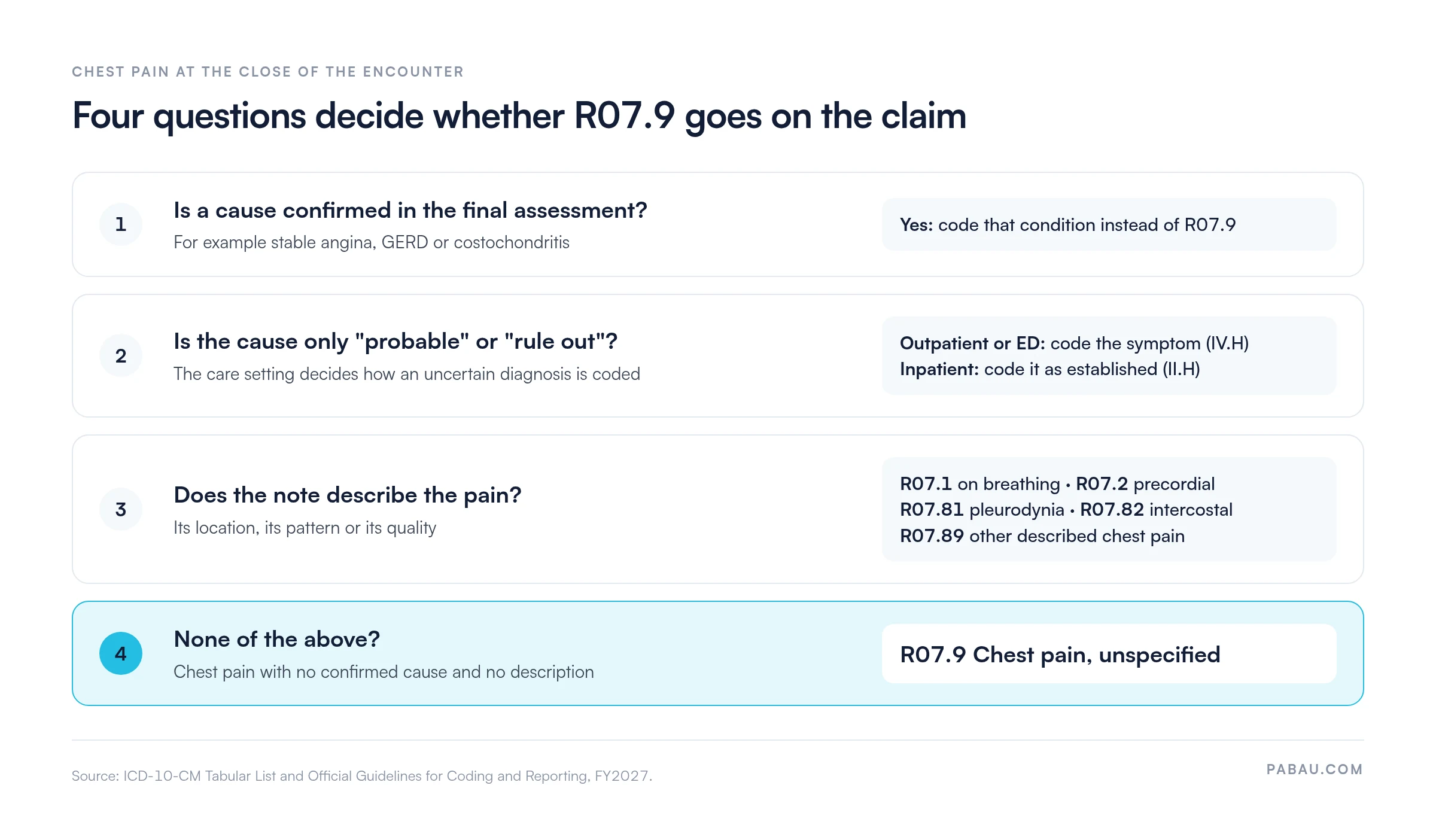
Four-step decision path for chest pain codes
R07.9 is the last stop, reached only after the cause, the setting and the description have been ruled out. Based on the FY2027 ICD-10-CM Tabular List and Official Guidelines.
  • General rule (Section I.B.4-5): Code signs and symptoms when no related definitive diagnosis is established. Don’t add them when they are routine parts of a confirmed condition.
  • Outpatient and ED (Section IV): Code the diagnosis documented at the close of the encounter. With no confirmed cause, the chief complaint or symptom is coded, which makes R07.9 the first-listed diagnosis.
  • Uncertain diagnoses, outpatient (Section IV.H): “Probable”, “suspected” and “rule out” diagnoses are not coded. The symptom code is correct, so “likely ACS” in an ED note still leads to R07.9.
  • Uncertain diagnoses, inpatient (Section II.H): A diagnosis documented as “probable” at discharge is coded as if established. “Likely ACS” in a discharge summary is coded as ACS.
  • Inpatient principal diagnosis (Section II.A): A symptom code is not the principal diagnosis once a related definitive diagnosis is established. R07.9 is principal only when the stay ends without a cause.

These rules sit inside WHO’s ICD-10 framework for symptoms and signs, which the US clinical modification extends.

The chart has to show why the pain stayed unspecified

An R07.9 claim that reaches audit with thin notes is hard to defend. The record should show that the provider looked for a cause and didn’t find one, not simply that no diagnosis was written down.

  • Chief complaint: “Chest pain” or an equivalent such as chest discomfort, recorded without a confirmed cause.
  • Assessment: A closing statement such as “chest pain, etiology undetermined” or “chest pain, workup pending”.
  • Workup: The tests ordered, such as an ECG, troponin or chest X-ray, with results negative or still pending.
  • Exam: Cardiovascular and respiratory findings relevant to the presentation.
  • No conflicting diagnosis: No confirmed condition that explains the pain, and none of the R07 Excludes1 conditions.

Watch the wording of the assessment, because its meaning depends on the setting. “Consistent with angina” or “likely ACS” keeps R07.9 on an ED claim under Section IV.H. On an inpatient discharge summary, the same words are coded as the condition itself.

Keeping those phrases consistent across the chart is part of everyday billing compliance. A coder who queries the provider early saves a recode later.

Here is how an R07.9 claim moves from chart to payment

R07.9 problems usually start before the claim reaches the billing team. Following one claim through shows where each check belongs.

  1. The visit closes. The provider signs an assessment that either names a cause or leaves the chest pain unexplained.
  2. The coder assigns the code. They work through the decision path above and settle on R07.9 or a more specific code.
  3. Procedures are matched. The E/M level, ECG and lab codes are linked to R07.9 on the claim lines.
  4. The claim goes to the clearinghouse. Its edits check code validity, format and payer-specific rules before the payer sees it.
  5. The payer adjudicates. The remittance shows payment, a reduction, or a denial with a reason code.

Steps two and three are where R07.9 claims usually go wrong. Getting them right makes step five uneventful.

Payers check the procedure codes against R07.9

Payers accept R07.9 when the record shows a reason to evaluate the patient and the unspecified code is the most accurate choice. They also expect the services billed to match an evaluation that ended without a diagnosis.

  • ED E/M codes (99281-99285) or office E/M codes (99202-99215) for the visit itself.
  • A 12-lead ECG with interpretation, reported as CPT 93000.
  • Cardiac markers, such as a quantitative troponin billed as CPT 84484, total CK (82550) or CK-MB (82553).
  • A clear rationale for unspecified coding, so the chart explains why no cause could be confirmed at this visit.

A high-acuity procedure paired with R07.9 invites a closer look. A cardiac catheterization (CPT 93458) usually follows a more specific cardiac finding, so the payer may question medical necessity.

Medicare Local Coverage Determinations can add documentation requirements for particular tests. If you bill Medicare for many chest pain encounters, check whether an LCD applies in your MAC jurisdiction.

Run this checklist before you submit an R07.9 claim

A short review before submission catches the errors that turn a clean claim into a denial.

  • The final assessment names no confirmed cause for the chest pain.
  • The note gives no location, pattern or character that fits a more specific R07 code.
  • No R07 Excludes1 code (D57.0-, B33.0) sits on the same claim.
  • The care setting matches how “probable” or “rule out” wording was coded.
  • Each CPT code is linked to R07.9 and fits an unresolved chest pain evaluation.
  • Pending results are noted, so a later visit can recode once they come back.

Denials on R07.9 claims trace back to a few errors

Start with the Claim Adjustment Reason Code (CARC) on the remittance, then read the Remittance Advice Remark Code (RARC) beside it. Together they tell you what went wrong and what the payer needs.

Denial reasonTypical CARCCorrective action
A confirmed diagnosis was documented but not codedVaries by payer; see the RARCReview the assessment, recode to the confirmed diagnosis and resubmit.
An R07 Excludes1 code was billed with R07.9Payer edit; variesRemove the conflicting code and keep the one the documentation supports.
Medical necessity not supported50 (CO-50)Get an addendum that explains the clinical rationale, then resubmit with the notes.
Procedure inconsistent with the diagnosis11 (CO-11)Check the procedure against the visit. Query the provider for a more specific diagnosis if one exists.
Timely filing limit passed29 (CO-29)Send proof of a timely first submission if you have it. Otherwise, the denial stands.

Behind those reason codes sit four coding mistakes:

  • Coding from the differential. “Rule out angina” is not angina, and “stable angina” is not R07.9.
  • Ignoring a descriptor. “Atypical” or “tightness” in the note points to R07.89.
  • Applying the wrong setting rule. Inpatient uncertainty rules on an ED claim, or the reverse.
  • Leaving R07.9 on a follow-up visit. Once results confirm a cause, that later visit codes the cause.

A denial management routine helps here. Flag R07.9 claims paired with cardiology procedures before submission, and send ambiguous assessments back to the provider as queries.

Appeal a denied R07.9 claim in five steps

A documentation denial on R07.9 is often recoverable. The appeal works when it answers the specific reason the payer gave.

  1. Read the CARC and RARC on the remittance. The CARC gives the reason, and the RARC says what the payer needs from you.
  2. Pull the chart and the claim side by side. Confirm that R07.9 was the most accurate code and that no specific code was missed.
  3. Get an addendum if the notes are thin. It must be dated and signed, address the payer’s concern, and add no new clinical findings.
  4. Write a short rationale letter. Cite the Official Guidelines rule and the documentation that supports the unspecified code.
  5. File within the appeal window. Medicare Part B redeterminations are due within 120 days of the initial determination. Commercial windows vary, so check the payer’s provider manual.

If the same payer keeps denying R07.9, group the denials by their medical billing denial codes. The pattern shows whether the fix is documentation, CPT pairing or a payer-specific rule.

Pro Tip

Before you appeal a CO-50 denial on R07.9, check whether your MAC publishes an LCD or billing article with documentation criteria for the service. Quote that language next to the chart evidence in your rationale letter, so the reviewer can match one to the other.

As an inpatient principal diagnosis, R07.9 groups to MS-DRG 313

When R07.9 is the principal diagnosis on an inpatient claim, it groups to MS-DRG 313, Chest pain. CMS updates grouper logic every year, so confirm the assignment against the current MS-DRG Definitions Manual.

  • Query before the record closes. If the discharge summary still says only “chest pain” after a full workup, ask the attending whether a cause was established.
  • CC and MCC status. R07.9 is not a CC or MCC itself. Secondary diagnoses such as heart failure or atrial fibrillation can still affect the payment.
  • Principal diagnosis definition. The principal diagnosis is the condition established after study as chiefly responsible for the admission. A cause found during the stay replaces R07.9.

How Pabau keeps R07.9 claims clean from chart to clearinghouse

Today, many practices code chest pain visits from one screen and send claims from another. The assessment, the codes and the claim drift apart, and the payer finds the mismatch first.

Pabau, the practice management platform we build, keeps notes, invoices and insurance details on the same patient record. Its claims software for practices builds CMS-1500 and 837P claims from the visit.

In the US, claims go out through the Claim.MD clearinghouse, with eligibility checks before the visit and ERA remittances after it. Payer lists come from Claim.MD.
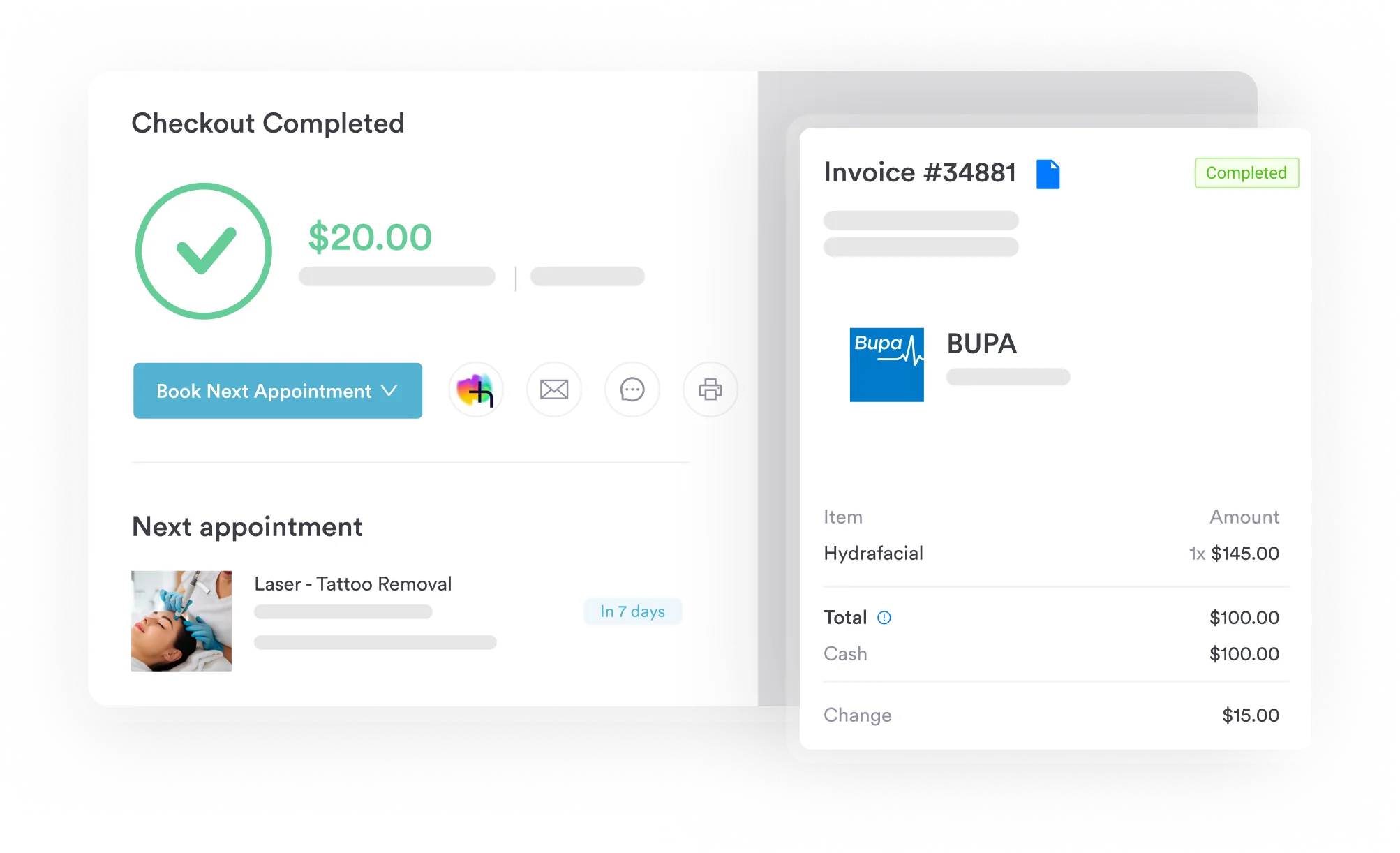
Pabau checkout screen with a completed invoice assigned to an insurer
Pabau ties each invoice to the patient’s insurer at checkout, so a chest pain visit is billed against the right payer from the start.

Send cleaner chest pain claims

Pabau keeps notes, invoices and insurance details on one patient record, then sends 837P claims through Claim.MD with eligibility checks and ERA remittances.

Pabau claims and billing dashboard

Conclusion

R07.9 is a legitimate code, and payers pay it. It holds up when the assessment leaves the pain unexplained and the note gives no description that points to a sibling code.

The habit worth building is reading the final assessment before anything else. Check the setting rule for uncertain wording, then match the procedures to an evaluation that found no cause. Run those three checks before submission, and the denials in the table above become rare events rather than a weekly queue.

Book a demo to see how Pabau keeps the chart, the codes and the claim on one record for chest pain visits.

Continue your research

Continue your research

Need a framework for managing denied claims systematically? Denial management in healthcare covers the end-to-end process for tracking, appealing and preventing claim rejections across your practice.

Want to understand how clearinghouse claim submission works? Our Claim.MD clearinghouse guide explains how 837P claims, eligibility checks and ERA remittances connect to your billing workflow.

Looking for a plain-English breakdown of medical billing fundamentals? What is medical billing walks through the full claim lifecycle from patient encounter to payment posting.

Frequently asked questions

What ICD-9 code did R07.9 replace?

R07.9 maps back to ICD-9-CM 786.50, Chest pain, unspecified. Use the crosswalk only for historical data, because claims with service dates from October 1, 2015 onward need ICD-10-CM.

Does R07.9 need a seventh character or laterality?

No. R07.9 is complete at four characters, with no laterality and no encounter character. Adding a character makes the code invalid.

What is the ICD-10 code for chest wall pain?

Anterior chest-wall pain with no named cause codes to R07.89, Other chest pain. If the provider confirms a cause such as costochondritis, code that condition instead, for example M94.0.

Can R07.9 be the first-listed diagnosis?

Yes, in outpatient and ED settings, when the encounter ends without a confirmed cause. For inpatients, it is the principal diagnosis only when the stay ends without a related definitive diagnosis.

How often do the rules for R07.9 change?

ICD-10-CM updates every year on October 1, and CMS can add mid-year changes on April 1. Check the current tabular list and guidelines at each update.


Avatar photo
Monika Lazarevska
Content Writer

Monika Lazarevska writes content for owners and healthcare professionals who want clear, no-fluff content that actually helps them run their practice better. With a background in storytelling and SEO, she knows how to make even the driest topics worth reading. Off the clock, you'll find her in a café somewhere in Europe, probably with a good book and an even better coffee.
×

