ICD-10 code T32.22: Burns 20-29% TBSA with 20-29% third-degree
ICD-10 code T32.22: Quick reference Use the table below to confirm you have the ...

Last Updated: Nov 9, 2026
Billable Code Specific Code
R06.02 is the billable ICD-10-CM code for shortness of breath. It applies when the physician documents "shortness of breath" or "SOB" and no coded condition accounts for the symptom.
It sits in Chapter 18 of ICD-10-CM (Symptoms, signs and abnormal clinical and laboratory findings) under the R06 category for abnormalities of breathing. It is a commonly miscoded symptom code, most often confused with R06.00 (Dyspnea, unspecified) and R06.09 (Other forms of dyspnea).
Let Pabau's smart automation suggest the right codes, reduce claim denials, and keep your practice compliant—effortlessly.
Automate repetitive tasks and focus on what matters most—your patients.
Reduce coding errors and ensure compliance with the latest regulations.
Clean claims, fewer denials, and faster reimbursements.
Powerful insights and reporting to help your practice thrive.
HIPAA compliant SOC 2 certified GDPR-compliant Trusted by 4,000+ clinics worldwide

R06.02 is a valid, billable ICD-10-CM code for shortness of breath in fiscal years 2026 and 2027.
Use R06.02 when the note says ‘shortness of breath’ or ‘SOB.’ Plain ‘dyspnea’ goes to R06.00, and dyspnea on exertion goes to R06.09.
Do not report R06.02 when the symptom is integral to a confirmed, coded diagnosis such as asthma, heart failure or COPD.
Pabau’s claims management software submits CMS-1500/837P claims through Claim.MD with eligibility checks and ERA remittances.
ICD-10 Code R06.02 is a billable, valid diagnosis code with the official descriptor “Shortness of breath.”
It sits in category R06 (Abnormalities of breathing), within Chapter 18 (Symptoms, signs and abnormal clinical and laboratory findings, not elsewhere classified). It covers encounters where shortness of breath is the documented symptom and no separately coded diagnosis accounts for it.
The CDC/NCHS ICD-10-CM web tool is the authoritative source for code validity, descriptors and inclusion notes by fiscal year. Check it before billing if you are unsure whether the code has been revised.
R06.02 applies when the physician documents “shortness of breath” or “SOB” and no definitive causal diagnosis is separately assigned for that encounter. Plain “dyspnea” with no other wording codes to R06.00 instead. The symptom may be acute or chronic, at rest or on mild exertion. Documented dyspnea on exertion routes to R06.09.
Common clinical contexts where R06.02 is correct:
The code does not require the cause to stay unknown for good. It reflects that, at this encounter, the symptom drove the visit and no more specific diagnosis was documented.
R06.02 has no code-level Excludes1 note, but the R06 category Excludes1 note applies to it. That note sends respiratory failure to J96.-, acute respiratory distress syndrome to J80 and respiratory arrest to R09.2. Several other conditions also take priority when they are established and coded.
The most common coding errors involving R06.02 exclusions:
The governing principle is ICD-10-CM Official Guidelines Section I.C.18: signs and symptoms that are integral to a confirmed and coded condition are not coded separately. When in doubt, ask whether a knowledgeable clinician would expect that symptom with the diagnosed condition. If yes, leave R06.02 off the claim.
Subcategory R06.0 holds five codes: R06.00, R06.01, R06.02, R06.03 and R06.09. The three most often confused are R06.00, R06.02 and R06.09. The choice turns on what the physician wrote, not on what the coder infers about the presentation, so work through the check below in order.
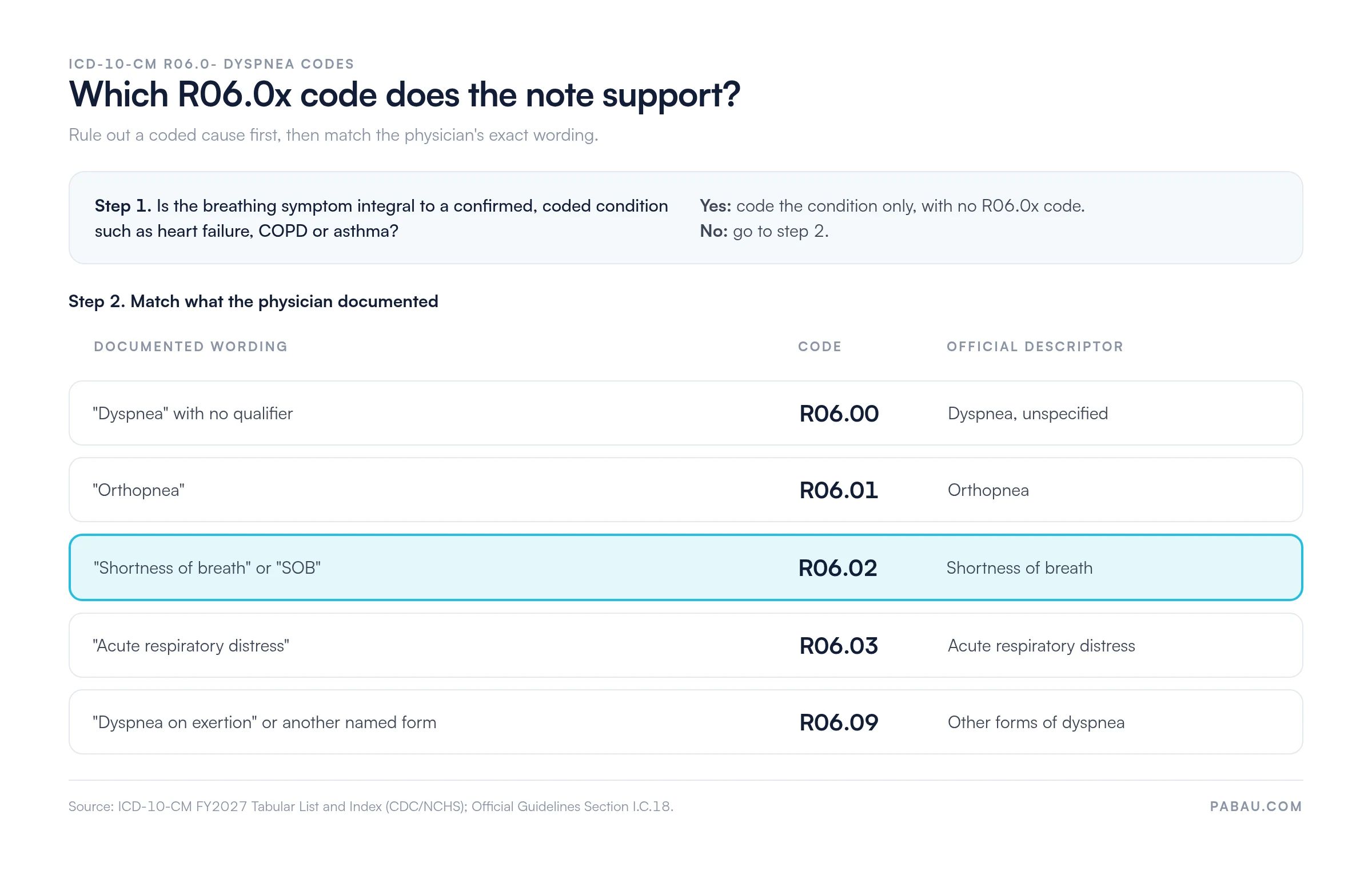
The table below adds the common error to avoid for each of the four dyspnea codes.
The practical rule: Code what is written, not what you assume. “Shortness of breath” is R06.02, “dyspnea on exertion” is R06.09, and “dyspnea” alone is R06.00. R06.00 is the correct code for that wording, not a documentation error.
Run a quarterly audit of R06.02 claims submitted alongside R06.09 or R06.00 on the same encounter. Finding both on one claim usually signals a coder entering a code from memory rather than from the physician’s documented wording. One encounter, one dyspnea code.
Billing R06.02 correctly takes five steps, from the documented wording to a clean submission.
Medical necessity criteria for each CPT-ICD pairing vary by Medicare Administrative Contractor (MAC) jurisdiction. Check the relevant Local Coverage Determination (LCD) before billing diagnostic procedures alongside R06.02. Billing teams can confirm each test’s descriptor in our CPT code library before pairing it with the diagnosis.
Medicare treats R06.02 as a symptom code and applies the outpatient coding rules in Section IV of the ICD-10-CM Official Guidelines, available via CMS. The note must show that shortness of breath was the reason for the encounter and that no definitive diagnosis was established. Alternatively, it must show the symptom is not an inherent part of an already-coded condition.
Key medical necessity considerations for R06.02 claims:
R06.02 denials follow predictable patterns. Knowing them upfront prevents rework on a high-volume symptom code.
A pre-submission coding review catches the sibling-code and sequencing errors in this table before the payer sees them. Effective denial management workflows for R06.02 start with the note, not in the appeals queue.
ICD-10-CM Official Guidelines Section I.C.18 sets out two scenarios for symptom codes like R06.02 when a definitive diagnosis also exists.
If shortness of breath is an integral, defining symptom of an already-coded condition, leave R06.02 off entirely. The definitive diagnosis code captures the clinical picture. Examples are I50.9 for heart failure, J44.1 for COPD with acute exacerbation, and J45.51 for severe persistent asthma with acute exacerbation. Adding R06.02 is redundant and may trigger a denial edit or an audit flag.
R06.02 may appear as a secondary code when the shortness of breath is separately evaluated. It must not be a defining symptom of the primary condition, and it needs its own clinical attention during the encounter.
Example: A patient with documented hypertension (I10) presents for a routine follow-up. The physician also evaluates a new complaint and documents “shortness of breath” with no exertional qualifier, then orders a chest X-ray. Here, I10 is primary, R06.02 is secondary, and the R06.02 documentation supports the medical necessity of 71046.
The test: Would a knowledgeable clinician expect this patient to have shortness of breath as part of their primary condition? If yes, leave R06.02 off. If it is a new, separately investigated finding, code it as secondary. Good medical billing compliance means documenting this distinction explicitly in the chart.
Most R06.02 denials trace back to a note that did not give the coder enough to work with. These documentation habits fix that without adding much charting time.
Documentation that maps to the right code is cheaper than correcting claims after submission. That handoff is where the medical billing process begins, and every clean claim depends on it.
Add a short documentation prompt to your EHR’s dyspnea visit template: ‘SOB: acute or chronic? At rest or exertional? Definitive diagnosis established? Y/N.’ A few seconds of prompting at the point of care saves denial follow-up later.
In many practices, the note lives in one system and the claim is built in another. A coder reads the assessment, picks an R06.0x code, checks eligibility in a payer portal and submits through a separate clearinghouse login.
Pabau, the practice management platform we build, keeps the clinical note and the claim in one record. Its claims management software submits CMS-1500/837P claims through Claim.MD, with eligibility checks, ERA remittances and secondary claims in the same workflow.
Your coders choose between R06.00, R06.02 and R06.09 from the physician’s own wording, in the record the claim is built from. Fewer hand-offs between chart and claim give each submission a better chance of going through clean the first time.

Pabau’s claims management software submits CMS-1500/837P claims through Claim.MD with eligibility checks and ERA remittances. Your coders work from the same record the physician documented in.

R06.02 is a wording code. If the assessment says “shortness of breath” or “SOB” and no coded condition explains it, R06.02 is right, and plain “dyspnea” belongs to R06.00.
The fix for R06.02 denials sits upstream of the claim. A templated documentation prompt and a quarterly audit of the R06.0x split catch errors before a payer does. That is cheaper than working the denial afterward.
Book a demo to see how Pabau’s claims management software sends your R06.02 claims through Claim.MD with eligibility checks built in.

Need to understand the broader billing workflow before submitting claims? Medical billing process overview explains the full journey from charge capture to payment posting.
Want to reduce denials across your code set, not just R06.02? Denial management workflows covers systematic approaches to tracking, appealing, and preventing claim rejections.
Checking coverage before a shortness of breath workup? Insurance eligibility verification explains how to confirm a patient’s benefits before services are billed.
Filing R06.02 on a paper claim? CMS-1500 form template gives you the standard professional claim form to complete.
ICD-10 Code R06.02 is a billable diagnosis code for shortness of breath when no definitive underlying cause has been separately coded for the encounter. It is assigned when the physician documents “shortness of breath” or “SOB” as the presenting symptom. Plain “dyspnea” codes to R06.00 instead.
R06.00 is “Dyspnea, unspecified,” used when the physician documents only “dyspnea” with no further qualifier. R06.02 is “Shortness of breath,” used when the note says “shortness of breath” or “SOB.” Assign the code that matches the physician’s exact documented wording, never the coder’s clinical inference.
Use R06.02 when the physician documents “shortness of breath” or “SOB” without an exertional qualifier. Use R06.09 when the note says “dyspnea on exertion,” “exertional dyspnea” or “DOE.” The word “exertional” decides it, not the physician’s overall impression of the case.
Yes. R06.02 is valid for fiscal year 2026 and for FY2027, which took effect on October 1, 2026. Confirm the current descriptor in the CDC/NCHS ICD-10-CM web tool at icd10cmtool.cdc.gov before billing.
Yes. R06.02 can be the first-listed diagnosis when shortness of breath is the reason for the encounter and no definitive diagnosis was established at that visit. Under Section IV of the ICD-10-CM Official Guidelines, the first-listed code reflects the condition chiefly responsible for the encounter.
Yes. Medicare and most commercial payers require documentation showing that shortness of breath was the clinical reason for the services billed. The note must show that SOB prompted the visit and that the E/M service and diagnostics were needed to evaluate it. Vague documentation is a leading cause of medical necessity denials on R06.02 claims.