

CCSD code G5100: Bypass of duodenum billing guide
CCSD code G5100 bills a bypass that leaves the duodenum in place CCSD code G5100...

Last Updated: Oct 16, 2026
84484 is the CPT code for troponin, quantitative. A quantitative assay reports a numeric troponin concentration rather than a positive or negative result, so clinicians can follow the trend across serial draws.
That trend separates an acute myocardial infarction from a stable elevation caused by chronic cardiac disease. Each claim line needs a supporting ICD-10-CM diagnosis, so document the clinical indication before the test is ordered.
Let Pabau's smart automation suggest the right codes, reduce claim denials, and keep your practice compliant—effortlessly.
Automate repetitive tasks and focus on what matters most—your patients.
Reduce coding errors and ensure compliance with the latest regulations.
Clean claims, fewer denials, and faster reimbursements.
Powerful insights and reporting to help your practice thrive.
HIPAA compliant SOC 2 certified GDPR-compliant Trusted by 4,000+ clinics worldwide

CPT code 84484 covers troponin, quantitative, a chemistry test in the 82009-84999 range that reports a numeric troponin concentration.
CPT 84512 covers troponin, qualitative, so billing both codes off a single assay result is unbundling.
Each serial troponin draw is billed as its own claim line, provided the note records why the repeat test was ordered.
Every claim needs a supporting ICD-10-CM diagnosis, most often I21.x for AMI, I20.0 for unstable angina, or R94.31 for an abnormal ECG.
Pabau’s claims management software validates CPT and ICD-10 pairs through the Claim.MD clearinghouse before a troponin claim is submitted.
CPT code 84484 carries the official descriptor Troponin, quantitative. It sits in the Chemistry subsection of the Pathology and Laboratory section, which spans codes 82009 through 84999 and covers laboratory analyte measurements. The AMA’s CPT code set maintains the descriptor and the reporting rules that govern it.
Troponin is a regulatory protein complex found in cardiac and skeletal muscle. When the heart muscle is damaged, the cardiac-specific isoforms cTnI and cTnT release into the bloodstream.
A quantitative assay measures the serum concentration, so clinicians can detect small elevations and track the rise-and-fall pattern that confirms myocardial injury. Which isoform the lab measured still matters for billing, because payers map the two high sensitivity assays differently.
Emergency physicians and cardiologists order troponin testing for chest pain, shortness of breath, or ECG changes. Each of those raises concern for acute coronary syndrome (ACS). A single elevated value is rarely diagnostic on its own.
Most protocols call for serial measurements 3 to 6 hours apart, and sometimes again at 12 hours. The rise-and-fall pattern is what gets confirmed or ruled out. Each draw is a separate billable event where the documentation supports the repeated clinical indication.
Non-cardiac conditions also elevate troponin. Pulmonary embolism, sepsis, renal failure, and myocarditis all appear in the differential. That matters for coders, because the diagnosis submitted must reflect the documented reason for testing rather than a reflex assumption of AMI.
R79.89 (other specified abnormal findings of blood chemistry) can support a troponin order before a cardiac cause is confirmed. The note has to record the clinical concern driving the test.
CPT 84484 covers quantitative troponin testing and CPT 84512 covers qualitative troponin testing. The two descriptors are not interchangeable, and payers enforce the distinction at adjudication.
The AMA’s CPT Knowledge Base addresses how often 84484 or 84512 may be reported. The question comes up when both troponin I and troponin T are tested in one encounter. Each analyte is separately billable when a different assay method produced it, and when the documentation shows why both results were needed. Billing both codes off a single assay result is unbundling, and it triggers denial or audit.
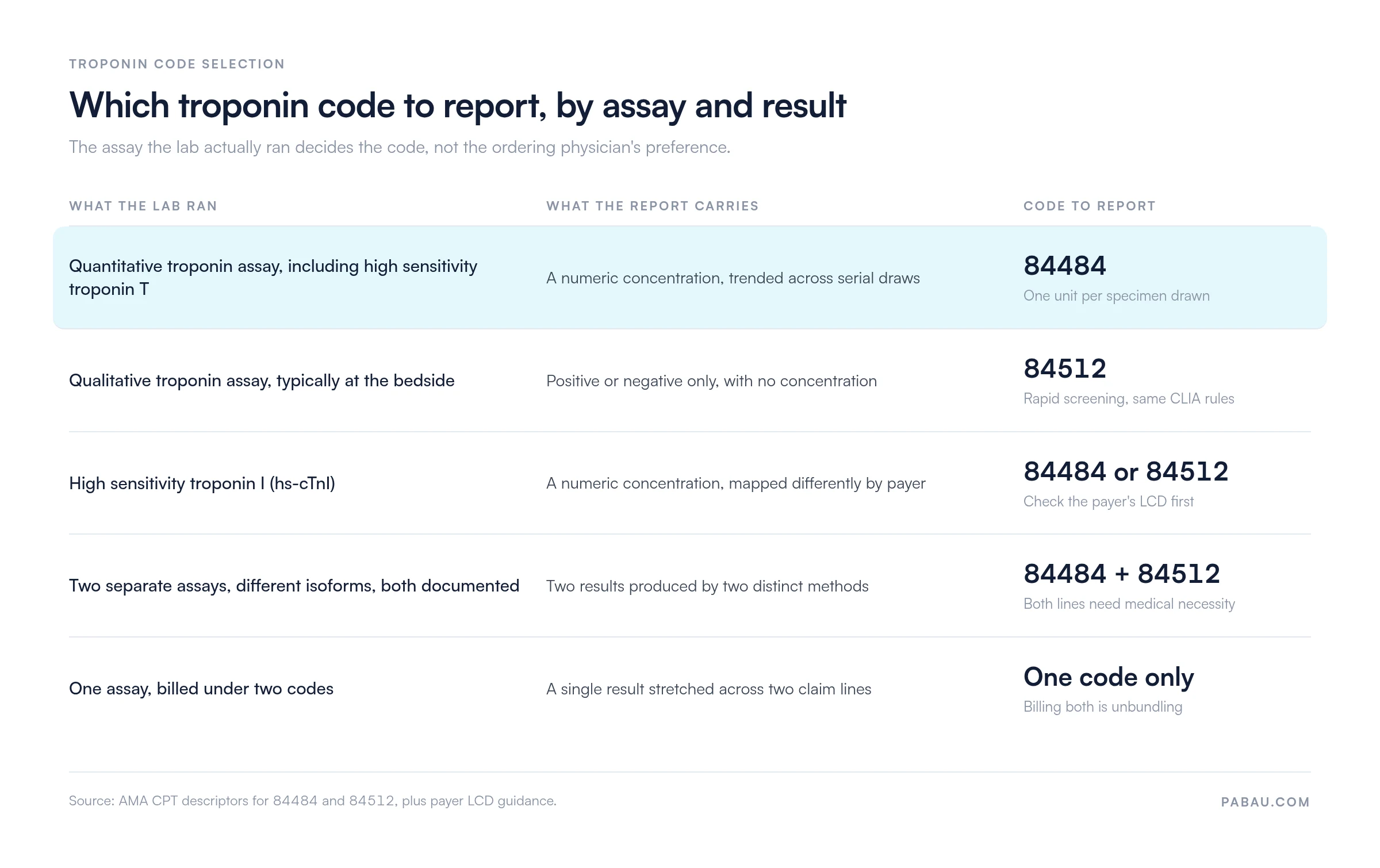
Code selection comes down to what the lab ran and what the result report carries, as the table below sets out.
High sensitivity troponin assays (hs-cTnI, hs-cTnT) have largely replaced conventional troponin testing in US hospital laboratories following FDA clearance. They detect concentrations well below the 99th-percentile upper reference limit used by conventional methods, which supports faster rule-in and rule-out protocols.
For billing purposes, hs-troponin T assays map to CPT code 84484 under current AMA guidance. The test still produces a quantitative troponin result, and both LabCorp and Quest Diagnostics list 84484 in their directories for high sensitivity troponin testing.
The mapping for hs-troponin I is less uniform. Some payers accept 84484 while others require 84512 or apply their own policy. Check each payer’s Local Coverage Determination (LCD) before billing hs-troponin I as 84484, especially where the lab report does not state the assay type. The code follows the assay the lab actually performed, not the ordering physician’s preference.
Flag high sensitivity troponin results in your billing workflow. When the lab report labels the result ‘hs-cTnT’ or ‘high sensitivity troponin T,’ bill 84484. When it labels the result ‘hs-cTnI,’ confirm your payer’s LCD before assigning 84484 or 84512. A single wrong assignment repeated across hundreds of serial-draw claims creates a pattern that triggers payer audit.
Every troponin claim needs a paired diagnosis from the ICD-10-CM code set to establish medical necessity. Payers cross-reference the submitted diagnosis against their covered indication lists. A diagnosis missing from that list denies automatically, however good the clinical note is. The codes below are the pairings payers accept most often, organized by clinical scenario.
Use the most specific diagnosis available at the time of the encounter. Where the provider documented “rule out NSTEMI” without confirming it, use the sign or symptom code (R07.9 or I20.0) rather than the confirmed AMI code. Submitting a confirmed AMI diagnosis against a “rule out” note misrepresents the encounter and creates compliance risk.
Medicare reimburses CPT code 84484 under the CMS Clinical Laboratory Fee Schedule (CLFS), not the Medicare Physician Fee Schedule. Chemistry codes are paid at a single national rate, with no facility versus non-facility split on the technical component. The rate is updated annually, so verify the current year’s CLFS final rule before quoting rates to patients or forecasting revenue.
Laboratory codes under the CLFS carry no geographic price index adjustment, unlike Physician Fee Schedule codes. A practice in rural Mississippi receives the same Medicare allowable as one in Manhattan. Commercial rates are set by contract and often sit well above or below Medicare, so the CMS figure is a weak proxy for expected revenue. Confirm payer eligibility and the contracted rate before the encounter closes.
Troponin denials cluster around three billing errors: mismatched ICD-10-CM codes, incorrect unit reporting on serial draws, and point-of-care claims handled like send-out lab work. The guidelines below address each.
Consistent documentation also lowers audit exposure on high-volume serial testing, and denial management in healthcare covers how to work the claims that still come back. A practice ordering hundreds of troponin draws a month without documentation standards is a statistical outlier that medical review programs flag.
Review your troponin denial rate quarterly. Pull all 84484 and 84512 claims from the past 90 days and sort by denial reason code. If CO-4 (procedure inconsistent with modifier) or CO-B7 (provider not certified) appear, you have a documentation or enrollment problem. If CO-96 (non-covered charge) dominates, your ICD-10 pairings need review against your payers’ current LCDs.
Point-of-care testing (POCT) uses an analyzer at or near the bedside rather than a central laboratory. The CPT code itself (84484 or 84512) does not change with where the test is performed, but the billing requirements do.
A cardiology or emergency medicine practice running dozens of serial troponin draws per shift needs a billing workflow that validates codes on its own. Volume and clinical urgency are what let coding errors pile up unnoticed until the remittances arrive.
Practice management software like Pabau closes that route to error. Our claims management software carries a built-in CPT and ICD-10 catalog. It checks each submitted pair against payer policy before the claim leaves the practice.
For serial troponin billing, each draw’s claim line is validated on its own against the documented diagnosis. Any line likely to deny is flagged for review. The Claim.MD clearinghouse integration adds payer eligibility checks and ERA remittance tracking. Billing staff see within hours whether a troponin claim paid, denied, or pended, instead of waiting on a paper explanation of benefits.
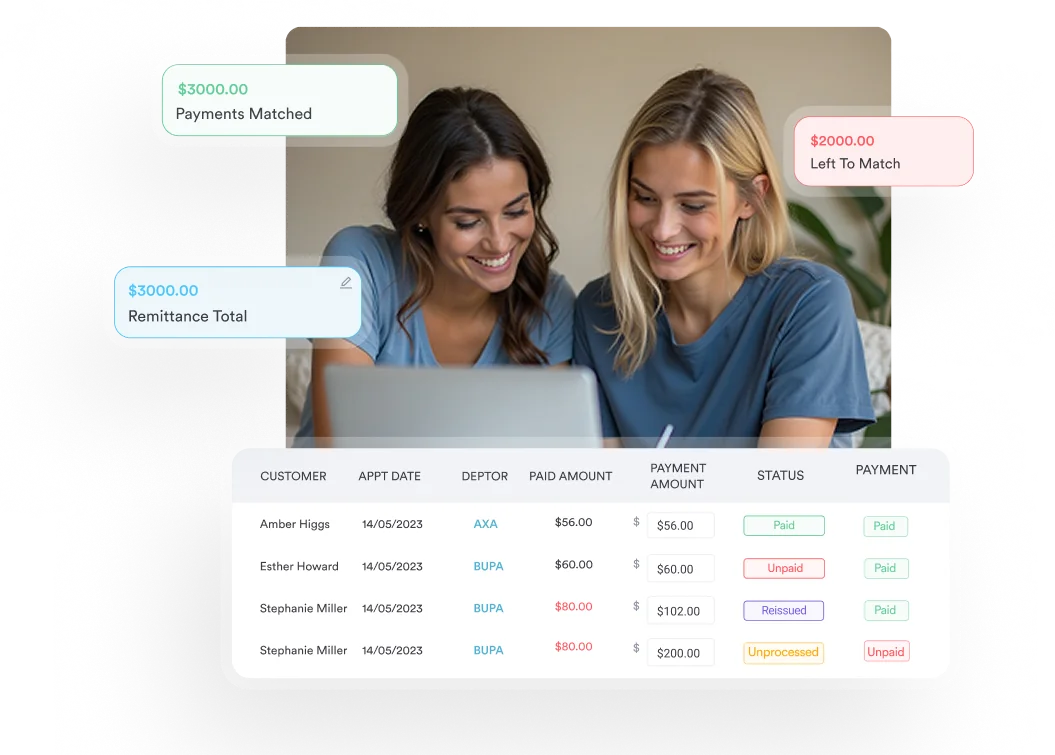

Pabau’s claims management workflow flags CPT and ICD-10 mismatches before submission, tracks serial draw billing, and connects to the Claim.MD clearinghouse for eligibility checks. See how it works for cardiology and emergency medicine billing teams.

CPT code 84484 is simple in its descriptor and demanding in its documentation. Each serial draw needs its own claim line, its own ICD-10-CM pairing, and a note that explains the clinical decision behind the repeat test.
Guard three failure points: a mismatched diagnosis, two codes billed off one assay result, and a POCT claim sent without a CLIA certificate on file. Close those three and the resubmission cycle on cardiac testing shrinks to the claims that genuinely need a second look. Book a demo to see how Pabau handles serial troponin draws and CPT-ICD-10 pairing.

Need guidance on managing cardiac-related claim denials? Denial management in healthcare walks through the denial resolution process for high-volume diagnostic lab claims.
Want to understand the full claim submission process? Submitting claims via the 837 electronic file covers how laboratory claims move from your system to the payer through EDI.
Looking for a practical overview of the clearinghouse connection? How a medical claims clearinghouse works explains payer routing, eligibility checks, and remittance processing in plain language.
Checking insurance eligibility before the troponin draw? Insurance eligibility verification outlines the real-time check process that prevents coverage-related denials on laboratory claims.
CPT code 84484 is the billing code for a troponin, quantitative laboratory assay. It is a chemistry test that measures cardiac troponin concentration in blood to detect myocardial injury. The code sits in the Chemistry subsection (82009-84999) of the AMA CPT code set.
CPT 84484 covers troponin, quantitative testing, which produces a numeric concentration for troponin T or troponin I depending on the assay. CPT 84512 covers troponin, qualitative testing, which returns a positive or negative result only. Both can be billed in one encounter where two separate, medically necessary assays were performed by distinct methods.
Each serial draw is billed separately as one unit of 84484 per specimen. The medical record must document the time of each draw, the result obtained, and the clinical reason the repeat test was ordered. The AMA permits separate billing for each clinically indicated draw, and “standard protocol” alone will not support multiple claim lines.
Commonly accepted ICD-10-CM codes include I21.4 (NSTEMI), I20.0 (unstable angina), R07.9 (chest pain, unspecified), R79.89 (other abnormal blood chemistry findings), and R94.31 (abnormal ECG). Use the most specific diagnosis available at the time of the encounter, and check payer LCDs for additional or restricted code lists.
Yes, CPT 84484 applies wherever the assay is performed, though point-of-care billing requires the practice to hold a CLIA certificate for the analyzer’s complexity level. Most bedside troponin analyzers carry CLIA-waived status following FDA clearance, and billing without a valid waiver certificate is a compliance violation. CLIA certificates are issued by CMS through state agencies, so confirm your status there before billing POCT troponin claims.
High sensitivity troponin T (hs-cTnT) assays are generally billed under CPT 84484, because they still produce a quantitative troponin result. Mapping for high sensitivity troponin I (hs-cTnI) is less uniform. Some payers accept 84484, while others apply their own LCD guidance. Verify the payer’s policy and the assay type documented in the lab report before assigning the code.



