ICD-10 Code Z86.73: Personal history of TIA
ICD-10 Code Z86.73: Definition, descriptor, and code hierarchy ICD-10 Code Z86.7...

Last Updated: Nov 20, 2026
Billable Code Specific Code
R00.2 is the billable ICD-10-CM code for palpitations. It records a patient's awareness of a forceful, rapid or irregular heartbeat when no cardiac diagnosis explains it.
The code sits in category R00 of Chapter 18, which covers symptoms, signs and abnormal findings. A frequent R00.2 coding error is leaving it on the claim after a confirmed arrhythmia has been documented. Under ICD-10-CM Guidelines Section I.B.5, a symptom integral to a confirmed diagnosis is not coded separately.
Let Pabau's smart automation suggest the right codes, reduce claim denials, and keep your practice compliant—effortlessly.
Automate repetitive tasks and focus on what matters most—your patients.
Reduce coding errors and ensure compliance with the latest regulations.
Clean claims, fewer denials, and faster reimbursements.
Powerful insights and reporting to help your practice thrive.
HIPAA compliant SOC 2 certified GDPR-compliant Trusted by 4,000+ clinics worldwide

R00.2 is a valid, billable ICD-10-CM symptom code for palpitations, used until a definitive cardiac diagnosis is documented.
Once a confirmed cardiac diagnosis explains the palpitations, such as an I48 code for atrial fibrillation, the definitive code replaces R00.2.
R00’s only Excludes1 note covers perinatal heartbeat abnormalities (P29.1-), while specified arrhythmias (I47-I49) are Excludes2 and may be reported separately.
Pabau, the practice management platform we build, supports electronic claim submission and denial tracking for R00.2 encounters.
ICD-10 Code R00.2 is the billable ICD-10-CM code for palpitations, a patient’s awareness of a forceful, rapid or irregular heartbeat. It is listed under category R00, Abnormalities of heart beat, in CDC’s FY2027 ICD-10-CM tabular list, with “awareness of heart beat” as its inclusion term. Use it while no cardiac diagnosis explains the symptom. The table below covers billable status, chapter placement, effective date and the ICD-11 equivalent.
Use the CDC/NCHS ICD-10-CM web tool to confirm the current fiscal year status of R00.2 before submitting claims. Code descriptors and excludes notes are updated every October.
R00.2 covers the patient’s subjective sensation of an abnormal, forceful, rapid or irregular heartbeat. It is documented as a presenting symptom with no confirmed underlying cardiac diagnosis. Under the ICD-10-CM Official Guidelines (Section I.C.18), Chapter 18 symptom codes apply when the encounter ends without a related definitive diagnosis.
R00.2 is appropriate for the clinical presentations listed below.
R00.2 is not appropriate once a clinician documents a confirmed arrhythmia, structural defect or other cardiac diagnosis that explains the palpitations. At that point, the definitive code replaces the symptom code.
Category R00 carries one Excludes1 note and one Excludes2 note in the FY2027 ICD-10-CM tabular, and R00.2 has no code-level Excludes1 note of its own. The Excludes1 note removes heartbeat abnormalities originating in the perinatal period (P29.1-), which are coded in Chapter 16 instead. The Excludes2 note lists specified arrhythmias (I47-I49). Those conditions are not part of R00, but the tabular lets you report them alongside it when both are present.
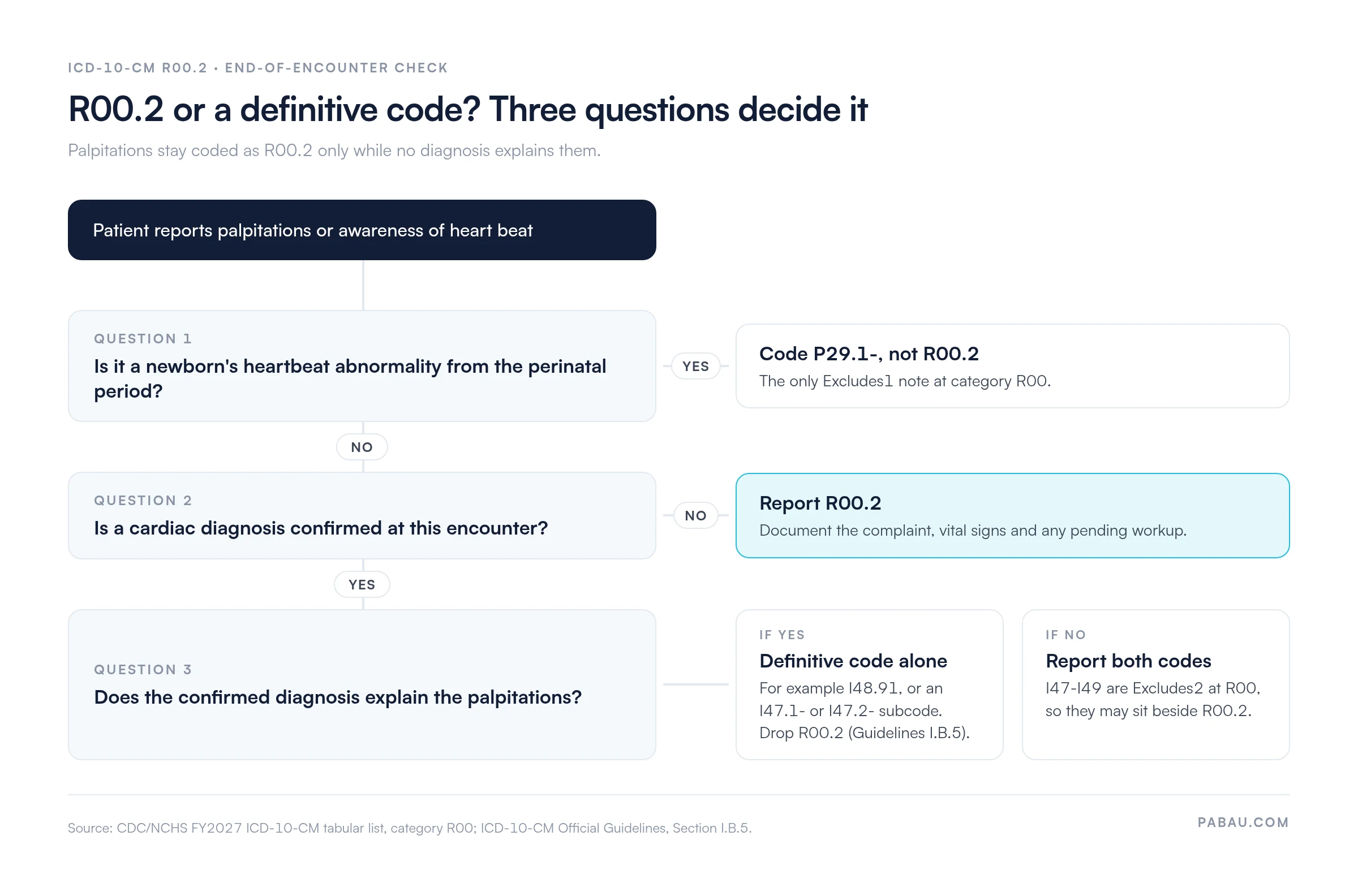
Key rule: The limit that matters most for R00.2 comes from ICD-10-CM Official Guidelines Section I.B.5, not from an excludes note. Signs and symptoms routinely associated with a disease process are not coded separately once that diagnosis is confirmed. When palpitations lead to confirmed atrial fibrillation in the same encounter, report the matching I48 code, such as I48.91, and drop R00.2. Add R00.2 beside a confirmed diagnosis only when the physician documents palpitations that the diagnosis does not explain. Check the current notes at R00 in the official CDC/NCHS ICD-10-CM browser with each fiscal year update. The flow below puts the excludes note and this rule in the order a coder checks them.
All R00.x codes fall under “Abnormalities of heart beat,” but each describes a distinct clinical presentation. Selecting the wrong sibling code is a common audit flag, particularly when tachycardia (R00.0) is confused with palpitations (R00.2).
Practical tip: R00.0 requires an objectively documented elevated rate. R00.2 is driven by the patient’s subjective experience. If the note says “patient complains of racing heart” but the ECG shows a normal rate, R00.2 is the correct code.
Upgrading from R00.2 to a definitive code is mandatory once the physician documents a confirmed cardiac diagnosis that explains the palpitations. The ICD-10-CM Official Guidelines are explicit: Signs and symptoms that are integral to a confirmed condition should not be coded separately.
Timing note: The upgrade rule applies at the encounter level. A Holter result that confirms AF after the office visit does not change that visit’s R00.2. The monitoring service itself is different. Under Guidelines Section IV.K, when the interpreted final report is available at the time of coding, that claim carries the confirmed diagnosis. Later encounters carry the I48 code too. A rhythm strip read on its own follows the same rule, and that interpretation bills as CPT 93042.
Payers reviewing R00.2 claims look for specific elements in the clinical note. Missing documentation is a frequent reason for R00.2 denials. Structuring notes for clean claim submission starts with knowing exactly what must appear in the chart.
Minimum vs. optimal documentation: The minimum is a complaint, vital signs, and a clinical impression. Optimal documentation includes the full symptom history, all ordered tests with results, and an explicit note that the workup was inconclusive or pending. Optimal documentation reduces prior authorization friction for ambulatory cardiac monitoring services billed alongside R00.2.
Prior authorization rules attach to the tests ordered for palpitations, and R00.2 is often the diagnosis supporting them. Medicare Administrative Contractors (MACs) publish Local Coverage Determinations (LCDs) for ambulatory cardiac monitoring, and commercial payers set their own policies. Requirements vary by MAC jurisdiction and plan, so verify them before ordering.
Pabau’s claims software for billers submits R00.2 claims through its Claim.MD clearinghouse integration. It runs real-time eligibility checks and routes claims to thousands of US payers. It also tracks prior authorization on each case, warning you when an authorization code is missing.

R00.2 denials trace to five root causes. The table below maps each cause to its typical CARC (Claim Adjustment Reason Code) and the correction action. Strong denial management in healthcare starts with knowing which code triggered the rejection.
Read the full ERA (Electronic Remittance Advice) on every R00.2 denial, not just the CARC. The RARC paired with CARC 16, for example, often names the missing documentation element. Our guide to medical billing denial codes covers CARC/RARC combinations in more depth. Electronic remittance advice workflows then flag each denial at the encounter level.
Audit R00.2 claims for cardiac monitoring against the monitor report dates. If the interpreted final report was available when the monitoring service was coded and it confirms AF or SVT, that claim carries the wrong code. File a corrected 837P with the definitive I48 or I47.1- subcode and note the report date.
These rules apply at the encounter level. They cut denial exposure for practices that bill palpitation workups and cardiac monitoring services.
A palpitations workup spans several dates. The first visit carries R00.2, then a Holter or event monitor report arrives days later and may confirm an arrhythmia. Billers have to match each claim to the right report, and that matching is where R00.2 claims go wrong.
Pabau keeps the clinical note and the claim in the same patient record. The coder sees the physician’s assessment before choosing between R00.2 and a definitive code. Claims go out electronically through the Claim.MD integration, with an eligibility check first.
When a payer denies a claim, your team sees it beside the paid and pending ones and can flag it for rework. The corrected claim then goes out with the code the chart supports.

Pabau’s claims management software integrates with Claim.MD to submit R00.2 claims electronically, see paid, pending and denied claims, and flag denied claims for rework. See how it works in a live demo.

R00.2 is a straightforward symptom code. It is still denied often because coders keep it on the claim after a definitive diagnosis explains the palpitations. That limit comes from Guidelines Section I.B.5, not from an Excludes1 note.
So code from the physician’s assessment, and switch to the specific I47 or I48 subcode once a cardiac diagnosis is confirmed. Confirmed AF that the physician documents as paroxysmal, for example, takes the I48.0 code. Keep R00.2 where the workup is still open, and make sure the note carries the six documentation elements a payer reviewer looks for. If the workup instead ties the palpitations to low magnesium the physician documents, the claim carries hypomagnesemia code E83.42.
Pabau’s integration with Claim.MD processes R00.2 claims across thousands of US payers and surfaces ERA denial codes against each encounter. Book a demo to see how your team can fix R00.2 coding errors before they turn into aged denials.

Need a broader denial resolution framework? Denial management in healthcare covers the end-to-end workflow for identifying, appealing, and preventing claim denials across diagnosis and procedure codes.
Unfamiliar with ERA workflows? Electronic remittance advice explains how to read ERA files and use CARC/RARC codes to route denials to the right correction action.
Building a clean claim checklist? Clean claim requirements outlines the documentation and coding standards that prevent R00.2 and other diagnosis code rejections at submission.
Is the rate objectively elevated? ICD-10 code R00.0 covers tachycardia, unspecified, the sibling code that needs a documented fast rate rather than a reported sensation.
Billing the event monitor? CPT code 93270 explains the ambulatory event monitoring service that R00.2 often supports.
ICD-10 Code R00.2 is the billable ICD-10-CM diagnosis code for palpitations, the patient’s subjective awareness of an abnormal or forceful heartbeat. It is a Chapter 18 symptom code, so it describes a presenting complaint rather than a confirmed cardiac condition. Use it when no definitive arrhythmia or structural diagnosis has been established by the end of the encounter.
Yes. R00.2 is active and billable in the FY2027 ICD-10-CM tabular, which you can verify via CDC/NCHS. It can be submitted as a primary or secondary diagnosis when no definitive cardiac diagnosis explains the symptom and the documentation supports the palpitations complaint.
R00.2 (palpitations) is a symptom code driven by the patient’s subjective complaint of an abnormal heartbeat sensation. R00.0 (tachycardia, unspecified) requires an objectively documented elevated heart rate on examination or ECG, without a confirmed arrhythmia cause. If a patient complains of a racing heart but the ECG shows a normal rate, R00.2 is the correct code.
Yes. R00.2 can be the first-listed diagnosis when palpitations are the main reason for the encounter and no definitive cardiac condition is established. Some payers restrict R00.2 as the primary diagnosis for downstream services such as ambulatory cardiac monitoring. Check payer-specific LCD policies before ordering those tests.
R00.2 denials usually trace to four causes. The first is leaving R00.2 on a claim beside a confirmed diagnosis it is integral to, such as I48.x atrial fibrillation. The others are a symptom code used as the final diagnosis, insufficient clinical documentation, and missing prior authorization for cardiac monitoring. Each denial carries a CARC code on the ERA that identifies the specific root cause.
The ICD-11 equivalent of R00.2 is MC81.2 (Palpitations), under MC81 Abnormalities of heart beat. Crosswalks between the two systems are approximations. Confirm the current mapping in the WHO ICD-11 browser before using ICD-11 codes in clinical or billing work.
R00.2 has no code-level Excludes1 note. The only Excludes1 note at category R00 is P29.1-, heartbeat abnormalities originating in the perinatal period, which is never coded with R00.2. Specified arrhythmias (I47-I49) are Excludes2, so the tabular allows them on the same claim. However, Guidelines Section I.B.5 says not to code a symptom routinely associated with a confirmed diagnosis. Once atrial fibrillation (an I48 code) or SVT (an I47.1- subcode) explains the palpitations, report the definitive code alone.