ICD-10 Code Y76.0: Diagnostic obstetric and gynecological devices
ICD-10 Code Y76.0: Definition and billable status ICD-10 Code Y76.0 is a valid, ...

Last Updated: Oct 23, 2026
ICD-10 code N33 is the billable ICD-10-CM code for bladder disorders in diseases classified elsewhere. It records bladder involvement caused by a disease coded in another chapter, such as schistosomiasis.
N33 has no subcodes in FY2026, so it is reported at three characters. It is a manifestation code, which means the underlying disease is always sequenced first. This reference covers the Excludes1 note that sends tuberculosis of the bladder to A18.12, and how N33 differs from N30-N32. It also covers the documentation and denial patterns coders meet with this code.

ICD-10 code N33 is billable at three characters in FY2026 ICD-10-CM and has no subcodes, so N33.0 and N33.8 are not valid US codes.
N33 is a manifestation code, so the underlying disease is always sequenced first, with schistosomiasis (B65.0-B65.9) named in its Code first note.
The Excludes1 note sends tuberculosis of the bladder to A18.12 alone, and organism-specific cystitis codes such as A54.01 or A56.01 are never paired with N33.
Most N33 denials come from four errors: N33 listed first, a missing etiology code, an Excludes1 pairing, or no documented causal link.
Practice management software like Pabau sends claims through Claim.MD with the coder’s diagnosis sequence as entered, and rejections come back to one worklist.
ICD-10 code N33 classifies bladder disorders that arise as a manifestation of a disease documented and coded elsewhere in ICD-10-CM. The code sits in Chapter 14 (Diseases of the genitourinary system, N00-N99), inside the N30-N39 block for other diseases of the urinary system. According to the CDC/NCHS FY2026 ICD-10-CM tabular list, N33 is a complete, valid code with no fourth-character subdivisions.
The N33.0 and N33.8 codes that appear in some references come from the WHO international version of ICD-10, a separate classification. US claims use ICD-10-CM, maintained by CDC/NCHS and CMS, where the category stops at N33. A claim that carries N33.0 fails as an invalid diagnosis code.
Yes. ICD-10 code N33 is billable at the three-character level because the category has no subcodes to report instead. The CDC/NCHS ICD-10-CM web tool lists N33 as a complete code for FY2026.
Billable does not mean it can stand alone. N33 is a manifestation code, so it is only valid in a secondary position behind the code for the disease that caused the bladder disorder. Payers reject N33 as the first-listed diagnosis even though the code itself is valid.
N33 follows the etiology/manifestation convention in Section I.A.13 of the ICD-10-CM Official Guidelines for Coding and Reporting. Codes titled “in diseases classified elsewhere” describe a manifestation and never serve as the principal or first-listed diagnosis. The tabular list attaches a Code first note to N33, naming schistosomiasis (B65.0-B65.9) as its example.
The Code first note at N33 names schistosomiasis as its example underlying disease. Several other infections that affect the bladder have their own combination codes and are excluded from N33, so they never pair with it.
Schistosoma haematobium is the species most associated with urogenital involvement, including bladder fibrosis and calcification. Verify species documentation before choosing the B65 code, as B65.0 (S. haematobium), B65.1 (S. mansoni), and B65.2 (S. japonicum) carry different clinical implications.
The ICD-10-CM tabular list attaches an Excludes1 note to N33, which means the listed conditions are coded elsewhere and never with N33. Most of them are infections with their own combination code for bladder involvement. Pairing any of them with N33 is a coding error that claim edits flag.
The practical consequence: when tuberculosis is documented as the cause of a bladder disorder, report A18.12 by itself. Neither N33 nor a WHO-only code such as N33.0 belongs on that claim. The same rule applies to each organism-specific cystitis code in the table.
All four codes sit in the N30-N39 block, and documentation can plausibly support more than one of them. The choice hinges on causation and on the tabular instructions, as set out in the CDC/NCHS FY2026 ICD-10-CM tabular list.
Neurogenic bladder is a common documentation confound. When a neurological condition such as multiple sclerosis or spinal cord injury drives the bladder dysfunction, the correct path is N31, not N33. Code the neurological condition as well, following the instructions at the N31 code chosen. The decision path below puts the three routes in the order a coder checks them.
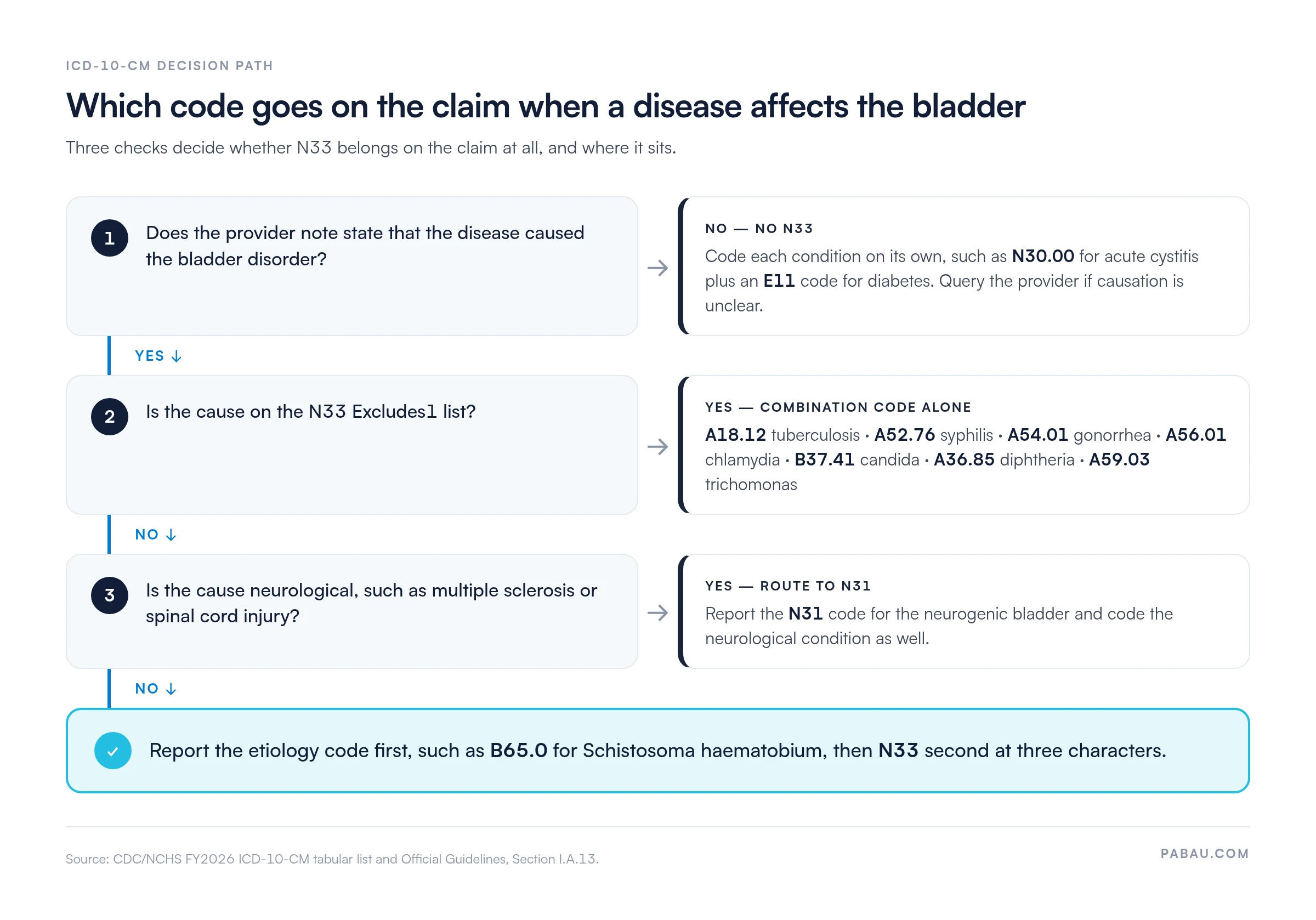
Read the Excludes1 note at N33 before assigning it. If the cause is tuberculosis, syphilis, gonorrhea, chlamydia, candida, diphtheria, or trichomonas, use that combination code alone. If the cause is neurological, route to N31. N33 is left for a bladder disorder caused by a disease coded elsewhere that has no combination code of its own.
Supporting documentation for N33 must establish a clear causal link between the underlying disease and the bladder disorder. Vague language such as “bladder symptoms in a patient with schistosomiasis” is insufficient. The provider note needs three elements.
When documentation is ambiguous, the coder should query the provider rather than assign N33 on the basis of inference. Causation has to come from the provider, because a coder cannot infer it from two conditions appearing in the same note. An audit that finds N33 without a documented causal link can lead to recoupment and further review.
N33 claims generate a predictable set of denials, and most trace back to sequencing, Excludes1, or invalid-code errors. Knowing which edits apply to manifestation codes like N33 lets a team catch them at coding review, before the claim reaches the denial queue.
With claims software for practices, the corrected diagnosis sequence stays attached to the claim, so a fix made once is the one that gets submitted. Practice management software like Pabau sends corrected ICD-10 claims through Claim.MD, which submits each claim and tracks its status and payer responses. The coding review itself stays with your coders. Reading the matching denial codes alongside the table above helps teams separate documentation fixes from simple resequencing.
These vignettes show correct and incorrect coding for three common N33 presentations. Each follows the etiology/manifestation convention in Section I.A.13 of the ICD-10-CM Official Guidelines and the Excludes1 note at N33.
A patient admitted for pulmonary tuberculosis develops frequency, dysuria, and cystoscopy findings consistent with tuberculous cystitis. The provider documents “bladder involvement secondary to pulmonary tuberculosis.”
A patient with documented Schistosoma haematobium infection presents with bladder calcification confirmed on imaging. The provider documents “bladder calcification due to urinary schistosomiasis.”
A patient with a history of recurrent UTIs is treated for acute cystitis. The coder attempts to use N33 because the patient also has type 2 diabetes. No documentation links the cystitis to the diabetes.
A systemic disease alongside a bladder disorder does not justify N33 on its own. The provider note must state that the bladder disorder is caused by the disease. Comorbidity without documented causation routes to separate codes, not the etiology/manifestation pairing.
N33 errors usually start upstream of the claim. The provider documents the bladder finding in one place, the coder reads it somewhere else, and the claim is rebuilt again in a billing tool. Each hand-off is a chance for the etiology code to drop off or the order to flip.
Pabau keeps the clinical note, the diagnosis codes in the coder’s chosen order, and the claim in the same patient record. Claims go out through Claim.MD, which submits them and tracks their status and payer responses. When an N33 claim is rejected, it comes back into Pabau next to the documentation that needs checking.
The outcome is fewer resubmission loops. Your coders make the sequencing call once, the claim carries it to the payer unchanged, and rejections are worked from one list.

Pabau keeps the linking documentation, the diagnosis sequence, and the claim in one patient record. Claims go out and are tracked through Claim.MD, so N33 rejections come back where your team can work them.

Treat N33 as a valid code that never travels alone. Before you report it, check the Excludes1 note, because tuberculosis and most infectious cystitis causes have a combination code that replaces N33 entirely.
When N33 does apply, the claim depends on two details. One is the etiology code in front of it, and the other is a provider note that names the cause. Getting both right at the point of coding costs less than any appeal. It also retires the N33.0 habit that WHO-based references keep feeding into US billing.
Book a demo to see how Pabau keeps documentation, diagnosis sequence, and claim tracking together for manifestation codes like N33.

Need to understand how denials are classified and appealed? Denial codes in medical billing explains CARC and RARC codes used in remittance advice for corrected claim resubmissions.
Coding a kidney manifestation instead? ICD-10 code N08 covers glomerular disorders in diseases classified elsewhere, which follow the same code-first rule.
Working a renal tubule complication? ICD-10 code N16 covers renal tubulo-interstitial disorders in diseases classified elsewhere and their sequencing.
Want a broader overview of ICD-10 claim workflows? Medical claims clearinghouse covers how 837P files move from practice to payer and where sequencing errors are caught.
Racing a resubmission deadline? Timely filing limits sets out the payer windows that apply when a corrected N33 claim goes back out.
ICD-10 code N33 is the billable ICD-10-CM code for bladder disorders in diseases classified elsewhere. It captures bladder involvement caused by a disease coded in another chapter, such as schistosomiasis. N33 sits in Chapter 14 (Diseases of the genitourinary system), in the N30-N39 block, and it has no subcodes in FY2026.
Yes. N33 is billable at the three-character level in FY2026 ICD-10-CM because the category has no subcodes. Codes such as N33.0 and N33.8 come from the WHO international ICD-10 and are not valid on a US claim. N33 still cannot be the first-listed diagnosis, because it is a manifestation code.
Sequence the underlying disease first and N33 second. For bladder involvement from Schistosoma haematobium, that means B65.0 followed by N33. N33 in the first position is a sequencing error that payers and clearinghouse edits reject.
The usual triggers are N33 listed as the primary diagnosis, no etiology code ahead of it, or a WHO-only code such as N33.0. Pairing N33 with an Excludes1 code such as A18.12 or A56.01 also fails. So does a note that never links the bladder disorder to the underlying disease.
Tuberculosis of the bladder is coded with A18.12 alone. A18.12 is on the N33 Excludes1 list, so N33 is never added alongside it, and N33.0 does not exist in ICD-10-CM. Code any other active tuberculosis site, such as the lungs, with its own A15-A19 code.