

ICD-10 Code R63.4: Abnormal weight loss
ICD-10 code R63.4: Definition, billability and code structure ICD-10 code R63.4 ...

Last Updated: Nov 13, 2026
Billable Code Specific Code
N17.9 is the billable ICD-10-CM code for acute kidney failure, unspecified. It applies when a physician documents acute kidney injury (AKI) or acute renal failure without naming tubular, cortical or medullary necrosis.
The code sits in category N17, Acute kidney failure, within Chapter 14 of ICD-10-CM (N00-N99). Assignment turns on three checks. Does the record support a more specific N17 subcode? Does chronic kidney disease (N18) coexist, and does sepsis need to be sequenced first?
Let Pabau's smart automation suggest the right codes, reduce claim denials, and keep your practice compliant—effortlessly.
Automate repetitive tasks and focus on what matters most—your patients.
Reduce coding errors and ensure compliance with the latest regulations.
Clean claims, fewer denials, and faster reimbursements.
Powerful insights and reporting to help your practice thrive.
HIPAA compliant SOC 2 certified GDPR-compliant Trusted by 4,000+ clinics worldwide

N17.9 codes acute kidney failure when the physician documents AKI without naming tubular, cortical or medullary necrosis.
KDIGO defines AKI as a creatinine rise of 0.3 mg/dL within 48 hours, or to 1.5 times baseline within 7 days. Urine output below 0.5 mL/kg/h for 6 or more hours also qualifies.
When AKI develops in a patient with known CKD, assign N17.9 and the N18 stage code. The condition that drove the admission goes first.
N17.9 generally counts as a CC when coded as a secondary inpatient diagnosis, so check it against the current CMS MS-DRG files.
Outpatient coders cannot code “probable AKI” and report R79.89 or R34 until the physician confirms the diagnosis.
ICD-10 Code N17.9 is the billable ICD-10-CM code for acute kidney failure, unspecified, used when the physician documents AKI without naming a type of necrosis.
CMS’s current ICD-10-CM code files list it as a valid code in category N17, within Chapter 14 (N00-N99). It replaced ICD-9-CM code 584.9, acute renal failure, unspecified.
N17.9 captures acute, sudden-onset kidney failure when the clinician documents AKI or acute renal failure without identifying the histological subtype. The “unspecified” qualifier describes the documentation, not the patient. It means the record supports no more specific subcode, and it says nothing about how severe the AKI is.
The N17 block carries important exclusion notes that change coding behavior. Postprocedural renal failure has its own code. Use N99.0 when AKI follows a surgical or procedural intervention. Crush syndrome-related acute renal failure maps to T79.5. Hemolytic-uremic syndrome codes to D59.3.
Chronic kidney disease sits entirely within the N18 block and must never be coded with N17.9 as a synonym. When a patient presents with both conditions simultaneously, see the dual-coding rules in a later section.
Accurate subcode selection requires a physician query whenever the clinical record suggests a specific pathological type. N17.9 is the fallback, not the default.
CDI specialists should query for ATN specificity whenever the chart shows ischemic injury, nephrotoxic medication exposure, or prolonged hypotension alongside an AKI diagnosis. That query alone can shift N17.9 to N17.0, which may carry a different reimbursement weight depending on the DRG. When that hypotension is diagnosed with no type documented, I95.9 can be reported alongside the kidney code.
The decision path below runs the same logic in order. It starts with the documentation check and ends with the codes that travel alongside N17.9.
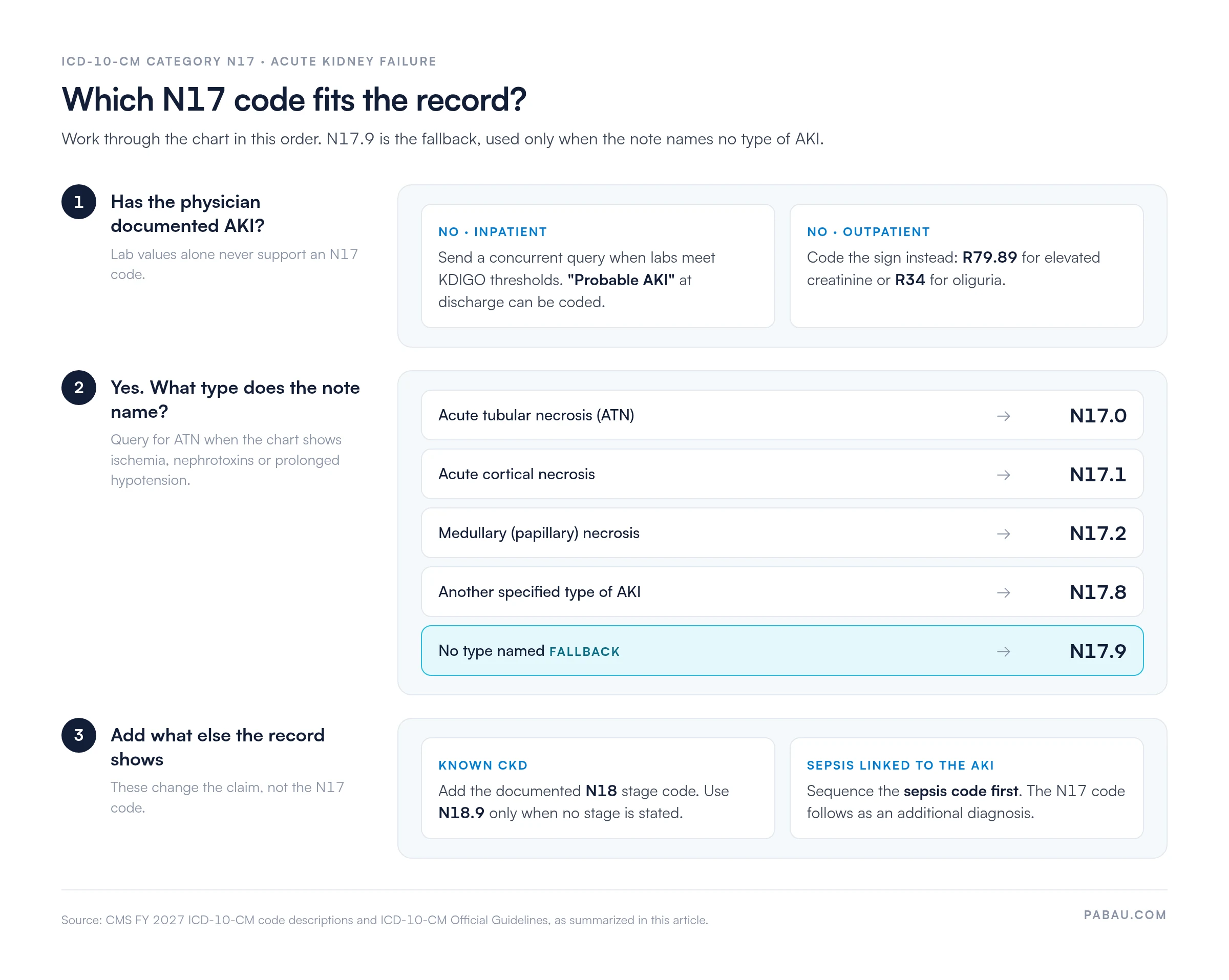
A coder cannot assign N17.9 based on lab values alone. The physician must document the AKI diagnosis in the medical record. The KDIGO criteria tell you whether the clinical picture supports that diagnosis. They also tell you when to query, because the labs point to AKI but the attending has not stated it.
Under the ICD-10-CM Official Guidelines, code assignment rests on the provider’s diagnostic statement, not on the coder’s reading of the clinical criteria. The KDIGO 2012 Clinical Practice Guideline defines AKI as meeting any of the following:
When any of these thresholds appear in the chart without a corresponding AKI diagnosis, CDI teams should initiate a concurrent physician query following AHIMA/ACDIS standards. The query should ask the physician to document whether AKI is present, not lead the physician toward a specific answer.
N17.9 and N18.9 (chronic kidney disease, unspecified) are the most commonly confused codes in the genitourinary block. They describe different conditions. Yet a patient with worsening renal labs can look identical on paper until the timeline is established.
Picture a patient with known CKD who arrives with worsening creatinine. Assigning N18.9 alone skips the question of whether an acute episode sits on top of the chronic baseline. If the physician documents AKI in that context, both codes are correct.
AKI can develop in a patient with pre-existing CKD. The ICD-10-CM Official Guidelines for Coding and Reporting then permit an N17 code and the appropriate N18 stage code together. This is one of the few situations in ICD-10-CM where two codes from the same organ system are intentionally used together.
Missing the N18 code in an acute-on-chronic case understates the patient’s comorbidity burden, which can lead to underpayment or audit flags. Our guide to medical billing fundamentals explains how each diagnosis code feeds into what the payer pays.
The setting where the encounter occurs changes both how N17.9 is sequenced and what level of diagnostic certainty is required before coding it.
The uncertain-diagnosis difference is the most practically significant. An inpatient coder reviewing a discharge summary that says “likely AKI” can assign N17.9. An outpatient coder seeing the same phrase cannot. They code R79.89 (elevated creatinine) or R34 (oliguria) until a confirmed diagnosis is documented.
N17.9 generally qualifies as a complication or comorbidity (CC) when coded as a secondary inpatient diagnosis. Verify the current designation against the CMS MS-DRG Definitions Manual for the active fiscal year, because CC/MCC designations can change with each annual update.
The CC designation matters because MS-DRG reimbursement is calculated in tiers. There is a base DRG without a CC or MCC, a CC variant, and an MCC variant. Suppose the base DRG has a CC split and N17.9 is coded as a secondary diagnosis. N17.9 then moves the case into the higher-weighted CC tier. Strong revenue cycle management depends on capturing secondary diagnoses like N17.9 every time the documentation supports them.
Each quarter, pull discharges where N17.9 is the only secondary diagnosis and no clinical indicator backs it up. Look for a creatinine trend, urine output data or a treatment note. These cases often point to under-documented comorbidities, or to N17.9 coded without enough physician documentation. Both are audit risks.
AKI rarely presents alone. The table below lists codes most frequently reported alongside N17.9, with brief sequencing notes for each. Per the CDC/NCHS ICD-10-CM coding tool, code sequencing follows the Official Guidelines and the etiology-manifestation convention where applicable.
Sepsis-related AKI deserves extra attention because the sequencing rule is counterintuitive. Even when AKI is the more visible clinical problem, the infection code, such as A41.9, leads when the physician documents the two as related. Sepsis with acute organ dysfunction is severe sepsis, so R65.20 follows the infection code and N17.9 comes after it. A pre-submission claim edit that flags N17.9 as the principal diagnosis on a sepsis encounter catches the error before the payer does.
Medicare and most commercial payers do not require prior authorization for the diagnosis itself. They do scrutinize the record for documentation that supports the AKI diagnosis and any related services, such as dialysis, vasopressors or an ICU admission. N17.9 on a claim without supporting clinical indicators in the record is a common audit trigger.
Key payer expectations for N17.9 claims:
Dedicated claims management software lets a billing team build pre-submission edits that flag N17.9 without a supporting clinical indicator. The claim is held for review before it goes out, instead of returning as a denial weeks later. A clean claim for an AKI encounter needs the right sequence and complete supporting documentation.
AKI claims are denied for a narrow set of predictable reasons, and each one has a prevention step.
A quarterly coding audit of N17.9 denials shows which of these five causes is costing you most. Run it through your denial management workflow. Then match each denial against the common denial codes to tell missing documentation from a sequencing error or a payer-specific edit.
AKI coding errors usually start upstream of the claim. The diagnosis sits in a progress note, the history of CKD sits in an older record, and the biller pieces them together under time pressure.
Pabau, the practice management platform we build, keeps the clinical note, the invoice and the claim in the same patient record. US practices send CMS-1500/837P claims through our Claim.MD clearinghouse integration, with eligibility checks before the visit.
Electronic remittances (ERAs) come back into Pabau. A denial for a missing N18 code or a sequencing error then shows up against the encounter that caused it. Your billing team corrects the code where the documentation lives, instead of chasing paper remittances.

Pabau integrates with Claim.MD to handle electronic claim submission, real-time eligibility checks, and ERA processing for US practices. See how it works for your team.

Treat N17.9 as the code you reach last, not first. Query whenever the chart shows ATN indicators. Look for known CKD before you settle on one code, and confirm the sepsis link before you sequence the claim.
Those three checks take minutes per chart. They decide whether the case lands in the right DRG tier the first time or comes back as a denial you have to work twice.
Book a demo to see how Pabau keeps AKI documentation, claims and remittances on one record, so coding errors surface before payers find them.

Need a broader overview of the medical claims process? Medical billing fundamentals explains the claims lifecycle from code assignment to payment posting.
Coding an outpatient visit where AKI is not yet confirmed? ICD-10 code R79.89 covers the abnormal blood chemistry findings you report instead.
Is the chart showing low urine output without a diagnosis? ICD-10 code R34 explains when oliguria is coded on its own.
Struggling with remittance reconciliation after AKI claims? Electronic remittance advice covers how to read ERAs and match payments back to claims.
Want to reduce denials across your diagnostic code submissions? Medical billing compliance outlines the documentation standards payers audit most often.
ICD-10 Code N17.9 is the billable ICD-10-CM diagnosis code for acute kidney failure, unspecified. It is used when a physician documents AKI without naming the type: tubular, cortical or medullary necrosis. It replaced ICD-9-CM code 584.9 and is valid in both inpatient and outpatient settings.
Use N17.9 when the physician documents AKI without specifying a type of necrosis. Use N17.0 for documented acute tubular necrosis (ATN), N17.1 for acute cortical necrosis and N17.2 for medullary necrosis. N17.8 covers another specified type. ATN indicators include ischemia, nephrotoxin exposure and prolonged hypotension. When they appear without a documented ATN diagnosis, send a concurrent query instead of defaulting to N17.9.
Yes, when the physician confirms the AKI diagnosis at the encounter. Outpatient coders cannot apply the inpatient uncertain-diagnosis rule. If the note says “probable AKI” or “suspected AKI”, code R79.89 (elevated creatinine) or R34 (oliguria) instead. Add N17.9 once a confirmed diagnosis appears.
N17.9 codes a sudden-onset kidney injury that is often reversible. N18.9 codes chronic kidney disease of unspecified stage, which is progressive and permanent. An acute creatinine rise from a normal baseline points to N17.9, while a stable, chronically raised creatinine points to N18.9. When both conditions are present, assign both codes.
Yes, in most cases. N17.9 generally counts as a complication or comorbidity (CC) when coded as a secondary inpatient diagnosis, which can raise the DRG weight. Check the CMS MS-DRG files for the active fiscal year, because designations are reviewed annually. CC status does not apply when N17.9 is the principal diagnosis.
Sepsis is sequenced first when both conditions are documented and the physician links them. Code the infection first, then R65.20 for severe sepsis, then N17.9 for the organ dysfunction. The rule comes from the Official Guidelines and holds even when the AKI is the more prominent clinical problem. Confirm the documented link before coding them together.



