ICD-10 code V04.92XD: Skateboarder hit by bus, follow-up
ICD-10 code V04.92XD is for an undeterminable setting ICD-10 code V04.92XD repor...

Last Updated: Oct 6, 2026
ICD-10 Code R34 is the billable ICD-10-CM diagnosis code for anuria and oliguria, or absent and sharply reduced urine output with no definitive diagnosis yet. As a symptom code, it covers the encounter while the cause is still being worked up.
Once the provider documents acute kidney injury (N17.-), chronic kidney disease (N18.-) or unspecified kidney failure (N19), the renal code replaces R34.
That swap comes from the signs and symptoms guideline, because R34 carries no Excludes1 note against N17-N19. Its only Excludes1 notes cover oliguria and anuria that complicate pregnancy, abortion, ectopic or molar pregnancy, or the puerperium.
Most R34 denials trace back to a symptom code left on after a definitive diagnosis, missing output measurements, or sequencing that ignores the setting. Checking those before submission keeps R34 claims clean.

R34 covers both anuria and oliguria as a single billable ICD-10-CM symptom code, valid through FY2027.
Once AKI, CKD or kidney failure (N17-N19) is documented, the renal code replaces R34 under the signs and symptoms guideline, not an Excludes1 note.
R34’s only Excludes1 notes are obstetric, so check pregnancy and postpartum encounters before the code goes on the claim.
Documented urine output measurements with a time period are required to support R34 at audit or appeal.
Pabau’s claims management software maps diagnosis codes to the encounter and holds a claim until required fields, like authorization codes, are complete.
ICD-10 Code R34 is active and billable for fiscal years 2025, 2026, and 2027. The table below gives coders the essential reference data at a glance.
R34 covers two distinct presentations of reduced urine output under a single code. Understanding the clinical thresholds for each matters because documentation must reflect the severity the treating provider observed.
These thresholds are commonly used clinical definitions. Documentation must reflect what the treating provider recorded, including the measurement method (catheter output, timed collection) and the observation window. A note that says “decreased urine output” without a measured value is insufficient to support R34 at payer audit.
R34 sits in the symptoms chapter, and that position explains why it gives way to a definitive diagnosis once a cause is established.
Because R34 lives in the R-code block, it is by definition a residual or interim code. The CMS ICD-10 coding and billing guidance and the CDC/NCHS ICD-10-CM official code tool both support R-codes when no definitive diagnosis has been established. Once a cause is documented, R34 is displaced by the more specific code.
The ICD-10-CM Tabular List gives R34 three Excludes1 notes, and all of them are obstetric. The renal codes that coders most often pair with R34 are governed by a coding guideline instead, which works differently.
Excludes1 means two conditions are never coded together. Every Excludes1 note under R34 points to an obstetric code, which is used on its own instead of R34:
For a pregnant or postpartum patient with reduced urine output, check these notes before R34 goes on the claim. If the provider links the oliguria to the pregnancy or the puerperium, the obstetric code applies and R34 does not.
No Excludes1 note links R34 to N17, N18 or N19 in either direction. The R30-R39 block has no exclusion notes, and the Chapter 18 note is an Excludes2.
N17 excludes only traumatic anuria (T79.5). N18’s Excludes1 notes cover renal failure complicating pregnancy (O00-O07, O08.4), following labor and delivery (O90.41), and postprocedural renal failure (N99.0). None of them names R34, and neither does the N19 list.
The rule comes from the ICD-10-CM Official Guidelines for Coding and Reporting, Section I.B.5. A sign or symptom routinely associated with a disease is not coded separately once that disease is diagnosed. Oliguria is routinely associated with AKI and CKD, so the renal code replaces R34.
Getting the reason right matters at appeal and audit. An appeal that cites an Excludes1 conflict between R34 and N17.9 cites a note that does not exist. R34 stays alongside a renal code only when the provider documents reduced output the renal diagnosis does not explain, per Section I.B.6.
Several urinary and renal codes are frequently mixed up with R34. The comparison below clarifies the decision point for each.
The R33 vs R34 distinction trips up coders most often in catheterized patients. Urinary retention (R33) means the kidneys are producing urine but it cannot drain from the bladder.
Oliguria (R34) means the kidneys are producing less urine than expected. Document the mechanism, not just the symptom label. When the note records retention without a cause, the code is R33.9.
The decision order below puts these checks in sequence, from R34’s obstetric exclusions down to R34 itself.
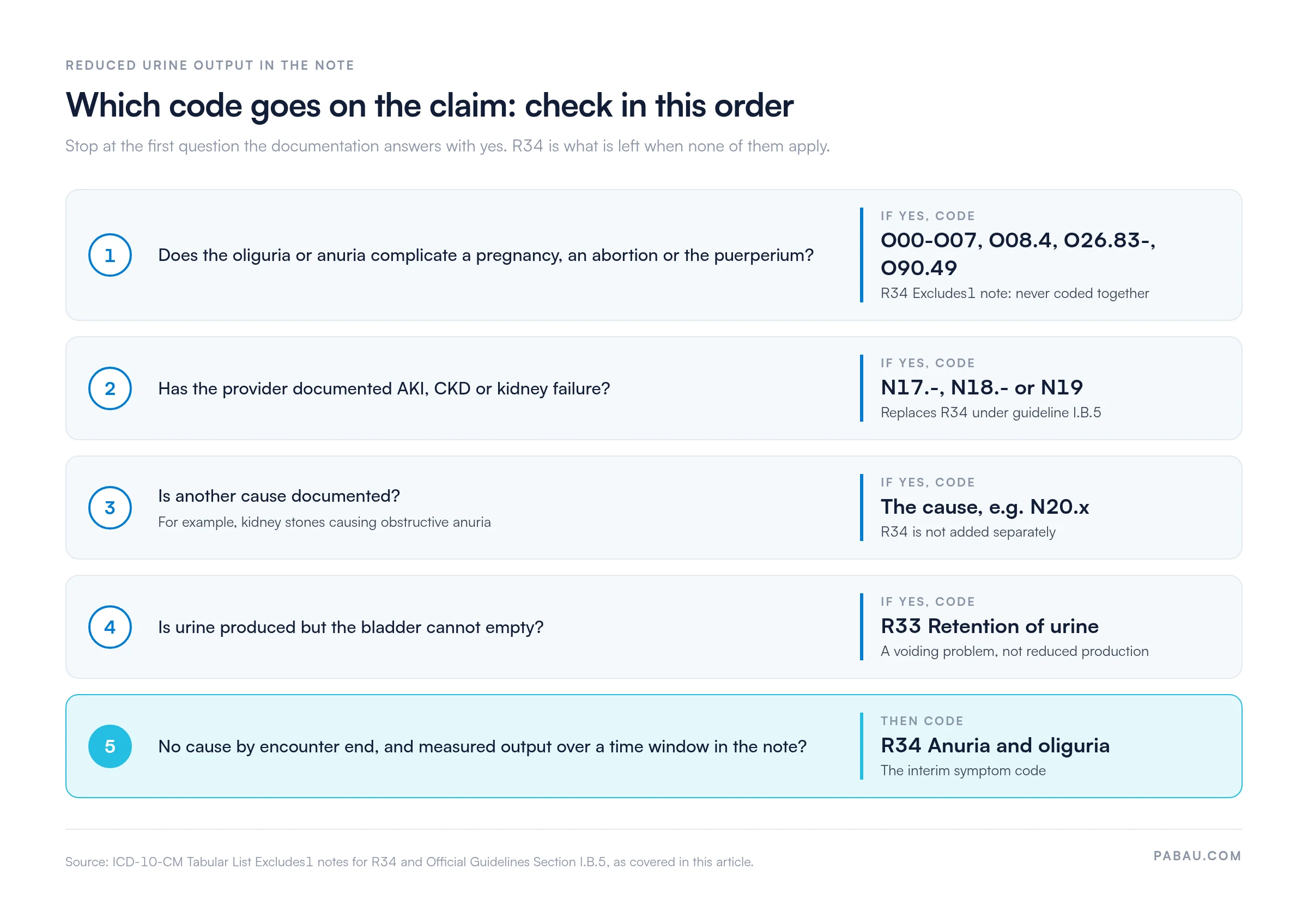
Run a chart check before coding. If the physician note documents a cause for the reduced output, such as obstruction, AKI or CKD, code that diagnosis instead of R34. For a pregnant or postpartum patient, check the obstetric Excludes1 notes first. If the workup is still open at encounter end, R34 is the correct interim code, as long as measured output is in the note.
R34 is a symptom code, which means it depends entirely on what is in the medical record. Payers auditing R34 claims look for three things: a measured value, an observation window, and provider attestation.
Outpatient and inpatient settings follow different documentation rules per CMS and the Uniform Ambulatory Care Data Set (UACDS). In the outpatient setting, code the condition to the highest degree of certainty at the time of the encounter. If R34 is the best-supported code at encounter end, it is appropriate.
Inpatient settings use the principal diagnosis definition from the UHDDS (Uniform Hospital Discharge Data Set). That is the condition established after study to be chiefly responsible for the admission. Good medical billing compliance practices include a pre-submission documentation review for symptom codes like R34.
R34 can be sequenced as the principal or first-listed diagnosis, but the rules differ by setting.
Per the ICD-10-CM Official Guidelines for Coding and Reporting (Section IV, outpatient services), code the condition to the highest degree of certainty for each visit. If anuria or oliguria is the reason for the encounter and no etiology is established by its end, R34 is the first-listed diagnosis.
If a definitive cause is established during the encounter, that cause becomes the first-listed code and R34 is dropped.
In the inpatient setting, R34 is the principal diagnosis when reduced urine output is chiefly responsible for admission. That holds only if no definitive diagnosis is established after study.
Once a definitive diagnosis (AKI, CKD, obstruction) is confirmed and documented, that code becomes the principal diagnosis. R34 stays on as an additional code only when the reduced output is not routinely associated with the principal diagnosis, per guideline I.B.6. Oliguria is integral to AKI and CKD, so this rarely applies to renal admissions.
R34 is an interim code that reflects diagnostic uncertainty, so sequencing it correctly matters as much as selecting it. Each sequencing call feeds the wider medical billing workflow, where the first-listed diagnosis has to support the service billed.
R34 is a symptom code, and symptom codes attract more payer scrutiny than definitive diagnosis codes. Understanding what major payers require before accepting R34 prevents the most common front-end denials.
A real-time eligibility check before submission brings coverage problems and policy mismatches to light while they can still be fixed, instead of after a denial. Clean claim submission for R34 means the code is supported by the documented output measurement, the correct sequencing position, and any required lab co-documentation.
R34 denials cluster around the same root causes across payers. Each has a specific prevention action.
Systematic denial management in healthcare requires tracking R34 denials by denial reason code (CARC). Repeated CO-11 denials on R34 claims, where the diagnosis does not support the service billed, usually trace back to one of the five causes above.
The AAPC ICD-10-CM code lookup and the official CDC/NCHS ICD-10-CM tool can confirm code validity and Excludes notes when a denial is being researched.
Build a two-step pre-submit check for R34. First, if an N17, N18 or N19 code is on the claim, confirm R34 should come off, and check obstetric cases against its Excludes1 notes. Second, confirm the physician note records a measured output value with a time window. Both checks catch errors while a correction still costs nothing.
R34 sits in the R30-R39 block alongside a set of adjacent urinary symptom and renal codes. Knowing the full neighborhood helps coders select the right code and understand when to add a code versus replace R34.
Coders in nephrology, urology and critical care meet R34 most often during initial workup encounters. At that stage, the attending has not yet confirmed the cause of reduced output. If the workup ends with kidney failure of no stated type, the claim moves to N19. Pabau’s ICD-10-CM code references cover many of the other neighboring codes.
On many renal, urology and critical care teams, the clinical note lives in one system and the claim is built in another. Each re-keyed code is a chance for R34 to stay on after the provider has named the renal diagnosis.
Pabau, the all-in-one practice management platform we build, keeps the note and the claim in one patient record. Its claims management software maps the diagnosis codes assigned at the encounter to the outbound claim. Your coders can then review R34 against the note it came from, before submission rather than after a denial.
Before a claim goes out, Pabau checks that required fields such as membership numbers and authorization codes are complete. The Send button stays disabled until they are.
US practices submit through the Claim.MD clearinghouse integration, with real-time eligibility checks and ERA (electronic remittance advice) posting in the same dashboard.

Pabau keeps the encounter note and the claim in one patient record, so coders can check R34 against the documentation before it goes out. Claims then go through the Claim.MD integration with real-time eligibility checks.

ICD-10 Code R34 holds up when the chart shows a measured output, a physician who owns the finding, and no definitive diagnosis yet. Treat it as a placeholder for an open clinical question, and change the claim once the question is answered.
When the provider names AKI, CKD or kidney failure, swap R34 for the renal code and cite the signs and symptoms guideline as the reason. Reserve Excludes1 for the three obstetric cases R34 lists. An appeal built on an exclusion note that does not exist weakens every other point in it.
Those swaps are easiest to catch when the code and the note live in one record. Book a demo to see how Pabau keeps R34 and its replacement codes aligned with the clinical note from encounter to claim.

Want a reference on what a clean claim requires? Clean claim submission outlines the data elements payers check before accepting a claim, applicable to R34 and other symptom-code encounters.
ICD-10 Code R34 is the billable ICD-10-CM diagnosis code for anuria and oliguria. It applies when a patient has absent or sharply reduced urine output and no definitive diagnosis has been established. It is valid through FY2027 and sits in the R30-R39 genitourinary symptom block of Chapter XVIII.
Both conditions fall under a single code, R34. Anuria is near-complete absence of urine output, commonly defined as less than 100 mL per 24 hours. Oliguria is reduced but present output, commonly less than 400 mL per 24 hours in adults. Documentation must reflect the measured volume and time period the treating provider recorded.
Usually not, but the reason is a coding guideline, not an Excludes1 note. R34 has no Excludes1 note for N17. Oliguria is routinely associated with AKI, so Section I.B.5 of the Official Guidelines says to code N17.- alone once AKI is documented. R34 stays only for reduced output the provider attributes to something other than the AKI.
Yes. In the outpatient setting, R34 is listed first when reduced output prompted the visit and no cause is found by its end. In the inpatient setting, R34 is the principal diagnosis when it is chiefly responsible for admission and study establishes no more specific diagnosis. Once a definitive etiology is documented, that code takes the primary position and R34 is dropped.
The ICD-10-CM code for nocturia is R35.1, which sits in the same R30-R39 genitourinary symptom block as R34. Nocturia describes excessive urination at night, a distinct condition from oliguria or anuria, so it should not be coded as R34.
The five most common denial reasons start with missing urine output measurements and coding R34 on an obstetric case covered by its Excludes1 notes. Sequencing R34 as secondary when it should be primary is the third. The other two are keeping R34 after a definitive diagnosis such as AKI is documented, and missing physician attestation of the finding. Each has a specific pre-submission prevention step detailed in the denial section above.