ICD-10 code K85.90: Acute pancreatitis without necrosis
ICD-10 code K85.90: Definition and clinical description ICD-10 code K85.90 is th...

Last Updated: Nov 13, 2026
Billable Code Specific Code
M25.512 is the billable ICD-10-CM code for pain in left shoulder. It covers left shoulder pain when no structural cause has been established.
Coders most often trip on M25.512 when a structural diagnosis already exists. Once rotator cuff pathology, subacromial bursitis or shoulder impingement is documented, a more specific code replaces M25.512. The note also has to name the left side, or the claim needs a query first.
Let Pabau's smart automation suggest the right codes, reduce claim denials, and keep your practice compliant—effortlessly.
Automate repetitive tasks and focus on what matters most—your patients.
Reduce coding errors and ensure compliance with the latest regulations.
Clean claims, fewer denials, and faster reimbursements.
Powerful insights and reporting to help your practice thrive.
HIPAA compliant SOC 2 certified GDPR-compliant Trusted by 4,000+ clinics worldwide

M25.512 (Pain in left shoulder) is a billable ICD-10-CM code for FY2027. Its 6th character sets it apart from right (M25.511) and unspecified (M25.519).
Use M25.512 only for non-specific left shoulder pain. Once rotator cuff, bursitis or impingement is documented, code that diagnosis instead.
The note must name the left side, and the claim must carry all six characters, because the parent code M25.51 is not billable.
Pabau’s claims management software offers ICD-10-CM lookup and checks required claim fields before submission, so the correct code goes on the claim.
ICD-10 code M25.512 is the billable ICD-10-CM code for pain in left shoulder when no structural diagnosis explains the pain. It sits in CMS’s FY 2027 ICD-10-CM code files, which apply from October 1, 2026, through September 30, 2027.
The table below gives coders the core facts at a glance.
M25.512 covers non-specific left shoulder pain where no structural cause has been identified or documented. It applies when the record shows pain localized to the left shoulder without an established etiology. Typical missing causes are a rotator cuff tear, bursitis or inflammatory arthritis.
Anatomically, the code takes in the glenohumeral joint region, the acromioclavicular joint area and the pericapsular soft tissue of the left shoulder. The deciding factor is the absence of a structural diagnosis. Use it when the clinician documents pain as the primary complaint and workup is pending or inconclusive.
Common clinical scenarios where M25.512 is correct include:
A symptom code is not reported when a definitive diagnosis explains it. ICD-10-CM Official Guideline I.B.5 says signs and symptoms routinely associated with a disease process are not assigned as additional codes. So once a shoulder condition is documented, its own code takes the claim.
In practice, once imaging, examination or specialist assessment confirms a structural diagnosis, the clinician documents it and the coder switches codes. Continuing to submit M25.512 after that is a documentation-coding mismatch that auditors look for.
M25.512 is a 6-character code at the most specific level of its hierarchy. Each level above it is non-billable, and the rest of the family sits in our full ICD-10-CM code library.
Submitting the parent code M25.51 instead of M25.512 is a common reason for left shoulder claim rejection. Per CMS ICD-10-CM coding requirements, the highest level of specificity available must be reported. Because M25.512 exists, M25.51 is never acceptable on a claim.
The three laterality variants under M25.51 each serve a distinct purpose. Defaulting to unspecified when the clinical note documents a side is the error auditors flag most often here. Knee pain follows the same pattern, so a note that names the left knee takes ICD-10 M25.562.
Per the CDC/NCHS ICD-10-CM official guidelines, coders must use the most specific code the documentation supports. If the note says “left shoulder,” M25.519 is incorrect even though it is technically billable. Payer audits can flag M25.519 when the visit or therapy note contains laterality language.
M25.512 is a symptom code. When a specific structural diagnosis exists, a different code path applies. This table covers the most common decision points.
Here’s how that plays out over two visits. A patient reports three weeks of left shoulder pain, and the exam is inconclusive, so the first claim carries M25.512. An MRI later confirms an incomplete rotator cuff tear, so the follow-up claim switches to M75.112.
The chart below puts both questions on one page: is there a diagnosis, and if not, which side does the note name?
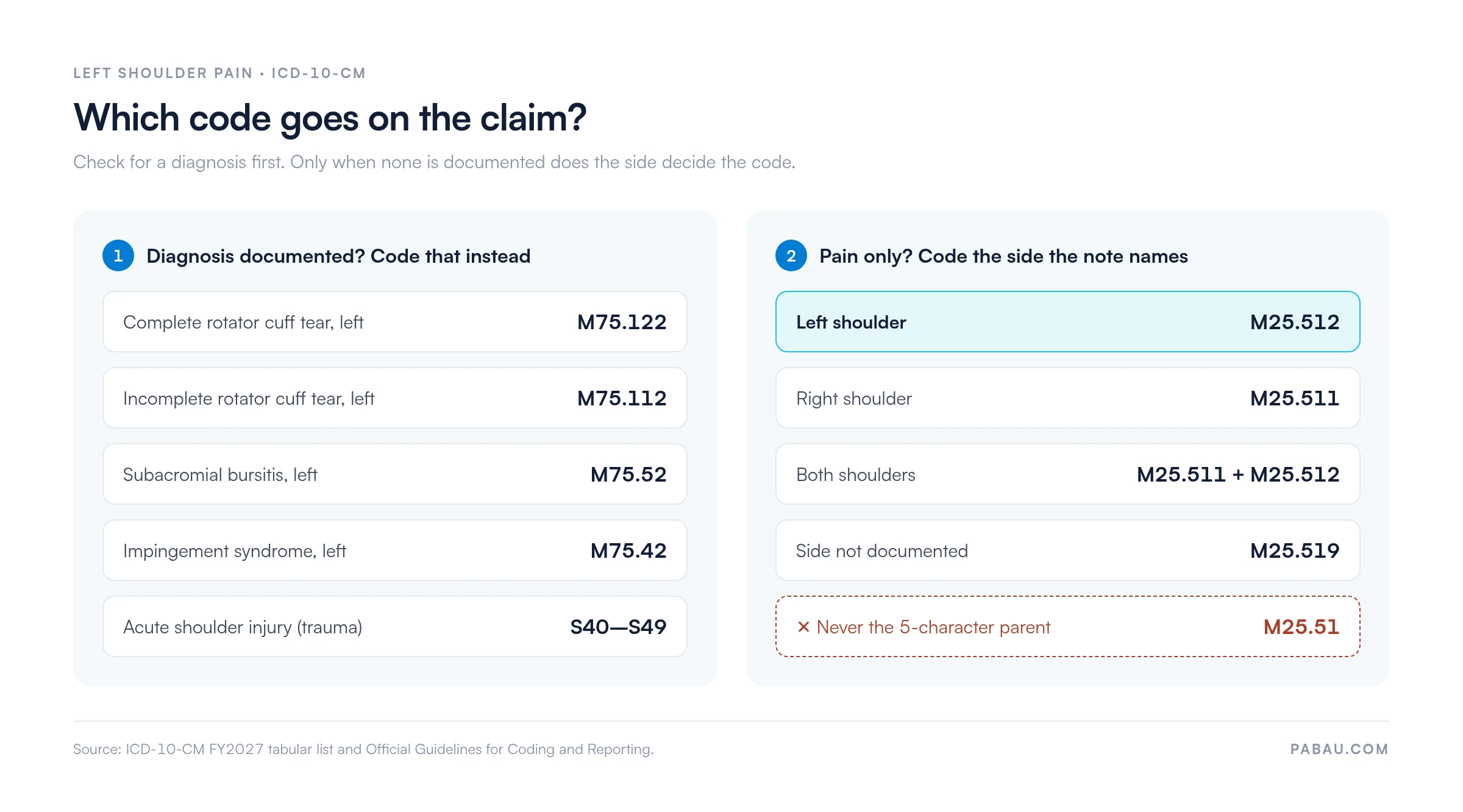
A claim supported by M25.512 is only as defensible as the note behind it. Payer auditors look for four elements before they accept the code as appropriately assigned.
Run a laterality audit on your shoulder pain claims monthly. Pull all M25.519 submissions and cross-reference them against the clinical notes. Any note that names ‘left’ or ‘right’ but was coded to unspecified is a correctable billing error.
Physical therapists are among the most frequent users of M25.512. When a physician refers a patient for left shoulder pain without a specific musculoskeletal diagnosis, M25.512 is usually the right code for the PT claim. That holds as long as the PT’s own documentation doesn’t identify a structural cause either.
The table below shows the CPT codes most commonly paired with M25.512 on physical therapy and outpatient claims.
Exercise and manual therapy are the two PT services you’ll pair with M25.512 most. Our guides to 97110 and 97140 cover how each one is billed.
For Medicare Part B PT claims, the plan of care must link M25.512 to the functional limitations being treated. A diagnosis code without a functional goal is a common reason Medicare contractors request records. The AAPC ICD-10-CM code range browser helps you check neighboring codes before you settle on one.
Medicare accepts M25.512 for reimbursement when medical necessity is documented. The code itself doesn’t trigger prior authorization.
Coverage for some paired services can still depend on your MAC’s Local Coverage Determination (LCD) or the payer’s own rules. Imaging, joint injections and longer PT episodes are the usual examples. Check both before you submit.
Five denial patterns come up again and again on M25.512 claims:
Pabau integrates with Claim.MD, so US practices can submit claims, run eligibility checks and receive remittances without leaving the patient record. Its ICD-10-CM lookup library and required-field validation help the coder pick a full code and send a complete claim.
Practices with high volumes of musculoskeletal claims also benefit from a denial management in healthcare workflow that tracks these patterns by code and provider.
Most of the denials above are visible on the claim before you submit it. Five questions take under a minute:
CMS and the National Center for Health Statistics (NCHS) publish the ICD-10-CM Official Guidelines for Coding and Reporting. They require the highest level of specificity documented. For M25.512, that means laterality is required whenever the clinical note specifies a side.
ICD-9-CM had no laterality for shoulder pain. The closest ICD-9-CM predecessor to M25.512 was 719.41 (Pain in joint, shoulder region), which did not specify left or right. The move to ICD-10-CM in October 2015 brought laterality into shoulder pain coding.
For legacy system conversions or retrospective record reviews, treat CMS’s General Equivalence Mappings (GEMs) as a starting point only. 719.41 maps approximately to M25.519, which has no laterality. Where the note documents a side, M25.511 or M25.512 applies instead.
Most M25.512 errors start at code entry. A coder types “shoulder pain” into a free-text field, picks the first match, and the parent code or the wrong side lands on the claim.
Pabau’s claims management software gives your team ICD-10-CM and CPT lookup libraries, so codes come from the code set itself. Claims pre-fill from the patient record, and required fields are validated before you press Send. US practices then submit claims, check eligibility and receive remittances through Claim.MD.
The goal is a clean claim submission on the first pass. That matters most for PT and orthopedic practices billing M25.512 across several providers.
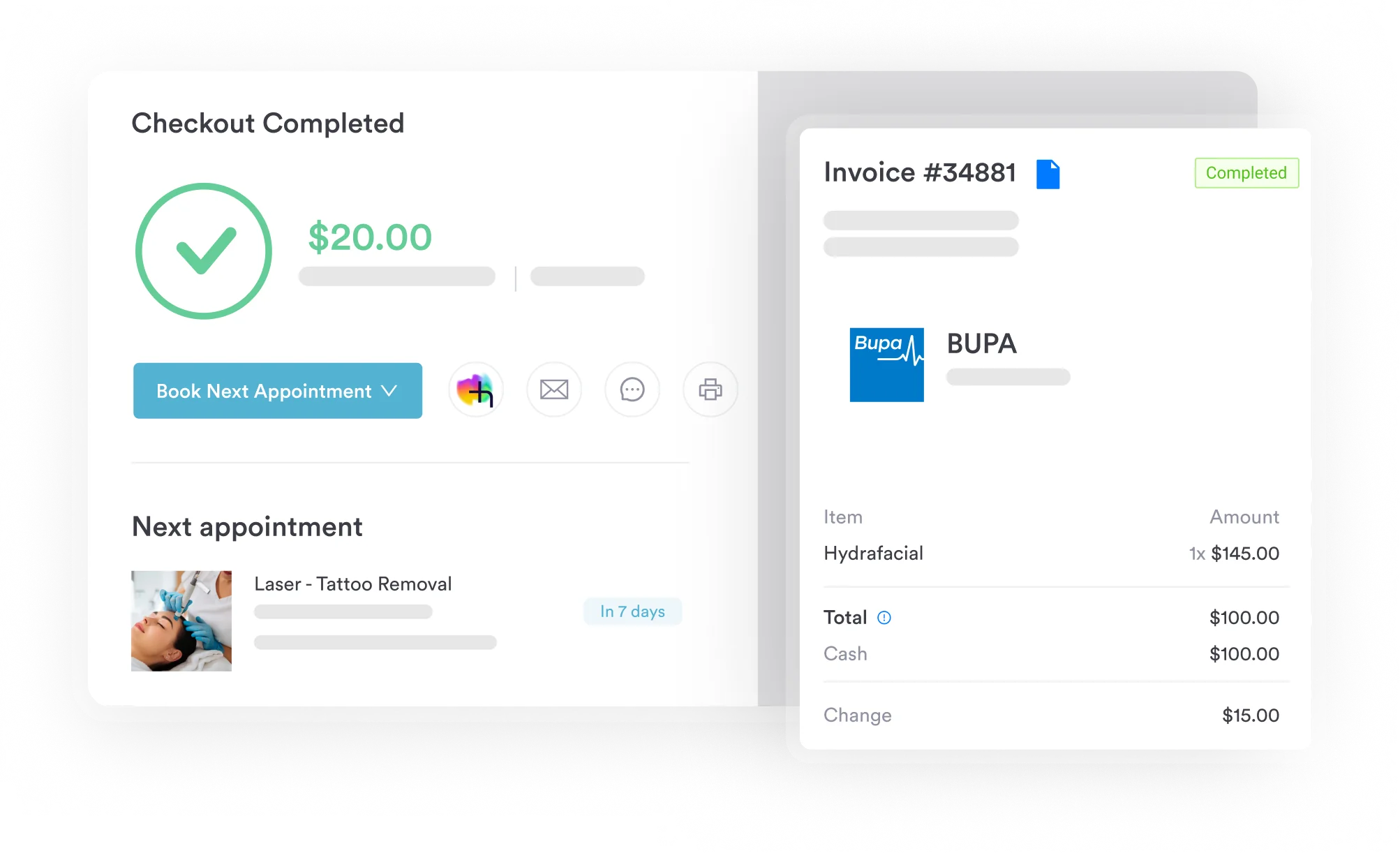

Pabau’s ICD-10-CM lookup and required-field checks, plus Claim.MD submission, help your team send complete claims.

Treat M25.512 as a holding code. It’s right while the cause of left shoulder pain is still open. From the visit where a diagnosis lands in the note, it’s wrong. Build that switch into your review habit, and most laterality and parent-code errors go with it.
Software can’t make that clinical call for you, but it can take the typing errors out of the claim. Pabau pairs code lookup with Claim.MD submission, eligibility checks and remittances, so your medical billing workflow runs from one record.
Book a demo to see how PT and orthopedic practices send M25.512 claims from the visit note.

Billing a shoulder injection alongside M25.512? CPT code 20610 covers arthrocentesis billing, modifiers and Medicare rates for major joints.
Seeing repeat denials across your billing claims? Denial management in healthcare covers the workflow strategies that reduce rework and accelerate reimbursement.
Coding the follow-up visit for left shoulder pain? CPT code 99213 explains the established patient office visit and its documentation.
Adding functional training to a shoulder plan of care? CPT code 97530 walks through therapeutic activities billing.
No. M25.512 is complete at six characters and takes no 7th character. Shoulder injury codes in S40-S49 do need one, such as A for an initial encounter.
Yes, in outpatient settings, when pain is the reason for the visit and no definitive diagnosis has been established. Section IV of the official guidelines accepts symptom codes in that case.
Use M25.612, Stiffness of left shoulder, not elsewhere classified. You can report it with M25.512 when the provider documents pain and stiffness as separate findings.
Add G89.29, Other chronic pain, when the provider documents the pain as chronic. Guideline I.C.6.b allows a G89 code with a site-specific pain code when it adds detail. Sequence G89.29 first only when the encounter is for pain control.
No. M25.512 covers the shoulder region only. Pain in the left upper arm is M79.622, one of the limb pain codes listed in the Excludes2 note at M25.5.