ICD-10 code E55.9: Vitamin D deficiency, unspecified
ICD-10 code E55.9: Definition and official descriptor ICD-10 code E55.9 is the I...

Last Updated: Nov 10, 2026
Billable Code Specific Code
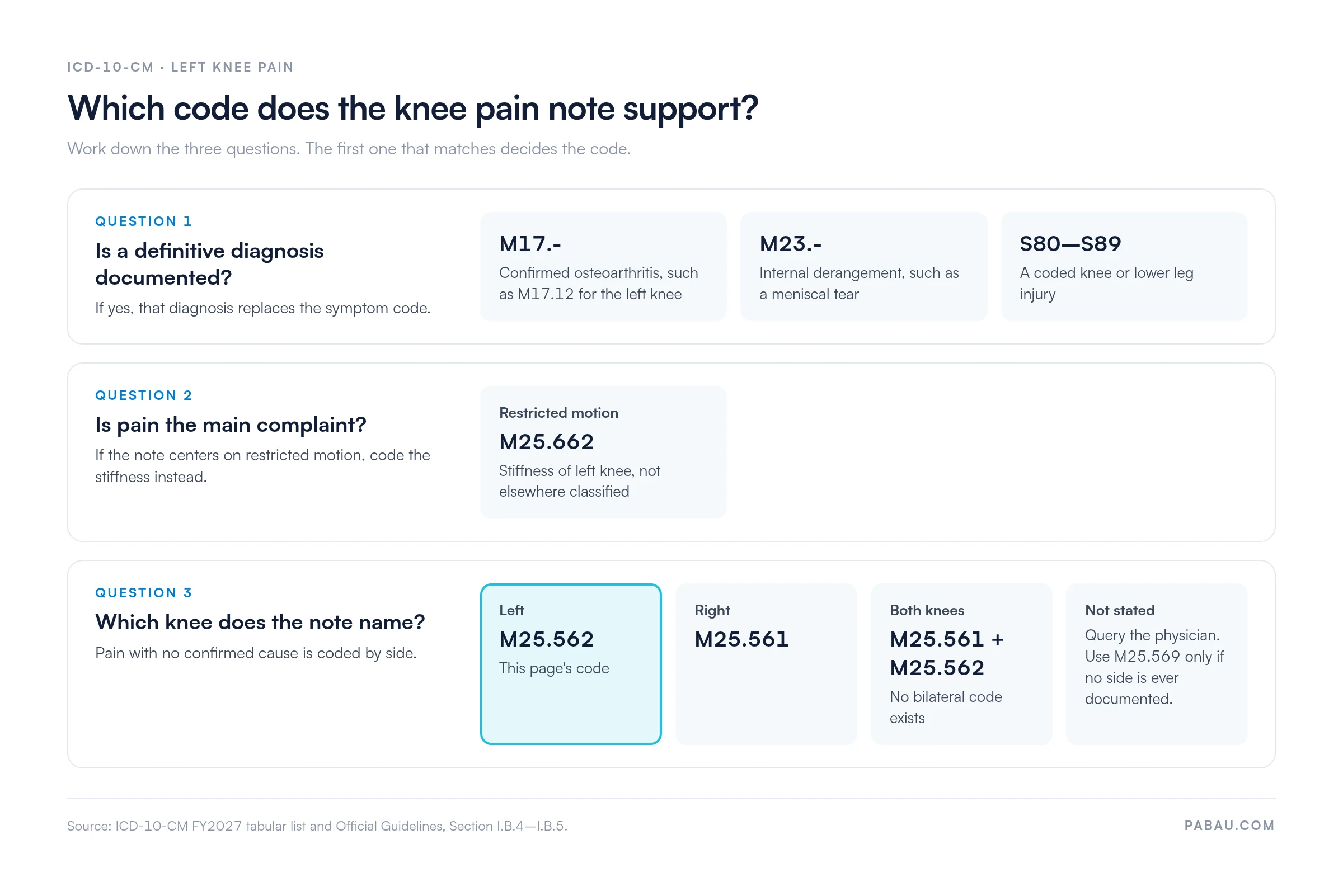
M25.562 is the billable ICD-10-CM code for pain in left knee. It applies when the note documents left-sided knee pain and no definitive cause, such as osteoarthritis, has been confirmed.
Laterality is a frequent cause of denials. Reaching for M25.569 (unspecified knee) when the note clearly states "left" invites a payer edit. Pain in both knees takes M25.561 and M25.562 together.
Let Pabau's smart automation suggest the right codes, reduce claim denials, and keep your practice compliant—effortlessly.
Automate repetitive tasks and focus on what matters most—your patients.
Reduce coding errors and ensure compliance with the latest regulations.
Clean claims, fewer denials, and faster reimbursements.
Powerful insights and reporting to help your practice thrive.
HIPAA compliant SOC 2 certified GDPR-compliant Trusted by 4,000+ clinics worldwide

M25.562 is a billable ICD-10-CM code for left knee pain, distinct from M25.561 (right) and M25.569 (unspecified).
Use M25.562 only when the note documents left-sided knee pain and no definitive diagnosis, such as osteoarthritis (M17.12), has been established.
There is no bilateral knee pain code, so pain in both knees is reported with M25.561 and M25.562 together.
Unspecified laterality is a frequent denial trigger, where M25.569 is coded although the record supports M25.562.
Pabau, the practice management platform we build, submits 837P claims through Claim.MD, with eligibility checks and ERA remittances in the same workflow.
ICD-10 code M25.562 is a valid, billable ICD-10-CM code for pain in the left knee joint. It sits in the M25.56 subcategory (pain in knee) under Chapter 13, Diseases of the Musculoskeletal System and Connective Tissue (M00-M99). Use it for pain at the knee joint itself, documented as left-sided, when no more specific diagnosis has been confirmed. Left leg pain outside the joint belongs to other codes.
M25.562 covers pain arising from the left knee joint when the clinician has not established a definitive underlying diagnosis. ICD-10-CM Official Guidelines (Section I.B.4-I.B.5) direct coders to report the confirmed diagnosis instead of a symptom code once it is documented.
Appropriate uses: M25.562 fits left-sided knee pain with no confirmed cause. Typical settings are an initial evaluation, a physical therapy plan of care with an unresolved referring diagnosis, and an orthopedic visit before imaging results return.
Definitive diagnoses that replace it: Under the Official Guidelines, each of these takes the place of M25.562 once it is confirmed:
Excludes2 notes sit at the M25 category level. They mean the listed condition is not part of M25, but both codes can be reported when both conditions exist. The list includes abnormality of gait and mobility (R26.-) and acquired deformities of limb (M20-M21). Check the current-year tabular for the full wording, because the code set is updated every year. The CDC/NCHS ICD-10-CM web tool is the authoritative free lookup for exclude notes and code hierarchy.
ICD-10-CM requires the most specific code available. When a note documents a specific side, reporting the unspecified code (M25.569) is a coding error. The three laterality variants under M25.56 are:
A frequent laterality error: A coder defaults to M25.569 because the EHR template auto-populates “unspecified” instead of prompting for a side. If the physician’s note says “left knee pain,” the coder overrides the template and assigns M25.562. Knee X-ray codes such as CPT 73562 carry no side of their own. The side is reported with the LT or RT modifier, and it must match M25.562 (left), or the claim can hit a payer edit.
The physician’s note must give a coder enough to confirm independently that M25.562 is the most accurate code. In practice, that means four elements.
Query the physician when laterality is missing from the note, instead of defaulting to M25.569. A brief addendum confirming “left knee” resolves the question and protects the claim. Our guide to medical billing fundamentals follows the same path a diagnosis takes from the note to a paid claim.
Run a laterality audit every quarter. Pull every M25.569 claim submitted in the past 90 days and check it against the encounter note. Claims where the note documents a specific side but the code is unspecified mean rework and lost reimbursement. Correcting those submissions retroactively can recover revenue on denied claims still within the payer’s timely filing window.
M25.562 is a symptom code. Several more specific codes displace it once a diagnosis is confirmed. The table below covers the codes coders most frequently consider alongside ICD-10 code M25.562.
The choice between M25.562 and M17.12 carries the most weight. Osteoarthritis of the left knee has LCDs that govern which procedures CMS covers. Coding M25.562 when OA is documented shifts the medical necessity burden. It can also trigger a denial on procedures the payer would approve under the OA diagnosis.
The three questions below put these choices in order, from a confirmed diagnosis down to the side the note names.
M25.562 is a diagnosis code, not a procedure code. Claims pair it with the appropriate CPT procedure code. The table below lists the most frequently combined pairings by clinical setting, along with payer scrutiny notes.
Pairing M25.562 with CPT 20610 for a knee injection needs particular care. Many Medicare LCDs for knee injections (hyaluronic acid, corticosteroid) require a confirmed diagnosis such as osteoarthritis rather than a symptom code. Submitting M25.562 with an injection CPT may result in a medical necessity denial. Confirm the applicable LCD before billing the combination. The AAPC Codify ICD-10-CM lookup lists crosswalk relationships between diagnosis and procedure codes that help flag these pairing risks.
CMS requires medical necessity documentation for every service billed to Medicare, regardless of the diagnosis code. For M25.562 specifically, coverage depends entirely on the paired procedure, not the diagnosis code alone.
M25.562 denials tend to follow four recurring patterns, and each has a correctable root cause. The claim adjustment reason code on the remittance usually shows which one you are dealing with. Our reference on denial codes explains what each one means.
Track the denial reason codes (CARCs) on M25.562 claims each quarter, and route recurring patterns back to the clinical team. That feedback loop sits at the center of most denial management strategies. A clean claim submission check confirms laterality, the diagnosis-procedure pairing and medical necessity documentation before the 837P file goes out.
Three clinical settings use M25.562 regularly, each with distinct documentation and LCD considerations.
M25.562 can serve as the primary diagnosis on a physical therapy claim when the referring clinician has not established a definitive diagnosis. Medicare’s therapy LCDs expect the plan of care to include functional outcome measures, such as a LEFS score. They also expect a treatment goal tied to the left knee complaint and progress notes at defined intervals. An approvable PT claim rests on that functional record more than on the diagnosis code. When outcome scores live in the same record as the claim, the audit trail is ready before a payer asks for it.
Orthopedic offices use M25.562 most often at the first evaluation visit, before imaging results are available. Once X-ray or MRI confirms a diagnosis, the specific code replaces M25.562 at later encounters. In sports medicine and orthopedic care, a symptom code that persists past the initial workup is a common audit trigger. Document the reason whenever M25.562 stays on the claim.
Primary care physicians often code M25.562 when managing left knee pain conservatively before an orthopedic referral. The referral documentation should carry the same M25.562 code (or the confirmed diagnosis if established) so the receiving specialist’s claim reflects continuity of care. Inconsistency between the referring diagnosis and the specialist’s claim can trigger a coordination-of-benefits review.
Orthopedic practices can build a 30-day diagnostic review rule into the EHR. If M25.562 appears on a patient’s record for more than 30 days without a diagnosis upgrade, flag the encounter for coder review. This prevents the symptom code from persisting on claims after imaging has established a confirmable condition.
M25.562 is valid and unchanged for FY2027. The code, its descriptor, and its chapter placement have remained stable across multiple fiscal year update cycles. No revisions to the code’s Excludes notes or laterality convention were published for the FY2027 release (effective October 1, 2026).
Confirm current-year validity using the CMS ICD-10 codes page, which publishes the official FY update files each spring ahead of the October effective date. The WHO ICD-10 browser provides the international classification reference for context on where the M25 category sits within the global disease taxonomy.
In many practices, the knee note lives in one system and the claim gets built in another. A coder re-reads the note, picks a laterality code and keys it into a separate billing tool. Every hand-off is another chance for “left” to turn into “unspecified.”
Pabau keeps the treatment note and the claim in the same patient record. Its claims management software sends CMS-1500/837P claims through the Claim.MD clearinghouse. Eligibility checks, ERA remittances and secondary claims run from the same workflow.
The coder works from the signed note, and the remittance comes back to the same record. When a denial does arrive, the claim, the note and the payer’s reason code are in one place for whoever works the correction.

Pabau keeps the knee note and the claim in the same patient record. Claims go out as 837P files through Claim.MD, with eligibility checks, ERA remittances and secondary claims in the same workflow.

M25.562 is a simple code with one recurring failure point, and that point is laterality. Check the note for the word “left” before accepting an auto-populated unspecified code. Then confirm that no definitive diagnosis has taken the symptom code’s place.
The quickest win is an audit of last quarter’s M25.569 claims against their notes. Each one with a documented side is a correction you can still resubmit inside the timely filing window. Keep the trade-off in mind too. M25.562 keeps a workup moving, but it rarely supports an injection or an arthroscopy on its own.
To see the knee note, the code and the 837P claim handled in one Pabau record, book a demo with our team.

Need a step-by-step overview of the medical billing process? Medical billing fundamentals covers the full revenue cycle from code assignment through payment posting.
Looking to reduce claim rejections across your practice? Denial management in healthcare explains how to track, appeal, and prevent recurring rejections by denial code category.
Want to understand what a clean claim looks like? Clean claim submission breaks down the required fields, common errors, and pre-submission validation steps that keep claims out of the denied queue.
Coding the other knee? ICD-10 code M25.561 covers right knee pain, with the same documentation and laterality rules.
Billing the knee X-ray that goes with it? CPT code 73562 covers billing for the three-view knee X-ray that often pairs with M25.562.
ICD-10 code M25.562 is the billable ICD-10-CM diagnosis code for pain in the left knee. It is assigned when the physician documents left-sided knee pain without a confirmed cause, such as osteoarthritis or internal derangement. It sits under the M25.56 subcategory (pain in knee) in Chapter 13 of ICD-10-CM.
Yes, M25.562 is a billable ICD-10-CM code. Its parent code, M25.56 (pain in knee), is not billable on its own. M25.562 adds the laterality that makes the code reportable on a claim for FY2027.
M25.561 is pain in the right knee, M25.562 is pain in the left knee, and M25.569 is pain in an unspecified knee. ICD-10-CM guidelines require the most specific code available. If the note documents a side, use M25.561 or M25.562. For pain in both knees, report M25.561 and M25.562 together.
Use M25.562 when no definitive diagnosis has been established. If the physician has confirmed osteoarthritis of the left knee, the correct code is M17.12 (unilateral primary osteoarthritis, left knee). The symptom code is not reported once a related definitive diagnosis is established (ICD-10-CM Guidelines Section I.B.4-I.B.5).
Yes, M25.562 can be the primary diagnosis on a physical therapy claim when no definitive diagnosis has been established. Medicare therapy LCDs require a plan of care, a functional baseline and progress documentation alongside the diagnosis code. Without that documentation, the claim may be denied on medical necessity grounds whichever code is used.
Yes, M25.562 is valid for FY2027 with an effective date of October 1, 2026. The code, its descriptor, and its laterality convention are unchanged from prior fiscal years. Confirm current validity via the CMS ICD-10 codes page, which publishes the annual update files each spring.