

ICD-10 Code R63.4: Abnormal weight loss
ICD-10 code R63.4: Definition, billability and code structure ICD-10 code R63.4 ...

Last Updated: Nov 13, 2026
Billable Code Specific Code
M25.519 is the billable ICD-10-CM code for pain in unspecified shoulder. It applies when shoulder pain is documented but no source in the record names the right or left side.
Most denials tied to this code come from one avoidable mistake. The clinical note names a side, but the claim still carries M25.519 instead of M25.511 or M25.512. Checking laterality before submission prevents the most common rejection pattern for shoulder pain claims.
Let Pabau's smart automation suggest the right codes, reduce claim denials, and keep your practice compliant—effortlessly.
Automate repetitive tasks and focus on what matters most—your patients.
Reduce coding errors and ensure compliance with the latest regulations.
Clean claims, fewer denials, and faster reimbursements.
Powerful insights and reporting to help your practice thrive.
HIPAA compliant SOC 2 certified GDPR-compliant Trusted by 4,000+ clinics worldwide

M25.519 is a valid, billable FY2027 ICD-10-CM code for shoulder pain when no side is documented or known.
Use M25.511 (right shoulder) or M25.512 (left shoulder) whenever the note names a side, because M25.519 never applies once laterality appears in the chart.
Payers audit unspecified codes heavily, so the clinical note should say why the side is unknown instead of leaving it out.
Pabau’s claims management software sends claims through the Claim.MD clearinghouse and warns when a case is missing its prior authorization.
ICD-10 Code M25.519 is the billable diagnosis code for pain in an unspecified shoulder, used when the clinical documentation doesn’t identify which side hurts.
The code entered ICD-10-CM on October 1, 2015, and has stayed valid through every update since, including FY2027 (October 1, 2026 – September 30, 2027). Per the CMS ICD-10 codes page, it may appear as the principal or secondary diagnosis on a claim.
The CDC’s ICD-10-CM web tool confirms M25.519 as an active code with no pending deletion or revision notices for FY2027. Coders can use this tool to verify current validity before submitting any claim that relies on an unspecified laterality code. Neighboring musculoskeletal codes are indexed in our ICD-10-CM code reference.
M25.519 covers atraumatic joint pain localized to the shoulder girdle when the clinical documentation does not identify which shoulder is involved. The code is appropriate for the shoulder joint itself and surrounding soft tissue pain that cannot be attributed to a named structural condition.
The ICD-10-CM tabular list carries Excludes notes that restrict M25.519’s scope. Understanding these prevents the most common upcoding and downcoding errors.
When the physician’s note documents rotator cuff involvement, adhesive capsulitis, or another named M75 condition, M25.519 is the wrong code. That holds even if the word “pain” appears in the note. The M75 block takes precedence because it provides greater clinical specificity.
The M25.51x subcategory assigns a distinct code to each side: M25.511 for the right shoulder, M25.512 for the left, and M25.519 for unspecified.
The ICD-10-CM Official Guidelines for Coding and Reporting require coding to the highest degree of specificity the documentation supports. So M25.519 fits only when no source names the shoulder, including the physician note, imaging request, and operative report.
Bilateral shoulder pain has no single ICD-10-CM code. When both shoulders are affected and the note documents bilateral involvement, report M25.511 and M25.512 together on the claim. Using M25.519 alone for bilateral presentations is incorrect and may trigger a payer query. Bilateral does not mean unspecified, and coder forums field this question often.
Decision rule: Before submitting M25.519, search the full encounter note, imaging order, and any referral letter. Look for “right,” “left,” “bilateral,” or any other laterality marker. Only use M25.519 if none appears and the provider, when queried, cannot confirm a side. The path below puts both checks in the order a coder runs them.
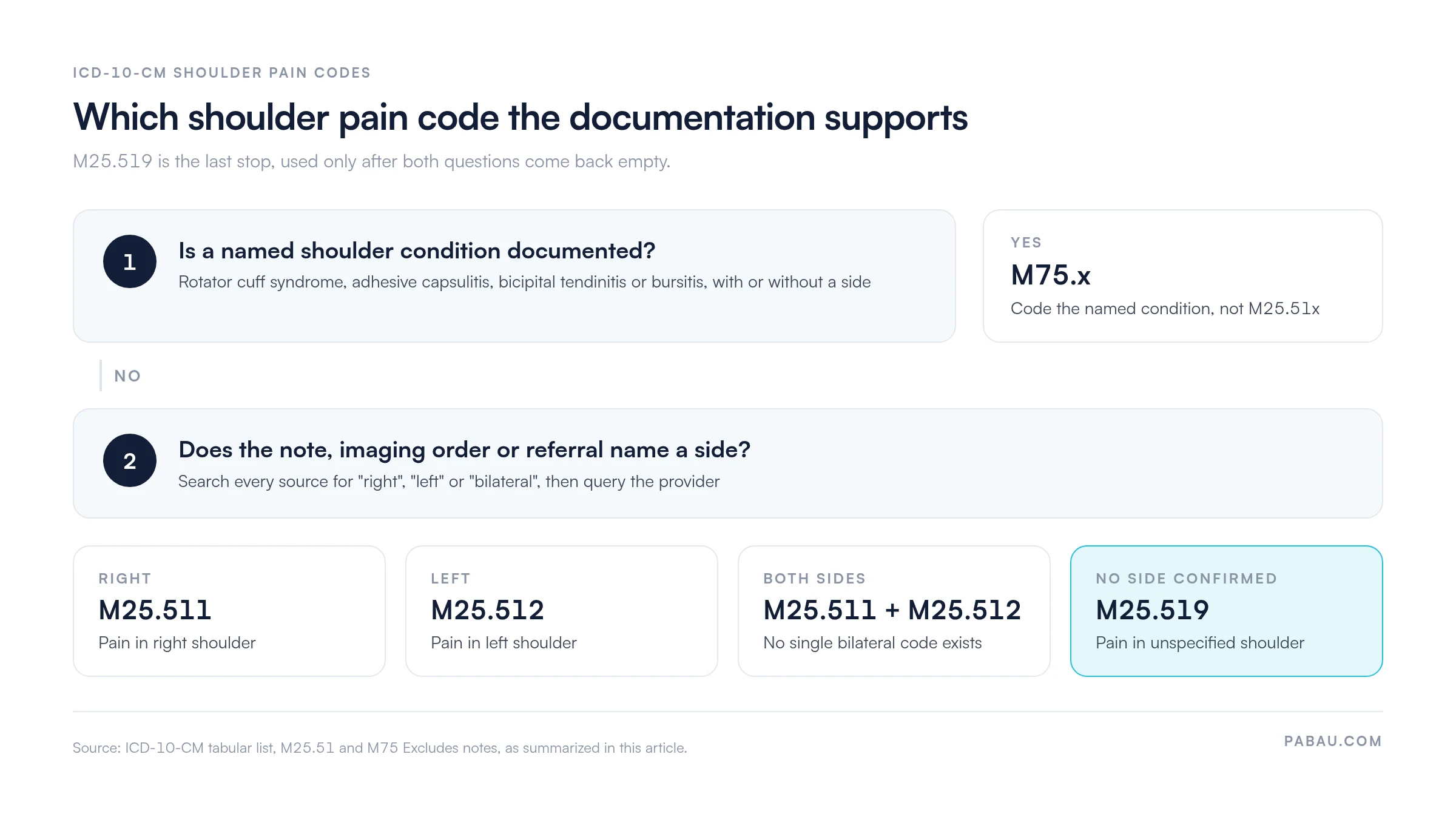
M25.519 is a valid landing point for a narrow set of clinical presentations. Knowing which scenarios support the code helps coders avoid two errors. One is under-coding, using M25.519 when a specific code exists. The other is over-coding, reaching for M75.x without a documented named diagnosis.
Sports medicine and musculoskeletal practices see these presentations often during early workups.
M25.519 is not appropriate when rotator cuff pathology, adhesive capsulitis, bicipital tendinitis, or shoulder impingement is documented anywhere in the chart. That holds even without laterality, because those conditions belong to the M75 block.
Payers audit unspecified codes more heavily than laterality-specific codes because “unspecified” can conceal under-documented encounters.
A compliant SOAP note supporting M25.519 must affirmatively establish why the shoulder cannot be identified, not simply omit a laterality reference. Understanding what accurate medical billing requires at the documentation level is the foundation for avoiding audits.
The clinical note must include all of the following to satisfy payer medical necessity requirements:
CMS and Medicare Administrative Contractors (MACs) publish Local Coverage Determinations (LCDs) for shoulder pain diagnoses that set minimum documentation thresholds for covered procedures. These LCDs vary by jurisdiction.
A note that satisfies Novitas Solutions may not satisfy CGS Medicare. Coders should verify the applicable MAC LCD before submitting claims with M25.519 attached to advanced imaging or injection procedures.
Every ICD-10 diagnosis code on a claim pairs with one or more CPT procedure codes. For shoulder pain diagnoses, the CPT selection drives prior authorization requirements and coverage determination.
Physical therapy and musculoskeletal practices see this pairing often. The CMS Physician Fee Schedule lookup confirms reimbursement amounts and payment rules for each CPT-ICD pairing.
When M25.519 appears on the claim, many commercial payers require a documented trial of conservative therapy before authorizing MRI or corticosteroid injection. That means physical therapy, NSAIDs, or activity modification.
Submitting 73221 or 20610 without evidence of a prior conservative trial is a leading cause of non-covered claim decisions for unspecified shoulder pain.
M25.519 cannot supply the side a 64418 claim needs, because the suprascapular nerve block note must state left, right or bilateral. When the note does name a side, M25.511 or M25.512 belongs on that injection claim instead.
Unspecified codes attract heightened payer scrutiny because they signal incomplete documentation. Medicare Administrative Contractors publish LCDs that govern which procedures are covered when M25.519 appears as the supporting diagnosis.
Commercial payers often apply stricter standards than Medicare for unspecified shoulder pain, particularly for imaging and injections. Effective denial management for shoulder pain claims starts with understanding those payer-specific thresholds before submission.
The most common denial triggers for M25.519 claims, and how to address each:
Submitting a clean claim means verifying laterality, confirming code-to-procedure clinical logic, and attaching sufficient documentation before the claim leaves the practice. Post-submission corrections cost significantly more time than pre-submission checks.
Before submitting any claim with M25.519, run a three-point check. (1) Confirm no laterality word appears in the encounter note, imaging order, or referral. (2) Confirm no M75.x condition is documented. (3) Confirm the CPT procedure attached has documented clinical justification. Claims that fail any of these three checks should be held for physician query before submission.
ICD-9-CM was retired by US payers on October 1, 2015. The crosswalk below is provided for legacy audit purposes, historical record review, and research contexts only. No active US payer accepts ICD-9-CM codes on current claims.
The CrossCoder bidirectional crosswalk tool and the AAPC ICD-10-CM lookup both confirm 719.41 as the standard GEM (General Equivalence Mapping) translation for M25.519. Notably, ICD-9-CM code 719.41 mapped to all three laterality variants of M25.51x because ICD-9 did not distinguish right from left for shoulder joint pain.
This one-to-many expansion is why some legacy billing systems flag M25.519 as an ambiguous match when converting historical records.
Most M25.519 errors happen when a coder picks the code from an EHR dropdown without reviewing laterality across the full encounter. Building that check into the clinical workflow catches the error before it reaches a claim, instead of leaving it to a separate manual review.
Any practice submitting musculoskeletal claims benefits from keeping code selection and claim validation in one workflow. Splitting them between standalone coding software and a separate billing platform adds a handoff where the side can drop off.
Many practices write the note in one system and build the claim in another. The diagnosis gets re-keyed on the way, and a side recorded in the chart can drop off before the claim leaves.
Pabau, the practice management platform we build, keeps the shoulder note, the diagnosis codes and the claim in one patient record.
US claims go out as 837P files through the Claim.MD clearinghouse, which also runs eligibility checks before the appointment. Electronic remittance advice comes back against the same record, so a denial shows up next to the visit that caused it.
Pabau’s claims management software also tracks prior authorizations on the patient’s case. It warns when a case is missing its auth code, which matters when M25.519 sits on a shoulder MRI claim.

Pabau keeps the shoulder note, the diagnosis code and the claim in one patient record, then submits through the Claim.MD clearinghouse. See how it handles musculoskeletal claims.

Treat M25.519 as the code you reach only after the chart has been searched and the provider queried. When a side turns up anywhere in the record, the right or left code is the one that gets paid.
The trade-off is a few minutes per encounter against a denial and resubmission cycle. Adding a laterality field to the shoulder note template shifts that work to the visit, where the side is easy to record.
Book a demo to see how Pabau keeps the shoulder note, the diagnosis code and the claim in one record for your musculoskeletal practice.

Need a framework for clean claim submission? Clean claim best practices explains every element a claim must carry to clear payer edits on the first pass.
Want to understand how denials are managed after they arrive? Denial codes in medical billing covers CARC and RARC code interpretation and the appeal workflow for shoulder pain rejections.
Looking for the broader revenue cycle context? Revenue cycle management explained connects ICD-10 coding accuracy to claim collection rates and practice financial performance.
ICD-10 Code M25.519 is the billable ICD-10-CM diagnosis code for pain in an unspecified shoulder, valid for FY2027 (October 1, 2026 – September 30, 2027). It belongs to subcategory M25.51 (Pain in shoulder) within the M25.5 pain-in-joint block. Coders use it when shoulder pain is documented but no side appears anywhere in the clinical record.
Use M25.519 only when laterality is genuinely undocumented after reviewing the full encounter note, imaging order, and any referral letters. If “right” or “left” appears anywhere in the chart, use M25.511 (right) or M25.512 (left) instead. M25.519 is never appropriate as a default code when laterality simply was not checked.
No. Bilateral shoulder pain requires reporting M25.511 and M25.512 together on the claim. There is no single ICD-10-CM code for bilateral shoulder pain, and M25.519 does not cover bilateral presentations. Using M25.519 alone for a documented bilateral complaint is a coding error that may trigger a payer query.
No separate chronic shoulder pain code exists in ICD-10-CM. Chronicity is captured in the clinical documentation and may influence medical necessity review, but the code itself remains M25.519 (unspecified) or the appropriate laterality sibling. If the chronic pain is due to a named condition such as rotator cuff syndrome, use M75.1 regardless of duration.
M75.1 is the code for rotator cuff syndrome (shoulder impingement), a named structural diagnosis requiring documented clinical or imaging evidence of rotator cuff involvement. M25.519 covers undifferentiated shoulder pain where no structural diagnosis has been established. If the note documents rotator cuff pathology, M75.1 applies and M25.519 does not, regardless of which shoulder is affected.
The leading denial cause is submitting M25.519 when laterality appears in the clinical note, triggering a payer claim edit. Another is pairing M25.519 with an MRI or injection without documented medical necessity or a prior conservative therapy trial. A third is using M25.519 when a more specific M75.x code was clinically indicated.



