ICD-10 Code Z86.73: Personal history of TIA
ICD-10 Code Z86.73: Definition, descriptor, and code hierarchy ICD-10 Code Z86.7...

Last Updated: Nov 20, 2026
Billable Code Specific Code
K56.609 is the billable ICD-10-CM code for unspecified intestinal obstruction, unspecified as to partial versus complete obstruction. It covers a bowel obstruction documented with no hernia, no named cause, and no stated degree.
If any note calls the obstruction partial, K56.600 applies, and if any note calls it complete, K56.601 applies. Query the physician before settling on K56.609 when imaging suggests a degree the notes never state.
Let Pabau's smart automation suggest the right codes, reduce claim denials, and keep your practice compliant—effortlessly.
Automate repetitive tasks and focus on what matters most—your patients.
Reduce coding errors and ensure compliance with the latest regulations.
Clean claims, fewer denials, and faster reimbursements.
Powerful insights and reporting to help your practice thrive.
HIPAA compliant SOC 2 certified GDPR-compliant Trusted by 4,000+ clinics worldwide

K56.609 codes an intestinal obstruction with no hernia, no named cause, and no statement of whether it is partial or complete.
K56.600 is partial obstruction and K56.601 is complete obstruction, both unspecified as to cause. Use either one whenever a note states the degree.
The K56 Excludes1 note bars postprocedural obstruction (K91.3-), duodenal obstruction (K31.5), ischemic stricture (K55.1), and congenital or neonatal obstructions.
Pabau’s claims management software sends 837P claims through Claim.MD and flags a missing prior authorization before a K56.609 claim goes out.
ICD-10 code K56.609 is the billable ICD-10-CM code for unspecified intestinal obstruction, unspecified as to partial versus complete obstruction. It is a valid code in CMS’s FY2027 ICD-10-CM files, which apply to encounters from October 1, 2026 through September 30, 2027.
The code sits in Chapter 11, Diseases of the digestive system. Its category is K56 (Paralytic ileus and intestinal obstruction without hernia), and its subcategory is K56.6 (Other and unspecified intestinal obstruction). The table below summarizes the reference facts coders need before assigning it.
The CDC/NCHS ICD-10-CM web tool provides the official tabular list and index for verifying K56.609 and all related codes against the current fiscal year release.
K56.609 captures intestinal obstruction (small bowel, large bowel, or an unspecified segment) when the physician’s notes name no cause. The notes also don’t state whether the obstruction is complete or partial, and no hernia is documented. The ICD-10-CM index sends intestinal obstruction NOS here.
Clinical presentations that commonly result in this code assignment include:
Obstructive ileus is a different case. The tabular list places obstructive ileus NOS under K56.69-, other intestinal obstruction, not under K56.609.
When the cause is documented (adhesions, volvulus, intussusception, impaction, or a neoplasm), a more specific code applies, from K56 or another chapter. K56.609 fits only when the documentation cannot support a more specific code.
Knowing where K56.609 sits in category K56 prevents mis-sequencing and points coders to the most specific code available. The table maps the K56.6 subcategory alongside the neighboring codes coders most often confuse with it.
K56.609 is the right code only when no note in the chart says whether the obstruction is complete or partial. K56.600 applies when the physician writes “partial obstruction,” “high-grade partial SBO,” or “incomplete obstruction.” K56.601 applies when the note says “complete obstruction,” “total obstruction,” or “fully obstructed.”
The choice among the three doesn’t move the MS-DRG, because all three group to the same GI obstruction family as principal diagnosis. It does decide whether the claim survives a payer’s specificity edit or a coding audit. A physician query is warranted, and defensible under the AHIMA/ACDIS query practice guidelines, when:
Never query the physician only to change the code. The query asks for a clinically accurate answer. If the physician confirms the obstruction was partial, assign K56.600. If the physician can’t specify further after review, K56.609 is appropriate.
The degree is only the last question. The chart below runs the full order, from the Excludes1 check down to the three K56.60- codes.
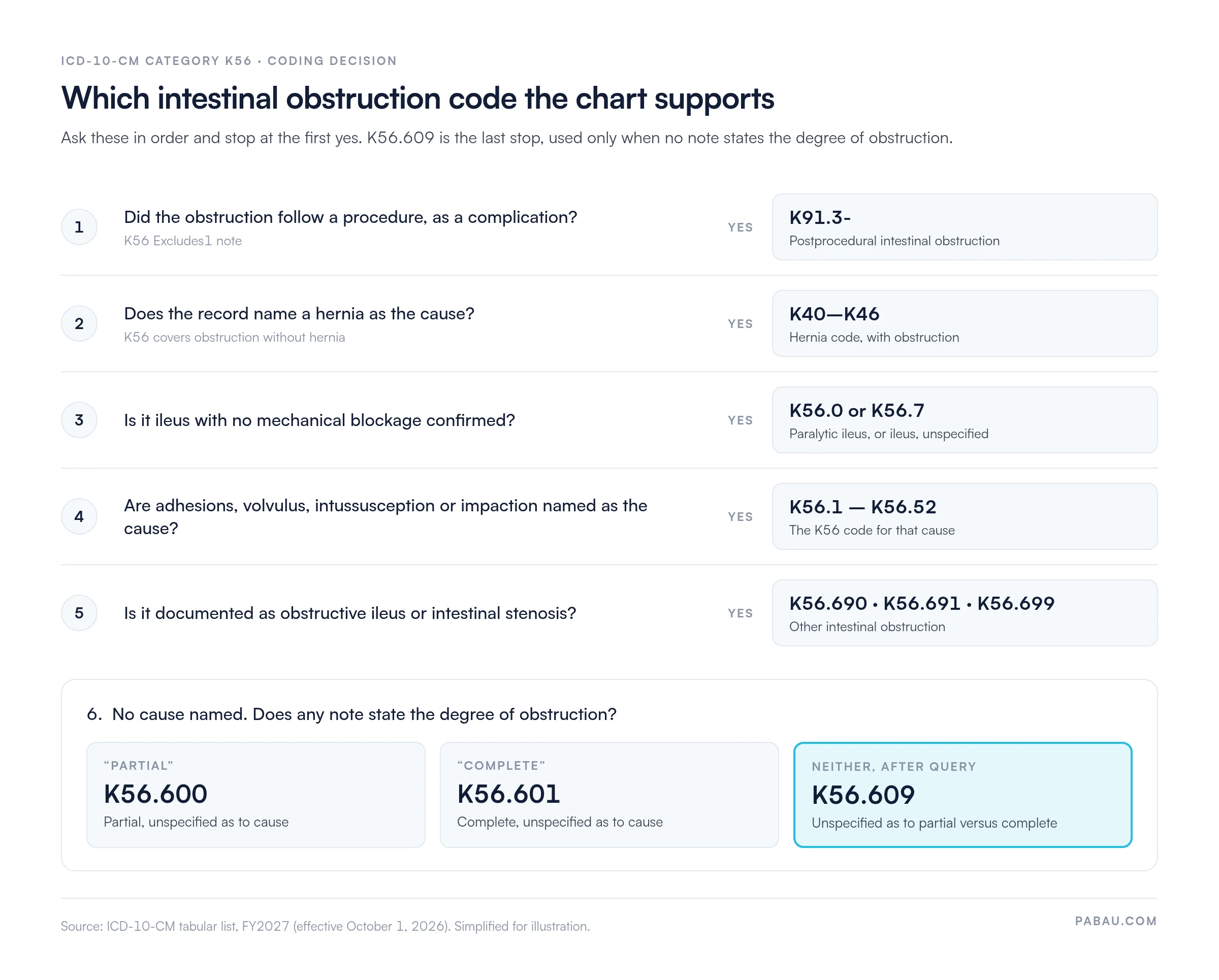
Category K56 carries an Excludes1 note that applies to K56.609. Excludes1 means the two conditions are never coded together, because one can’t occur with the other. The K56 list covers seven conditions:
Two common mix-ups are not on that list. Obstruction caused by a hernia never reaches K56, because the category covers obstruction without hernia. It is coded in the hernia categories (K40-K46), with obstruction.
Paralytic ileus (K56.0) is a separate code in the same category, chosen when the physician documents a loss of motility rather than a mechanical blockage.
A claim that pairs K56.609 with K91.3- for the same episode breaks the Excludes1 note, and claim scrubbers flag the pair. Check the operative and discharge notes for a postprocedural complication before choosing either code.
Assigning K56.609 defensibly takes a record that supports the unspecified code, not one that simply defaults to it. Confirm each point below before assigning it.
When documentation is ambiguous, a compliant query asking for the degree of obstruction is appropriate. The AHIMA/ACDIS guidelines allow multiple-choice queries. List the clinically plausible options, plus an “unable to determine” choice, without steering toward a code.
When K56.609 is the principal diagnosis on an inpatient claim with no operating room procedure, the grouper assigns MS-DRG 388, 389 or 390. The secondary diagnoses decide which one. A Major Complication or Comorbidity (MCC) gives 388, a Complication or Comorbidity (CC) gives 389, and neither gives 390.
A bowel resection or adhesiolysis on the same stay moves the case to a surgical MS-DRG instead, such as 329-331 or 335-337. Each fiscal year brings a new MS-DRG version, with new weights and geometric mean lengths of stay. The CMS MS-DRG classifications page carries the current definitions manual and grouper software.
Before finalizing the DRG on a K56.609 inpatient stay, audit every secondary diagnosis for CC/MCC status. Sepsis or acute respiratory failure coded alongside K56.609 is an MCC, which moves a DRG 390 case to DRG 388. Acute kidney injury, unspecified (N17.9) is a CC and moves it to DRG 389. Run this check as part of your CDI workflow on every bowel obstruction admission.
K56.609 does not trigger a prior authorization requirement on its own. Prior authorization attaches to the procedures performed during the encounter, not to the diagnosis code. Several payer-side rules still apply to claims carrying K56.609:
Knowing how revenue cycle management works end to end helps billing teams catch authorization problems before submission rather than during denial recovery.
K56.609 claims are denied in predictable ways, and most are preventable before submission. Building denial management workflows around these triggers cuts recovery cost.
Reviewing medical billing denial codes helps revenue cycle teams triage K56.609 denials and route each one to the right correction workflow.
K56.609 appears on claims as a standalone diagnosis (conservative management, observation) and alongside surgical procedure codes. The table covers the most common pairings. Check procedure pairs against the CMS NCCI edits before billing them together, because the edit files update quarterly.
When the operative report confirms adhesions as the cause, revisit the principal diagnosis. K56.50, K56.51 or K56.52 replaces K56.609 when documentation supports it, and those codes pair more cleanly with 44180 and 44005.
A resection billed with 44120 follows the same rule, because the final diagnosis comes from the operative findings. Before submitting, confirm that a clean claim carries the post-operative diagnosis and the matching PCS code.
On outpatient claims where K56.609 accompanies CPT 44180, read the operative report before closing the chart. If the surgeon documents adhesions as the cause, change the diagnosis to K56.50, K56.51 or K56.52. When the operative note and the admission note differ, the operative findings carry more weight.
Most K56.609 denials trace back to a detail the claim and the chart disagree on. It might be a degree the notes stated, a hernia the surgeon found, or an authorization nobody logged. Billing teams usually learn about these from the remittance, after the payer has already denied the claim.
Pabau’s claims management software keeps the patient record and the claim in one place. Claims go out as 837P transactions through the Claim.MD clearinghouse, with eligibility checked first. Prior authorization codes, dates, and sessions are tracked on the case, with a warning when one is missing.
ERA remittances post back against the same patient record, so a denied bowel obstruction claim surfaces the day the remittance arrives. Secondary claims go out from that record too, without re-keying the diagnosis.

Pabau’s claims management software sends 837P claims through Claim.MD, checks eligibility first, and flags a missing prior authorization. See how it handles intestinal obstruction encounters.

K56.609 is a valid code, but it should be the last answer, not the first. The degree of obstruction is usually written down somewhere, in an imaging report, an operative note or a discharge summary. Finding it before the claim goes out costs less than defending the unspecified code in an audit.
The other trap is the Excludes1 list. Postprocedural obstruction never pairs with K56.609, and a documented hernia moves the code out of K56 altogether. Book a demo to see how Pabau keeps the record, the authorization and the claim together for GI billing teams.

Need to understand how clearinghouse submission works? Claim.MD clearinghouse guide explains how electronic claims are validated and transmitted to payers.
Confused by denial code definitions? Electronic remittance advice explained covers how to read ERA files and act on CARC/RARC denial codes.
Coding an obstruction caused by Crohn’s disease? ICD-10 code K50.90 covers Crohn’s disease, unspecified, and shows where its complication codes sit.
Coding another digestive-system diagnosis? ICD-10 code K57.92 covers diverticulitis of the intestine, part unspecified.
ICD-10 code K56.609 is the billable ICD-10-CM code for unspecified intestinal obstruction without hernia. It applies when the documentation does not state whether the obstruction is complete or partial. It is a 6-character code, valid for HIPAA-covered transactions in the FY2027 ICD-10-CM code set, effective October 1, 2026.
Yes, K56.609 is a billable, valid-for-submission code in the FY2027 ICD-10-CM tabular list. It is the most specific level under K56.60, not a header code, so it may be assigned on outpatient and inpatient claims.
K56.600 is partial intestinal obstruction and K56.601 is complete intestinal obstruction, both unspecified as to cause. K56.609 is used when documentation does not specify the degree. Assign K56.609 only after reviewing every note. If any note states complete or partial, use the matching code.
Use K56.609 when the physician documents mechanical intestinal obstruction with no named cause and no stated degree. Use K56.50, K56.51 or K56.52 when adhesions are the confirmed cause. Use K56.7 (ileus, unspecified) when documentation does not confirm a mechanical obstruction at all.
As principal diagnosis with no operating room procedure, K56.609 maps to MS-DRG 388, 389 or 390. MS-DRG 388 is GI obstruction with MCC, 389 is with CC, and 390 is without CC/MCC. DRG weights update with each annual MS-DRG release.
The most common trigger is coding K56.609 when the notes support K56.600 or K56.601. Others are pairing it with postprocedural obstruction (K91.3-), which the K56 Excludes1 note bars, and missing prior authorization for surgery. Thin medical necessity documentation is the fourth. Each is preventable at pre-submission review.
Yes. K56.609 covers small bowel obstruction (SBO) and large bowel obstruction (LBO) when the physician names no cause and no degree. If the physician documents partial small bowel obstruction, assign K56.600 instead.