HCPCS code J3471: Hyaluronidase ovine injection billing guide
HCPCS code J3471: Descriptor, code type, and quick-reference data HCPCS code J34...

Last Updated: Oct 14, 2026
Billable Code
44120 is the CPT code for enterectomy, resection of small intestine; single resection and anastomosis. It covers an open operation in which the surgeon removes one diseased segment of small bowel and rejoins the two ends in the same session.
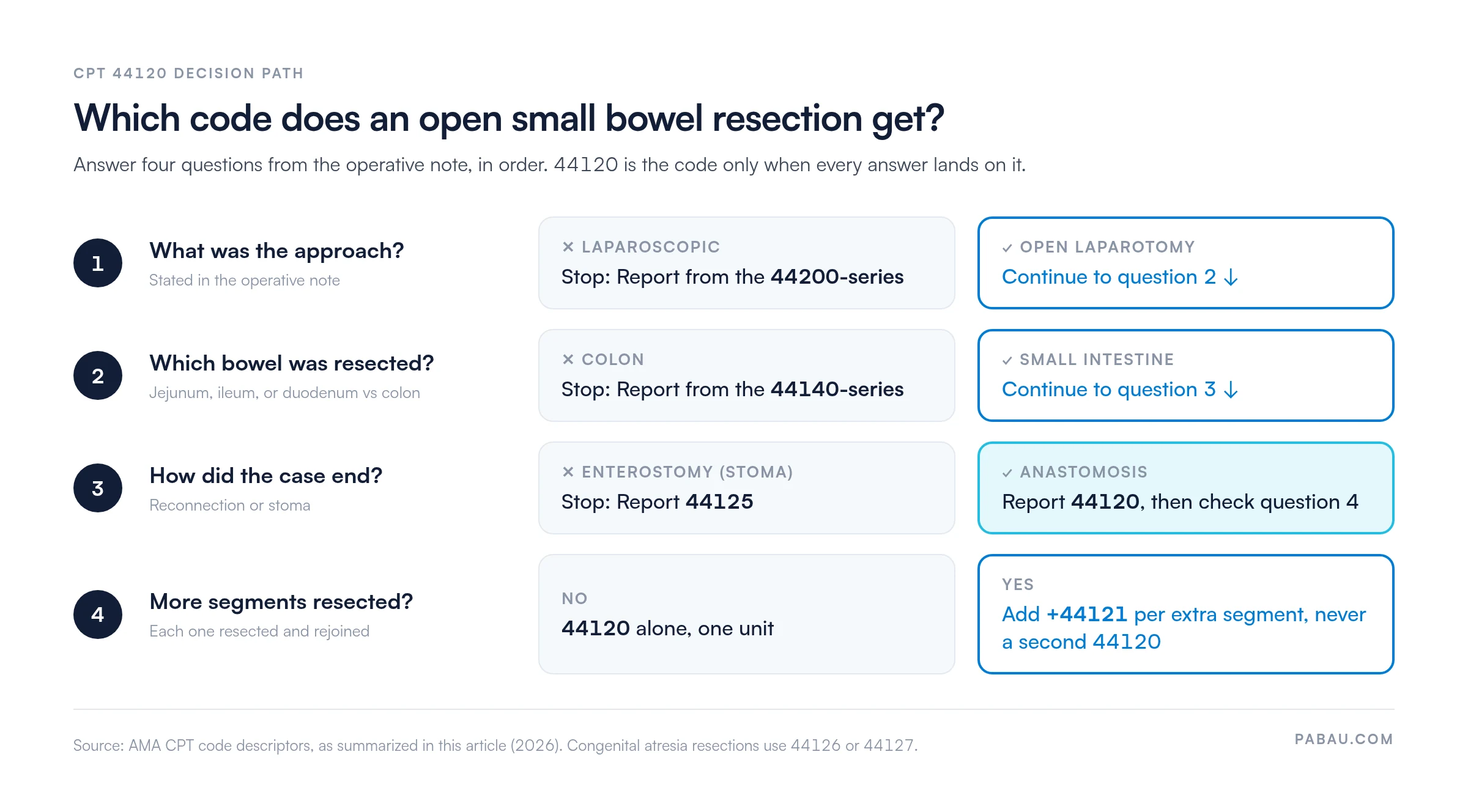
The code applies only to the open approach. Laparoscopic small bowel resections move to the 44200-series. A resection that ends in a stoma is reported with 44125, and each additional segment resected and rejoined adds 44121.
Let Pabau's smart automation suggest the right codes, reduce claim denials, and keep your practice compliant—effortlessly.
Automate repetitive tasks and focus on what matters most—your patients.
Reduce coding errors and ensure compliance with the latest regulations.
Clean claims, fewer denials, and faster reimbursements.
Powerful insights and reporting to help your practice thrive.
HIPAA compliant SOC 2 certified GDPR-compliant Trusted by 4,000+ clinics worldwide

CPT code 44120 describes an open (not laparoscopic) single resection and anastomosis of the small intestine only.
The anastomosis must be explicitly documented in the operative report. Missing this detail is the leading cause of denial.
A case that ends with a stoma instead of an anastomosis is reported with 44125, not 44120.
44120 pairs with add-on code 44121 for each additional resection. Billing multiple units of 44120 itself is an unbundling error.
The 2026 Medicare national facility rate is about $1,064 before geographic practice cost index (GPCI) adjustments apply by locality.
CPT code 44120 is the billing code for an open enterectomy with a single small intestine resection and anastomosis. It is defined in the American Medical Association’s CPT code set. The full official descriptor reads: Enterectomy, resection of small intestine; single resection and anastomosis.
Two elements define the code precisely. First, the approach must be open, not laparoscopic. Second, a completed anastomosis must be performed during the same operative session. A resection that ends with a stoma instead of an anastomosis is reported with 44125.
The 44100-44160 range covers several open intestinal excisions, but 44120 is the only one that pairs a single small bowel resection with an anastomosis. A laparoscopic case billed as 44120 is miscoded before the claim leaves the practice.
An open small bowel resection with anastomosis follows a predictable surgical sequence. Understanding the steps helps coders verify that an operative note supports 44120 rather than a related code.
The anastomosis step is the clinical and coding pivot point. If the operative note describes resection but then documents stoma creation instead of reanastomosis, 44120 does not apply and 44125 does.
Bundling rules for CPT code 44120 are stricter than many coders expect. The following table separates what is already valued inside 44120 from what can be legitimately reported separately.
CPT codes 44120 and 44125 describe the same open single resection of the small intestine but differ on how the operation ends. With 44120, the surgeon rejoins the two bowel ends with an anastomosis. With 44125, the surgeon brings the bowel out through the abdominal wall as an enterostomy, creating a stoma.
If the operative report documents a stoma instead of reconnection, 44125 is the supported code. Code 44120 applies to a standard open single-segment resection that ends with an anastomosis. Tapering for congenital atresia belongs to neither code and is reported with 44126 or 44127.
Several adjacent codes share procedural territory with CPT code 44120, and the distinctions are granular enough to slip past automated edits. This reference table covers the neighbors coders confuse most often.
Checking the operative note against these distinctions during charge capture review catches most approach and anatomy mismatches before a claim is filed. Approach drives code choice elsewhere in the 44000 series, where a laparoscopic appendectomy is reported with CPT code 44970. The decision path below runs those checks in the order a coder should ask them.
Every payer requires a diagnosis code that supports medical necessity for 44120. The diagnosis must be clinically consistent with an open bowel resection. A nonspecific or low-acuity code triggers a medical necessity denial, however accurate the procedure code is.
Local coverage determinations (LCDs) for intestinal resections typically require a primary diagnosis showing failed conservative management or an acute presentation. Coders should confirm the LCD their Medicare Administrative Contractor (MAC) applies in their region. For an oncologic resection, check whether C17.9 is specific enough, or whether the pathology report supports a site-level code.
The operative report is the primary record for a 44120 claim. It must contain each of the following elements for the claim to hold up on audit.
Structured surgical note templates make these elements hard to skip. When the anastomosis field is mandatory rather than free text, the note reaches charge entry with the detail the coder needs.
Run a quarterly audit of 44120 operative reports against this checklist. Flag any note that does not name the anastomosis type and technique. Those claims are the most likely to come back as medical record requests or outright denials. Correcting documentation before submission costs far less than handling appeals after a denial.
Modifier selection for CPT code 44120 is governed by AMA guidelines, but payer acceptance rates vary. Appending a modifier without meeting its clinical and documentation threshold is worse than omitting it. An unsupported modifier flags the claim for manual review and can trigger a denial with a fraud-risk note in the payer file.
Modifier -22 is the most frequently abused on 44120 claims. CMS and most commercial payers pay an additional 15 to 20 percent when the documentation justifies it. They also audit -22 usage aggressively. Practices that append -22 to every 44120 claim without case-specific narrative documentation are building an audit target.
CMS publishes the 2026 Medicare Physician Fee Schedule (MPFS) values for CPT code 44120 in its fee schedule lookup tool. They reflect the CY 2026 final rule. All figures below are national unadjusted rates. Your reimbursement varies by geographic practice cost index (GPCI) locality.
The CY 2026 conversion factor is $33.4009 per RVU, or $33.57 for qualifying alternative payment model (APM) participants. At the standard rate, the facility total of 31.87 RVUs works out to roughly $1,064 at the national average GPCI. You can check the current values with FastRVU’s 2026 RVU lookup. Non-facility rates are substantially higher because the practice bears the overhead cost of the supply, equipment, and staff.
For locality-adjusted figures, the free 2026 RVU calculator from PCC imports CMS data and applies GPCI multipliers.
Always pull the locality-adjusted rate for your MAC region before setting your fee schedule. A surgical practice in Manhattan faces a GPCI well above 1.0, while a rural practice in Mississippi may see a GPCI below 0.85. Using the national average as your benchmark understates or overstates expected Medicare revenue by a meaningful margin.
Most 44120 denials fall into five recurring patterns. Each one is preventable at the coding or documentation stage. Knowing the medical billing denial codes helps coders trace each remittance remark code back to its root cause instead of resubmitting blindly.
Denial management at the practice level starts with sorting denials by type before any claim is resubmitted. A billing team that tracks the most frequent reason code on 44120 claims can trace it to the surgical note template. Fixing the template once beats appealing claim by claim.
On the 835 electronic remittance advice (ERA), claim adjustment reason codes (CARCs) separate approach, documentation, and medical necessity errors. The billing team can see the cause without calling the payer.
Medicare sets the floor for 44120 payment policy, but commercial payers frequently impose additional requirements. Practices billing 44120 to UnitedHealth, Aetna, or Cigna should check each payer’s own coverage determination before submission. Their prior authorization requirements and bundling rules differ from Medicare’s.
Each payer’s rules for surgical codes belong in the practice’s billing reference library, reviewed at least once a year. Centralized claims software for surgeons catches payer-level edits when the claim is created, not after submission. Each payer’s own fee schedule also makes a practical baseline for a quarterly payment reconciliation.
On many surgical billing teams, a 44120 claim is checked by hand. A coder reads the operative note, confirms the approach and the anastomosis, and picks the modifiers. Weeks later, someone matches the payment against the fee schedule in a spreadsheet.
Practice management software like Pabau keeps that work in one place. Charge capture, modifiers, and claim status sit beside the patient record and the appointment. Through its Claim.MD integration, Pabau lets US practices submit, track, and reconcile insurance claims without leaving the system.
The payoff is faster, cleaner reconciliation. Each 44120 payment is compared with the expected RVU-based amount line by line, so underpayments surface without manual matching.

Pabau’s claims management tools help surgical practices capture the right codes, attach the right modifiers, and track claim status through to ERA reconciliation. See how it works for your practice.

CPT code 44120 rewards the coder who reads the whole operative note before picking a code. An open approach, a small bowel site, and a documented anastomosis are the three facts it rests on. If any one of them is missing, a different code applies.
The fix belongs upstream. Mandatory approach and anastomosis fields in the surgical note template take some setup, but they replace claim-by-claim appeals with a single change.
Book a demo to see how Pabau keeps surgical charge capture, modifiers, and payment reconciliation in one workflow.

Pairing 44120 with a small bowel cancer diagnosis? ICD-10 code C17.9 covers when the unspecified small intestine malignancy code supports an oncologic resection and when a more specific site code is expected.
Resecting bowel after a perforation? ICD-10 code K63.1 explains how to code nontraumatic intestinal perforation, one of the findings that justifies an open enterectomy.
Was the resection done laparoscopically on the colon instead? CPT code 44204 breaks down the laparoscopic partial colectomy code that coders most often confuse with 44120.
Did the case end with a stoma rather than an anastomosis? CPT code 44227 walks through billing the laparoscopic enterostomy closure that reverses the stoma later on.
Started laparoscopically and converted to open? CPT code 49320 clarifies when a diagnostic laparoscopy is bundled and when it can be reported alongside the open procedure.
CPT code 44120 covers an open single resection of the small intestine with anastomosis. The surgeon removes a segment of bowel and reconnects the two ends in the same operative session. It does not cover laparoscopic approaches, colonic resections, or cases where a stoma is created instead of an anastomosis.
The difference between CPT 44120 and 44125 is how the procedure ends. 44120 rejoins the bowel with an anastomosis, while 44125 brings it out as an enterostomy (stoma). If the operative note documents a stoma instead of reconnection, 44125 is the correct code.
CPT 44120 includes one anastomosis for a single bowel resection. Each additional resection and anastomosis performed in the same operative session is reported with add-on code 44121. Billing multiple units of 44120 for additional resections is an unbundling error that violates CCI edits and triggers denial.
Lysis of adhesions (44005 open, 44180 laparoscopic) may be separately billable alongside 44120 when the adhesiolysis goes well beyond what the resection routinely requires. Whether it pays is payer-dependent. Verify the applicable CCI edits and payer LCD before appending, as some MACs bundle routine adhesiolysis into the resection payment.
CPT 44120 is an open procedure only. The laparoscopic equivalent for small bowel resection falls in the 44200-series. Billing 44120 when the operative note documents a laparoscopic approach is a coding error. It triggers edit-based denials and, on audit, a potential overpayment finding.
The 2026 total RVUs for CPT 44120 are approximately 31.87 in the facility setting and 52.41 in the non-facility setting. The work RVU is 20.04 in both settings. The difference between the facility and non-facility totals comes from the higher practice expense RVU when the practice bears overhead costs. Verify current values via the CMS fee schedule tool or a 2026 RVU calculator, as figures update annually.