

ICD-10 Code R63.4: Abnormal weight loss
ICD-10 code R63.4: Definition, billability and code structure ICD-10 code R63.4 ...

Last Updated: Nov 13, 2026
Billable Code Specific Code
J96.01 is the billable ICD-10-CM code for acute respiratory failure with hypoxia. It applies when the physician documents a sudden respiratory failure and names hypoxia or hypoxemia, backed by blood gas or oximetry values.
A note that only says "low O2 sat" leaves the coder at J96.00, the unspecified code. That costs specificity and invites audit findings, though J96.00 is still an MCC. J96.01 is valid in FY2026 and unchanged in FY2027, which began October 1, 2026.
Let Pabau's smart automation suggest the right codes, reduce claim denials, and keep your practice compliant—effortlessly.
Automate repetitive tasks and focus on what matters most—your patients.
Reduce coding errors and ensure compliance with the latest regulations.
Clean claims, fewer denials, and faster reimbursements.
Powerful insights and reporting to help your practice thrive.
HIPAA compliant SOC 2 certified GDPR-compliant Trusted by 4,000+ clinics worldwide

J96.01 is the billable ICD-10-CM code for acute respiratory failure with hypoxia, valid in FY2026 and unchanged in FY2027.
J96.00, J96.01 and J96.02 are all MCCs as secondary diagnoses, so specificity mainly protects the claim in an audit.
The physician must name acute respiratory failure and hypoxia in words, backed by ABG or SpO2 values in the record.
ARDS (J80), postprocedural failure (J95.82-) and newborn failure (P28.5) are Excludes1 at category J96, so none is reported with J96.01.
Sepsis-related respiratory failure follows the sepsis code under Guideline I.C.1.d, while pneumonia and respiratory failure can each be principal.
ICD-10 code J96.01 is the billable ICD-10-CM code for acute respiratory failure with hypoxia. It appears in CMS’s 2027 ICD-10-CM files, which cover discharges from October 1, 2026 through September 30, 2027. The code has no further subdivisions, so it goes on a claim exactly as written.
It sits in Chapter 10 (Diseases of the respiratory system), category J96 (Respiratory failure, not elsewhere classified), subcategory J96.0 (Acute respiratory failure). Here’s the reference card.
The CDC/NCHS ICD-10-CM web tool is the authoritative place to confirm J96.01 for any fiscal year. Check it against the year that matches the date of service you’re coding.
Acute hypoxic respiratory failure means the respiratory system fails suddenly and blood oxygen drops low enough to impair organ function. ICD-10-CM Alphabetic Index entries map acute hypoxemic and acute hypoxic respiratory failure to J96.01. Either phrase in the physician’s note supports the code.
Coding and clinical literature commonly cite a PaO2 below 60 mmHg on room air, or an SpO2 below about 90%, as the floor for hypoxia. Treat those numbers as guides rather than rules. The current AHA Coding Clinic holds the official position, and payers don’t all apply one cutoff.
Typical scenarios the code captures include:
Category J96 carries Excludes1 notes that redirect several scenarios elsewhere. An Excludes1 note means the two codes are never reported together, and misreading one is a common source of audit findings.
The postprocedural split causes the most trouble. When respiratory failure results from a procedure, such as an intraoperative complication or post-op hypoventilation, code from J95.82- instead of J96.01.
If failure develops later for a reason the surgery didn’t cause, such as aspiration pneumonia on day 5, J96.01 may fit. Query the physician whenever the record leaves the cause unclear.
J96.00, J96.01 and J96.02 are three distinct codes within subcategory J96.0 (Acute respiratory failure). What separates them is the abnormality the physician documents: none specified, hypoxia, or hypercapnia.
The decision path below runs the exclusion checks first, then lets that wording pick the code.
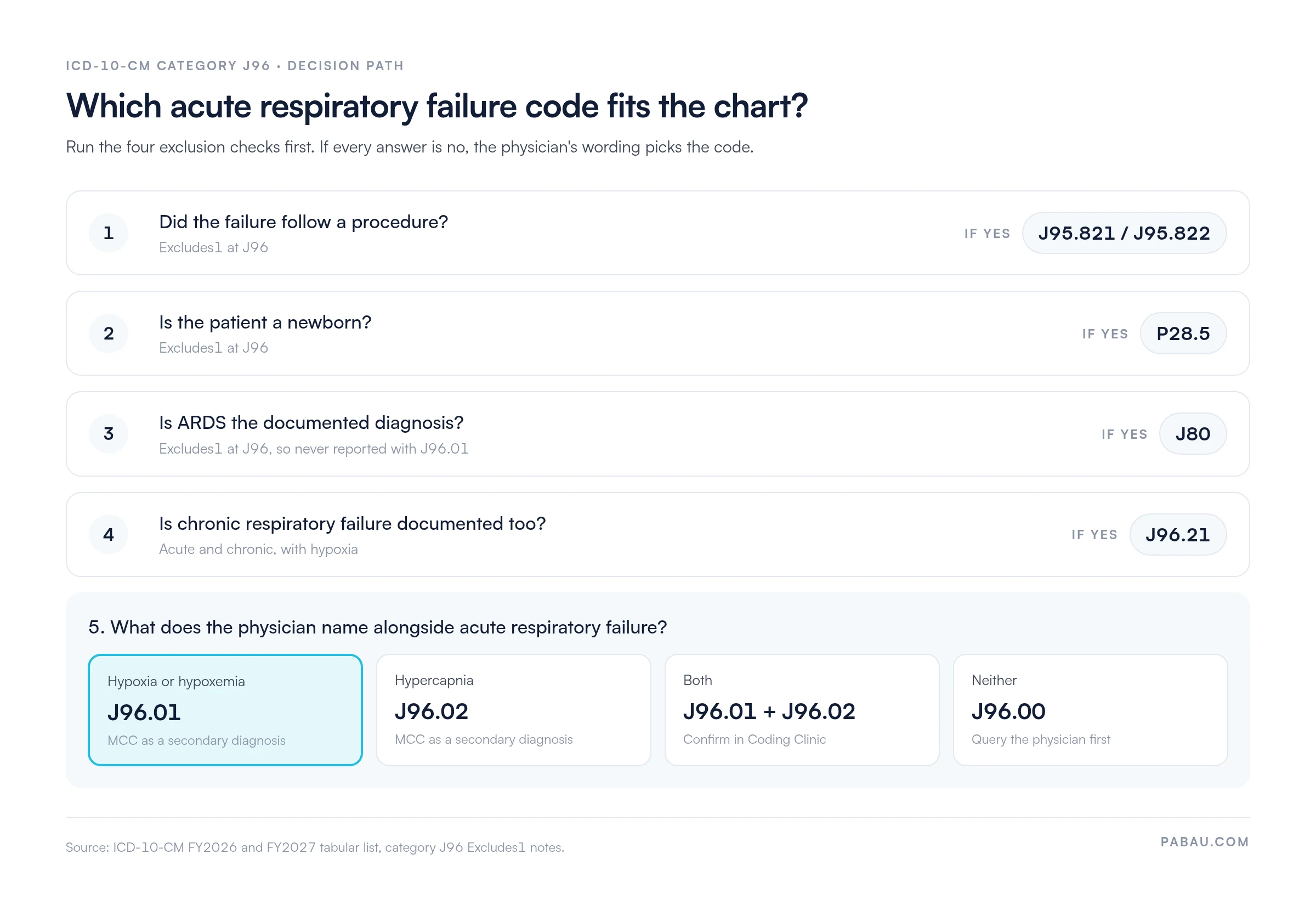
When both hypoxia and hypercapnia are documented, coding practice generally supports reporting J96.01 and J96.02 together. Confirm it against the current AHA Coding Clinic first, since advice on this pairing has shifted over time.
Treat J96.00 as a last resort. If the note carries ABG or oximetry values that point to hypoxia, the CDI team should query the physician. Settle on the unspecified code only after that. J96.00 is an MCC too, so the DRG barely moves, but an unspecified code still draws audit attention.
J96.21 is the code for acute and chronic respiratory failure with hypoxia, the picture clinicians call acute-on-chronic. It needs documented chronic respiratory failure that existed before the acute event, which makes it a different clinical scenario from J96.01.
Picture a patient with COPD or pulmonary fibrosis who arrives with an acute, hypoxic exacerbation. If the chart documents underlying chronic respiratory failure, the code is J96.21, and J96.01 would be an error.
CDI queries on this distinction are among the highest-yield clarifications on respiratory admissions. When the underlying condition is interstitial lung disease with no subtype or fibrosis recorded, diagnosis code J84.9 is reported alongside the respiratory failure code.
J96.01 is designated as a Major Complication or Comorbidity (MCC) by CMS when reported as a secondary diagnosis. That raises the MS-DRG weight for the admission. Medicare pays more as a result, and so do commercial payers that use the MS-DRG grouper.
That’s why capturing J96.01 as a secondary diagnosis is a core focus of revenue cycle management for hospital CDI programs. One missed J96.01 can drop a case a full severity tier.
Take a pneumonia admission. Simple pneumonia and pleurisy group to MS-DRGs 193-195, while respiratory infections and inflammations group to MS-DRGs 177-179. An MCC like J96.01 as a secondary diagnosis moves the case to the top tier of its family, which carries a higher relative weight.
CMS updates MS-DRG relative weights with each fiscal year. Check them against the MS-DRG Definitions Manual for the year that applies.
Run a quarterly query on inpatient discharges coded J96.00 where the record shows a PaO2 below 60 mmHg or an SpO2 below 90%. Those cases are J96.01 candidates that lost specificity at the documentation stage. A concurrent physician query on each one gives you a code that holds up in an audit.
Section I.C.10 of the ICD-10-CM Official Guidelines for Coding and Reporting governs respiratory failure sequencing. When a patient arrives with respiratory failure and another acute condition, either may be principal unless a specific guideline says otherwise.
Sepsis and obstetric cases are the two exceptions you’ll meet most. Everywhere else, apply the UHDDS definition of principal diagnosis: the condition established after study to be chiefly responsible for the admission.
Three scenarios account for most J96.01 sequencing questions in inpatient coding. Each one follows its own guideline.
Sepsis with acute respiratory failure puts the sepsis code first under Guideline I.C.1.d. When the physician links the failure to the sepsis, it counts as acute organ dysfunction, which makes the case severe sepsis.
A typical set is A41.9 for sepsis with no organism named, then R65.20 for severe sepsis without septic shock, then J96.01. If the physician documents septic shock, R65.21 replaces R65.20. J96.01 stays secondary even when the patient needs ventilation.
When pneumonia and acute respiratory failure are both present on admission and both drove the decision to admit, either may be principal. Report J96.01 alongside the pneumonia code, such as J18.9 when no organism is named. Many CDI programs sequence whichever condition used the most resources during the stay.
Acute respiratory distress syndrome is a distinct diagnosis, and category J96 lists it as Excludes1. So J80 and J96.01 aren’t reported together. When the physician documents ARDS, report J80 and leave J96.01 off the claim. J80 is an MCC in its own right, so the case keeps its severity tier.
The physician’s exact wording usually decides between a clean J96.01 claim and a J96.00 downgrade. Catching vague wording before coding saves a round of rework later. The record needs each of these elements.
CDI specialists send a query when the notes show hypoxic ABG values but no diagnostic statement. The right tool is a concurrent query that cites the lab values. It asks the physician to confirm or rule out acute respiratory failure with hypoxia. Retrospective queries are allowed but carry more audit risk.
Most J96.01 problems surface at one of five handoffs. Here’s the path a claim takes, and where each one can slip.
Medicare and most commercial payers expect J96.01 to rest on documentation that meets medical necessity criteria. Clearinghouse edits stop an invalid code early, but the clinical argument has to come from the chart.
Payer considerations to keep in view:
J96.01 claims are denied for predictable reasons. Denial management workflows that sort J96.01 denials by reason show which of the patterns below hits your organization most.
The full J96 family and several neighboring codes turn up regularly next to J96.01. The AAPC ICD-10-CM code lookup lets you search the whole category.
Check the CDC ICD-10-CM browser tool whenever you work in the J96 family. It shows the Excludes1 notes at category level, which settles quickly whether J80, J95.82- or a J96 code fits the scenario.
In many billing offices, a J96.01 claim gets coded in one system, sent from another and chased in a spreadsheet when it comes back denied. Each handoff is another chance to lose the cause code or the diagnosis pointer.
Pabau, the practice management and billing platform we build, brings cleaner claims management to US practices. Claims go out as CMS-1500 (837P) files through Claim.MD. Your team can run eligibility checks before the visit and send secondary claims from the same record.
ERA remittances post back against each claim, so you see what was paid and what was denied, with the payer’s reason, in one place. That leaves fewer spots for a J96.01 claim to stall.

Pabau sends CMS-1500 claims through Claim.MD, runs eligibility checks and posts ERA remittances back to each claim. Your team sees what was paid and what needs fixing in one place.

J96.01 rewards precision more than most respiratory codes. The physician’s words decide between J96.01, J96.00 and J96.21, and the Excludes1 notes decide whether a J96 code applies at all.
If you change one habit, query while the patient is still in the bed. A concurrent query that cites the ABG values takes minutes. A fix after a denial costs a resubmission and leaves an audit trail.
Keep the trade-off in mind, too. J96.00 still carries MCC weight, so specificity buys a defensible claim rather than a bigger DRG. Book a demo to see how Pabau tracks each claim from submission to remittance, so your team spends less time chasing payers.

Need a foundation for how claims flow from code to payment? Medical billing fundamentals covers the process from encounter documentation through remittance posting.
Struggling with denial patterns across your respiratory case mix? Denial management in healthcare explains how to sort, track and prevent the most common payer denials.
Want claims to process cleanly the first time? Clean claim requirements outlines the data elements payers check before they adjudicate a claim.
Coding respiratory failure in a newborn? ICD-10 code P28.5 covers the neonatal code that J96 excludes.
R09.02 is the code for hypoxemia. Use it when low blood oxygen is documented but the physician doesn’t diagnose respiratory failure. Don’t add R09.02 next to J96.01, because hypoxia is already part of the J96.01 descriptor.
Yes. J96.01 isn’t on the POA-exempt list, so inpatient claims report Y, N, U or W for it. The indicator tells payers and quality programs whether the failure began before or after admission.
Yes, when the provider documents the diagnosis. Outpatient rules don’t allow coding a probable or suspected condition, though. If the note only says possible respiratory failure, code the documented signs, such as R09.02, instead.
Sequence U07.1 for COVID-19 first, then J96.01. The official guidelines put the COVID-19 code first for confirmed cases, with the respiratory failure as a secondary code.
ICD-9-CM had no hypoxia split, so acute respiratory failure was coded 518.81. The GEMs crosswalk maps J96.01 back to 518.81, which helps when you compare data from before October 1, 2015.



