ICD-10 Code M62.82: Rhabdomyolysis diagnosis and billing guide
ICD-10 Code M62.82: Quick reference ICD-10 Code M62.82 is the billable ICD-10-CM...

Last Updated: Nov 16, 2026
Billable Code Specific Code
J81.1 is the billable ICD-10-CM code for chronic pulmonary edema. It also covers chronic or passive pulmonary congestion and pulmonary edema NOS.
Unqualified "pulmonary edema" indexes to J81.1, not J81.0. When heart disease or heart failure causes the edema, the J81 Excludes1 note routes it to I50.1 or the specific I50 code, with no J81.1.
Let Pabau's smart automation suggest the right codes, reduce claim denials, and keep your practice compliant—effortlessly.
Automate repetitive tasks and focus on what matters most—your patients.
Reduce coding errors and ensure compliance with the latest regulations.
Clean claims, fewer denials, and faster reimbursements.
Powerful insights and reporting to help your practice thrive.
HIPAA compliant SOC 2 certified GDPR-compliant Trusted by 4,000+ clinics worldwide

ICD-10 code J81.1 is the billable ICD-10-CM code for chronic pulmonary edema, valid for FY2027 claims across US payers and care settings.
Unqualified “pulmonary edema” indexes to J81.1, not J81.0. Assign J81.0 only when the physician documents the edema as acute.
When heart disease or heart failure causes the edema, code I50.1 or the specific I50.x alone. The J81 Excludes1 note bars pairing it with J81.1.
Pabau, the practice management platform we build, submits CMS-1500/837P claims through the Claim.MD clearinghouse, checks eligibility and posts ERA remittances to the patient record.
ICD-10 code J81.1 is the billable ICD-10-CM code for chronic pulmonary edema. The FY2027 ICD-10-CM code tables from CMS also place chronic or passive pulmonary congestion and pulmonary edema with no qualifier under it.
It sits in Chapter 10 (Diseases of the respiratory system, J00-J99), block J80-J84, under parent category J81 (Pulmonary edema). J81.1 remains billable for FY2027 with no deletion flags.
Confirm the current-year tabular list at the CDC/NCHS ICD-10-CM web tool. NCHS releases updated code files each fiscal year, and the tool is the authoritative source for billable status.
J81.1 covers chronic pulmonary edema and chronic or passive pulmonary congestion where no heart disease or heart failure is documented as the cause. The condition develops over weeks to months, which separates it from the acute presentation coded at J81.0.
The FY2027 tabular list gives J81.1 two inclusion terms:
The second term matters most to coders. The Alphabetic Index entry Edema, lung points to J81.1, so a note that says only “pulmonary edema” codes here. J81.0 has one inclusion term, “Acute edema of lung,” and it needs that acute qualifier in the record.
Cause decides whether J81.1 applies at all. Edema with heart disease or heart failure is coded to I50.1 or the specific I50.x code, never to J81.1. Edema from chemicals or other external agents routes to J68.1 or the J60-J70 range. Put together, the coding decision runs in two steps, cause first and wording second.
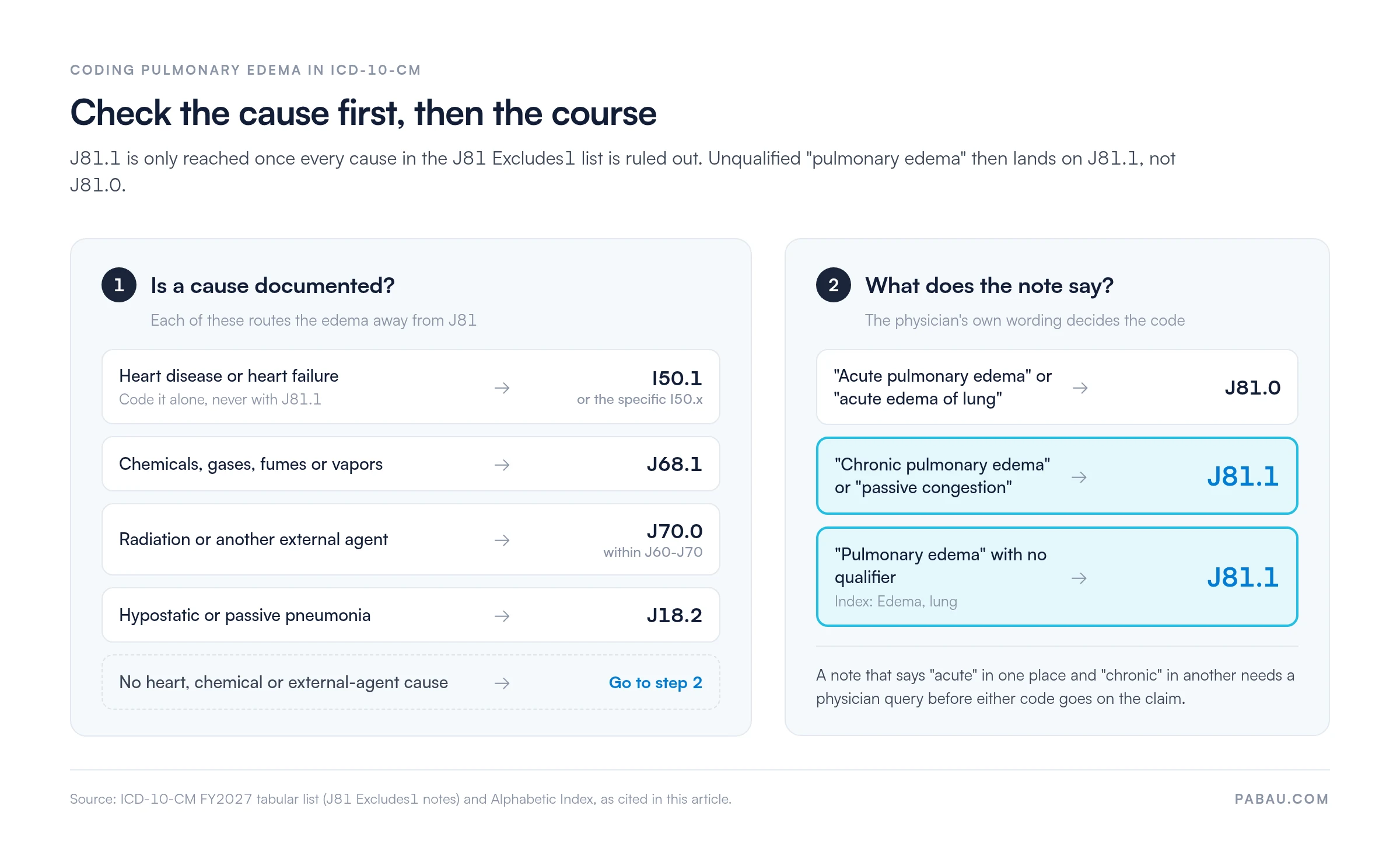
Document the cause alongside the course. ‘Chronic pulmonary congestion, no cardiac cause identified’ supports J81.1 on its own. ‘Pulmonary edema due to systolic heart failure’ codes to an I50.2- code alone, with no J81.1 on the claim.
Category J81 carries six Excludes1 notes, and all of them apply to J81.1. Neither J81 nor J81.1 has a code-specific Excludes2 note. The only Excludes2 that reaches J81.1 is the chapter-level J00-J99 note, which covers E00-E88 among other ranges.
An Excludes1 note means the excluded condition is never coded with J81.1 for the same problem. The one exception is when the physician documents the two conditions as unrelated. An Excludes2 note means the condition is not part of J81.1, but both codes may be reported when each is documented.
J81.0 is acute pulmonary edema and J81.1 is chronic pulmonary edema. J81.1 is also the default when the physician writes “pulmonary edema” with no qualifier, so J81.0 needs an explicit acute statement. Neither code applies when heart disease or heart failure causes the edema.
Several codes share clinical territory with ICD-10 code J81.1 and are often assigned in error. The table below maps each neighboring code to the criterion a coder should verify before selecting J81.1.
Use the AAPC Codify ICD-10-CM lookup to cross-reference neighboring codes and verify excludes relationships before finalizing the code set.
The J81 Excludes1 notes decide whether J81.1 belongs on the claim before sequencing comes up. Sequencing then follows the UHDDS principal diagnosis definition, the condition established after study to be chiefly responsible for the admission.
The word “with” in the Excludes1 note carries weight. ICD-10-CM presumes a link between pulmonary edema and heart failure documented together, so no “due to” statement is needed. Query the physician only when the record suggests the edema has a separate, non-cardiac cause.
Cardiogenic pulmonary edema never takes J81.1. When heart disease or heart failure drives the edema, the J81 Excludes1 note sends it to I50.1 or the specific I50.x, coded alone. J81.1 is reserved for chronic non-cardiogenic edema and congestion, and other non-cardiogenic causes route by etiology.
When the record says “pulmonary edema, etiology unclear” and the patient has a cardiac history, query the physician before assigning J81.1. A confirmed heart failure link moves the case to I50.x. Assigning J81.1 to a cardiogenic or chemically induced case creates an Excludes1 conflict that payers flag on audit.
Medical necessity for ICD-10 code J81.1 rests on two facts in the physician’s documentation. The record must name the pulmonary edema or congestion, and it must show no heart disease or heart failure behind it.
Query the physician when imaging shows congestion but the assessment names only symptoms such as dyspnea. Query again when the patient has a cardiac history the note neither links nor rules out. Maintaining medical billing compliance at this stage prevents denials downstream.
Echocardiography may show elevated filling pressures, such as a raised PCWP or E/e’ ratio, while the note says only ‘pulmonary congestion.’ Query the physician about heart failure. A confirmed heart failure diagnosis moves the case to I50.x and takes J81.1 off the claim.
When coded as the principal diagnosis, J81.1 groups to MS-DRG 189, Pulmonary edema and respiratory failure. DRG 189 is a single DRG with no CC/MCC severity split, it also takes acute respiratory failure as a principal diagnosis, so a claim led by J96.01 can group to the same DRG. DRGs 190 and 191 are often mistaken for its severity tiers, but they cover chronic obstructive pulmonary disease.
When heart failure is documented, the edema is coded to I50.x instead of J81.1. A principal I50.x code groups to the heart failure and shock DRGs, 291-293.
The cardiac-status question therefore decides the DRG family as well as the code. Verify current relative weights and LOS benchmarks against the CMS ICD-10 codes and MS-DRG Definitions Manual, which CMS updates annually.
The table below lists five common triggers for J81.1 denials. Three of them start in the physician’s documentation rather than in code selection.
Denial management workflows that screen for the I50 pairing catch J81.1 conflicts before the claim goes out. Reviewing denial codes in medical billing helps revenue cycle teams categorize J81.1 rejections and build targeted appeal templates.
Medicare treats J81.1 as a valid inpatient and outpatient diagnosis code, with no national coverage determination (NCD) restricting its use. Medicare Administrative Contractors (MACs) may still issue Local Coverage Determinations (LCDs) with documentation standards for specific settings. Sound revenue cycle management processes include periodic LCD sweeps for codes in active use.
Claim scrubbers built on ICD-10-CM edits flag J81.1 reported with an I50 code as an Excludes1 conflict. Prior authorization is rarely required for the diagnosis code itself, but it may apply to the inpatient admission. Submit claims in 837I (institutional) or 837P (professional) format with the ICD-10-CM codes in the correct positions.
A J81.1 claim usually fails on the note behind it. A missed cardiac history or a contradictory acute/chronic label can send it back weeks after the visit.
In Pabau, the clinical record and the claim sit in one system. Coders work from the physician’s note, so the cardiac status and the edema course are in front of them as they code. Pabau’s software for cleaner claims then submits CMS-1500/837P claims through the Claim.MD clearinghouse.
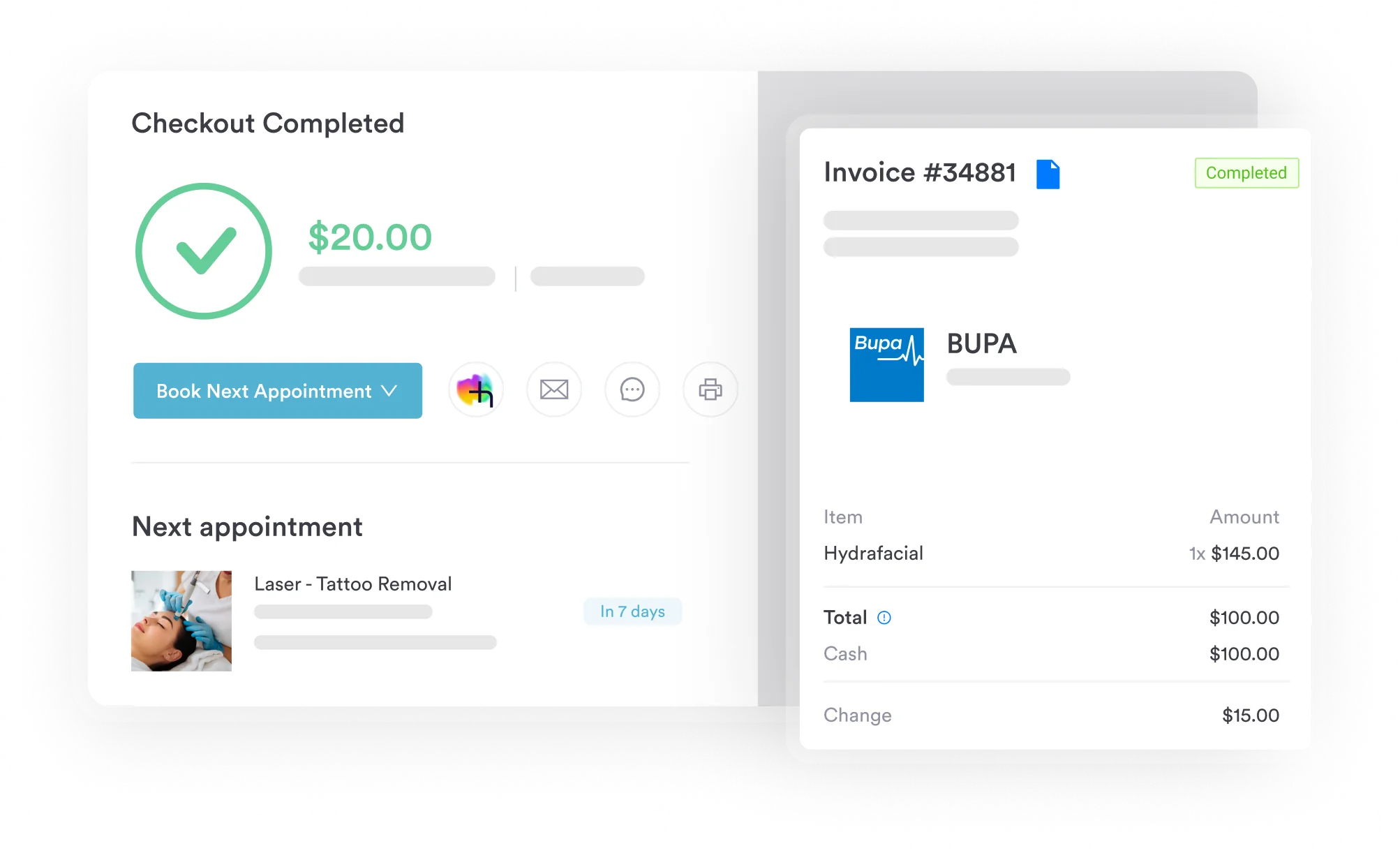
Eligibility checks, claim status updates and ERA remittances come back against the same patient record. Billers see a rejection the day it arrives, while the note is still fresh enough to fix and resubmit. For submission habits that cut rework, see the guide on clean claim submission.

Pabau submits CMS-1500/837P claims through the Claim.MD clearinghouse, checks eligibility and posts ERA remittances to the patient record. See how it fits your billing workflow.

J81.1 is a narrow code. It covers chronic pulmonary edema and congestion with no heart disease or heart failure behind it, plus pulmonary edema the physician leaves unqualified.
Once heart failure enters the record, the Excludes1 note hands the case to I50.x and J81.1 leaves the claim. Checking cardiac status before choosing the code settles the code, the DRG and most of the denial risk.
Pabau keeps the physician’s note and the claim in one place, so the coder sees the cardiac history before the claim goes out. To see how it handles diagnosis coding and claim submission, book a demo.

Need a clearinghouse integration for ICD-10 claim submission? Pabau’s Claim.MD clearinghouse guide explains how CMS-1500/837P claims route through the clearinghouse and how remittances come back.
Reading the remittance on a denied J81.1 claim? Understanding electronic remittance advice covers how to read ERA 835 files and interpret the CARC codes behind a denial.
Mapping diagnosis codes onto the visit form? The superbill guide walks through how ICD-10 diagnosis codes like J81.1 appear on the superbill and flow into the claim cycle.
ICD-10 code J81.1 is the billable ICD-10-CM code for chronic pulmonary edema. Its inclusion terms are pulmonary congestion (chronic)(passive) and pulmonary edema NOS. It sits under category J81 in Chapter 10 and is valid for FY2027 billing.
J81.0 is acute pulmonary edema and J81.1 is chronic pulmonary edema. Pulmonary edema with no acute or chronic qualifier indexes to J81.1, so J81.0 needs an explicit acute statement. Neither code applies when heart disease or heart failure causes the edema. That case is coded to I50.1 or the specific I50.x.
Yes. J81.1 is a billable ICD-10-CM code valid for FY2027. It has been billable since ICD-10-CM adoption and carries no deletion flags in current CMS code files. Verify its status each fiscal year at the CDC/NCHS ICD-10-CM web tool.
No. The J81 Excludes1 note covers pulmonary edema with heart failure and with heart disease NOS, both coded to I50.1. Code the heart failure alone, using the specific I50.x code when the type is documented. Coding Clinic treats cardiogenic pulmonary edema as integral to heart failure.
E87.70 is a metabolic code for fluid overload without a stated organ manifestation. J81.1 is a respiratory code for chronic edema or congestion in the lungs. No code-specific note links them. The chapter-level J00-J99 Excludes2 covers E00-E88, so both may be coded when each is documented separately.
Yes. J81.1 is the principal diagnosis when chronic non-cardiogenic pulmonary edema or congestion is chiefly responsible for the admission. If heart disease or heart failure causes the edema, J81.1 is not coded at all, and the I50.x code takes its place.