ICD-10 Code S42.444P: Medial epicondyle fracture, right humerus
ICD-10 Code S42.444P: full descriptor and code validity ICD-10 Code S42.444P car...

Last Updated: Oct 13, 2026
Billable Code Specific Code
P28.5 is the billable ICD-10-CM code for respiratory failure of newborn.
Unlike respiratory distress syndrome (P22.0) or transient tachypnea (P22.1), P28.5 requires explicit documentation of respiratory failure rather than distress alone. It applies to failure that originates in the perinatal period, and it stays in use after day 28 while that condition persists. P28.5 also carries Major Complication and Comorbidity (MCC) designation under CMS MS-DRG logic, so assignment directly affects inpatient reimbursement.
Let Pabau's smart automation suggest the right codes, reduce claim denials, and keep your practice compliant—effortlessly.
Automate repetitive tasks and focus on what matters most—your patients.
Reduce coding errors and ensure compliance with the latest regulations.
Clean claims, fewer denials, and faster reimbursements.
Powerful insights and reporting to help your practice thrive.
HIPAA compliant SOC 2 certified GDPR-compliant Trusted by 4,000+ clinics worldwide

P28.5 is billable for neonatal respiratory failure, and it still applies after day 28 when the condition began in the perinatal period
The physician must explicitly document ‘respiratory failure’ (not just distress or tachypnea) before P28.5 can be coded
P28.5 carries a single Excludes2 note for P22.0 and P28.81, so both may be reported when documented separately
P28.5 carries MCC status under CMS MS-DRG, affecting inpatient DRG weight and hospital reimbursement
Practice management software like Pabau submits and tracks neonatal claims, so denials surface before they pile up
ICD-10 code P28.5 is a specific, billable diagnosis code, valid for FY 2026 reimbursement. It belongs to the ICD-10-CM classification system maintained by the Centers for Medicare and Medicaid Services. Its official descriptor is “Respiratory failure of newborn.” The code sits in Chapter 16, Certain conditions originating in the perinatal period (P00-P96). Within that chapter it belongs to category P28, other respiratory conditions originating in the perinatal period.
The table below summarises the key reference data coders need at the point of assignment.
P28.5 applies when a newborn develops respiratory failure in the perinatal period, meaning the lungs cannot maintain adequate gas exchange independently. The attending physician must document the condition as “respiratory failure,” not merely difficulty breathing or respiratory distress. Chapter 16 guidance turns on that wording, so the term in the note decides the code.
Clinical presentations that commonly support P28.5 assignment include:
The code does not require a specific underlying etiology. A newborn with severe sepsis who develops respiratory failure can carry both a sepsis code and P28.5. The physician has to document both conditions. The coder’s checkpoint is the wording itself: the note must say “failure” rather than “distress,” “tachypnea,” or “labored breathing.”
P28.5 carries a single exclusion note in the FY 2026 tabular list. It is an Excludes2 note covering respiratory distress syndrome of newborn (P22.0) and respiratory arrest of newborn (P28.81).
An Excludes2 note means the excluded condition is not part of P28.5, but a newborn can have both. When the attending documents respiratory failure and one of those conditions separately, report both codes. P28.5 carries no Excludes1 note, so no code is barred from the claim by an exclusion at the code level.
Confirm the exclusion notes on the current FY 2026 P28.5 tabular entry through the CDC/NCHS ICD-10-CM web tool before coding. Tabular notes are updated annually, and a code’s exclusion list can change between fiscal years.
The most frequent coding error here is swapping P28.5 (respiratory failure) for P22.0 (respiratory distress syndrome / hyaline membrane disease). The distinction turns on physician language and clinical mechanism. Use this table to pick the correct code.
When the physician documents both RDS (P22.0) and respiratory failure (P28.5) in the same neonate, both codes may be assigned, each with its own documentation. Query CDI when the notes describe failure but the physician only wrote “distress.”
The map below runs the same decision in one step: the documented term, then the onset timing.
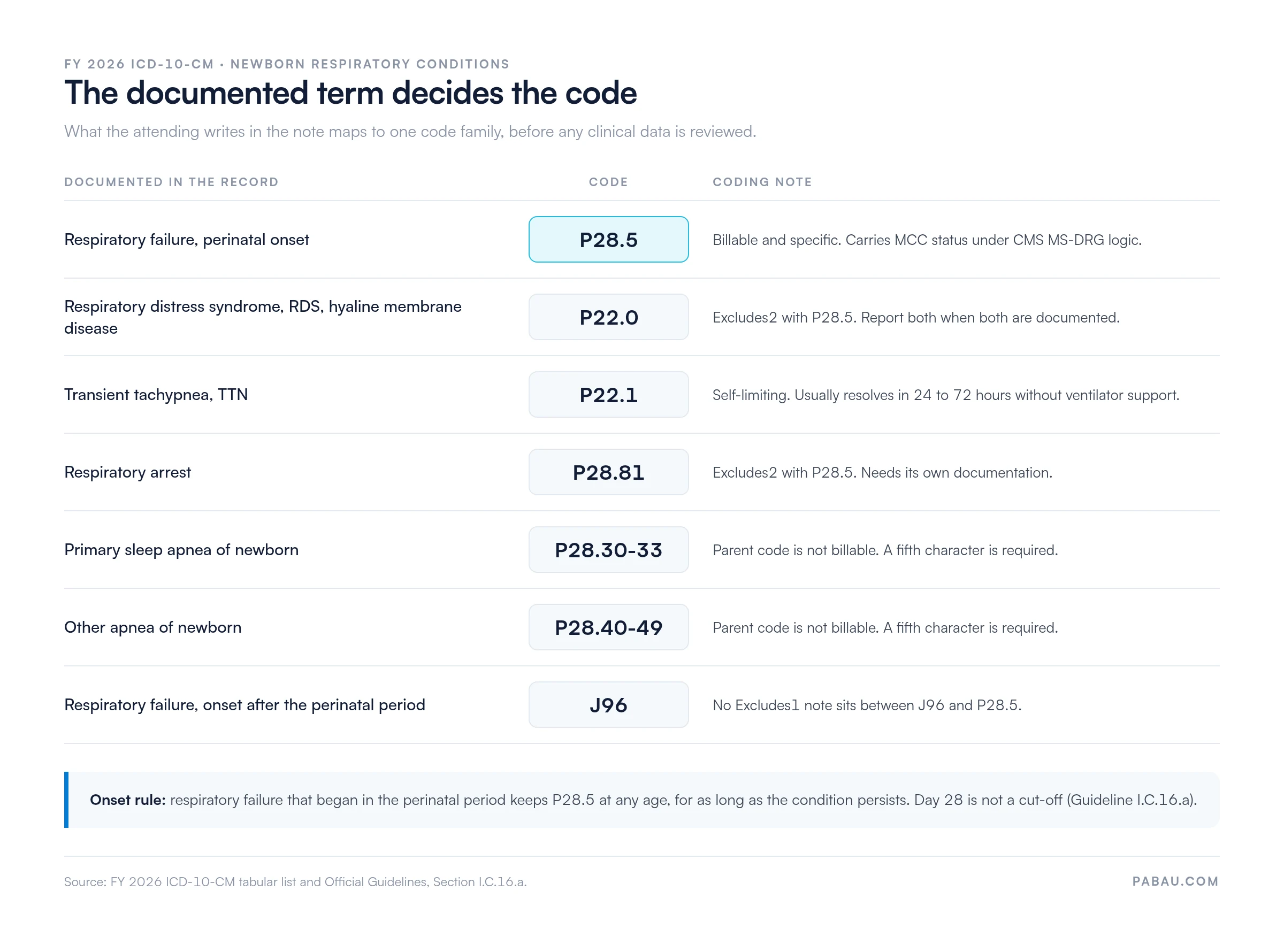
Per ICD-10-CM Official Guidelines Section I.C.16, Chapter 16 codes may only be assigned when the physician has documented the condition. For P28.5 the documentation threshold is higher than for most neonatal codes, because respiratory failure is a severity descriptor with direct MCC and reimbursement consequences.
Before assigning P28.5, confirm all of the following elements are present in the medical record:
When the clinical picture clearly supports respiratory failure but the physician has only documented “distress,” a compliant CDI query is appropriate. The query should present the clinical indicators, including ABG values, ventilator settings, and FiO2 requirements. It then asks the physician to confirm whether the condition meets the criteria for respiratory failure.
Run a structured CDI query checklist on every NICU stay exceeding 48 hours. Flag any record where oxygen support was documented but the note says only ‘distress’ or ‘compromise.’ A one-line physician clarification converts the code from P22.x to P28.5, activating MCC status and improving DRG accuracy without any change to clinical care.
P28.5 sequencing follows ICD-10-CM Chapter 16 guidelines and the UHDDS definition of principal diagnosis. That is the condition established after study to be chiefly responsible for the admission. The sequencing decision depends on the clinical scenario at admission.
The sequencing choice moves money. Coding P28.5 as an additional diagnosis when it was the principal reason for admission shifts the DRG assignment and undercuts the payment the stay earned.
P28.5 carries Major Complication and Comorbidity (MCC) designation under the CMS MS-DRG classification system. P28.5 as a secondary diagnosis qualifies an inpatient claim for a higher-weighted DRG than the same principal diagnosis coded without an MCC. That difference is what raises the payment for the stay. Verify the exact MCC flag and affected DRGs in the current CMS MS-DRG Definitions Manual (FY 2026, v43). These weights are updated annually, so check before quoting a reimbursement figure.
For coders and HIM teams, that makes P28.5 a revenue integrity item rather than a paperwork detail. A NICU admission carrying an MCC-qualifying secondary diagnosis can reimburse materially higher than the same clinical case coded without one. Documentation flagging inside claims management software gives CDI programs a practical way to catch these charts before billing.
The MCC flag only pays if it reaches the payer. Inpatient facility claims leave the hospital as the 837I institutional transaction, which carries the diagnosis codes the grouper reads. Missing or incorrectly attached diagnosis codes at the clearinghouse stage can nullify the MCC benefit even when the UB-04 coding is accurate.
CMS, Medicaid, and most commercial payers follow the same documentation thresholds described in Section I.C.16 of the ICD-10-CM Official Guidelines. Their audit triggers differ, so each payer’s own coverage policy is worth reading before a NICU stay is billed. These requirements apply across most payers for a P28.5 claim to process without a denial or a documentation request:
Claim structure matters as much as the codes themselves. Diagnosis codes, revenue codes, and procedure codes have to reach the payer in the correct relationship on the 837I. Misalignment between the diagnosis field and the revenue code field on the UB-04 is a frequent trigger for payer review on neonatal respiratory claims. Reading the remittance advice on P28.5 claims is the fastest way to spot a payer-specific denial pattern early.
P28.5 denials cluster around a predictable set of documentation and coding errors. The table below lists the most common scenarios, the root cause of each, and the corrective action. Build denial management workflows that address all six patterns before neonatal claims leave the facility.
A pre-submission audit is the cheapest place to catch all six. Check the physician’s language and confirm each P28 code on the claim carries its own documentation. Then align the revenue codes with the level of respiratory support billed.
Understanding where P28.5 sits within the P28 category helps coders navigate adjacent codes without mis-assignment. The full P28 block covers other respiratory conditions originating in the perinatal period. It contains several billable codes that come up in NICU coding reviews. Our wider ICD-10-CM codes index covers the neighboring categories a newborn chart can also require.
When auditing a NICU record that carries multiple P28 codes, verify each one has independent physician documentation. P28.4 (apnea) and P28.5 (respiratory failure) can coexist, but the chart must document both as distinct diagnoses. Apnea alone never qualifies for P28.5 without explicit failure language.
Most NICU billing teams run their documentation checks outside the billing system. Coders work from the chart, a CDI spreadsheet tracks open queries, and the claim is assembled somewhere else again. Each handoff is a chance for a P28.5 query to close after the claim has already gone out.
Pabau, our practice management software, keeps patient records, billing, and claim submission in one system. Claims go out electronically and their status comes back into the same record. A denial on a neonatal claim lands in front of the person who can act on it, with the chart one click away.
Every Pabau subscription includes every feature, so a two-coder pediatric team gets the same claims tools as a multi-site group. Structured onboarding moves your existing coding workflow across rather than asking you to rebuild it.

Pabau’s claims management tools let pediatric and NICU billing teams submit claims electronically, track their status, and see every denial against the patient record.

Accurate P28.5 assignment comes down to the attending’s language. Where the note says respiratory failure and the clinical data supports it, the code stands on its own. Where it says distress, a CDI query is the only compliant route to P28.5.
Onset is the second checkpoint, and it is not a deadline. Respiratory failure that began in the perinatal period keeps its P28 code as the infant grows. Age by itself never forces a switch to J96. Sequencing and the MCC benefit follow from those two decisions.
Pabau’s claims management tools help neonatal and pediatric billing teams run those checks before claims are batched. To see how the workflow fits a NICU billing program, book a demo.

Need a reference for common denial codes on neonatal claims? Denial codes in medical billing covers CARC reason codes and appeal workflows for high-denial-risk diagnoses.
Want to understand how clearinghouse submission affects DRG accuracy? Claim.MD clearinghouse overview explains how 837 claim files carry diagnosis codes to payers and where transmission errors occur.
Looking for a billing compliance framework for complex inpatient claims? Superbill documentation guide outlines the elements required to support multi-diagnosis inpatient claims and reduce audit risk.
ICD-10 code P28.5 is the billable diagnosis code for respiratory failure of newborn. It is assigned when a neonate develops respiratory failure in the perinatal period and needs documented intervention, such as mechanical ventilation, CPAP, or supplemental oxygen. It belongs to ICD-10-CM Chapter 16 (Certain Conditions Originating in the Perinatal Period) and carries MCC status under CMS MS-DRG classification.
Yes, when the respiratory failure originated in the perinatal period. Guideline I.C.16.a directs coders to keep using a Chapter 16 code throughout life while that condition persists. Assign a J96 code instead only when the respiratory failure began after the perinatal period.
Four patterns cover most P28.5 denials. The physician documented respiratory distress rather than respiratory failure. The attending attestation is missing from the record. The revenue codes on the UB-04 do not match the documented level of NICU respiratory support. Sequencing is wrong, with P28.5 as principal when the failure complicated another condition.
No. P28.5 is sequenced as principal diagnosis only when respiratory failure is the condition chiefly responsible for the admission. Where respiratory failure complicates another condition, such as neonatal sepsis or a congenital cardiac defect, the underlying cause is sequenced first. P28.5 is then coded as an additional diagnosis to capture the MCC benefit.