CCSD code L5910: Femorofemoral bypass billing guide
CCSD code L5910: What the code covers CCSD code L5910 is the billing code for a ...

Last Updated: Nov 12, 2026
J1652 is the HCPCS Level II code for injection, fondaparinux sodium, 0.5 mg. It reports Arixtra and its generics, a once-daily subcutaneous factor Xa inhibitor used to prevent and treat venous thromboembolism.
One unit equals 0.5 mg, so the common 2.5 mg prophylaxis dose is 5 units. Weight-based treatment doses of 5, 7.5 and 10 mg bill as 10, 15 and 20 units.
Let Pabau's smart automation suggest the right codes, reduce claim denials, and keep your practice compliant—effortlessly.
Automate repetitive tasks and focus on what matters most—your patients.
Reduce coding errors and ensure compliance with the latest regulations.
Clean claims, fewer denials, and faster reimbursements.
Powerful insights and reporting to help your practice thrive.
HIPAA compliant SOC 2 certified GDPR-compliant Trusted by 4,000+ clinics worldwide

HCPCS Code J1652 reports fondaparinux sodium (Arixtra and its generics), a subcutaneous factor Xa inhibitor used to prevent and treat venous thromboembolism.
One billing unit equals 0.5 mg, so a 2.5 mg prophylaxis dose is 5 units. The 5, 7.5 and 10 mg treatment doses are 10, 15 and 20 units.
Medicare presumes subcutaneous drugs are self-administered, so check your MAC’s self-administered drug exclusion list before billing J1652 to Part B.
Adult doses use the whole syringe and take JZ on Medicare claims. A partial pediatric dose splits into an administered line and a JW line.
The Medicare Part B payment limit for J1652 is $0.798 per unit for October to December 2026, or $3.99 for a 2.5 mg dose.
HCPCS Code J1652 is the Level II code for injection, fondaparinux sodium, 0.5 mg. That descriptor comes from the CMS quarterly HCPCS file, where the code is active with no termination date. It reports Arixtra and its generic equivalents, and each billing unit stands for 0.5 mg of drug given.
Fondaparinux is a synthetic factor Xa inhibitor, injected under the skin once a day to prevent or treat blood clots. The FDA-approved Arixtra label lists four strengths, all in single-dose prefilled syringes. Because the unit is small, the claim always shows twice as many units as milligrams given.
If you reached this page looking for the code for Vonvendi (vonicog alfa), that drug is billed with J7179, not J1652. The two codes sit in different parts of the J-series and describe unrelated products.
Fondaparinux is medically necessary when the record documents one of its FDA-approved uses and none of its contraindications. The label covers the following uses:
The label contraindicates fondaparinux in severe renal impairment (creatinine clearance under 30 mL/min), active major bleeding and bacterial endocarditis. It is also contraindicated for adult VTE prophylaxis when the patient weighs under 50 kg. A claim that carries one of these findings in the same record invites a medical necessity denial.
The label also carries a boxed warning on spinal and epidural hematoma when neuraxial anesthesia or spinal puncture is involved. For surgical prophylaxis, the record should show the first dose given no earlier than 6 to 8 hours after surgery, once hemostasis is established.
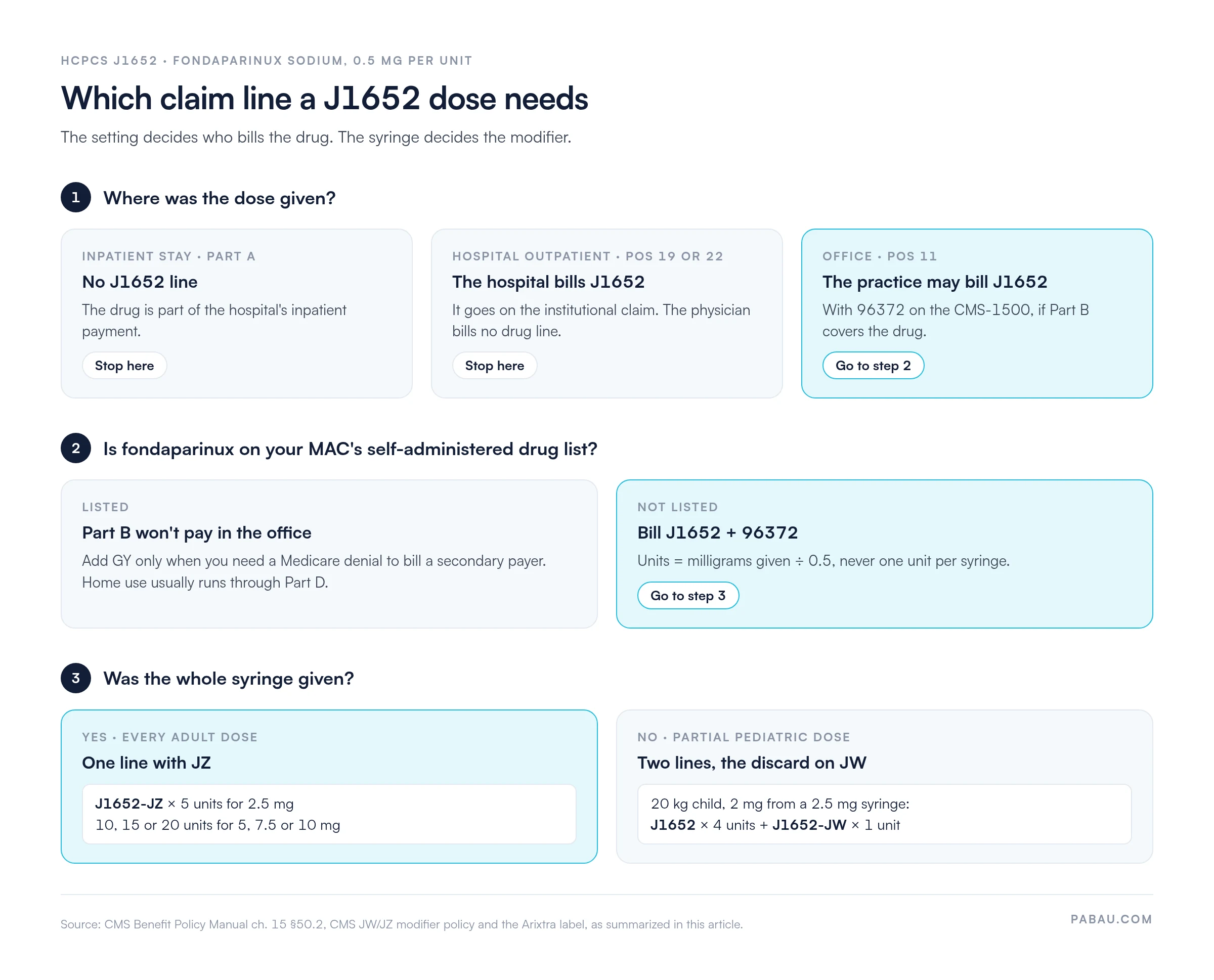
Divide the dose given in milligrams by 0.5 to get the units. A 2.5 mg prophylaxis dose is 5 units, never 1 unit for one syringe. Adult treatment doses follow body weight: 5 mg under 50 kg, 7.5 mg from 50 to 100 kg, 10 mg over 100 kg.
These conversions match the billing units per package that CMS lists against each fondaparinux NDC in its October 2026 ASP NDC-HCPCS crosswalk.
Pediatric dosing is 0.1 mg/kg once daily, so a child’s dose often leaves drug in the syringe. A 20 kg child receives 2 mg from a 2.5 mg syringe. Report 4 units as administered and 1 unit with JW for the 0.5 mg discarded.
Record the dose in milligrams, not as “one syringe”, in the administration note. Coders convert milligrams to units, and a note that only names the syringe leaves the unit count open to challenge.
Report the 11-digit National Drug Code in 5-4-2 format next to J1652 on the claim line. Arixtra’s 2.5 mg carton prints NDC 67457-592-10, which becomes 67457-0592-10 once a zero pads the product segment.
Generic fondaparinux from other labelers carries its own NDCs, all of which CMS maps to J1652 in the ASP NDC-HCPCS crosswalk.
California capitated plans add one more check, the Division of Financial Responsibility (DOFR). The DOFR matrix in the provider contract decides whether the health plan, the medical group or the hospital pays for an injectable drug. Billing J1652 to the wrong party under the DOFR leads to a denial even when the claim is otherwise clean.
Medicare requires a drug wastage modifier on separately payable Part B drugs from single-dose containers, which includes fondaparinux syringes.
Under the CMS JW and JZ modifier policy, JZ became required on July 1, 2023, after a voluntary period that began on January 1, 2023. Claims edits that reject a missing modifier started on October 1, 2023.
When drug is discarded, bill two lines: the administered units with no wastage modifier, and the discarded units with JW. When nothing is discarded, bill one line with JZ. Getting these lines right before submission is a large part of clean claim submission on drug codes.
Medicare Part B covers J1652 only when fondaparinux is not usually self-administered, and that is the main coverage question for this code. The Medicare Benefit Policy Manual, chapter 15, section 50.2 tells MACs to presume that drugs given by subcutaneous injection are self-administered. “Usually” means more than 50% of the time for all Medicare beneficiaries who use the drug.
Each MAC publishes its own self-administered drug (SAD) exclusion list, so the answer can differ by jurisdiction. If your MAC lists fondaparinux, Part B will not pay the drug when it is given in the office. Patients injecting at home are usually covered through their Part D plan instead.
Setting changes the claim as well:
Combined with the SAD list and the wastage modifiers, the setting rules come down to three questions. The chart below takes them in the order a biller meets them.
Traditional Medicare does not require prior authorization for J1652. Medicare Advantage, Medicaid managed care and commercial plans set their own rules, and some list fondaparinux among drugs needing approval. Check the plan’s current drug list before the first dose.
The diagnosis on the claim should match the documented reason for anticoagulation. There is no ICD-10-CM code for “DVT prophylaxis” itself. Prophylaxis claims point to the surgery or the condition that created the risk, and our ICD-10-CM code reference covers the full library.
When the record names the affected vein, code the DVT to that vein rather than the “unspecified deep veins” codes above. Payers and LCDs differ on which diagnoses they accept for fondaparinux.
The Medicare Part B payment limit for J1652 is $0.798 per unit from October 1 to December 31, 2026. That figure comes from the CMS ASP pricing file for the quarter. CMS sets it from second-quarter 2026 average sales price data and updates it every quarter. The patient’s coinsurance on this code is 20%.
CMS notes in the same file that a listed payment limit does not mean Medicare covers the drug. The local MAC makes that call, which brings the SAD list back into play. Commercial rates follow each payer contract, so confirm the fee schedule before relying on these figures.
The low unit price also changes what a denial costs. A rejected 2.5 mg line is worth less than $4, which can be less than the cost of reworking the claim. Setting the code up correctly once is cheaper than appealing it claim by claim.
J1652 sits in a run of anticoagulant codes, and each one bills by a different unit. Billing a heparin or enoxaparin dose under J1652, or the other way round, misstates both the drug and the units.
The NDC on the carton settles any doubt. If it maps to J1650 or J1645 in the CMS crosswalk, that code is the right one, whatever the charge master says. The injection itself is billed separately with CPT 96372 in the office setting.
J1652 denials usually trace back to a setup or data-entry error rather than a coverage dispute. The lasting fix is to correct the cause in the charge master, not only the single claim.
The superbill alone does not support a J1652 claim. The medical record needs these elements:
On a J1652 claim, the errors that cost money start at the bedside. A syringe recorded without milligrams, a missing lot or a wrong NDC all surface later as denials.
Pabau, the practice management and billing platform we build, keeps the record and the claim together. Stock carries a batch number and expiry date, and the lot is recorded against the patient and the appointment. US claims go out as 837P files through the Claim.MD clearinghouse, using Pabau’s claims management software.
Eligibility checks and ERA remittances come back against the same patient record. Prior authorization codes, dates and sessions sit on the case, with a warning when one is missing. Your billing team sees a J1652 rejection the day it lands, not at month-end.

Pabau records the lot against each patient visit and sends US claims through Claim.MD. Eligibility, remittances and authorizations come back to the same record.

For J1652, the coding is the easy part. The 0.5 mg unit converts cleanly, and adult doses use the whole syringe. The harder question is whether Medicare Part B pays for the drug at all, given the self-administered presumption.
Check your MAC’s SAD list once, and set the code up to match the answer. Put the dose in milligrams and the NDC from the carton into every note. Book a demo to see how Pabau links the injection record to the claim for drug codes like J1652.

Need a denial management framework for your billing team? Denial management in healthcare covers root-cause workflows and resubmission strategies for common claim rejection patterns.
Looking for a plain-English guide to the billing cycle? What is revenue cycle management explains how drug claims fit into the end-to-end billing process from service delivery to payment posting.
Want to understand what makes a drug claim clean before submission? Clean claim submission outlines the data elements payers require on every professional claim line, including injectable drug codes.
HCPCS Code J1652 represents fondaparinux sodium, sold as Arixtra and as several generics. Its official descriptor is “Injection, fondaparinux sodium, 0.5 mg”. Fondaparinux is a synthetic factor Xa inhibitor given by subcutaneous injection to prevent and treat venous thromboembolism.
Bill 5 units for a 2.5 mg dose, because one unit equals 0.5 mg. The 5 mg, 7.5 mg and 10 mg treatment doses are 10, 15 and 20 units. Never bill 1 unit per syringe.
Yes, on Medicare claims where J1652 is separately payable. JZ became required on July 1, 2023, with claims edits from October 1, 2023. Use JZ when the whole syringe is given. Use JW on a separate line for any discarded amount.
It depends on your MAC. CMS tells contractors to presume that subcutaneous drugs are self-administered. A MAC that lists fondaparinux on its self-administered drug exclusion list will not pay it under Part B in the office.
From October 1 to December 31, 2026, the Part B payment limit is $0.798 per unit. That makes a 2.5 mg dose $3.99 and a 7.5 mg dose $11.97. CMS updates the limit every quarter.
No. Vonvendi (vonicog alfa, recombinant von Willebrand factor) is billed with J7179. J1652 is only for fondaparinux sodium.
In the office, bill CPT 96372 for the subcutaneous injection alongside J1652. In a hospital outpatient department, the hospital bills the drug on its own claim. The physician bills no drug line there.