ICD-10 code Y83.0: Surgical operation with whole organ transplant
ICD-10 code Y83.0 names the transplant as the cause, not the problem ICD-10 code...

Last Updated: Nov 19, 2026
Billable Code Specific Code
I73.9 is the billable ICD-10-CM code for peripheral vascular disease, unspecified. Coders use it when the provider documents PVD or PAD without naming a cause, such as atherosclerosis or diabetes.
It sits in Chapter 9 (Diseases of the circulatory system), block I70-I79, and is valid for FY 2027 claims. Its tabular inclusion terms are intermittent claudication, peripheral angiopathy NOS and spasm of artery. Once atherosclerosis of the extremities is documented for the encounter, the I70.2- series replaces it.
Let Pabau's smart automation suggest the right codes, reduce claim denials, and keep your practice compliant—effortlessly.
Automate repetitive tasks and focus on what matters most—your patients.
Reduce coding errors and ensure compliance with the latest regulations.
Clean claims, fewer denials, and faster reimbursements.
Powerful insights and reporting to help your practice thrive.
HIPAA compliant SOC 2 certified GDPR-compliant Trusted by 4,000+ clinics worldwide

I73.9 codes peripheral vascular disease when the provider names no cause, so it is not a default for every limb circulation problem.
Atherosclerosis of the extremities documented for the encounter moves the claim to I70.2- through I70.7-, because I73.9 carries an Excludes1 note for it.
When the provider links peripheral angiopathy to diabetes, report the E08-E13 .51/.52 combination code instead of I73.9.
Pabau, a practice management platform, submits claims through Claim.MD, with real-time eligibility checks, status tracking and ERA remittances in Pabau.
ICD-10 Code I73.9 is the billable ICD-10-CM code for peripheral vascular disease, unspecified. It is listed in the CMS FY 2027 ICD-10-CM code files, which apply from October 1, 2026, through September 30, 2027. Coders assign it when the provider documents PVD or PAD without naming a cause, such as atherosclerosis or diabetes.
Coders checking neighboring circulatory codes can browse the ICD-10-CM library for coders. Every code there links to its own descriptor, notes and billing guidance.
I73.9 covers peripheral vascular or arterial disease when the provider documents no specific etiology in the clinical note. The code is meant for encounters where the documentation leaves the cause unspecified. It is not a default for every limb circulation problem.
The ICD-10-CM tabular list names three inclusion terms for I73.9:
Documentation like this typically lands on I73.9 when no more specific code applies:
The deciding word throughout is “unspecified.” Once the provider names a cause, such as atherosclerosis, diabetes or Buerger disease, a different code takes over.
Category I73 carries Excludes2 notes, and I73.9 itself carries an Excludes1 note for atherosclerosis of the extremities. Missing these notes is a fast route to a denied claim or a payer audit.
The Excludes1 note for atherosclerosis has the biggest effect on claims. If the provider documents atherosclerosis of the extremities for this encounter, I73.9 cannot be reported. The four checks below run in the order a coder should apply them.
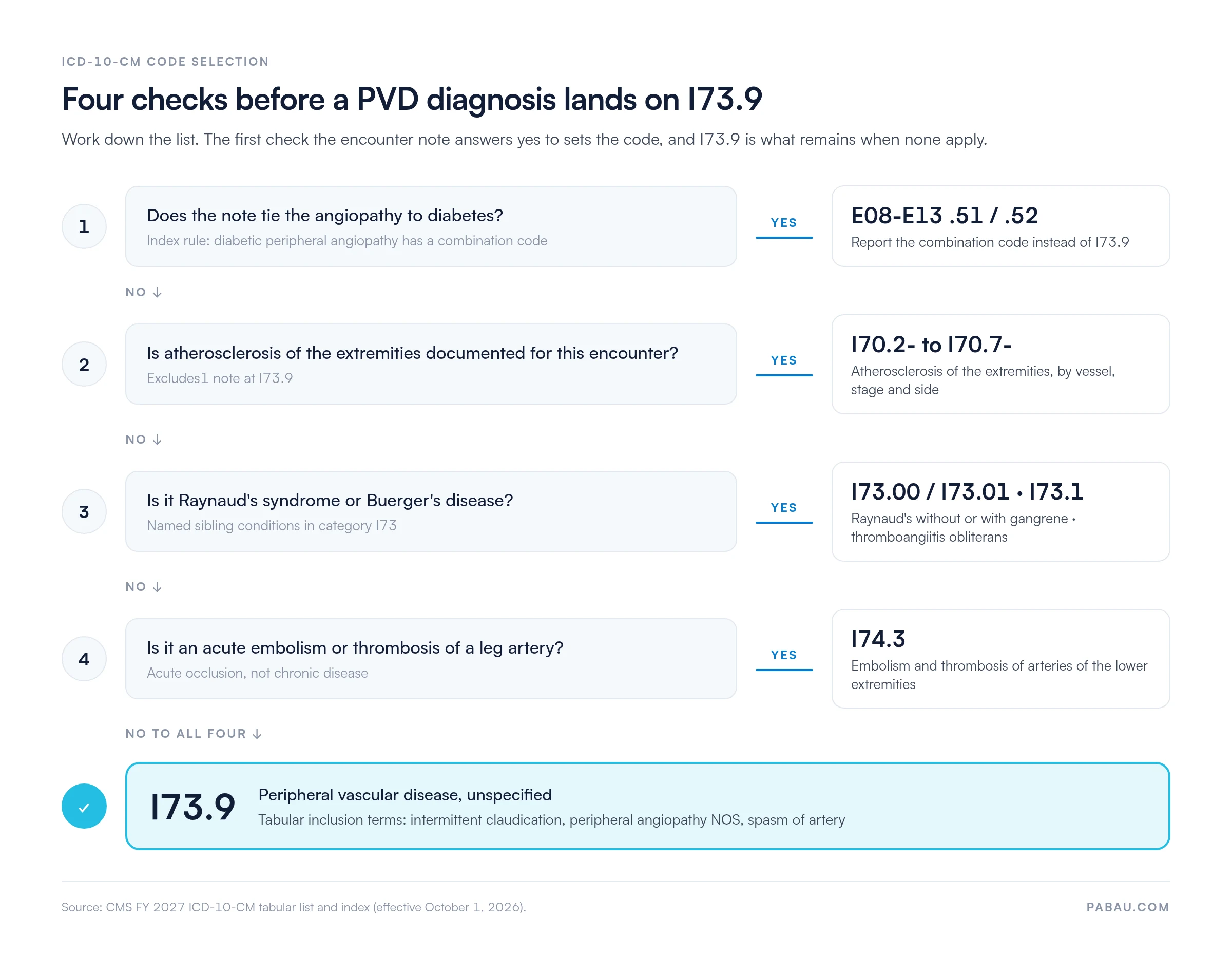
Several codes cover overlapping vascular territory. The table below shows the distinctions coders need when deciding whether I73.9 is correct, or whether a sibling or adjacent code fits better.
The ICD-10-CM Official Guidelines for Coding and Reporting govern when I73.9 can be used. The core rule is to apply I73.9 only when the provider has not specified the etiology of the vascular disease. Sound medical billing compliance means never assigning I73.9 when the documentation supports a more specific code.
Payer reviews of I73.9 focus on whether the note justifies the “unspecified” designation. Unspecified codes are valid, but they draw extra scrutiny. Submitting a clean claim with I73.9 requires the physician note to contain each of the following elements.
Query the physician before assigning I73.9 when atherosclerosis or diabetes appears in the problem list but not in the assessment. The answer settles whether that condition applies to this encounter. A corrected claim costs far more than a brief provider query at the time of coding.
These CPT codes pair regularly with ICD-10 Code I73.9 in outpatient vascular and primary care settings. Medical necessity for each procedure rests on the documented severity of the peripheral vascular disease.
The limited bilateral arterial study bills as CPT 93922, and the complete bilateral arterial duplex bills as CPT 93925. Both guides cover the documentation each study needs.
Payer rules for I73.9 vary by Medicare Administrative Contractor (MAC) jurisdiction and commercial plan. The common thread is that unspecified codes attract more documentation scrutiny than specific ones, especially when they support an intervention. Vascular practices do best when the note answers that scrutiny before the claim goes out.
Claims carrying ICD-10 Code I73.9 can draw more scrutiny than claims with a more specific diagnosis. The code is valid, but payers often want to see the cause documented. The patterns below are common I73.9 denial triggers, each with its corrective action.
Effective denial management workflows for vascular practices include a pre-submission edit check. It flags I73.9 on any endovascular CPT code before the claim leaves the practice.
Audit a sample of claims that pair I73.9 with an endovascular code from 37220-37235. Check whether the assessment for those encounters named atherosclerosis or diabetes. A pattern of matches points to coders under-querying physicians, which a short documentation session can address.
The WHO ICD-11 classification restructures peripheral vascular disease into a more granular hierarchy. Its equivalent for unspecified peripheral arterial disease sits in the circulatory system chapter. ICD-11 adds specificity options for etiology and clinical stage that ICD-10-CM lacks.
The United States has not set a mandatory ICD-11 transition date as of FY 2027. CMS continues to update ICD-10-CM annually, and CMS and NCHS have not published a US ICD-11 adoption timeline. Coders should watch CMS and CDC announcements, but they do not need to map I73.9 to ICD-11 for current claims.
When US adoption does come, it will require coding software updates, crosswalk mapping and payer policy revisions, much like the ICD-9 to ICD-10 migration. Practices that track the CMS ICD-10-CM update files and use integrated billing platforms will handle that transition with less claim disruption.
Much of the rework on an I73.9 claim happens after submission. Eligibility turns out to be stale, or a denial sits in a clearinghouse portal that nobody checks daily.
Pabau keeps that work beside the patient record through its vascular practice claims software. It submits CMS-1500/837P claims through the Claim.MD clearinghouse to thousands of US payers. Real-time eligibility checks, status tracking and ERA remittances all stay in Pabau.
Prior authorizations sit on the patient’s case too, with the auth code, dates and sessions tracked. Pabau warns staff when an authorization is missing, which matters before a duplex study or an endovascular procedure.

Pabau connects claim creation, eligibility verification, and clearinghouse submission through Claim.MD. Your vascular coding team spends less time fixing denials and more time getting paid.

I73.9 belongs on a claim only when the provider has assessed the patient and still named no cause. Treat it as a deliberate choice that the note supports, and the scrutiny it draws stays manageable.
The trade-off is a minute at coding against a resubmission later. A quick query about atherosclerosis or diabetes costs less than a corrected endovascular claim and a second payer review.
Pabau keeps eligibility checks, Claim.MD submission and ERA remittances in the same system as the patient record. Book a demo to see how your team can work vascular claims from one place.

Need a full picture of how clearinghouse submission works? Medical claims clearinghouse guide explains the end-to-end 837P claim lifecycle from submission to ERA receipt.
Seeing high denial rates across your vascular billing? Denial codes in medical billing breaks down the most common CARC denial reason codes and what each one requires to appeal.
Want to understand the 837 file your clearinghouse transmits? 837 file guide covers the EDI transaction set structure used for all professional claim submissions.
Billing a complete arterial study? CPT 93923 covers the multi-level bilateral physiologic study that often follows an abnormal ABI.
Coding a tibial or peroneal intervention? CPT 37228 walks through the documentation an endovascular revascularization claim needs.
ICD-10 Code I73.9 is the billable ICD-10-CM diagnosis code for peripheral vascular disease, unspecified. Coders use it when a physician documents peripheral arterial or vascular disease without naming a cause, such as atherosclerosis or diabetes. It is valid for FY 2027 submissions and maps to ICD-9-CM 443.9.
Yes. I73.9 is a billable ICD-10-CM code in the CMS FY 2027 tabular list and is valid for claim submission. Its parent category I73 is not billable, so I73.9 is the code that must appear on the claim.
I73.9 applies when peripheral vascular disease is documented without a specified cause. I70.209 applies when the provider documents atherosclerosis of the native arteries of the extremities, even without laterality. Once atherosclerosis of the extremities is documented for the encounter, an I70.2- code replaces I73.9, and the two are not reported together.
Yes. Intermittent claudication is one of the tabular inclusion terms for I73.9, so it applies when no etiology is specified. If the physician documents atherosclerosis as the cause, the correct code is I70.219 or a laterality-specific I70.21- code instead.
The most common reasons are using I73.9 when the chart documents atherosclerosis of the extremities, or missing vascular study documentation. Others include reporting I73.9 instead of the diabetic combination code, and MAC LCD policies that require a more specific diagnosis for interventions. The denial table in this article lists the corrective action for each.