



HCPCS code E0198: Water pressure pad billing guide
HCPCS code E0198 is a water pad for a standard mattress HCPCS code E0198 is the ...

Last Updated: Oct 13, 2026

CPT Code 93925 describes a complete bilateral duplex scan of lower extremity arteries or arterial bypass grafts. The study combines B-mode imaging, Doppler spectral analysis, and color flow mapping.
93925 requires documentation confirming both limbs were evaluated. Billing this code when only one limb was scanned is the most common audit trigger and denial cause.
Accepted ICD-10 pairings include I73.9, I70.209, I70.219, and related peripheral arterial disease codes. Payer acceptance varies by MAC jurisdiction, so verify the applicable LCD before billing.
Practice management software like Pabau supports clean claim submission for vascular duplex studies. It attaches supporting ICD-10 codes, applies modifiers, and flags missing documentation before a claim goes out.
CPT Code 93925 is the procedure code for a complete bilateral duplex scan of the lower extremity arteries or arterial bypass grafts. It covers both legs in a single session, using B-mode imaging, Doppler spectral waveform analysis, and color flow mapping. Incomplete documentation of any of those elements is the fastest route to a denial.
This reference guide covers the code definition, clinical indications, and accepted ICD-10 pairings. It also covers Medicare fee schedule rates, modifier usage, documentation requirements, and the errors that most often trigger rejections.
CPT Code 93925 describes a duplex scan of lower extremity arteries or arterial bypass grafts, complete bilateral study. The descriptor is maintained by the American Medical Association (AMA) CPT Editorial Panel.
The procedure uses real-time ultrasound to evaluate blood flow through both legs, and it relies on three imaging components.
All three components must be performed and documented for the claim to meet medical necessity standards. A scan that omits color flow mapping, for example, does not satisfy the full descriptor and should not be billed as CPT Code 93925.
Use this table as an at-a-glance reference before building a claim for CPT Code 93925.
Coverage for CPT Code 93925 is driven by Local Coverage Determinations (LCDs) issued by individual Medicare Administrative Contractors (MACs). Because LCD criteria vary by jurisdiction, always verify the applicable LCD before billing. These clinical indications are broadly accepted across most MAC policies.
The Centers for Medicare & Medicaid Services (CMS) requires that the ordering provider’s documentation clearly state the clinical indication. A referral that lists only “leg pain” without connecting it to vascular pathology is a common reason for medical necessity denials.
Choosing between CPT Code 93925 and its sibling code 93926 depends entirely on the scope of the study performed. Billing 93925 when only one limb was evaluated is the single most common audit trigger for vascular duplex claims.
CPT Code 93925 sits within a family of non-invasive vascular study codes. Knowing the adjacent codes helps coders select the right one and avoid unbundling issues.
Every code in the table above describes a non-invasive study. When a patient goes on to catheter angiography of both legs, its radiological supervision and interpretation is reported with 75716 instead.
Pairing CPT Code 93925 with an accepted ICD-10 diagnosis code is a prerequisite for demonstrating medical necessity. The codes below are commonly accepted across most MAC LCD policies for this procedure. Payer-specific acceptance varies, so confirm the applicable LCD before billing.
Exclusion notes decide several of these pairings, and they change between subcategories. Look each diagnosis up in the ICD-10-CM code set before you attach it to a 93925 claim.
Medicare payment for CPT Code 93925 varies by geographic location and MAC jurisdiction. It also depends on whether the claim is billed globally, under modifier 26, or under modifier TC. The CMS Physician Fee Schedule lookup tool provides current rates by locality.
The 2026 non-facility rate reflects a total of 7.11 RVUs at the $33.4009 conversion factor. For RVU-based calculations of your own, the FastRVU 2026 lookup tool pulls current CMS work, practice expense, and malpractice components.
Rates above are approximate national averages based on CMS data. Verify current rates using the CMS fee schedule lookup or FastRVU before submitting claims. Medicare reports its payment decisions and adjustment codes back to providers on 835 electronic remittance advice files.
Selecting the correct modifier for CPT Code 93925 determines whether a claim pays at the global, professional, or technical rate. Applying the wrong modifier is one of the top audit triggers for vascular duplex billing. Use the decision guide below to route each claim correctly.
The two decisions run in sequence, code first and modifier second. The chart below routes a finished study to one code and one modifier.
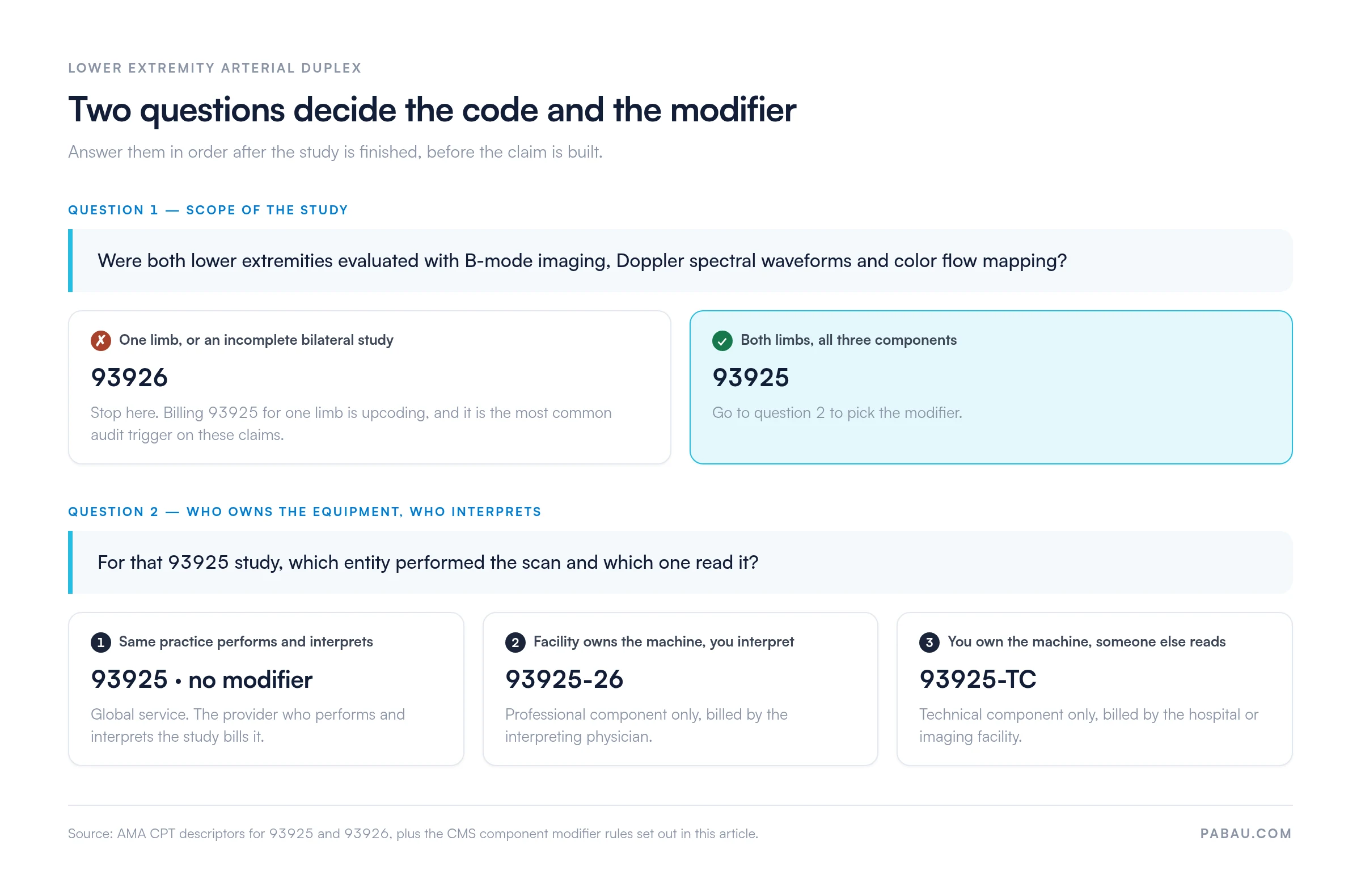
Incomplete documentation is the leading cause of medical necessity denials for vascular duplex studies. Capturing the required elements at the point of care beats reconstructing a record during an audit. Every CPT Code 93925 claim requires the following.
According to CMS LCD guidance, the report must document the specific vessels evaluated and the waveform findings at each level. It must also note any areas of stenosis or occlusion. A report that states only “bilateral lower extremity duplex completed, normal” without vessel-level detail is considered insufficient documentation by many MACs.
Run a pre-submission documentation audit on every 93925 claim before it leaves your billing queue. Check for bilateral confirmation language in the report, all three imaging components, and a supporting ICD-10 code that maps to vascular pathology. Catching a missing element before submission costs minutes. Fixing a denial takes days.
Vascular duplex claims carry a higher-than-average denial rate. The bilateral requirement and the documentation checklist create several failure points in one claim. The most frequent errors for CPT Code 93925 are below.
Submitting a clean claim from the outset reduces the rework burden on billing teams. The CARC and RARC codes on an 835 remittance file tell you which of the errors above a payer found.
Medicare coverage for CPT Code 93925 is governed by MAC-issued Local Coverage Determinations, not a single national policy. Coverage indications, frequency limits, and documentation requirements vary between MACs. Two practices in different states may face different LCD criteria for the same code.
The Society for Vascular Surgery and the American Institute of Ultrasound in Medicine publish clinical practice guidelines for these studies. Those guidelines can support a medical necessity argument on appeal when a payer denies a 93925 claim.
A vascular practice billing 50 or more duplex studies a month runs into a compounding problem. Small errors at the documentation stage surface as denial backlogs weeks later, once the original encounter context is gone. Catching them before claims leave the system is what keeps reimbursement predictable.
Practice management software like Pabau integrates with Claim.MD, our US clearinghouse partner, to route claims to thousands of US payers via 837P electronic submissions.
The integration also supports real-time eligibility checks before a study is performed. Staff can confirm coverage and pre-authorization rules for the patient’s payer and locality before the appointment.
Pabau’s claims management software lets billing teams attach supporting ICD-10 codes directly to a procedure, apply modifiers, and review documentation checklists before submission. Electronic remittance advice arrives as 835 ERA files, so denial reason codes appear in the same system that submitted the claim. That cuts the lookup time on every denial.


From eligibility checks to ERA-based denial tracking, Pabau’s claims workflow is built for practices billing complex procedure codes like 93925. Book a demo to see it in action.

Billing errors for CPT Code 93925 almost always trace back to one of two sources. Either a unilateral study was billed as bilateral, or the report failed to confirm all three imaging components. Both are fixable at the point of care rather than in the appeals queue.
The practical move is to make that check part of the scan itself. If the technologist cannot sign off on bilateral coverage and all three components, the claim should not go out as 93925.
Practices that hold the line there spend far less of the month reworking denials. Book a demo to see how Pabau flags an incomplete 93925 claim before it reaches the payer.

Need a clearinghouse that reaches thousands of US payers? Claim.MD vs Office Ally compares the two leading clearinghouse options for practices submitting vascular and specialty claims.
Want to reduce denial rates across your practice? 837 file submission guide explains how electronic claim files work and where common formatting errors trigger rejections.
Researching billing software options for a vascular or specialty practice? Best medical billing software in the US reviews the leading platforms with a focus on claims accuracy and clearinghouse integration.
CPT Code 93925 covers a complete bilateral duplex scan of the lower extremity arteries or arterial bypass grafts. The study uses B-mode imaging, Doppler spectral waveform analysis, and color flow mapping. All three imaging components must be performed on both limbs for the code to be correctly applied.
CPT 93925 is used for a complete bilateral lower extremity arterial duplex scan of both legs. CPT 93926 is used when only one limb was evaluated or the study was incomplete. Billing 93925 when only one limb was scanned is upcoding and a common audit trigger.
Commonly accepted ICD-10 codes include I73.9 (peripheral vascular disease, unspecified) and I70.209 (atherosclerosis of native arteries, unspecified extremity). Others include I70.219 (with intermittent claudication), I70.229 (with rest pain), and Z95.9 (graft surveillance). Payer acceptance varies by MAC and LCD, so always verify before billing.
Modifier 26 is appended when billing only the professional interpretation component. Modifier TC is appended when billing only the technical component. Global billing carries no modifier and applies when the same provider performs the study, interprets it, and owns the equipment. Modifier 59 may indicate a distinct procedural service where there is documented clinical justification.
Yes, Medicare covers CPT 93925 for peripheral arterial disease evaluations, subject to Local Coverage Determination criteria that vary by MAC jurisdiction. Clinical indications including claudication, rest pain, non-healing wounds, and graft surveillance are broadly accepted. The ordering provider’s documentation must still state a vascular indication to establish medical necessity.
No. CPT 93925 and 93926 are mutually exclusive for the same anatomical area. NCCI bundling edits apply when they are billed on the same date. Billing both without documented justification for a separate and distinct service is a denial risk and a potential compliance issue.



