CPT Code 96573: Photodynamic therapy billing guide
CPT Code 96573: Definition and official descriptor CPT Code 96573 is a medicine/...

Last Updated: Nov 13, 2026
83525 is the CPT code for insulin; total. It reports a laboratory measurement of total insulin in serum or plasma, by any immunoassay method.
Clinicians order it most often for insulin resistance workups, polycystic ovary syndrome (PCOS) evaluation, and prediabetes screening. It is commonly denied under CO-50 when the submitted ICD-10-CM diagnosis does not appear on the applicable Local Coverage Determination (LCD).
Let Pabau's smart automation suggest the right codes, reduce claim denials, and keep your practice compliant—effortlessly.
Automate repetitive tasks and focus on what matters most—your patients.
Reduce coding errors and ensure compliance with the latest regulations.
Clean claims, fewer denials, and faster reimbursements.
Powerful insights and reporting to help your practice thrive.
HIPAA compliant SOC 2 certified GDPR-compliant Trusted by 4,000+ clinics worldwide

CPT code 83525 reports total insulin measured by immunoassay, while free insulin is reported with CPT 83527.
A covered ICD-10-CM diagnosis from the applicable MAC LCD must be on the claim. E11.9, R73.03, R73.09, E28.2, E88.810 and E16.1 are accepted most often.
CO-50 (not medically necessary) is the most common denial, and the fix is matching the submitted diagnosis to the LCD’s covered-diagnosis list.
Pabau, the practice management platform we build, submits US claims through Claim.MD, covering 837P claims, eligibility checks and ERA remittances.
CPT code 83525 is the American Medical Association’s (AMA’s) code for measuring total insulin in serum or plasma, with the official descriptor Insulin; total.
Only the AMA creates and maintains the CPT code set, as the AMA’s CPT coding resources state. The code sits in the Pathology and Laboratory section (80047-89398), within the Chemistry subsection (82009-84999). It covers any immunoassay method used to quantify insulin, including radioimmunoassay (RIA), chemiluminescent immunoassay (CLIA), and electrochemiluminescence immunoassay (ECLIA).
“Total” means the assay captures bound and free insulin together, which is the clinically relevant measure for most metabolic workups. The specimen type is serum or plasma; whole blood is not standard for this code.
CPT code 83525 covers total insulin; CPT code 83527 covers free insulin, the fraction not bound to antibodies or proteins. These are distinct analytes with different clinical applications, and submitting the wrong code for the ordered test is an audit risk.
When both are billed on the same date of service, the record must show that the ordering provider requested each fraction separately. Each one also needs its own clinical rationale. A single note stating “insulin level” without specifying the fraction is insufficient. It can trigger a medical-necessity (CO-50) or records-request denial, or a CO-97 bundling denial if both codes are billed without distinct support.
The most common driver is insulin resistance evaluation, particularly when HOMA-IR (Homeostatic Model Assessment of Insulin Resistance) is being calculated. HOMA-IR requires a simultaneous fasting insulin and fasting glucose value, so CPT 83525 and CPT 82947 are ordered together as a pair. Documenting the clinical rationale for the dual order when the tests are ordered prevents billing confusion later.
Laboratory codes in the Chemistry subsection are analyte-specific, so each distinct test ordered takes its own code. The indications below are the clinical scenarios MAC LCDs accept most often.
Payers cross-reference the submitted diagnosis code against the covered-diagnosis list in the applicable MAC LCD. If the submitted ICD-10-CM code does not appear on that list, the claim generates a CO-50 denial regardless of clinical justification. The table below reflects the codes most commonly listed across published MAC LCDs for insulin laboratory testing. Code to the highest specificity the CDC/NCHS ICD-10-CM web tool offers. Submitting E11.9 (type 2 diabetes without complications) is acceptable in many LCDs, but some MACs require a complication-specific code. Check the LCD for your jurisdiction before defaulting to the unspecified code.
Always look up the specific MAC LCD for your state before submitting. Many MACs publish an attached article listing all covered and non-covered diagnoses for insulin lab testing. If your diagnosis appears only on the non-covered list, issue an Advance Beneficiary Notice (ABN) before the draw so the patient can authorize self-pay.
Accurate submission requires correct place-of-service codes, a clear ordering provider signature, and documentation of the fasting status when the assay requires it. Sound revenue cycle management starts with getting these elements right at the point of order, not at the time of claim scrubbing.
The Centers for Medicare and Medicaid Services (CMS) set the payment amount for CPT 83525 annually through the Clinical Laboratory Fee Schedule (CLFS). The national limitation amount changes each calendar year. A dollar figure written here would soon be outdated. Use the CMS CLFS annual update files for the current rate — CMS publishes the new schedule each November for the following year. Geographic payment adjustments (locality modifiers) apply; the rate in a high-cost metro area differs from a rural MAC jurisdiction.
There is no National Coverage Determination (NCD) for insulin testing. Coverage is therefore governed entirely by MAC-level Local Coverage Determinations (LCDs), so check the patient’s MAC LCD before every 83525 order. On the submission side, Pabau sends US claims through Claim.MD (837P claims, eligibility checks, ERA remittances).
Key coverage principles that most MAC LCDs share:
Because there is no NCD for insulin testing, each Medicare Administrative Contractor (MAC) may publish its own LCD or billing article. Examples include Novitas (jurisdictions H and L) and CGS (jurisdiction 15). Search the CMS Coverage Database for the one that lists 83525.
Working with a medical claims clearinghouse gives you real-time access to payer-specific edits before submission, reducing the volume of denials that require manual appeal. Here is how to locate the applicable LCD for any given claim:
The most preventable denials for CPT 83525 share one root cause: A mismatch between the submitted diagnosis and the LCD’s covered-diagnosis list. Sound denial management workflows treat this check as a pre-submission gate, not a post-denial correction task. Each of the four common denial codes in medical billing for this test maps to one check you can run before submission.
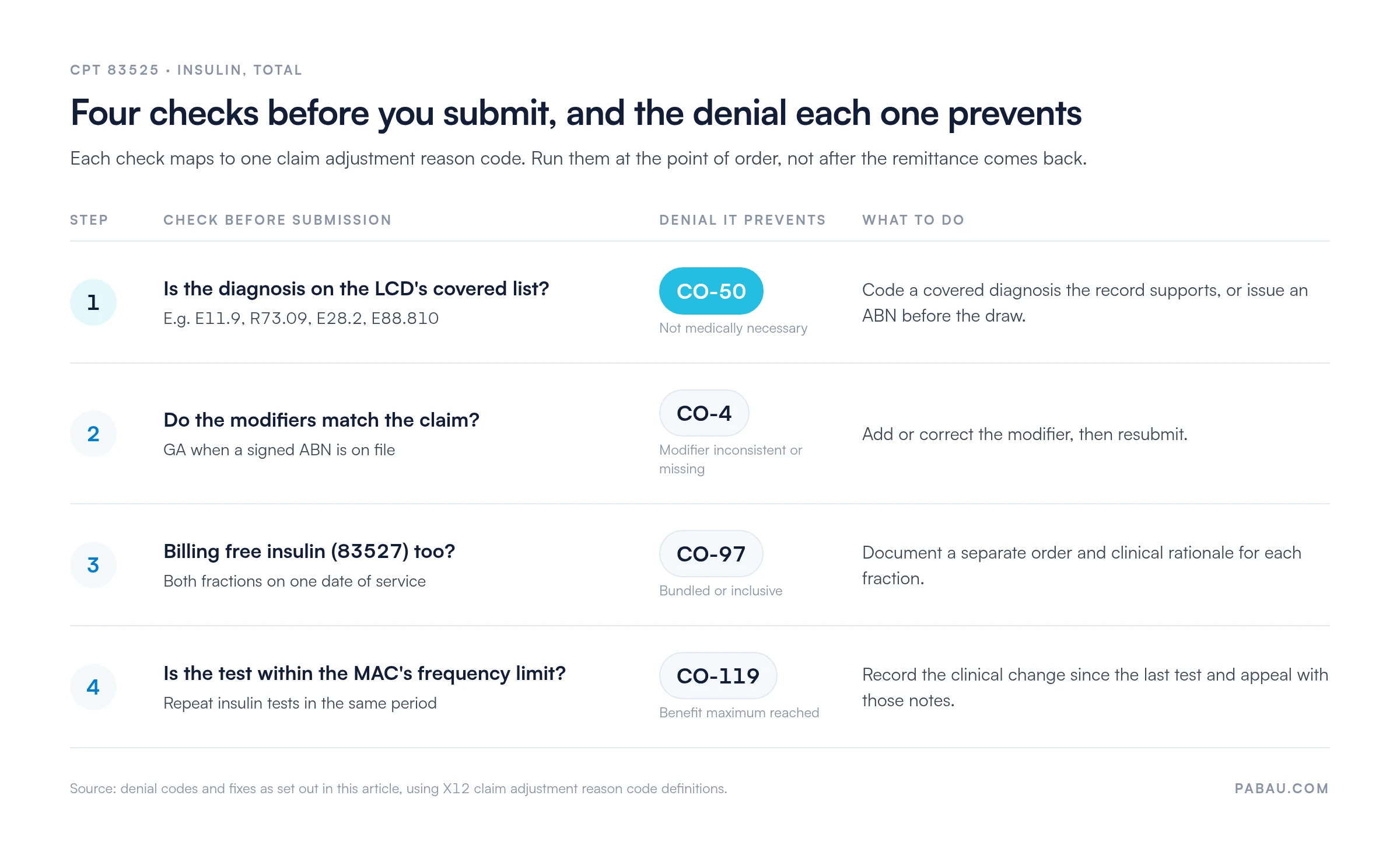
The table below gives the full reason behind each code and the corrective action once the denial has arrived.
CPT code 83525 and glucose test CPT 82947 are not bundled under the current National Correct Coding Initiative (NCCI) edit tables. Both may be reported on the same date of service when both are ordered and performed. This is the most common pairing for submitting a clean claim for a HOMA-IR calculation: 83525 for total insulin and 82947 for quantitative glucose.
The AAPC CPT-to-ICD-10 crosswalk can confirm medical necessity linkage between the ordered tests and the supporting diagnosis codes before submission. Per CMS’s NCCI edits page, NCCI edits are updated quarterly. Check the current quarter’s edit table before relying on an older non-bundle relationship.
An audit of CPT 83525 claims focuses on five elements. Missing any one of them can be enough for a Recovery Audit Contractor (RAC) to demand repayment, even when the test was clinically appropriate. Build this into your pre-visit and post-visit documentation workflows.
Run a quarterly internal audit of your CPT 83525 claims. Pull the last 20 encounters, check each of the five documentation elements against this checklist, and calculate your clean-claim rate. Each missing element points to the step in your ordering workflow that needs fixing before an external auditor reviews it.
The five-element audit checklist for CPT 83525:
Several patient populations generate insulin orders regularly, and each carries a nuance that affects coverage.
PCOS patients: E28.2 is widely accepted across MAC LCDs for insulin testing. Still, confirm that the LCD in your jurisdiction lists it before assuming coverage. PCOS workups often also include androgen testing and lipid panels. Document the insulin order as its own clinical question rather than folding it into a vague “PCOS labs” note.
Bariatric surgery candidates: Pre-operative metabolic panels for bariatric patients frequently include CPT 83525. E66.01 (morbid obesity) alone is often not accepted for insulin testing. Pair it with the metabolic indication (E88.810, E88.819 or E11.x), and check the LCD. Some LCDs treat obesity alone as a non-covered indication for insulin testing.
Pediatric patients: Some MAC LCDs apply age restrictions to insulin testing coverage. Verify whether the applicable LCD includes pediatric-specific coverage criteria, particularly for insulin resistance workups in adolescents with PCOS or early metabolic syndrome.
A lab order for 83525 often passes through three systems. The clinician orders in the EHR, the lab portal holds the result, and the biller rekeys the claim. Each handoff is a chance for the diagnosis on the order to drift from the diagnosis on the claim.
In Pabau, practices can switch on US lab ordering. Quest tests are ordered from the patient record with the practice’s own Quest login, and Labcorp orders are placed in Labcorp Link. Results from both sync back to the record automatically, next to the ordering note.
Billing runs from the same record. Pabau submits US claims through Claim.MD, with 837P claims, eligibility checks and ERA remittances. Your team still checks the diagnosis against the LCD, but it works from one chart, so a CO-50 is quicker to trace and correct.

Order Quest tests from the patient record, see Quest and Labcorp results sync back, and submit 837P claims through Claim.MD. Your team traces a CO-50 to its source in one chart.

CPT code 83525 denials are almost always preventable. The diagnosis code either matches the LCD or it does not, and catching that mismatch before submission costs nothing. Catching it after a CO-50 denial costs time, staff, and sometimes the payment entirely if the appeal window closes.
So move the LCD check to the moment of ordering. Record the covered diagnosis, the fasting status and any ABN at the draw. The claim then goes out with the evidence a MAC asks for on review. Pabau keeps the lab order, the result and the 837P claim on one patient record. Book a demo to see a lab claim travel from order to remittance in one place.

Comparing clearinghouse costs for lab claims? Claim.MD pricing and plan overview explains what the clearinghouse charges and how its plans differ.
Want to understand how electronic remittance works after a claim pays or denies? Understanding electronic remittance advice (ERA) covers 835 transaction reading, ERA posting, and CARC denial code interpretation.
Building a denial prevention workflow from scratch? What is medical billing gives a full revenue cycle walkthrough from charge capture through payment posting, including where lab codes most often derail.
CPT code 83525 covers total insulin measurement in serum or plasma using immunoassay methodology, capturing both endogenous and exogenous insulin fractions. It does not cover free insulin (83527) or C-peptide (84681), which require separate codes.
CPT 83525 measures total insulin (bound plus free fractions combined); CPT 83527 measures only the free, unbound fraction. Total insulin is used for insulin resistance and metabolic workups; free insulin is ordered when antibody interference is suspected or for exogenous insulin monitoring. Both may be billed on the same date when each fraction is separately ordered and documented.
The most commonly accepted ICD-10-CM codes are E11.9 (type 2 diabetes mellitus), R73.03 (prediabetes), R73.09 (other abnormal glucose), E28.2 (PCOS) and E88.810 (metabolic syndrome). E16.1 (other hypoglycemia, including hyperinsulinism NOS) and Z13.1 (diabetes screening encounter) also appear on many lists. Coverage depends on the applicable MAC LCD; verify the covered-diagnosis list for your jurisdiction before submitting.
CO-50 (not medically necessary) is the most frequent denial, caused by submitting a diagnosis that does not appear on the MAC LCD’s covered-diagnosis list. CO-97 (bundled) occurs when 83525 and 83527 are billed together without separate clinical justification for each fraction. CO-50 can arrive with remark N130, which points to plan benefit documents for restrictions on this service. If a signed ABN is on file, bill with modifier GA. Otherwise the provider writes off the charge.
Yes, when a covered ICD-10-CM diagnosis from the applicable MAC LCD is submitted with the claim. Some MAC LCDs specify that the specimen must be fasting for coverage to apply; others do not. Document fasting status in the chart regardless, so the claim is defensible if the MAC requests records.
Yes. CPT 83525 and CPT 82947 (glucose, quantitative) are not bundled under current NCCI edit tables. They may be reported together on the same date of service. This is the standard pairing for HOMA-IR calculation. Verify the current quarter’s NCCI edit tables, as edits update quarterly.