CCSD code A2720: Proximal gastric vagotomy billing guide
What is CCSD code A2720? CCSD code A2720 is the procedure billing code assigned ...

Last Updated: Oct 8, 2026

CPT code 76536 covers real-time ultrasound of head and neck soft tissue, including the thyroid, parathyroid, salivary glands, and cervical lymph nodes.
Permanent archived images are mandatory. A written report with no stored images does not meet the code’s requirements.
The technical component is 75.7% of the 2025 national payment, so equipment ownership decides most of what a practice collects.
Modifiers 26 and TC split that payment. Billing global from a facility place of service is a common denial trigger.
Pabau’s claims management software validates the CPT and ICD-10-CM pairing before a 76536 claim reaches the payer.
CPT code 76536 is the billable code for a real-time ultrasound of the soft tissues of the head and neck. Permanent image documentation is part of the code, not an optional extra.
It covers the thyroid, the parathyroid glands, the salivary glands, cervical lymph nodes, and other neck soft tissue masses.
The technical component carries three-quarters of the Medicare payment, so the modifier and the place of service decide most of what you collect.
This guide covers the official descriptor, coverage rules, modifier selection, and the 2025 Medicare amounts. It also works through ICD-10-CM pairings, NCCI bundling edits, documentation requirements, and the denial reasons that come up most often.
CPT code 76536 describes a real-time ultrasound of the soft tissues of the head and neck, performed with permanent image documentation.
The American Medical Association maintains the CPT code set. Its descriptor covers any soft tissue structure in the head and neck, scanned in real time with a permanent record of the findings.
Two elements are mandatory for a billable exam. The first is real-time scanning, and the second is permanent image documentation. A verbal or written-only report, with no archived images, does not satisfy the code and will be denied.
Anatomical structures covered under the code include:
That final entry makes 76536 the catch-all for head and neck soft tissue. A scan of this anatomy does not belong on 76999, the unlisted ultrasound code, which is reserved for procedures no specific code describes.
The code sits in the 76xxx diagnostic ultrasound series. It is bilateral by definition, so separate claims for right-side and left-side structures are not appropriate under normal billing rules.
Medical necessity drives coverage. CMS Billing and Coding Article A57029, associated with LCD L34027, covers CPT 76536 when a physician orders it for an appropriate clinical indication. The order has to document why the study is medically necessary.
Commonly covered indications include:
Non-covered indications under Article A57029 include routine screening with no clinical indication, and studies ordered only for patient reassurance. Always document the specific finding or symptom that prompted the order.
Modifier selection is where most billing errors on this code start. Three modifiers apply: 26, TC, and 59. Each one reflects a different split of ownership and service delivery.
Modifier 59 caution: appending the modifier without clear documentation is an audit risk. Medicare and commercial payers both look for a separate, distinctly documented clinical indication. Record that indication in the chart note before you attach the modifier.
When the same physician scans the patient in their own office and writes the interpretation, no modifier is added. That is global billing, and it captures the full amount. Under split billing the facility bills TC and the radiologist bills modifier 26, and the two payments add up to the global rate.
Medicare payment for CPT 76536 differs by component and by place of service. The amounts below are Medicare Physician Fee Schedule national figures. Verify current rates with the CMS Physician Fee Schedule lookup tool, since amounts change annually and vary by Medicare Administrative Contractor (MAC) locality.
Actual payment depends on your Geographic Practice Cost Index (GPCI) locality adjustment. Non-facility rates apply when the study is performed in a physician office (POS 11). In a facility setting the physician bills only the professional component, and the facility bills the technical component on its own claim.
The split between those two components is lopsided, and that is what makes the modifier decision expensive to get wrong.
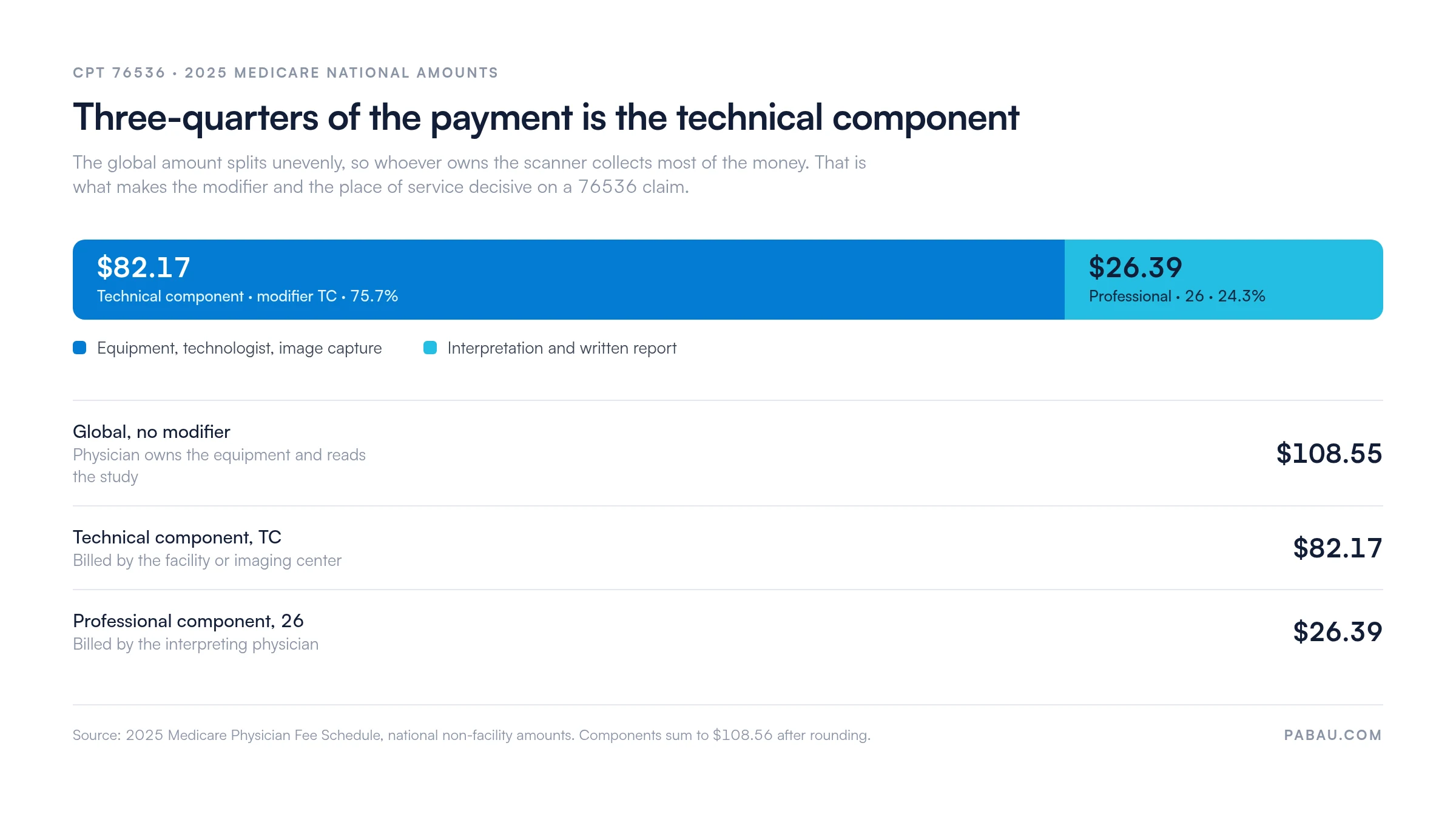
Read that split against the place of service table further down. A physician office that owns its scanner keeps both components, while a radiologist reading for a hospital keeps $26.39 of the $108.55.
Verify your MAC locality before setting expected reimbursement benchmarks. A practice in Manhattan will receive a meaningfully different payment for CPT 76536 than one in rural Mississippi, even under the same Medicare fee schedule. Use the CMS fee schedule lookup filtered by your specific state and locality for accurate projections.
Pairing CPT 76536 with a covered diagnosis code is required for medical necessity. The codes below are commonly accepted under CMS Billing and Coding Article A57029, which is associated with LCD L34027. Individual MAC policies may narrow that list further, so check your own contractor’s current article.
Select the most specific code the clinical documentation supports. An unspecified or overly broad code, where a more specific one exists, raises denial risk. The ICD-10-CM code set is revised every October, so confirm the descriptor and any instructional notes with the CDC ICD-10-CM web tool before filing.
Knowing which codes sit next to CPT 76536 helps billers avoid unbundling errors and spot legitimate add-on coding.
The 76536 and CPT 76942 pairing is the one payers question most. Billing both on the same date is allowed when the guidance for needle placement is separately documented. NCCI edits may apply, so verify with your MAC before submitting the pair.
The ophthalmic ultrasound codes sit in the same 76506-76536 head and neck group. 76512 covers a diagnostic B-scan of one eye, so each eye scanned is billed as its own unit.
The place of service (POS) code on the claim decides whether Medicare applies the facility or non-facility rate. Getting POS wrong causes either underpayment or a denial that has to be resubmitted.
The National Correct Coding Initiative (NCCI) publishes edit tables naming which code pairs cannot be billed together without a modifier. Some pairs are mutually exclusive under any circumstances. The tables update quarterly, so check the current edits before finalizing a claim that combines 76536 with another code.
Key bundling considerations for this code:
Unbundling means billing component codes separately when a comprehensive code already covers the service. Both CMS and commercial payer review programs treat it as an audit trigger.
Missing or incomplete documentation is the most fixable denial cause on a 76536 claim. A complete record carries all six elements below before the claim is submitted. Structured forms pre-mapped to those elements cut the chance of an omission at the point of care.
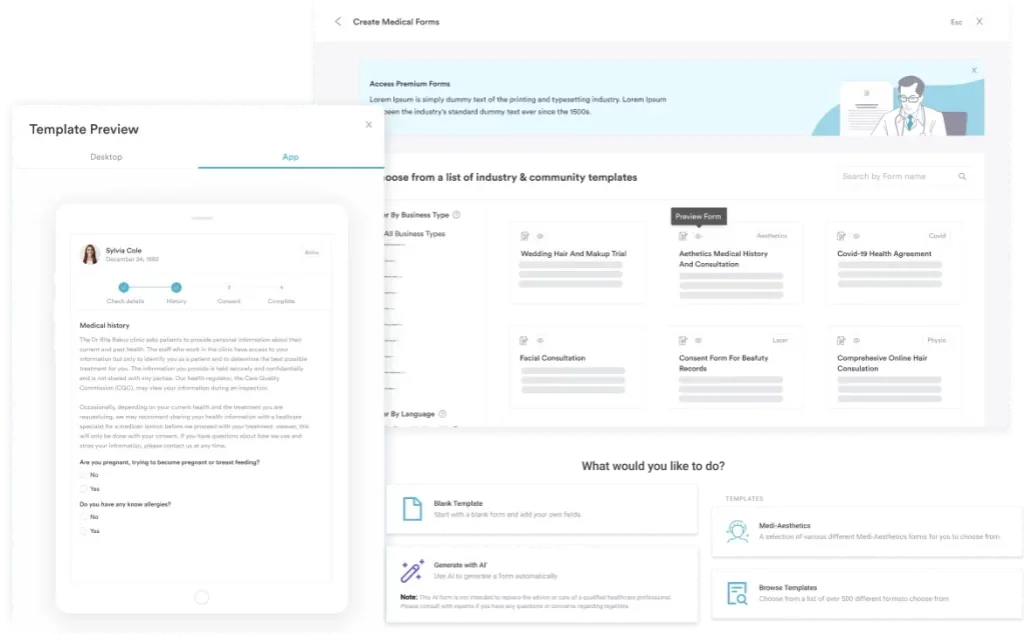
Capture every element above before the patient leaves, rather than reconstructing it after a denial arrives. A superbill generated from the encounter record, with the archived images attached, gives the biller the documentation a payer will ask for.
Claims for CPT 76536 get denied for a short list of predictable reasons. Knowing the root cause before the appeal is written shortens the whole cycle. The table below pairs each denial with the fix that prevents it recurring.
High-volume 76536 billing stalls in the handoff between the imaging suite and the billing queue. Practice management software like Pabau closes that handoff. Its error-checking claims management gives billing staff one place to record the clinical indication, attach the encounter documentation, and validate the claim before submission.
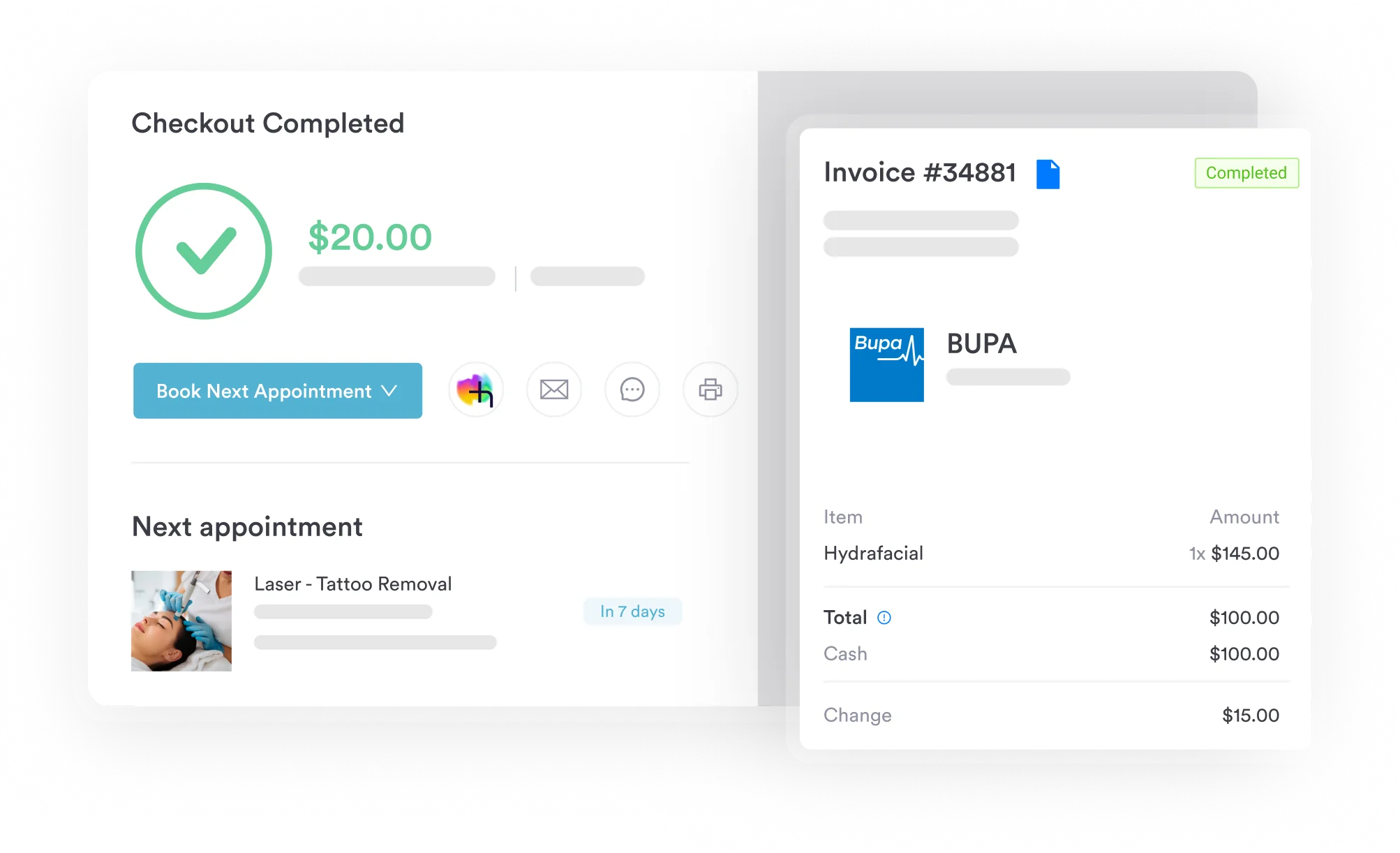
Claims submitted through the Claim.MD clearinghouse integration run against real-time eligibility checks and built-in CPT and ICD-10-CM validation. That reaches thousands of payers, with real-time eligibility available for more than 400. A claim that fails an edit is flagged before it leaves the practice, not after the payer rejects it.
The integration also handles electronic remittance advice and 835 files, so denial reason codes surface in the practice workflow, not in a separate clearinghouse login. For practices billing across several providers or locations, that feedback loop shortens the time between a denial and its fix.
Pabau’s digital forms capture structured documentation at the point of care, with fields mapped to what 76536 requires. That means the ordering indication, the imaging findings, and the image-retention attestation.
Sending the 837 claim file with that documentation already attached lowers the odds of a medical necessity denial on first submission.

Pabau’s claims management software connects to the Claim.MD clearinghouse. Radiology and practice billing teams can validate CPT 76536 claims, check eligibility, and work denials in one place.

For billing teams measured on first-pass resolution, that single change moves the number more than any appeal workflow does.
The money on a 76536 claim is decided before the biller touches it. Whoever owns the scanner takes three-quarters of the payment, and whoever archives the images decides whether any of it survives review.
So the fix sits upstream of billing. Set the modifier from equipment ownership and place of service. Pair the code with a diagnosis on your MAC’s covered list, and archive the images with the encounter.
One trade-off is worth remembering. A practice that reads studies on someone else’s equipment collects about a quarter of the code’s value, however clean its claims are. Book a demo to see how Pabau validates ultrasound claims and keeps image documentation attached to the encounter.

Need to understand how clearinghouse validation works? Medical claims clearinghouse guide explains how electronic claim routing reduces denial rates for diagnostic imaging codes.
Working through remittance codes on a denied 76536 claim? Electronic remittance advice explained walks through how to read ERA files and act on denial reason codes.
Want to reduce first-pass denial rates across your entire billing workflow? Clean claim submission checklist covers the documentation and coding elements required before any claim leaves your practice.
CPT code 76536 covers a real-time ultrasound of the soft tissues of the head and neck. That includes the thyroid gland, the parathyroid glands, the salivary glands, and cervical lymph nodes. Both real-time scanning and permanent archived images must be present for the code to be billable.
The 2025 Medicare national amounts for CPT 76536 are $108.55 global and $26.39 for the professional component (modifier 26). The technical component (modifier TC) is $82.17. In a facility place of service the facility bills that technical component, not the physician. Exact payment depends on your MAC locality, so verify current rates with the CMS Physician Fee Schedule lookup tool.
Yes. Modifier 26 applies when the interpreting physician bills only for the professional component (reading and reporting the images) without owning the equipment. Modifier TC applies when a facility or entity bills only for the technical component (scanning equipment, technologist, image capture). If the same physician owns the equipment and performs the interpretation, bill the global code with no modifier.
Commonly accepted ICD-10-CM codes include E04.1 (non-toxic single thyroid nodule), E04.2 (non-toxic multinodular goiter), and E21.0 (primary hyperparathyroidism). R22.1 (localized swelling or mass, neck), R59.0 (localized enlarged lymph nodes), and Z85.850 (personal history of malignant neoplasm of thyroid) are also common pairings. Always verify against the covered diagnosis list in CMS Article A57029 before filing.
The top denial reasons are missing permanent image documentation, a non-covered ICD-10-CM code, incorrect or missing modifiers, undocumented medical necessity, and a POS code mismatch. Missing image documentation is the most common and the most preventable. Attach the archived images to the encounter record before the claim is submitted.
Yes, when the services are separately documented. CPT 76942 may be billed alongside CPT 76536 when the two are distinct services. That means a diagnostic imaging study plus ultrasound guidance for a biopsy or aspiration. Verify the NCCI edit pair before submitting both codes, since payer-specific rules may apply.