ICD-10 Code Z86.73: Personal history of TIA
ICD-10 Code Z86.73: Definition, descriptor, and code hierarchy ICD-10 Code Z86.7...

Last Updated: Nov 20, 2026
Billable Code Specific Code
N92.0 is the billable ICD-10-CM code for excessive and frequent menstruation with regular cycle. It covers heavy periods, menorrhagia and polymenorrhea when the cycle still arrives at predictable intervals.
Cycle regularity is what separates it from the codes next door. A note that says heavy bleeding without confirming the cycle is regular often leaves the coder on N92.6 or N92.1 instead. Postmenopausal bleeding goes to N95.0, which can't be reported with it.
Let Pabau's smart automation suggest the right codes, reduce claim denials, and keep your practice compliant—effortlessly.
Automate repetitive tasks and focus on what matters most—your patients.
Reduce coding errors and ensure compliance with the latest regulations.
Clean claims, fewer denials, and faster reimbursements.
Powerful insights and reporting to help your practice thrive.
HIPAA compliant SOC 2 certified GDPR-compliant Trusted by 4,000+ clinics worldwide

N92.0 is a billable ICD-10-CM code for heavy or frequent periods that still arrive on a regular cycle.
Cycle regularity is the deciding detail, so an irregular cycle moves the claim to N92.1.
The N92 Excludes1 note bars postmenopausal bleeding (N95.0) and precocious puberty with menstruation (E30.1).
A claim for ablation or hysteroscopy needs the cycle pattern, a flow measure, symptom duration and failed medical therapy in the note.
Most N92.0 denials can be fixed before submission, with a provider query or an eligibility check at scheduling.
ICD-10 code N92.0 is the billable diagnosis code for excessive and frequent menstruation with regular cycle. It sits in the ICD-10-CM code set that CMS publishes each fiscal year, under Chapter 14 and category N92. It has no further subdivisions, so it goes on the claim as it stands.
The code has been valid since ICD-10-CM took effect in the US on October 1, 2015. You can confirm the current descriptor in the CDC/NCHS ICD-10-CM web tool.
“NOS” (not otherwise specified) means N92.0 fits when the note confirms heavy bleeding on a regular cycle but names no structural or hormonal cause. Once a cause is found, such as a uterine fibroid (D25 category, the L in PALM-COEIN), you may need to report that condition as well.
The descriptor bundles two presentations that coders often treat as one. Menorrhagia is heavy or prolonged bleeding at regular intervals. Polymenorrhea is a cycle that comes back more often than every 21 days, whatever the flow. Both land on N92.0 as long as the pattern stays regular.
FIGO’s PALM-COEIN system sorts abnormal uterine bleeding (AUB) into structural and non-structural causes. ACOG uses it in its practice bulletins.
N92.0 itself doesn’t need a PALM-COEIN etiology. Payers reviewing an ablation or hysteroscopy request often look for that work-up, though, so record it as it happens.
The ICD-10-CM Tabular List places one Excludes1 note at the N92 category level. Excludes1 is a hard stop, so an excluded code can’t be reported with N92.0 for the same condition.
Bleeding after menopause belongs to N95.0, and pairing it with N92.0 creates an Excludes1 conflict. Heavy bleeding during the premenopausal transition has its own code, N92.4. Confirm the patient’s menstrual status from the encounter note before you choose between them.
Regularity is the main axis splitting N92.0 from its neighbors. Payers check cycle-pattern documentation when they review gynecological procedures. Coding N92.0 when the note never says the cycle is regular is a common audit finding.
In practice, the choice runs as a short series of questions, and the decision path below puts them in order. Stop at the first yes.
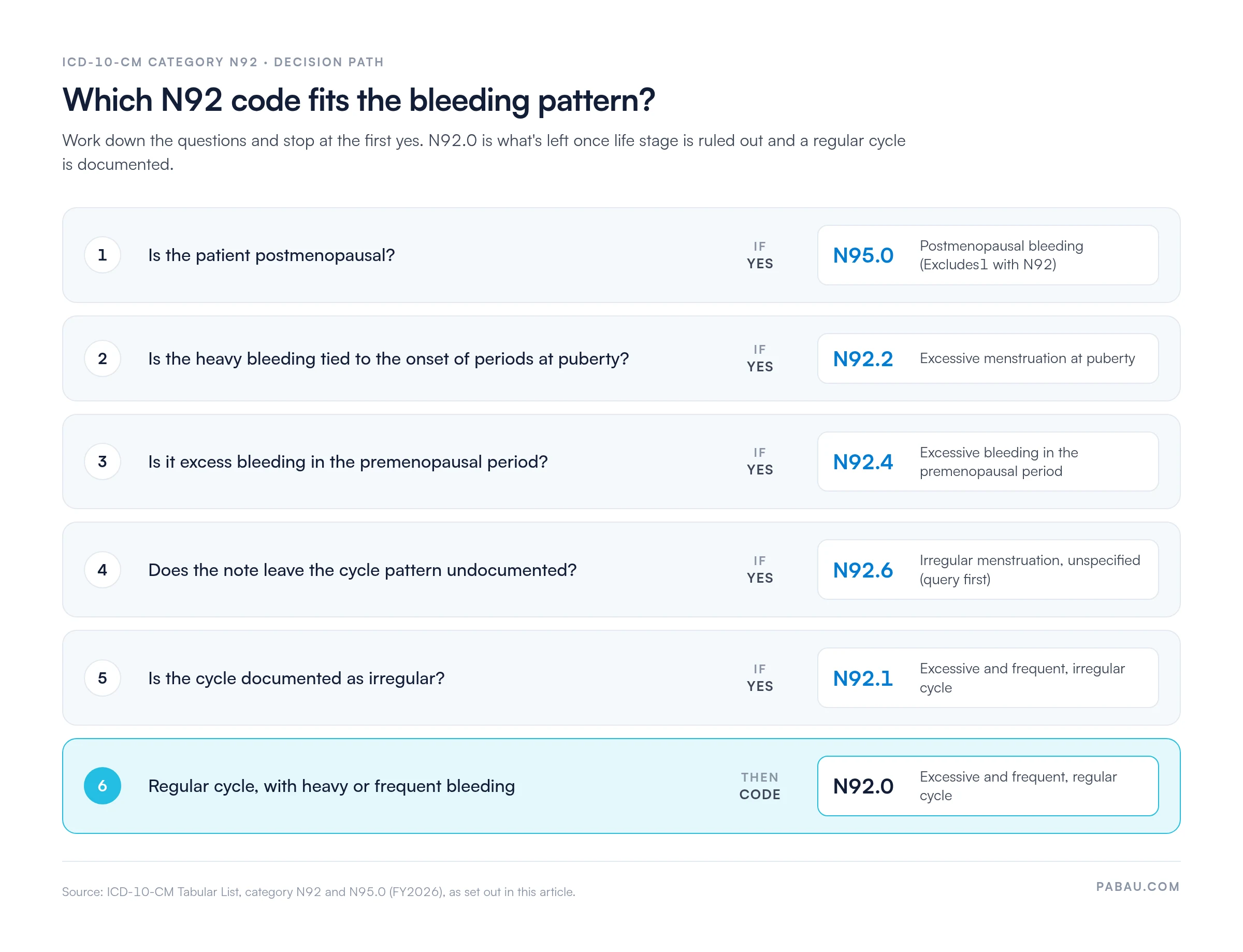
N92.6 is the residual “unspecified” code. Using it when the note supports N92.0 is downcoding, and it can weaken the medical necessity case for a procedure. If the note lacks cycle language, query the provider rather than defaulting to N92.6.
Payers reviewing N92.0 claims look for five documentation elements. Missing one can trigger a medical necessity denial or a records request, even when the care was clinically justified. Use this as a pre-submission checklist.
Pull your N92.0 claims from the last 90 days and filter for notes with no cycle regularity language. Those encounters are where ablation and hysteroscopy authorizations most often stall.
N92.0 is the principal diagnosis on many gynecological procedure claims. Endometrial ablation, 58563, is the most common surgical pairing. A mismatch between the procedure and the diagnosis is a leading denial trigger for OB/GYN practices.
When the hysteroscopy is diagnostic with sampling, 58558 is the usual pairing, and a stand-alone D&C bills as 58120. Verify CPT descriptors each year against the AMA CPT manual. The AAPC Codify ICD-10-CM lookup also offers crosswalk tools for checking payer pairings.
N92.0 is often the principal diagnosis, but documented related conditions belong on the claim too. Leaving them off is an accuracy problem. It can also cost you where a secondary diagnosis affects DRG grouping or risk adjustment.
Anemia is the pairing that carries the most weight in a review. If labs confirm it, report D50.0 alongside N92.0 so the payer sees the clinical impact of the blood loss.
Office visits and basic imaging billed with N92.0 rarely need prior authorization. Surgery is different. Most commercial plans require authorization for endometrial ablation, and many want proof of failed medical therapy first.
Check eligibility and benefits when the procedure is scheduled, so an authorization requirement surfaces before the date of service.
N92.0 claims fail for predictable reasons, and each one has a fix you can build into the pre-submission check. A clean claim starts with the encounter note rather than the billing queue. When a remittance does come back with a denial, the denial codes in medical billing guide decodes the reason.
Track which of these reasons recur in your remittances. A steady denial management routine turns each one into a template fix instead of a rework.
Most N92.0 rework starts in the note. A clinician writes “heavy periods”, the coder can’t confirm the cycle pattern, and the claim waits on a query or goes out as N92.6.
Pabau, the practice management platform we build, lets your practice add cycle pattern, flow measures and symptom duration to its customizable forms and treatment notes. The details are captured at the visit and sit in the patient record when the claim is built.
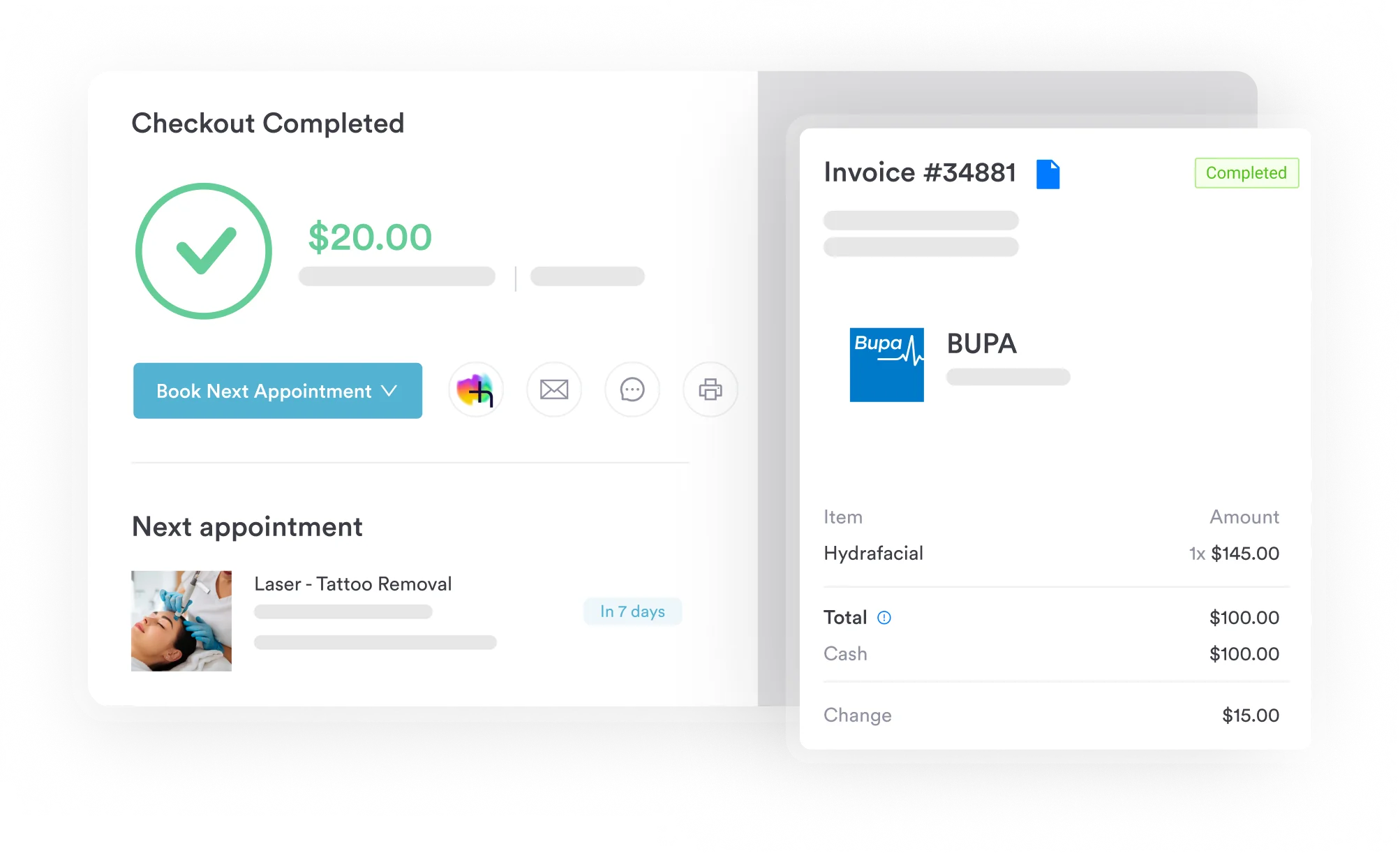
For US practices, claims go out through Claim.MD with eligibility checks, and prior authorization codes are tracked on the case. Pabau flags a case with no authorization code, so your team spots it before an ablation goes out. Our claims management software then posts remittances back against the claim.

Pabau keeps cycle and flow details in the patient record, tracks prior authorization codes on the case and sends US claims through Claim.MD. Your team spends less time on queries and resubmissions.

N92.0 comes down to one documented fact, the regular cycle. Get that sentence into the note and the code holds up, from the office visit to the ablation request.
If you change one habit, query before you default. A two-line message to the clinician costs less than an N92.6 claim that weakens a surgical authorization. The trade-off is a short delay at charge entry instead of a denial weeks later.
Book a demo to see how Pabau keeps cycle details, authorization codes and claims together for your gynecology patients.

Need a full gynecology billing workflow? Pabau claims management software covers charge capture, eligibility verification, and clearinghouse submission for OB/GYN practices.
Preparing an ablation authorization? UnitedHealthcare prior authorization form lays out the fields a payer expects before a planned procedure.
Want to reduce claim rejection rates? Revenue cycle management fundamentals covers the end-to-end process from encounter to payment posting.
No. N92.0 is complete at four characters and has no laterality or encounter extension. A longer version, such as N92.00, doesn’t exist and will be rejected as an invalid code.
ICD-9-CM used 626.2, excessive or frequent menstruation. ICD-10-CM splits that bleeding by cycle pattern, into N92.0 for a regular cycle and N92.1 for an irregular one. Keep this in mind when you code from records dated before October 1, 2015.
There’s no single code. N93.9 covers abnormal uterine and vaginal bleeding, unspecified, and N93.8 covers other specified patterns. Heavy or frequent bleeding on a regular cycle still codes as N92.0.
Yes, once her cycles are established and regular. Heavy bleeding tied to the onset of periods at puberty codes to N92.2 instead. Precocious puberty with menstruation is E30.1, which N92 excludes.