GLP-1 diet plan
A GLP-1 diet plan is a structured eating framework for patients taking semagluti...

2
Last Updated: Oct 13, 2026

TheraBand bands run from yellow, the lightest, through red, green, blue, black, and silver or gold, the heaviest.
Most patients start on yellow or red, and green becomes a realistic target within four to six weeks.
Move up a color once 15 reps feel clean, and drop back a color if form breaks before eight.
Upper body, lower body, and core work each need a different anchor point and movement plane.
The Tyler Twist with a FlexBar has clinical support for tennis elbow, using slow eccentric loading.
TheraBand exercises are resistance movements performed with color-coded elastic bands, used to build strength, restore mobility, and support rehabilitation at home.
The band color sets the resistance. Yellow is lightest, then red, green, blue, black, and silver or gold. Most adults start on yellow or red, and progress once 15 reps feel easy.
This guide gives the exercises for each body region, the anchor position each one needs, and the sets and reps to prescribe. Separate sections cover back pain, tennis elbow with the FlexBar, and seated work for older patients.
TheraBand exercises are structured resistance movements performed with latex or latex-free elastic bands. The bands were developed for clinical rehabilitation, and they are now standard in physical therapy, sports medicine, occupational therapy, and home fitness.
The resistance is progressive. Tension rises as the band stretches, which mirrors the strength curve of many natural movements.
Three decisions get you started. Pick the band color that matches your current strength, find a secure anchor point, and learn the form cues for each movement. An anchor can be a door frame, a sturdy chair leg, or your own foot.
Most exercises begin from a stable seated or standing position. The band is either looped around the working limb or anchored at chest height.
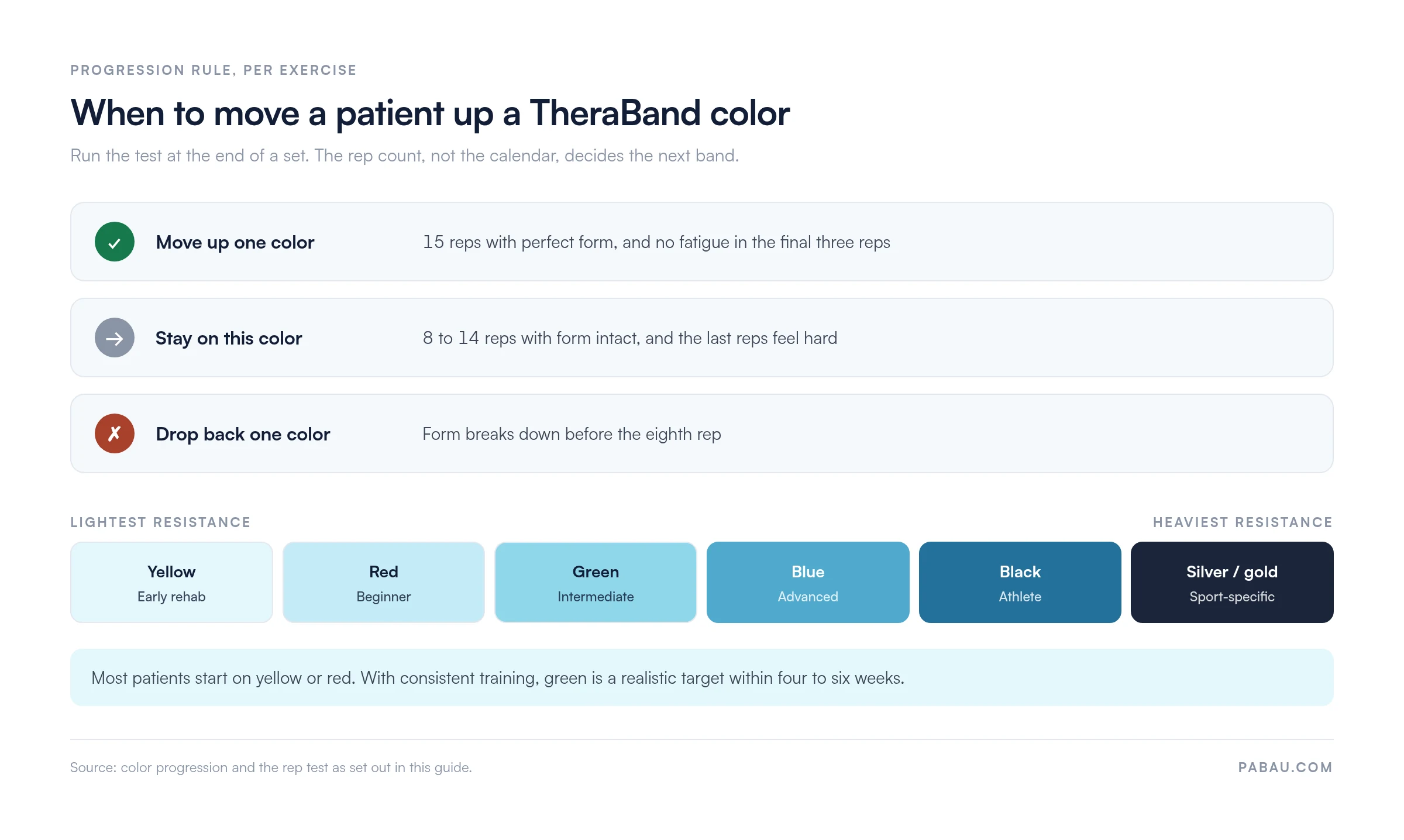
TheraBand bands follow a standardized color progression from lightest to heaviest. A band that is too light gives too little stimulus. A band that is too heavy wrecks your form and raises the risk of injury.
The rep count decides progression, not the calendar. Complete 15 repetitions with perfect form and no fatigue in the final three reps, and you are ready to move up a color. If form breaks before eight reps, drop back a color.
Most patients start on yellow or red. Green becomes a realistic target within four to six weeks of consistent training. The chart below turns that rule into one test you can run at the end of any set.
Upper body work with a TheraBand targets the shoulders, chest, back, biceps, and triceps. The elastic resistance curve is what separates it from free weights. Tension is lowest at the start of the movement and highest at full extension. That loads the muscle through a different range than a dumbbell does.
Shoulder work is the most commonly prescribed category of band exercise, particularly for rotator cuff rehabilitation. The American Physical Therapy Association includes elastic resistance training in its shoulder rehabilitation clinical practice guidelines.
Lower body work with a band targets the quadriceps, hamstrings, glutes, and hip abductors. The band can be looped above the knees, looped around the ankles, or anchored to a fixed point for leg press variations.
Elastic resistance is an effective way to build lower body strength in older adults and after surgery. The American College of Sports Medicine publishes resistance training resources that cover how to dose it.
Seated leg work builds lower limb strength with no balance demand. It suits older patients, people recovering from hip or knee replacement, and anyone who cannot stand safely for long. Our guide to seated exercises extends the same approach to the upper body and core.
Core work with a band adds rotational and anti-rotation demand that bodyweight movements cannot replicate. These exercises train the deep stabilizers, including the transverse abdominis, obliques, and multifidus. Those muscles matter for back pain prevention and for athletic performance.
Low back pain affects an estimated 619 million people globally, according to the World Health Organization, and it is the leading cause of disability worldwide. Band exercises build the posterior chain muscles that hold spinal alignment, without the compressive load of a barbell or a heavy machine.
Patients with chronic low back pain should see a physical therapist before starting these exercises. Follow-through at home is the harder problem in back pain rehabilitation, and a written program gives the patient something to check against between visits.
The TheraBand FlexBar is a cylindrical rubber bar built for forearm and elbow rehabilitation. Its main clinical use is lateral epicondylitis, better known as tennis elbow. Tyler and colleagues published the exercise in 2010 in the Journal of Shoulder and Elbow Surgery. Their randomized trial recorded significant pain reduction and strength gains in patients with lateral epicondylitis.
The eccentric phase is the whole point, so the patient needs it written down rather than demonstrated once. An elbow stiffness exercises handout gives them the sequence to follow between visits.
Start with the green FlexBar for most tennis elbow cases. If 15 reps bring pain above 3 out of 10, begin with the softer yellow FlexBar. Move to green once pain allows. The therapeutic effect sits in the eccentric phase, where the bar untwists slowly, so do not rush it.
A TheraBand works well for assisted stretching, especially for patients with limited range of motion after injury or surgery. The band does the job a partner would, and it lets the patient load the stretch gradually.
How many reps you do with a TheraBand depends on the goal. The British Heart Foundation suggests starting resistance band work at two to three sets and building up slowly. That pacing matters most for cardiac rehabilitation patients.
Progress once you can hit the top of the rep range across every set with good form. For rehabilitation patients, a physical therapist should agree the progression rather than leaving it self-directed. That holds especially in the first six to eight weeks after injury or surgery.
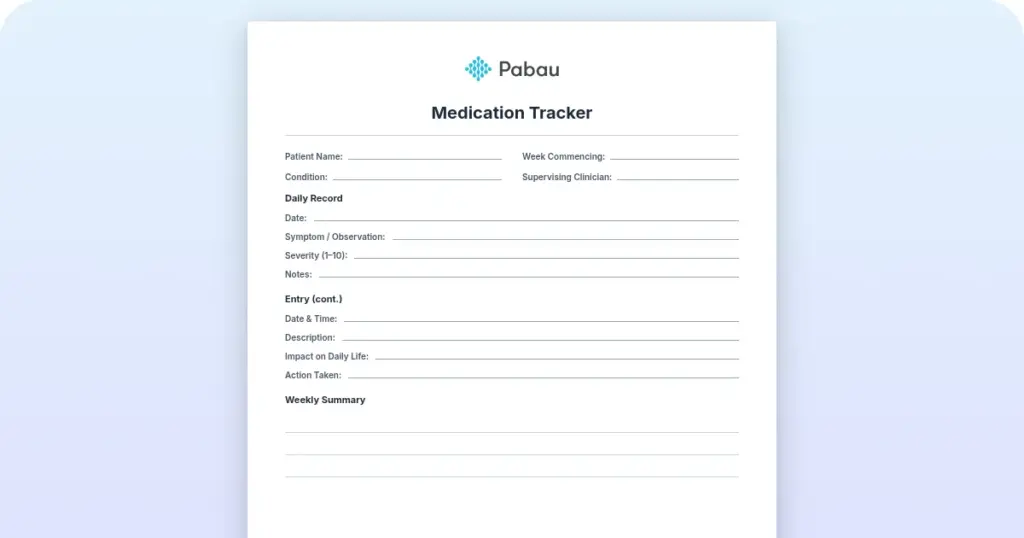
Written instructions travel better than spoken ones. A home exercise program template puts the sets, reps, and band color on one sheet the patient can keep.
Band exercises are low-risk when the form is right. A few precautions still belong in every patient hand-off, and the six below cover the common failure points.
Prescribing band exercises is the easy half of the workflow. The other half is documentation, follow-up, and outcome tracking, which is where rehab practices lose time. Practice management software like Pabau, built as an EMR for rehab teams, is made for that side of the job.
Clinicians record the prescribed program inside the client record and treatment notes. The band color, exercise name, sets, reps, and session date all sit in structured fields rather than in free text.
Every future appointment opens on the same record. Any clinician seeing the patient can check what was prescribed, what was completed, and whether the progression is on track.
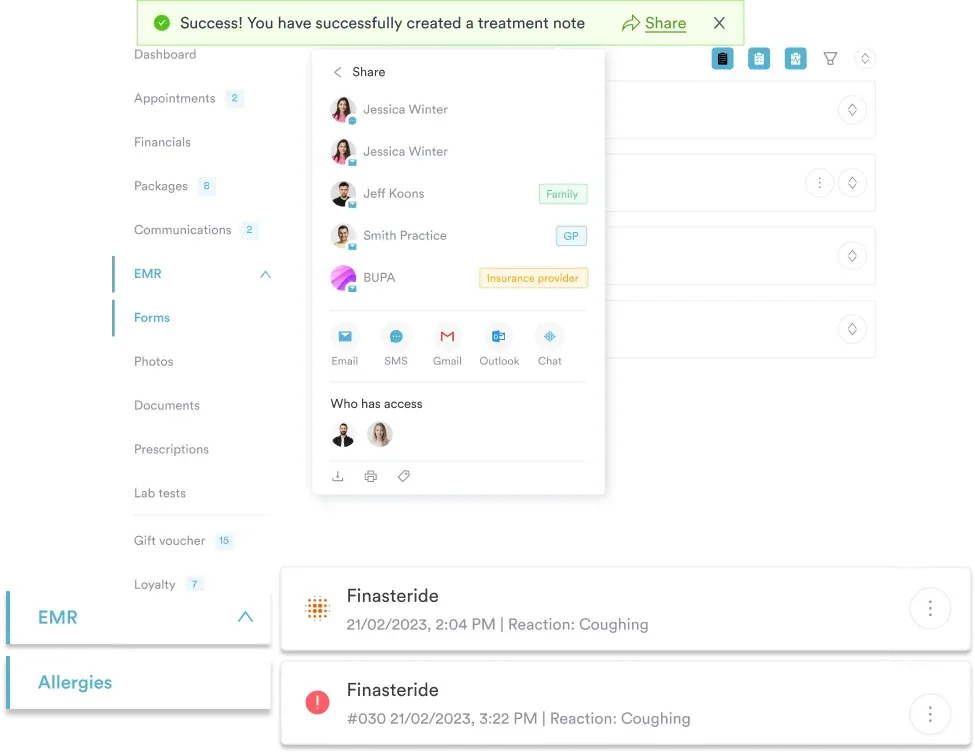
Printed exercise sheets are easy to mislay between visits. Automated workflows in Pabau send the exercise instructions by SMS or email on the day of the consultation. A second message at the 48-hour mark prompts the first home session while motivation is still high.
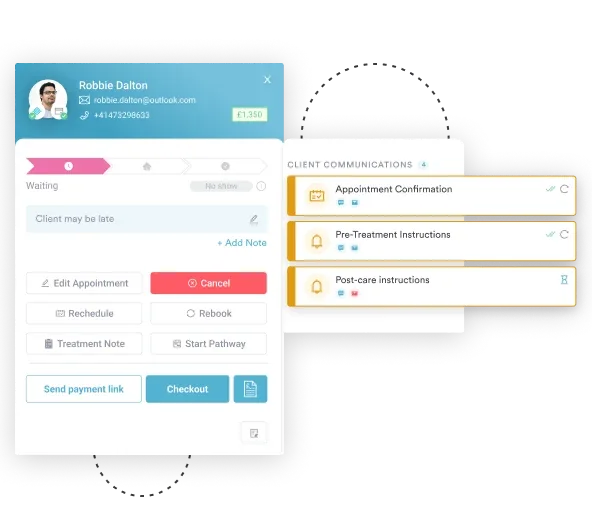
Practices with several practitioners or high patient volumes carry a heavier admin load. Physical therapy practice software that joins scheduling, notes, and communications in one place cuts the work that pulls clinicians off the floor. Automated reminders, digital consent, and centralized reporting all save time in a busy rehab service.

Pabau helps physical therapy and sports medicine practices document exercise programs, track patient progress, and automate follow-up messages from one system. Every subscription includes every feature.

The color system is what makes TheraBand practical in a clinical setting. It gives you a dose you can write down and a progression you can test. The patient can then work at home without supervision.
Adherence is the part that decides the outcome. Prescribe the band color, record it, and check it at the next visit, and the program keeps working after the patient leaves the room. Skip the record and the next progression becomes a guess.
Book a demo to see how Pabau keeps exercise prescriptions, progress notes, and patient follow-up in one record for your rehab practice.

Need band work for the neck as well? Neck pain exercises sets out the movements and the dosing for cervical cases.
Programming for older patients? Strength exercises for older adults covers the load, frequency, and safety checks that suit an older caseload.
Treating a lumbar case? McKenzie method exercises gives you a printable directional preference sequence for low back pain.
Checking your regulatory obligations? Mandatory compliance for physiotherapy clinics lists the record-keeping and consent duties a rehab practice has to meet.
Setting up a new rehab practice? Opening a physiotherapy clinic walks through licensing, equipment, staffing, and the systems you need from day one.
TheraBand exercises are resistance movements performed with color-coded elastic bands. The colors run from yellow, the lightest, through red, green, blue, black, and silver or gold, the heaviest. They are used in physical therapy, sports medicine, and home rehabilitation for strength, mobility, and post-surgical recovery.
Start with a color that lets you complete 10 to 15 reps with good form, with noticeable effort in the last three reps. Yellow and red suit most beginners and early rehab patients. If 15 reps bring no fatigue, move up a color. If form breaks before eight reps, drop back.
For rehabilitation and early strengthening, aim for 10 to 15 reps across two to three sets. For general strength, use 12 to 15 reps across three to four sets. For muscle building, use 8 to 12 reps with a heavier band. Stretching holds last 30 seconds, repeated two to three times.
Yes, and yellow and red band movements are the usual starting point. The seated leg exercises in this guide are built for patients who cannot stand safely for long. Older patients with cardiovascular conditions or recent surgery should confirm the program with a physical therapist first.
Most physical therapists prescribe resistance work every other day, so the muscle has time to recover. Stretching with a TheraBand can be done daily. If you are following a prescribed rehabilitation program, use your therapist’s frequency guidance rather than a generic schedule.
Yes. The Tyler Twist, performed with a TheraBand FlexBar, has clinical support for lateral epicondylitis. Tyler and colleagues reported on it in 2010 in the Journal of Shoulder and Elbow Surgery. Adding the eccentric exercise beat standard therapy alone on both pain and strength. Start with the green FlexBar under supervision.