Sulcus Test: Shoulder Instability Assessment
The sulcus test is an orthopedic special test that checks for inferior glenohume...

3
Last Updated: Oct 22, 2026
An exercise log template is a ready-made sheet for recording every workout in the same format, so you can compare weeks without relying on memory. Our free version is a five-week PDF. Each weekly block records the date and time, type of exercise, distance, duration or intensity, and notes.
It works for people tracking their own training and for patients following a home program set by a physical therapist, coach, or physician. Print it or fill it in on screen, then bring it to your next review.
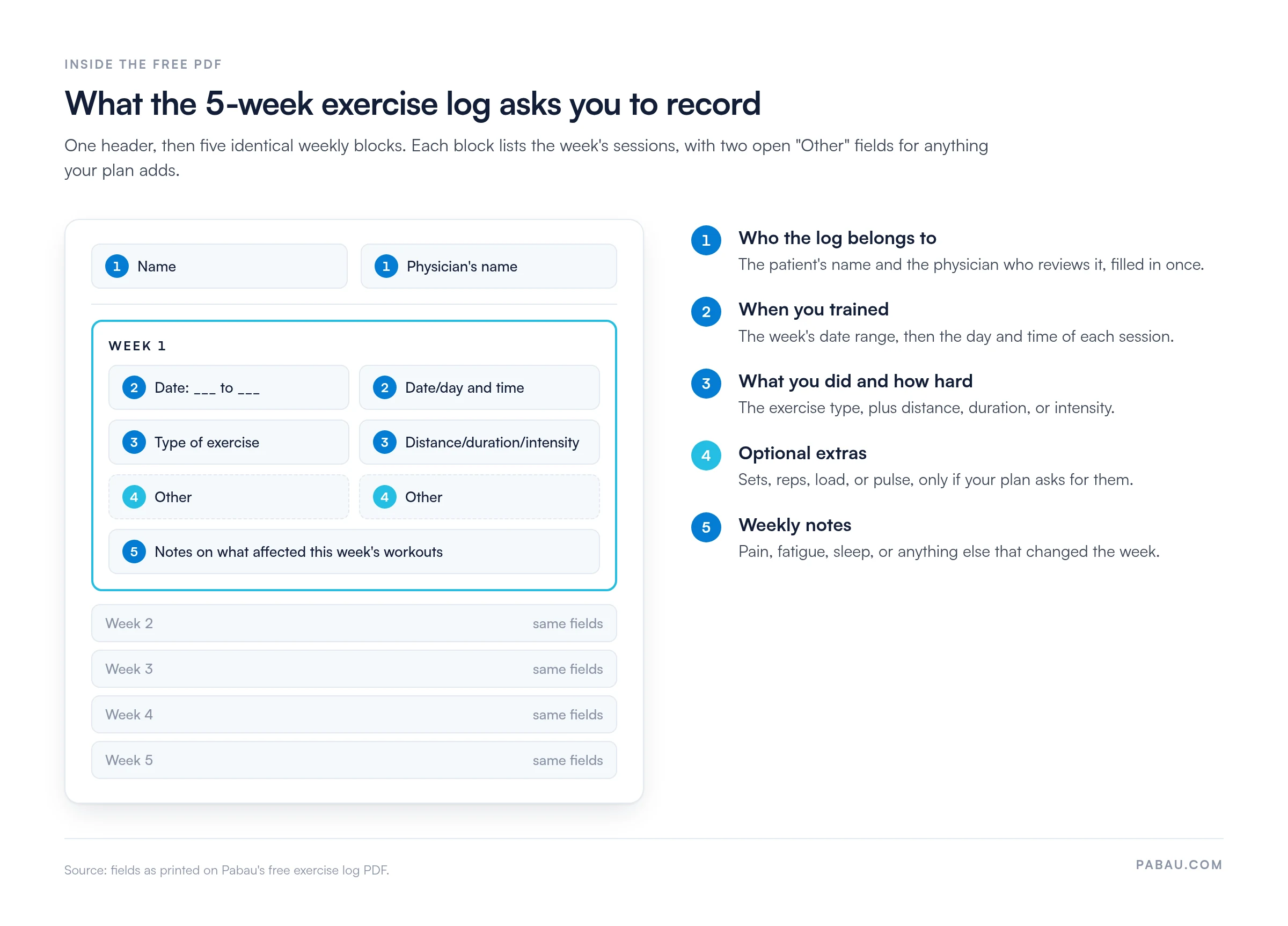
A five-week exercise log with a header for your name and your physician’s name. Each weekly block has fields for dates and times, exercise type, distance, duration or intensity, and notes, plus two open fields.
Download template
The free exercise log is a five-week PDF, with one block per week for all of that week’s sessions.
Each block records the date and time, type of exercise, distance, duration or intensity, and notes.
Use the two Other fields for sets, reps, load, or pulse when your program asks for them.
Practices can store completed logs with treatment notes in Pabau, the practice management platform we build.
An exercise log template is a pre-formatted sheet that records each workout in the same fields every time. Because the fields never change, you can compare sessions weeks apart without rebuilding the record from memory.
The free PDF on this page is a weekly log that covers five weeks. A header holds your name and your physician’s name, and each week repeats the same fields.
The diagram below maps each field on the sheet, so you know where each detail goes before your first session.
The CDC’s National Diabetes Prevention Program also gives participants a fitness log to record their activity. Its adult activity guidelines recommend 150 minutes of moderate-intensity activity a week, plus muscle strengthening on at least two days. That gives you a useful benchmark when you plan each weekly block.
Fill in the log on the day you train, not at the end of the week. Each week gets one block, and you list every session from that week inside it.
Review the log at the end of each week. Look for patterns, such as longer distances, pain that repeats after one exercise, or sessions that keep getting shorter. If you would rather collect this information before a first visit, digital intake forms can gather the same details online.
The log suits anyone who needs a repeatable record of training, from solo gym users to teams running a home exercise program. Each group fills in the same fields but reads them for a different reason.
Clinicians get the most value when the log feeds into a treatment decision. A patient who notes knee pain after every lunge session gives the clinician what they need to adjust the next one.
A written record turns memory into evidence. Instead of guessing whether a program is working, you can see sessions, effort, and symptoms side by side.
For patients, a log also supports accountability. A weekly entry makes adherence visible to both the patient and the clinician.
Set a fixed time to complete your entry, such as straight after your session or before bed. Tie the log to a habit you already have, and keep it somewhere visible, like beside your gym bag or on your phone’s home screen. In the first month, consistency matters more than detail.
Each field answers a different question. The table below shows what to write and why it matters. Leave the Other fields blank if your program does not use them.
If your plan asks for pulse readings, record them in an Other field. URMC Rochester’s guidance recommends checking pulse before exercise and at peak activity. Calorie estimates vary widely between devices and formulas, so treat any calories you note as approximate.
This PDF is a weekly log, which suits most people. Each block covers one week, and you list every session from that week inside it. A daily log gives each day its own sheet, which suits high-frequency training or rehab plans with daily repetitions.
Start with the weekly log. If your plan needs more detail per session, ask your clinician whether a daily sheet would help.
A physical therapy exercise log lets a patient show a clinician which home exercises they completed between sessions.
Clinicians usually ask patients to note how each exercise felt and whether the program was too easy or too hard. Those notes let the clinician adjust the plan at the next review instead of relying on memory.
A log also keeps patients engaged between visits, which supports physical therapy patient retention. Clinicians who write up session notes can use an AI medical scribe to cut the time spent on documentation.
Many practices hand out a paper log, read it at the next appointment, then file it or type the key points into the patient record. Sheets go missing, and progress across weeks ends up in the clinician’s head.
In Pabau, completed logs and treatment notes sit together in the patient record, so trends are visible at every review. Automated pre- and aftercare messages remind patients about their home program between visits.
The same record holds bookings, notes, and billing, which makes Pabau a simpler physical therapy EMR for small teams. Growing groups can compare options in our guide to physiotherapy clinic management software.

Book a demo to see how Pabau stores completed logs alongside treatment notes, so your team reviews progress without chasing paper.

A weekly log only helps if someone reads it. Agree with the patient on what goes in the Other fields before week one, so every block records the same measures.
Over five weeks, that consistency shows whether the plan is working and gives the clinician evidence for the next change. The cost is a few minutes of writing each week, far less than a review spent guessing.
Download the template, fill in the first block this week, and bring it to your next review. Book a demo to see how Pabau keeps patient exercise logs and treatment notes in one record.

Need a structured plan to log against? Home exercise program template gives patients a written program to follow between visits.
Working with resistance bands? TheraBand exercises covers upper body, lower body, core, and rehab routines.
Treating patients with limited mobility? Seated exercises explains chair-based routines for practices and patients.
Want to track pain alongside activity? Numeric pain rating scale gives patients a simple score to add to their weekly notes.
Losing patients partway through a plan? Patient retention in physical therapy sets out strategies that keep patients coming back.
An exercise log records what you did, how it went, and what changed, so you can judge whether a program is working. For clinicians, it provides evidence of adherence that can shape the next treatment decision.
Create one column for each field in the PDF: date and time, type of exercise, distance, duration or intensity, and notes. Add columns for sets, reps, or load if your plan uses them, then add one row per session. A SUM formula gives weekly totals for minutes or distance.
Count your pulse for 15 seconds at your wrist or neck, then multiply by four to estimate beats per minute. Record resting pulse before you start and peak pulse during the hardest effort, following the timing your program specifies. On this template, those readings go in an Other field.
Write the date and the reason in that week’s notes so the missed session is visible. Then continue the program as your clinician or coach directed, rather than doubling up to catch up.