Maja Popovska

Head to toe assessment cheat sheet: Printable nursing guide
A head to toe assessment cheat sheet gives you one fixed order at the bedside, s...

6
Last Updated: Oct 23, 2026
Free PDF 3 pages, print-ready Clinician-reviewed
A house rehab checklist is a home-readiness form that confirms a patient's home is safe before they return from the hospital, surgery, or inpatient rehab. It covers ten areas, from accessibility and safety modifications to medication management, caregiver support, follow-up appointments, and mental health.
Discharge planners, therapists, home health teams, and family caregivers complete their sections during a pre-discharge walkthrough. The treating doctor then reviews the findings and signs the acknowledgment, so the care team has a dated record of home readiness.
This home-readiness checklist covers accessibility, safety modifications, medical equipment, medication management, emergency preparedness, and meal preparation. It also covers caregiver support, therapy space, follow-up appointments, and mental health, with notes and a doctor's signed acknowledgment.
Start from scratch, or upload this PDF or any form you already use, and Pabau's AI Form rebuilds it with tick boxes, text fields and a signature. Attach it to the treatment once, and every patient gets it on time.
AI Form rebuilds the consent, history and aftercare forms you already use. You review each one, then publish.
Patients complete forms on their phone before they arrive, so the front desk stops retyping paper.
Every signed form is versioned and attached to the treatment record, ready when you need it.
Set how long a consent stays valid. Returning patients skip forms they have already signed.
Supports HIPAA and GDPR compliance AES-256 encryption 4.8 on G2 4.7 on Capterra Trusted by 4,000+ practices worldwide

A house rehab checklist confirms a patient’s home is safe and ready before they leave the hospital, surgery center, or inpatient rehab.
It covers ten areas, from accessibility and fall-proofing to medication management, caregiver support, and mental health.
Grab bars, cleared walkways, delivered equipment, and a reconciled medication list must be in place on discharge day.
Discharge planners, therapists, home health nurses, and family members each own different sections of the form.
A doctor’s acknowledgment and signature close the checklist, so the care team has a dated record of home readiness.
A house rehab checklist is a home-readiness form for a patient returning home after a hospital stay, surgery, or inpatient rehabilitation. It walks through ten areas of the home and the patient’s routine, then ends with a doctor’s sign-off. A discharge planning checklist covers the wider hand-off from hospital care.
No single person sees the whole picture, so the form is usually shared. Hospitals in the US must treat patients and their caregivers as active partners in discharge planning under the Medicare conditions of participation (42 CFR 482.43).
The grid below maps each of the form’s ten sections, plus the sign-off, to the person who usually completes it.
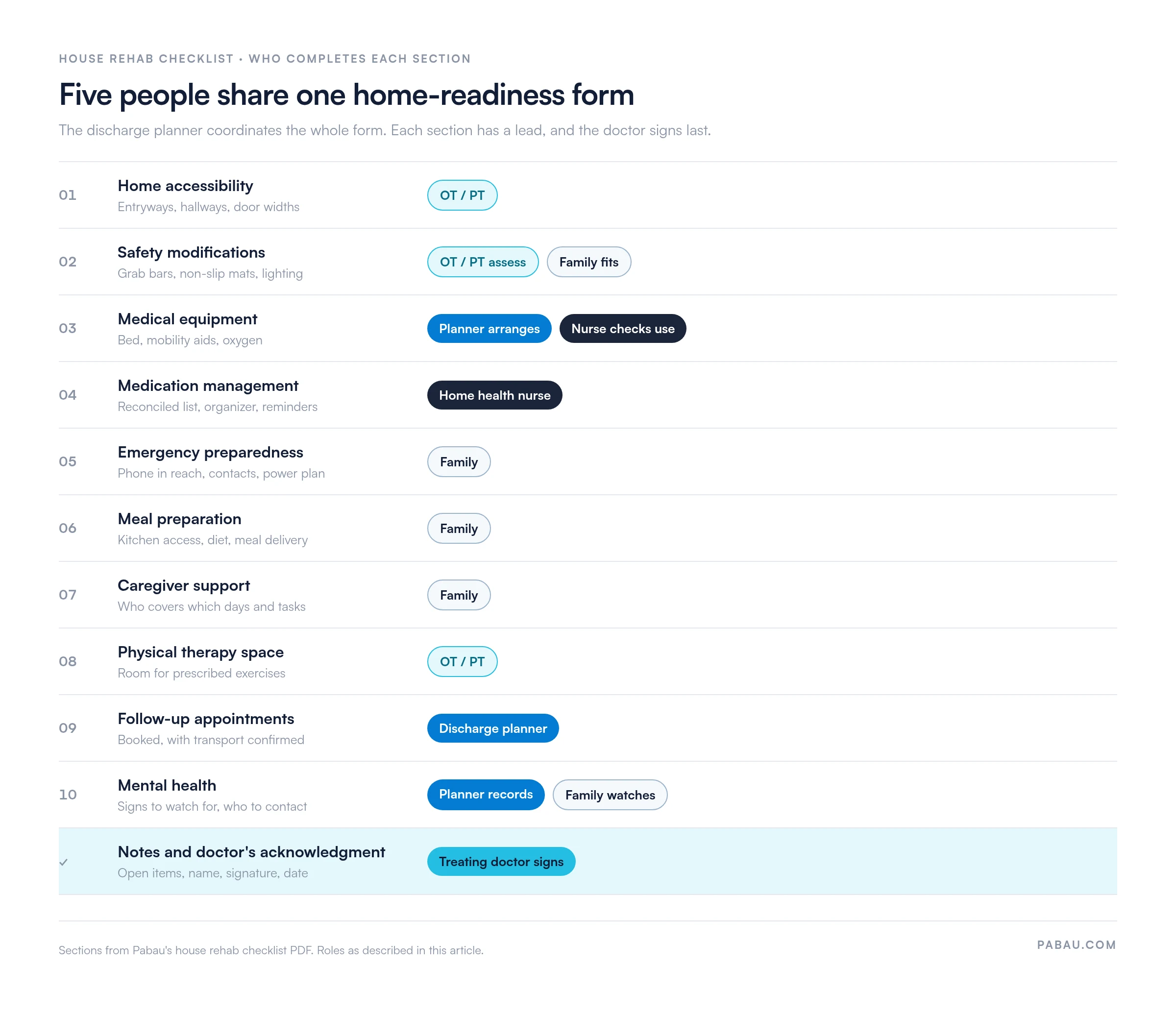
Not every item needs to be finished on the day the patient arrives home. The ones that prevent a fall, a missed dose, or an unanswered emergency do. Use this split to decide what blocks discharge and what can follow.
If an item in the middle column is still open on the discharge date, record it in the notes and actions section. The care team can then decide whether to delay discharge or add home health support.
Start at the front door and follow the route the patient will use every day. Entryways, hallways, and door widths decide whether a walker or wheelchair fits at all.
Safety modifications then reduce fall risk along that route. The CDC’s Check for Safety home fall prevention checklist recommends these fixes, room by room.
Equipment that arrives the day after discharge leaves the patient without support on the first night. Confirm each item has been delivered, set up in the right room, and demonstrated to the patient and caregiver.
Medication management needs a system the patient or caregiver can follow without the hospital’s routine. Compare the discharge prescriptions with the medications already at home, and set aside any the doctor has stopped. A medication reconciliation form records that comparison in one place.
Then set up a weekly pill organizer, phone alarms, or a printed schedule. Keep a written list of each prescription with its dose, frequency, and the patient’s allergies.
The emergency plan answers one question: How does the patient get help quickly? Put a phone or medical alert device within reach of the bed and the bathroom, and post emergency contacts where visitors can see them.
Patients who rely on powered equipment need extra planning. Ready.gov advises asking the care provider how to keep that equipment running in a power outage. It also suggests asking the power company about priority restoration lists.
The same guidance recommends a support network of people who can help in an emergency. Talk to the doctor or pharmacist about an emergency supply of medications, too.
Assess whether the patient can stand at the counter, reach the cupboards, and use the stove safely. If not, move everyday items to waist height, stock simple meals for the first days, and consider a meal delivery service.
Check any dietary instructions from the discharge plan, such as a low-sodium or diabetic diet, and plan the shopping around them. Note who is responsible for groceries and cooking.
Caregiver support works best when it is written down. List each caregiver, the days and tasks they cover, and their phone number. Add home health visits to the same list, so the family can see which days still need someone. A caregiver care plan can carry that schedule through the weeks that follow.
Ask the discharge team what training the caregiver needs before the patient leaves. Transfers, wound care, and equipment use are easier to learn in the hospital than on the first night at home.
Home exercises happen more often when there is a set place for them. Choose an area with a sturdy chair, enough floor space for the prescribed exercises, and a surface to hold the exercise sheet.
Book follow-up appointments before discharge, so the family has no calls to make in the first week. Record each appointment’s date, time, location, and purpose, and confirm transport for each one.
Mental health belongs on the checklist because recovery can bring low mood, anxiety, or frustration with lost independence. Ask the care team which signs to watch for, and note who to contact if they appear. Record any existing counseling or support group so it continues after discharge.
The form closes with a notes and actions section and a doctor’s acknowledgment. The notes list any item still open and who will complete it.
The doctor then adds their name, signature, and the date. That signature confirms the treating physician has reviewed the home-readiness findings before the patient leaves. File the signed form in the patient record. Share a copy with the home health team and the primary caregiver, alongside the written patient discharge instructions.
Run the checklist as a pre-discharge walkthrough, ideally a few days before the planned date. That leaves time to fix what the walkthrough finds.
Do the walkthrough with the patient’s own walker or wheelchair. A doorway that looks wide enough often stops a frame that is wider than expected.
A paper house rehab checklist passes between the hospital team, the therapist, the family, and the doctor. Each handover is a chance for a page to go missing or a section to stay blank.
Pabau, the practice management platform we build, lets your practice send the same checklist as one of its digital forms. The patient or caregiver completes their sections on their own phone or tablet before the walkthrough.
The doctor adds an e-signature to the acknowledgment, and the signed form is saved to the patient record automatically. When the home health team or a follow-up clinician opens the record, the home-readiness findings are already there.
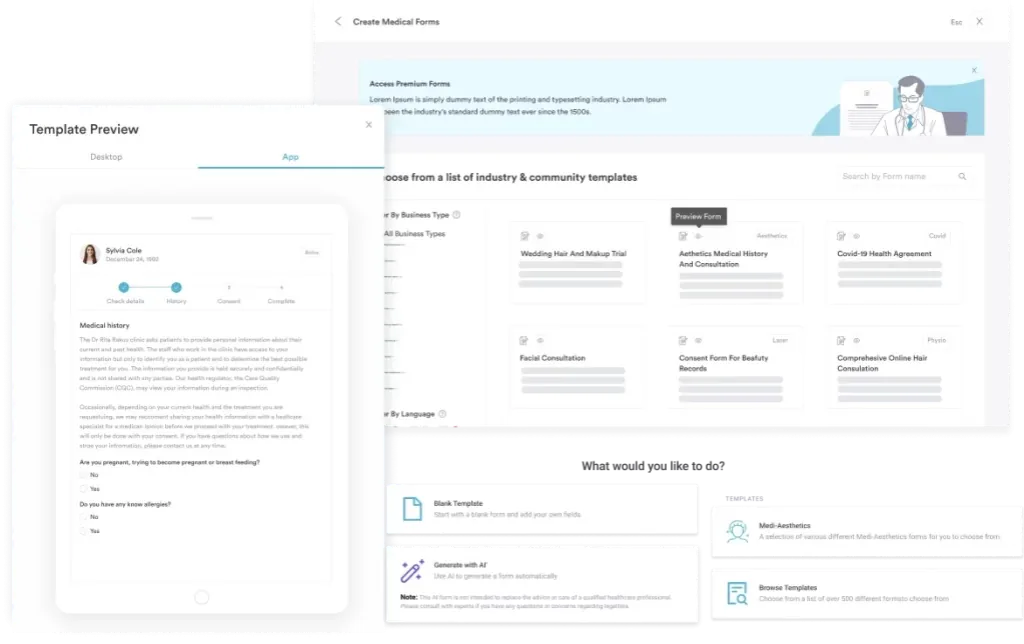

See how Pabau’s digital forms collect home-readiness checklists from patients and caregivers, capture the doctor’s e-signature, and file each one in the patient record.

Discharge succeeds or fails at home, in the first few days, once hospital support has gone. Make the signed house rehab checklist a condition of discharge. An open item that could cause a fall or a missed dose should delay the discharge.
The trade-off is a walkthrough a few days before discharge, which takes planning and a caregiver’s time. Skipping it moves the same work to the patient’s first night home, when fixing it is hardest.
Book a demo to see how Pabau sends home-readiness checklists to caregivers and stores each signed form in the patient record.

Planning the wider discharge? Discharge planning checklist covers medications, follow-up, home care, warning signs, and the doctor’s sign-off in one form.
Need patients to follow their instructions at home? Patient discharge instructions: A complete guide for practices explains what to include and how to confirm the patient understood.
Scheduling home health visits? Home care form captures home safety hazards, mobility needs, and visit scheduling for patients cared for at home.
Organizing family caregivers? Caregiver care plan sets out who provides which care and when.
Tracking what happens after discharge? Follow-up form documents the patient’s progress at each post-discharge visit.
A house rehab checklist is a home-readiness form completed before a patient returns home from the hospital, surgery, or inpatient rehab. It covers accessibility, safety, equipment, medications, emergencies, meals, caregivers, therapy space, follow-up, and mental health.
Discharge planners usually coordinate it, with input from therapists, home health nurses, the patient, and family caregivers. The treating doctor reviews the completed form and signs the acknowledgment.
Run it a few days before the planned discharge date. That leaves time to fit grab bars, deliver equipment, and reconcile medications before the patient arrives home.
The essentials are a clear path to the bed, bathroom, and kitchen, plus fitted safety aids and delivered equipment. A reconciled medication list, an emergency plan, and a booked first follow-up complete them. Other items can follow in the first week.