GLP-1 diet plan
A GLP-1 diet plan is a structured eating framework for patients taking semagluti...

2
Last Updated: Oct 13, 2026
The Elson test is a bedside examination that detects rupture of the central slip of the extensor tendon at the proximal interphalangeal (PIP) joint.
It takes under a minute to perform. With the PIP held at 90 degrees of flexion, a positive result shows rigid hyperextension at the DIP joint alongside weak or absent PIP extension.
Miss the injury and the patient develops boutonniere deformity. That is a fixed flexion contracture at the PIP joint, and it is far harder to treat than the rupture that caused it.
No published study reports a sensitivity or specificity for the Elson test, which is worth knowing before you lean on the result. This guide covers the anatomy, the technique, how to read both joints, where the test misleads you, and what to do after a positive finding.

The Elson test identifies central slip rupture by detecting whether extension force travels through the lateral bands instead of the central slip.
A positive result shows rigid DIP extension with weak or absent PIP extension when the PIP joint is held at 90 degrees of flexion.
No published study reports a sensitivity or specificity for the test, so clinical judgment still decides the borderline cases.
False negatives happen when the central slip and both lateral bands are cut together, which is why open wounds need exploration.
Untreated central slip injuries progress to boutonniere deformity, and closed injuries are splinted in PIP extension for six to eight weeks.
The Elson test is a physical examination maneuver that shows whether the central slip of the extensor digitorum tendon is intact or ruptured. Elson first described it in 1986. It works by exploiting the anatomy of the extensor mechanism at the PIP joint.
Flex the PIP joint to 90 degrees and ask the patient to extend it. An intact central slip drives the middle phalanx into extension and leaves the DIP joint passively mobile. A ruptured central slip sends that force through the lateral bands instead, and they pull the distal phalanx into rigid hyperextension.
The test matters because zone III extensor injuries, at or just proximal to the PIP joint, are easily underestimated at first presentation. Swelling, pain, and limited range of motion after a jammed finger or a laceration look identical whether the central slip is intact or not.
Without a structured assessment, missed injuries go on to develop boutonniere deformity within three to six weeks as the lateral bands migrate volarly.
Reading the Elson test correctly depends on knowing what the extensor mechanism does at the PIP joint. The extensor digitorum tendon splits into three terminal slips over the proximal phalanx.
When the central slip ruptures, the triangular ligament also fails over time. The lateral bands then migrate volarly, toward the palm, which converts them from DIP extensors into PIP flexors. That volar shift is the pathomechanical basis of boutonniere deformity, and the Elson test catches the force redistribution before the deformity sets.
Extensor tendon zone III covers injuries at the level of the PIP joint itself. Zone II covers the middle phalanx and zone IV the proximal phalanx. Zone III is the one the Elson test addresses.
Test whenever a patient presents with a PIP joint injury and you cannot confirm central slip integrity by observation alone. Four presentations should prompt it every time.
Sports medicine services see a disproportionate share of these injuries. Athletes minimize symptoms and return to play before anyone examines the finger properly. Practices running sports medicine software can make the central slip check a required field on finger injury notes.
The test also earns its place at follow-up. Repeat it before removing a splint to confirm that a confirmed or suspected central slip injury has healed. Post-reduction assessment of dorsal PIP dislocations is the highest-yield indication of all, because the reduction itself masks how much soft tissue was disrupted.
Performing the test correctly requires precise positioning. Examiner technique decides whether the result means anything.
The whole test takes under a minute. Poor stabilization of the proximal phalanx is the single most common technical error, because intrinsic muscles then recruit and mask weak PIP extension.
Interpretation depends on reading two joints at once, not one in isolation. The table below sets out the expected findings and the anatomy behind each one.
The physiology behind it is straightforward. With the PIP joint held at 90 degrees, a ruptured central slip cannot generate extension force across that joint at all. The effort is channeled entirely through the lateral bands, which pull the distal phalanx into rigid hyperextension.
An intact central slip transmits force to the middle phalanx and produces strong active PIP extension. The lateral bands stay slack, so the DIP joint remains passive and mobile.
A DIP joint that springs into rigid extension rather than staying relaxed is the most reliable positive sign. Weak PIP extension on its own is not enough, because pain inhibition produces the same finding with an intact central slip.
No published study reports a sensitivity or specificity for the Elson test. Clinicians rely on it because the mechanism is sound and the alternative is missing the injury. No diagnostic accuracy study has measured it against surgical findings.
The paper most often cited for those figures does not contain them. A 2021 cadaveric study in the Journal of Hand Surgery (Global Online) measured force and range of motion changes in fingers under cyclic loading. Its authors reported that the change in DIP resistance was likely imperceptible clinically.
Treat that honestly at the bedside. A positive test is strong evidence of rupture. A negative test is much weaker evidence that the central slip is intact, and neither result carries a number you can quote.
Several factors degrade the test in a live patient compared with a cadaver finger.
Treat an equivocal result with a plausible mechanism as positive until proven otherwise. Splinting carries minimal downside. A missed central slip injury does not.
The failure that matters clinically is a false negative caused by simultaneous laceration of the central slip and both lateral bands. A 2022 case report in PubMed Central documented exactly that presentation. Neither structure could transmit extension force, so the DIP joint did not rigidly extend and the test read as negative.
This pattern belongs to open lacerations where the wound track crosses both dorsal structures. Closed crush and jamming injuries usually spare the lateral bands. So never rely on the Elson test alone for an open dorsal PIP laceration.
Surgical exploration is indicated whatever the test shows, once the wound depth and location are consistent with an extensor mechanism injury.
With a dorsal laceration near the PIP joint, perform the Elson test before wound irrigation changes the tissue planes. Document the exact DIP posture you observe, flail or rigid, rather than a binary positive or negative. That detail matters if a hand surgeon reviews the patient later.
The modified Elson test is a passive alternative for patients who cannot comply with active extension because of pain or cooperation difficulties. The examiner does not ask for active extension. Instead they passively flex and extend the DIP joint while the PIP stays at 90 degrees over the table edge.
In the modified version, a ruptured central slip shows as increased passive DIP stiffness on attempted passive flexion. The lateral bands bear tension from the attempted PIP extension, so the DIP joint feels noticeably stiffer than the same finger on the uninjured hand. An intact central slip leaves the lateral bands slack and the DIP joint supple.
The modified test suits children, patients in severe pain, and anyone assessed under local anesthetic where active cooperation is unreliable. It does not replace the standard test when the patient can cooperate. Passive stiffness is more subjective and needs a comparison with the other hand. Record which version you used and what you found, since the two do not produce interchangeable evidence.
Boutonniere deformity is the predictable end stage of an untreated central slip rupture. The finger settles into PIP flexion with DIP hyperextension, the inverse of normal posture.
The sequence runs like this. Once the central slip fails, the PIP joint loses active extension. The triangular ligament attenuates, so the lateral bands are no longer held dorsally and displace toward the palm.
Once they sit volar to the axis of the PIP joint, the lateral bands switch function and flex the joint they used to extend. At the same time they tighten on the distal phalanx and pull the DIP into hyperextension.
The deformity typically becomes apparent three to six weeks after the injury if the central slip is not immobilized. Once it is fixed, correction needs prolonged splinting, serial casting, or surgical release. That timeline is why an accurate reading on day one is worth the minute it costs.
A positive Elson test dictates immediate management, and the pathway turns on whether the injury is open or closed.
Active DIP flexion exercises during the splinting period are critical, not optional. They stop the lateral bands adhering in their displaced volar position, which would produce a fixed boutonniere deformity even after the central slip has healed. Weekly review for the first four weeks is standard in most hand surgery units.
Set against the clock, the pathway is easier to hold in mind. Every branch below ends at a review point that falls inside the window in which the deformity would otherwise set.
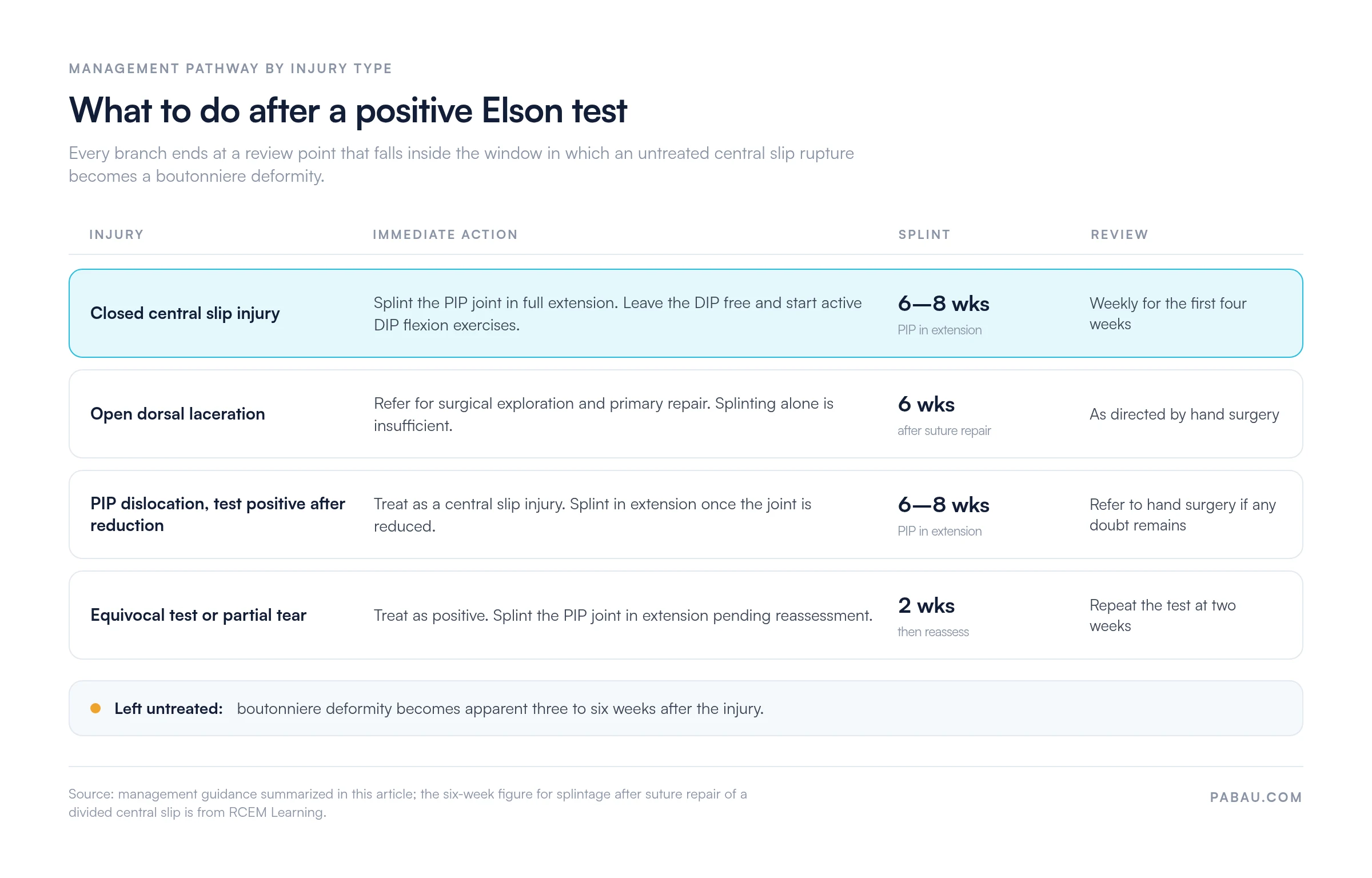
Documenting the Elson test accurately matters as much as performing it. A note reading “Elson positive” tells the next reviewer almost nothing. A note reading “positive Elson test, rigid DIP extension, proximal phalanx stabilized, right index finger” tells them what was seen, how, and where.
Practice management software like Pabau replaces that free-text note with a structured hand injury assessment form. The form prompts for the posture of both joints, the technique used, the result, and the immediate plan. A free-text field sits alongside the structured ones, so the clinician can still record the detail a binary result cannot hold.

For a practice running hand therapy alongside a general caseload, that structure has to sit in the same record as the appointment. A physical therapy EMR keeps the assessment, the splint issue date, and every review appointment on one patient timeline.
Follow-up is where these injuries are lost. Pabau’s automated workflows trigger a reminder at two weeks and again at six weeks once a positive Elson test is recorded. Fewer patients drop out before healing is confirmed. If you are comparing systems for a rehab caseload, our guide to physiotherapy practice management software sets out the options.

The same records satisfy an audit. Dated review notes and structured assessments are what an inspector looks for. Our summary of physiotherapy compliance requirements covers the standards that apply to musculoskeletal practice.

Pabau gives physical therapy, sports medicine, and orthopedic practices structured clinical forms, a single patient timeline, and automated review reminders. Assessments stay complete and patients reach the end of the splinting protocol.

Central slip injuries are missed because the first presentation looks benign and no single sign is diagnostic without this test. That makes the Elson test one of the highest-yield minutes in a hand examination.
Read both joints at once, stabilize the proximal phalanx, and record what you saw rather than a verdict. Treat every equivocal result as positive. For an open dorsal wound, send the patient for exploration whatever the test shows.
Six to eight weeks in a splint costs the patient far less than a fixed boutonniere deformity costs them later. Dropout at week three is what undoes the treatment, and catching it is a scheduling problem rather than a clinical one. Book a demo to see how Pabau keeps hand injury assessments structured and review reminders automatic.

Need to rule out a nerve injury as well? Hand nerve tests walks through the bedside checks for median, ulnar, and radial nerve function after a hand injury.
Assessing grip and pinch strength? The pinch grip test explains what an abnormal pinch posture tells you about the anterior interosseous nerve.
Working up hand numbness or swelling? The hand elevation test covers a quick provocative test for suspected carpal tunnel syndrome.
Want the patient to show you where it hurts? Hand pain diagrams give you a printable chart patients can mark up before the consultation.
Responsible for compliance across a rehab practice? Physiotherapy clinic compliance requirements sets out the documentation and regulatory standards for musculoskeletal practice.
A positive Elson test shows rigid hyperextension of the DIP joint together with weak or absent active extension at the PIP joint. You read both joints at the same moment, with the PIP held at 90 degrees of flexion over a firm edge. That pattern means the central slip has ruptured and extension force is traveling through the lateral bands instead.
Position the hand palm-down with the PIP joint flexed to 90 degrees over a table edge. Stabilize the proximal phalanx firmly against the table, then ask the patient to extend the PIP joint actively. Watch both joints together. A positive result shows rigid DIP hyperextension with weak PIP extension, and a negative result shows strong PIP extension with a flail, mobile DIP joint.
Yes. A false negative occurs when the central slip and both lateral bands are lacerated at the same time. Neither structure can then transmit extension force to produce the DIP hyperextension sign, so the test appears negative despite complete disruption of the extensor mechanism. A 2022 PubMed Central case report documents this, and it is most likely in open dorsal lacerations crossing both structures.
No published study reports a sensitivity or specificity for the Elson test, so there is no accuracy figure to quote. The 2021 cadaveric study often cited for such numbers measured force and range of motion under cyclic loading rather than diagnostic accuracy. Clinicians use the test because the mechanism is sound, and they treat equivocal results as positive rather than relying on a statistic.
The standard test requires active PIP extension from the patient, while the modified version assesses passive DIP stiffness instead. In the modified test the examiner passively flexes the DIP joint while the PIP stays at 90 degrees. Increased resistance compared with the same finger on the other hand indicates a ruptured central slip whose lateral bands are under tension. It is used when pain or age prevents active cooperation.
An untreated central slip rupture leads to boutonniere deformity, which typically becomes apparent three to six weeks after the injury. The lateral bands migrate volarly and turn from DIP extensors into PIP flexors, fixing the finger in PIP flexion with DIP hyperextension. Correcting an established deformity needs prolonged splinting, serial casting, or surgery, all far harder than six to eight weeks of PIP extension splinting.
The Elson test assesses zone III extensor tendon injuries, which sit at the level of the PIP joint itself. Zone III is where the central slip inserts into the dorsal base of the middle phalanx. Zone II covers the middle phalanx and zone IV the proximal phalanx. Injuries there need different clinical tests and different management.