HIV AIDS medication list template
An HIV AIDS medication list is a structured record of the antiretroviral drugs a...

1
Last Updated: Oct 15, 2026
The Crohn’s disease activity index (CDAI) is a clinical score that grades Crohn’s disease activity from eight weighted variables. It combines a seven-day patient diary, examination findings and one laboratory value, the hematocrit.
Clinicians use the total to classify disease and to track response to treatment over time. A total below 150 counts as remission, 150 to 219 as mild, 220 to 450 as moderate, and above 450 as severe.
The inputs can end up spread across separate notes, which makes scores hard to compare between visits. A standard template keeps the scoring inputs, the seven-day diary and the final calculation in one place. That makes the score easier to reproduce and audit.
Below, you’ll find how the index is built, what each band means, how it compares with the Harvey-Bradshaw Index, and where it falls short. The free template comes first.
A ready-to-use scoring form with the seven-day diary for liquid stools, abdominal pain and well-being. It also covers extraintestinal manifestations, antidiarrheal use, abdominal mass, hematocrit and body weight, then closes with the total score and severity band.
Download template
The CDAI sums eight weighted variables over a seven-day period, giving a total score.
A total below 150 is classed as remission, and a total above 450 as severe disease.
The CDAI contains no endoscopic component, so it cannot confirm mucosal healing alone.
Track scores in a consistent template to compare response across visits and audits.
The Crohn’s disease activity index is a composite score of how active Crohn’s disease is at a given time. Best and colleagues developed it in 1976. It has long been the reference measure of disease activity in clinical research. It also remains widely used in practice to document disease state.
Because the index combines subjective symptom reports with clinical and laboratory data, a single visit cannot capture all of it. The seven-day diary gives the score its reliability, so the template prompts for it.
The score is the weighted sum of eight variables, each collected over the preceding seven days. Each variable has its own multiplier, so the total reflects the relative weight each factor carries in the original formulation.
Several items are collected from the patient, so the form should prompt for them explicitly. Hematocrit and body weight need a reference value recorded at the same visit, otherwise the calculation cannot be completed.
Antidiarrheal use counts toward the total, so ask the patient to check their antidiarrheal medication list before answering.
A total below 150 indicates remission. Scores of 150 to 219 are mild, 220 to 450 are moderate, and above 450 indicates severe disease.
Trials have also used a fall of 70 points or more, or a fall of 100 points or more, as markers of clinical response. Teams should check which threshold their protocol or payer policy references before using a band as a treatment trigger.
Reading two scores side by side shows why the threshold matters, as the worked example below sets out.
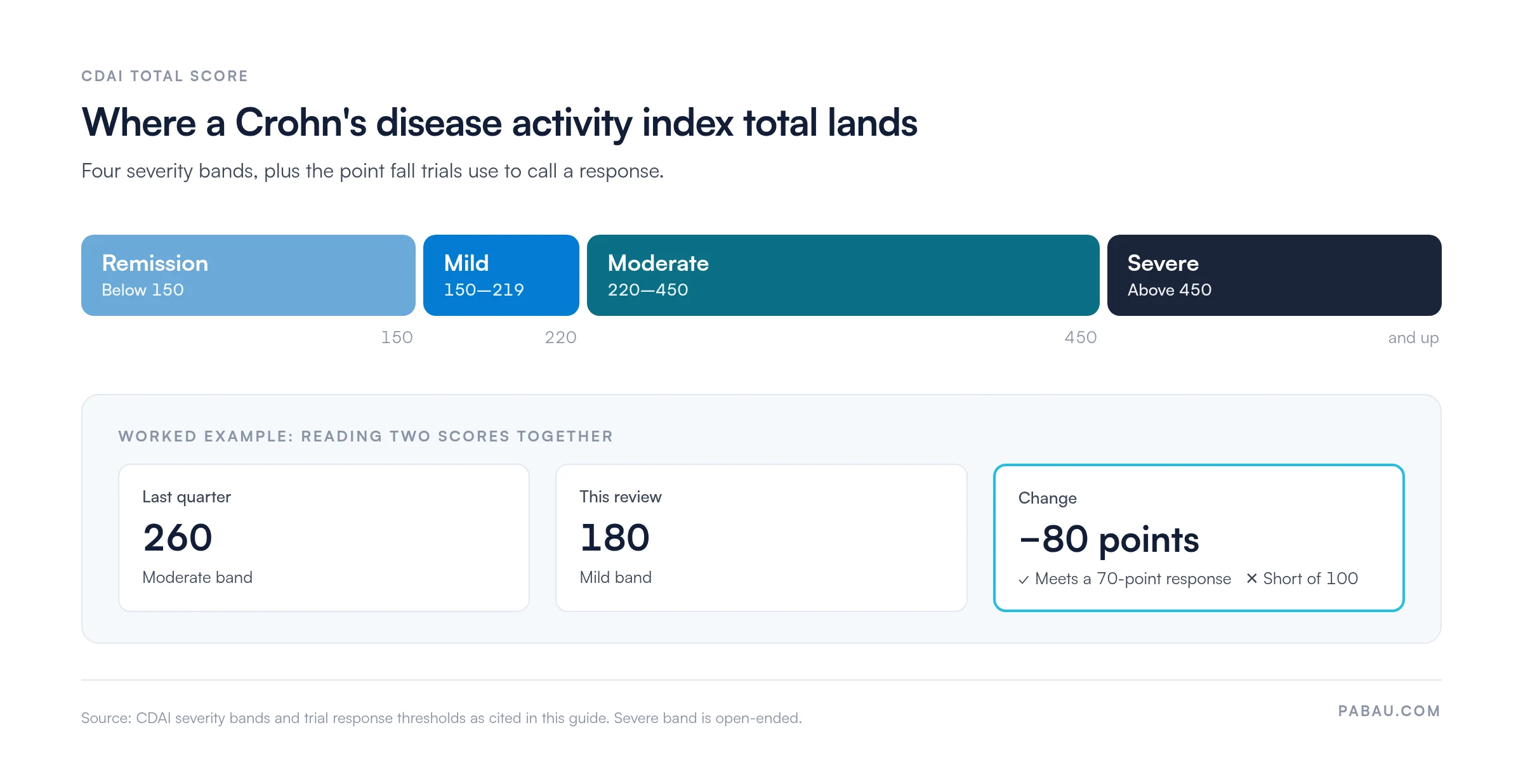
The template follows the same order as the original index, so staff can complete it without re-reading the method each time. Work through it in this sequence.
Keeping the completed form on the patient record means the next visit can start from a comparable score rather than a fresh recollection. If your practice uses digital forms, the same structure can be sent to the patient before the visit.

The Harvey-Bradshaw Index is a simplified alternative with five items and no laboratory component. It correlates with the Crohn’s disease activity index in published comparison studies, and it is quicker to score during a busy clinic session.
Choose the Crohn’s disease activity index when you need a score that matches trial methodology or a detailed record. Choose the Harvey-Bradshaw Index when speed matters more than granularity.
The index has no endoscopic component, so a low score does not confirm that the bowel has healed. Where mucosal assessment matters, the Simple Endoscopic Score for Crohn’s Disease (SES-CD) is commonly used alongside it.
Stool frequency and abdominal pain are patient-reported, so recall and reporting differ between patients. The index was validated in adults, and pediatric practice should use the Pediatric Crohn’s Disease Activity Index (PCDAI) instead.
After ileostomy or bowel resection, stool counts can be misleading, so the score may be unreliable. Note the surgical history in the record whenever the index is used in these patients.
For many years the Crohn’s disease activity index served as the primary endpoint in Crohn’s disease trials. CDISC standards have formalized its variable definitions, so trial datasets can report it in a consistent format.
Regulators have signaled interest in endoscopic endpoints, so the index should not be presented as the universal current standard. Check current FDA and EMA guidance before designing a study around it.
Teams get the most value when the score is collected at every review, not only when a patient is struggling. A fixed schedule, such as each clinic visit and each treatment change, keeps the trend line usable.
File each score next to the patient’s Crohn’s disease medication list. A change in band then reads against the treatment change that came before it.
Audit your scoring forms twice a year. Check that each variable has a clear definition, a named owner, and a stored reference value for hematocrit and weight. A score cannot be completed without them.
Without a digital form, the patient fills in a paper diary and staff copy the seven daily entries into the note at the consultation. Scores end up in different files, so comparing this quarter with last quarter means digging.
In Pabau, the patient completes the diary as a digital form before the appointment. The answers flow into the patient record automatically, next to the hematocrit, weight and previous totals. Body weight is one of the eight inputs, and the same record setup already supports weight and metabolic clinics that track it at every visit.
The outcome is a score your team can trust at each review, without retyping. You spend the consultation on the trend rather than on reconstructing the week.

See how Pabau’s digital forms collect the seven-day diary before the visit. Each total is stored beside the last one, so every review starts from comparable data.

The Crohn’s disease activity index is only as useful as the consistency of its inputs. A total of 180 says little on its own. Beside last quarter’s 260 and the treatment change in between, it tells a clear story.
That makes the template a practice decision as much as a clinical one. Decide who sends the seven-day diary, who records hematocrit and weight, and when the total is calculated. Settle those owners once, and every review starts from comparable data.
Keep the index’s limits in view as well. Pair it with endoscopic findings when mucosal healing is the question, and use the PCDAI for younger patients. Pabau keeps the score, the diary and the follow-up in one patient record. Book a demo to see how that keeps your CDAI reviews comparable.

Tracking Crohn’s treatment between reviews? Crohn’s disease medication list keeps each patient’s current Crohn’s medicines in one structured record.
Managing patients with ulcerative colitis too? Ulcerative colitis medication list gives the same structured layout for the other main form of inflammatory bowel disease.
Supporting diet changes alongside treatment? 7-day meal plan for ulcerative colitis offers a week-long eating plan you can share with patients.
Advising a patient through a flare? Gastrointestinal soft diet food list sets out gentle foods to suggest while symptoms settle.
Looking for trigger foods behind loose stools? FODMAP food list groups high- and low-FODMAP foods for a structured elimination trial.
The Crohn’s disease activity index is a composite clinical score that grades Crohn’s disease activity from eight weighted variables. It was developed by Best and colleagues in 1976.
A total below 150 is classed as remission. Trials may use different response thresholds, so check the protocol before relying on one.
The index was validated in adults. Pediatric practice should use the Pediatric Crohn’s Disease Activity Index (PCDAI) instead.
No. It has no endoscopic component, so a low score does not confirm mucosal healing on its own.
Most trials define clinical response as a fall of 70 points or more, or 100 points or more, from baseline. Remission is usually defined as a total below 150. Check which definition your protocol uses before you compare results.
It needs a seven-day patient diary plus one consultation for the clinical items. Each day, the patient records liquid stools, abdominal pain and general well-being. The total is calculated once every input is on the form.
The Harvey-Bradshaw Index uses five items collected on a single day and needs no blood test. The CDAI uses eight weighted variables, a seven-day diary and a hematocrit value. The CDAI suits trials and detailed records, while the Harvey-Bradshaw Index suits routine clinic reviews.
There is no fixed interval. Many teams score it at each review and at every treatment change, so the trend stays comparable. Record the total and the change from the previous score in the same note.