Pabau Engage inbox

Pabau Engage is here: every patient conversation in one inbox.

Learn more
Book a demo Book a demo
CCSD Code

CCSD code 20240 Impedance audiogram as part of another procedure


Code Definition

20240 is the CCSD code for impedance audiogram as part of other procedure.

Group
1 Simple investigations and procedures
Category
Investigation Codes
Code also known as
tympanometry and acoustic reflex testing, middle ear assessment, middle ear impedance test
Save time. Improve accuracy. Get paid faster.
Automate coding with Pabau

Let Pabau's smart automation suggest the right codes, reduce claim denials, and keep your practice compliant—effortlessly.

  • AI-powered code suggestions
  • Real-time compliance checks
  • Faster claims, fewer denials
Why practices choose Pabau
Save hours every week

Automate repetitive tasks and focus on what matters most—your patients.

Improve accuracy

Reduce coding errors and ensure compliance with the latest regulations.

Get paid faster

Clean claims, fewer denials, and faster reimbursements.

Grow with confidence

Powerful insights and reporting to help your practice thrive.

HIPAA compliant SOC 2 certified GDPR-compliant Trusted by 4,000+ clinics worldwide

Key Takeaways

Key Takeaways

CCSD Code 20240 covers an impedance audiogram performed as part of another procedure – it is an ancillary code and must always accompany a primary procedure code

The core components are tympanometry, acoustic reflex testing, and Eustachian tube function assessment, performed using a calibrated impedance audiometer

Submitting 20240 without a primary procedure code or confusing it with standalone code 20230 are the two most common causes of claim rejection

Pabau’s claims management tools help audiology and ENT practices track CCSD codes, flag missing primary codes, and maintain the documentation trail insurers require

CCSD Code 20240: definition and scope

CCSD Code 20240 is the Classification of Clinical Services Database code for “impedance audiogram as part of other procedure.” The critical phrase is “as part of other procedure”: this is an ancillary code, meaning it describes a test performed within a wider clinical encounter rather than as the sole reason for the appointment. The CCSD classifies it this way to reflect how impedance audiometry most often arises in practice: a patient attends for an ENT consultation or a diagnostic hearing assessment, and the clinician adds impedance testing to evaluate middle ear function during that same session.

Because 20240 is ancillary, it cannot stand alone on an invoice. The primary procedure must occupy its own line, and 20240 is added below it. Private insurers including Bupa and AXA Health enforce this rule at the point of adjudication. A claim presenting only 20240 without a host procedure code will be rejected automatically.

What the impedance audiogram involves

An impedance audiogram measures how the middle ear conducts and reflects sound energy. The test is objective – it does not require a behavioural response from the patient – and typically runs three components in sequence.

  • Tympanometry: A probe tip is placed in the ear canal and air pressure is varied to measure the compliance of the tympanic membrane. Results are plotted as a tympanogram – a Type A trace indicates normal middle ear function; Type B suggests fluid or perforation; Type C indicates negative middle ear pressure typical of Eustachian tube dysfunction.
  • Acoustic reflex testing: A loud stimulus triggers the stapedius muscle to contract, stiffening the ossicular chain. The threshold at which this reflex fires (the acoustic reflex threshold) and whether it is present or absent gives information about the integrity of the middle ear, cochlea, and facial nerve pathway.
  • Eustachian tube function assessment: Where clinically indicated, the tympanometer can also assess whether the Eustachian tube is opening correctly during swallowing, which is relevant in recurrent otitis media and post-grommet follow-up.

The British Society of Audiology’s guidance confirms that tympanometry and acoustic reflex testing together constitute the standard core of an impedance audiogram. Equipment must be a calibrated impedance audiometer maintained in accordance with BS EN 60645-5. The test takes approximately five to ten minutes per ear depending on the number of components performed.

Clinical indications: when is CCSD Code 20240 appropriate?

The impedance audiogram under 20240 is appropriate when middle ear function needs objective evaluation during a broader ENT or audiology encounter. Common clinical triggers include:

  • Suspected otitis media with effusion (glue ear) – tympanometry confirms the flat Type B trace and acoustic reflex absence characteristic of the condition
  • Eustachian tube dysfunction evaluation – required before grommet insertion and at post-operative follow-up
  • Asymmetric sensorineural hearing loss workup – acoustic reflex testing helps localise whether the lesion is cochlear or retrocochlear
  • Conductive hearing loss investigation – differentiates ossicular chain disruption from middle ear effusion
  • Facial nerve monitoring – acoustic reflex thresholds and decay testing are used in facial palsy and acoustic neuroma assessment
  • Hearing aid candidacy assessment – insurers frequently require middle ear status confirmation before authorising hearing aid assessment codes

The test is performed by an audiologist or ENT surgeon with access to a calibrated impedance audiometer. ENT surgeons often delegate impedance testing to the audiologist working alongside them in a shared clinic. Both practitioners should ensure the primary procedure code reflects who is billing and that the impedance audiogram is clearly attributed in the clinical record to the correct session. Good client record keeping is essential for auditable claims.

CCSD Code 20240 vs CCSD Code 20230: key differences

The distinction between 20240 and 20230 is the single most common source of coding errors in impedance audiometry billing. Both codes describe the same physical test. The difference is context: 20230 is the standalone code; 20240 is the ancillary code. Choosing the wrong one is not a minor clerical error – it determines whether the claim is valid at all.

Factor CCSD 20230 CCSD 20240
Descriptor Impedance audiogram (standalone) Impedance audiogram as part of other procedure
Primary code required? No – this IS the primary code Yes – must accompany a host procedure code
Typical scenario Patient attends solely for impedance testing; no consultation or other procedure billed Impedance testing added during a consultation, diagnostic hearing assessment, or surgical follow-up
Can it appear alone on invoice? Yes No – automatic rejection if submitted without host code
Fee level Typically higher (reflects standalone clinical episode) Typically lower (reflects ancillary status; verify per insurer schedule)
Bundling risk Lower – it is already the primary code Higher – some insurers bundle it into the consultation fee

A useful decision rule: if the patient’s only scheduled activity for that appointment is the impedance test, use 20230. If anything else is being billed for the same date of service, the impedance audiogram should be coded 20240. Good digital clinical forms that capture the appointment purpose at the point of booking help billing staff apply this rule consistently without needing to interrogate the clinical notes retrospectively.

Digital forms
Digital forms

Neighbouring CCSD audiology codes to know

Audiology billing involves a cluster of CCSD codes that practitioners bill alongside or instead of 20240 depending on the procedures performed. Understanding the adjacent codes reduces miscoding and helps billing teams answer insurer queries confidently.

CCSD Code Descriptor (approximate) Notes
20200 Pure tone audiogram (air and bone conduction) Frequently the primary code when 20240 is added
20210 Speech audiogram Used alongside pure tone audiogram in hearing aid assessments
20230 Impedance audiogram (standalone) Use when the impedance test is the sole billed procedure for that session
20240 Impedance audiogram as part of other procedure The subject of this article – always ancillary
20250 Brainstem evoked response audiometry (BERA) Used when retrocochlear pathology is suspected; separate clinical test
20270 Otoacoustic emissions (OAE) test Objective cochlear function test; sometimes performed alongside impedance audiometry

Code descriptors in the table above are approximate – always verify against the current CCSD schedule for the exact wording and any insurer-specific fee adjustments. Practices using Bupa’s procedure fee schedule should cross-reference that schedule as Bupa occasionally applies its own fee modifiers to CCSD-listed codes.

How to bill CCSD Code 20240 correctly

Billing 20240 correctly requires four elements to align on the same invoice: the right primary code, the ancillary code on a separate line, a clear procedure description, and supporting documentation attached or retrievable on request. The following steps reflect standard CCSD and insurer practice for UK private billing.

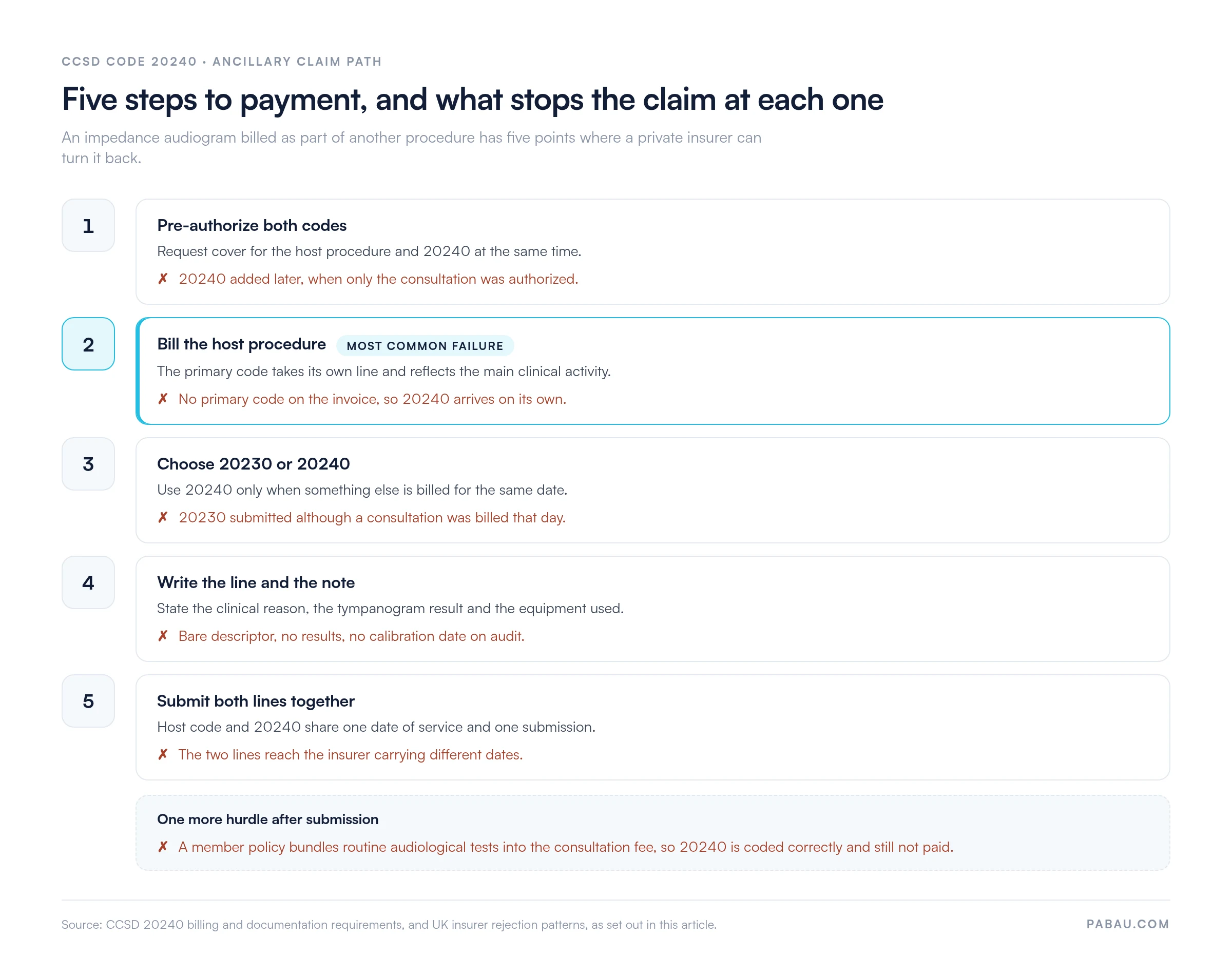
  1. Identify the primary procedure code. The most common host codes are pure tone audiogram (20200), a new or follow-up outpatient consultation code, or a surgical procedure code where impedance testing was performed intraoperatively or in an adjacent appointment slot on the same date. The host code must reflect the actual primary clinical activity – do not select an arbitrary code solely to provide a host for 20240.
  2. Add 20240 as a separate line item. On the Healthcode/Bupa and AXA submission forms, each procedure occupies its own line with its CCSD code, quantity (typically 1), and the applicable fee. The fee for 20240 is set by each insurer’s schedule separately from 20230 – verify the current fee in the relevant payer portal before invoicing.
  3. State the clinical reason on the invoice description line. Many practices leave the description field with the bare code descriptor. Adding the clinical context (for example, “tympanometry and acoustic reflex testing – bilateral, otitis media with effusion workup”) reduces adjudicator queries and speeds payment. This is especially valuable for Bupa, which performs automated pre-payment audits on ancillary codes.
  4. Confirm pre-authorisation status. For elective consultations where impedance testing is anticipated, request authorisation for both the primary code and 20240 at the outset. Adding 20240 retrospectively on a claim that was authorised only for the consultation code is a common rejection cause. Some insurers will accept retrospective authorisation requests; others will not reimburse the additional code without prior approval.
  5. Submit via Healthcode or the insurer’s own portal. The UK private sector uses Healthcode as the standard electronic billing pathway for most major insurers. Claims submitted via paper invoice bypass automated validation checks and take longer to process.

Pro Tip

Run a monthly audit of all invoices containing CCSD 20240. Filter for any line where no host procedure code appears on the same date of service. Those claims have either been miscoded (should be 20230) or will be rejected on submission. Catching this in the practice management system before submission saves re-submission delays of two to four weeks per claim.

Documentation requirements for CCSD Code 20240

Insurers treating 20240 as an ancillary code expect the clinical record to substantiate both the primary procedure and the impedance test. A claim may be paid initially and then clawed back on audit if the documentation does not support both elements. The record must contain the following.

  • Date of service: The impedance audiogram must be recorded on the same date as the primary procedure. Billing 20240 for a test performed on a different date from the host procedure is a coding violation and will result in rejection.
  • Indication for the impedance test: A brief clinical justification – “bilateral hearing loss with flat tympanogram on screening” or “post-grommet follow-up, assessing Eustachian tube function” – demonstrates that the test was not routine add-on testing. Insurers use this to determine medical necessity.
  • Equipment used: Note the make and model of the impedance audiometer, plus its last calibration date. Bupa and AXA Health may request this information on audit.
  • Results: Record the tympanogram type for each ear (A, B, As, Ad, C), the acoustic reflex thresholds or their absence, and any ETF findings. A bare “impedance audiometry performed” entry without results does not satisfy documentation requirements.
  • Clinician identity: The record must identify the clinician who performed the test. Where the audiologist performs the test within an ENT surgeon’s clinic, both practitioners’ names should appear in the relevant sections of the note.

Practices that use structured electronic client records with pre-built audiology templates find it significantly easier to maintain this standard consistently across clinicians. A manual paper-based system creates gaps whenever a busy clinician abbreviates their notes.

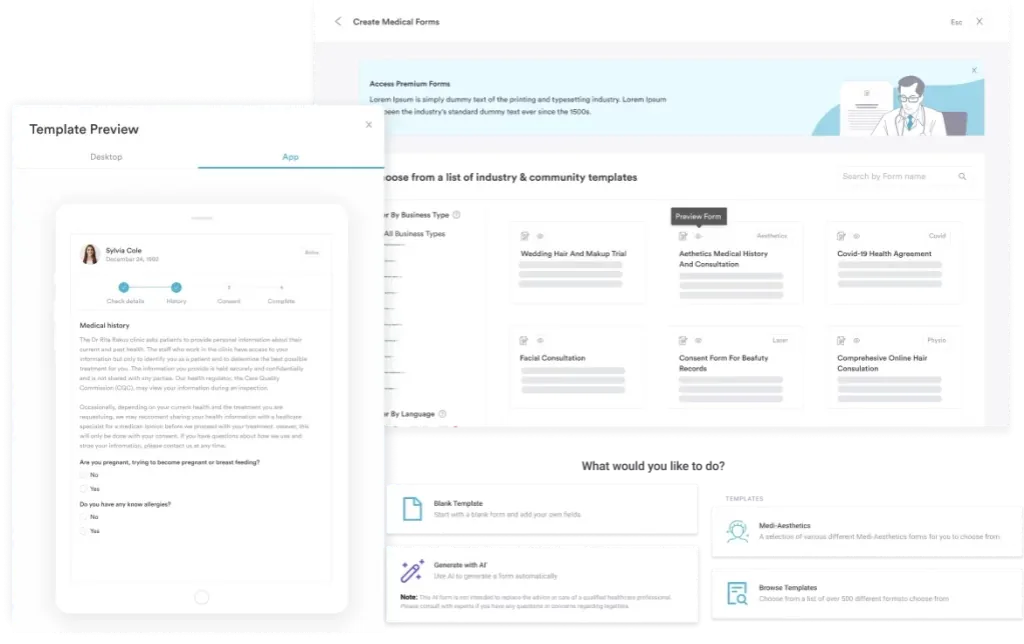
Detailed client records in Pabau

Payer rules: what Bupa, AXA Health, and Aviva require

Each of the major UK private medical insurers handles ancillary audiology codes differently. The table below summarises the key rules for CCSD 20240 across the four most common payers. Fee amounts are not published here because they are subject to annual revision; always verify against the current insurer fee schedule before invoicing.

Insurer Pre-auth required? Bundling risk Key requirement
Bupa Yes – pre-authorise both primary and 20240 Moderate – may bundle into consultation depending on member policy Detailed procedure note; calibration date on audit request
AXA Health Yes – especially for surgical episodes Lower for diagnostic episodes; higher when bundled with surgical code Invoice description line must state bilateral/unilateral and clinical indication
Aviva Check member policy – not universal Higher risk – Aviva schedules may roll ancillary audiology codes into the consultation Verify current fee schedule before billing; bundling rules vary by member plan
Healix Managed care rules apply – verify per episode Moderate – Healix publishes explicit unbundling guidelines in its fee schedule Consult Healix fee schedule guidelines for unbundling allowances before invoicing

The bundling risk column reflects a genuine tension in CCSD billing: insurers argue that a brief impedance test is a routine element of an ENT consultation and should not attract a separate fee; practices argue that it involves specialist equipment and additional time. The clinical record is the primary lever practitioners have in this dispute. A note that documents the specific components performed and their findings is far harder to bundle than a bare entry. For practices managing compliance across multiple clinical disciplines, a consistent documentation policy applied to all ancillary procedure codes reduces insurer pushback.

Stop losing revenue on CCSD 20240 claims

Pabau helps audiology and ENT practices track CCSD billing codes, flag missing primary procedure codes before submission, and maintain the audit-ready documentation trail that private insurers require.

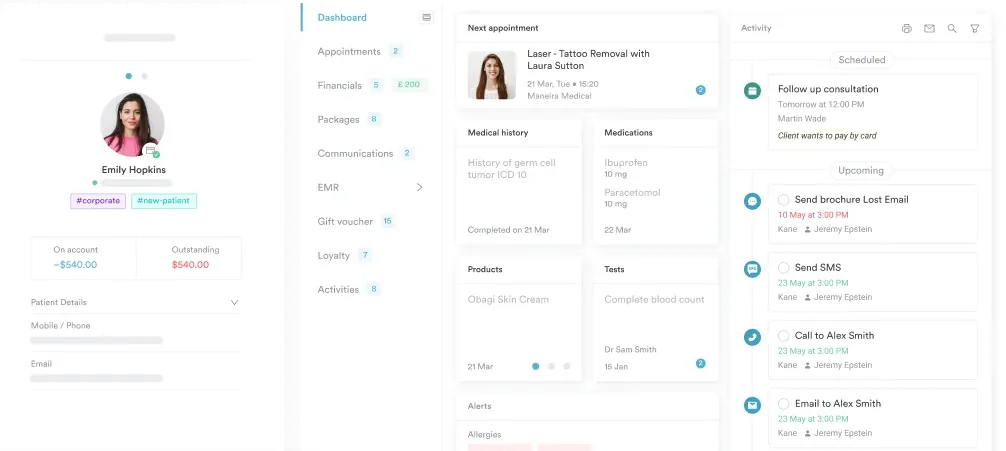
Pabau practice management dashboard

Common reasons CCSD Code 20240 claims are rejected

Rejection patterns for 20240 are consistent across practices and insurers. Most are preventable at the point of invoice creation rather than requiring re-submission appeals.

  • No primary procedure code on the same invoice. The single most common rejection. Submitting 20240 without a host code treats it as a standalone claim, which conflicts with its CCSD classification. The fix is a pre-submission check that flags any 20240 line without an accompanying primary code on the same date of service.
  • Wrong code used: 20230 submitted when 20240 applies, or vice versa. When a clinician performs impedance testing as part of a consultation but admin codes it as 20230, insurers may reject the 20230 on the grounds that a consultation was also billed for the same date. The codes describe different clinical situations; use the comparison table above to select correctly.
  • Missing pre-authorisation for the ancillary code. Some Bupa and AXA Health member policies require explicit pre-authorisation for each line item, not just the primary procedure. Adding 20240 to an invoice that was only authorised for the consultation triggers a “not authorised” rejection. Pre-auth should be requested for both codes at the start of the episode.
  • Insufficient documentation on audit. Bupa in particular performs retrospective audits on ancillary codes. If the clinical record contains no results, no equipment details, and no clinical indication for the impedance test, the claim can be clawed back even after initial payment. A structured clinical documentation workflow prevents this.
  • Insurer bundling policy applied. Some member policies specify that standard audiological tests performed during a consultation are included in the consultation fee. This is a policy-level rejection rather than a coding error – the response is to check the member’s policy schedule and, if appropriate, to challenge the bundling decision with reference to the specific equipment used and the additional time taken.
  • Date mismatch between primary and ancillary code. If the system processes the primary procedure on one invoice date and 20240 on a different date, the insurer’s adjudication system will not recognise the link. Both codes must share the same date of service on the same claim submission.

How practice management software supports CCSD 20240 billing

Manual CCSD billing in spreadsheets or paper systems creates the conditions for every rejection reason listed above. Practice management software designed for UK private healthcare reduces these errors by building the validation logic into the workflow rather than relying on billing staff to catch problems manually.

Pabau supports CCSD billing for audiology and ENT practices through its claims management tools, which allow practices to store CCSD code libraries, attach procedure codes to appointment types, and generate invoices that pre-populate the primary and ancillary code lines based on what was scheduled. For practices using Bupa’s CCSD schedule, the code library can be configured to reflect Bupa’s current fees, reducing the manual fee-lookup step that often introduces errors.

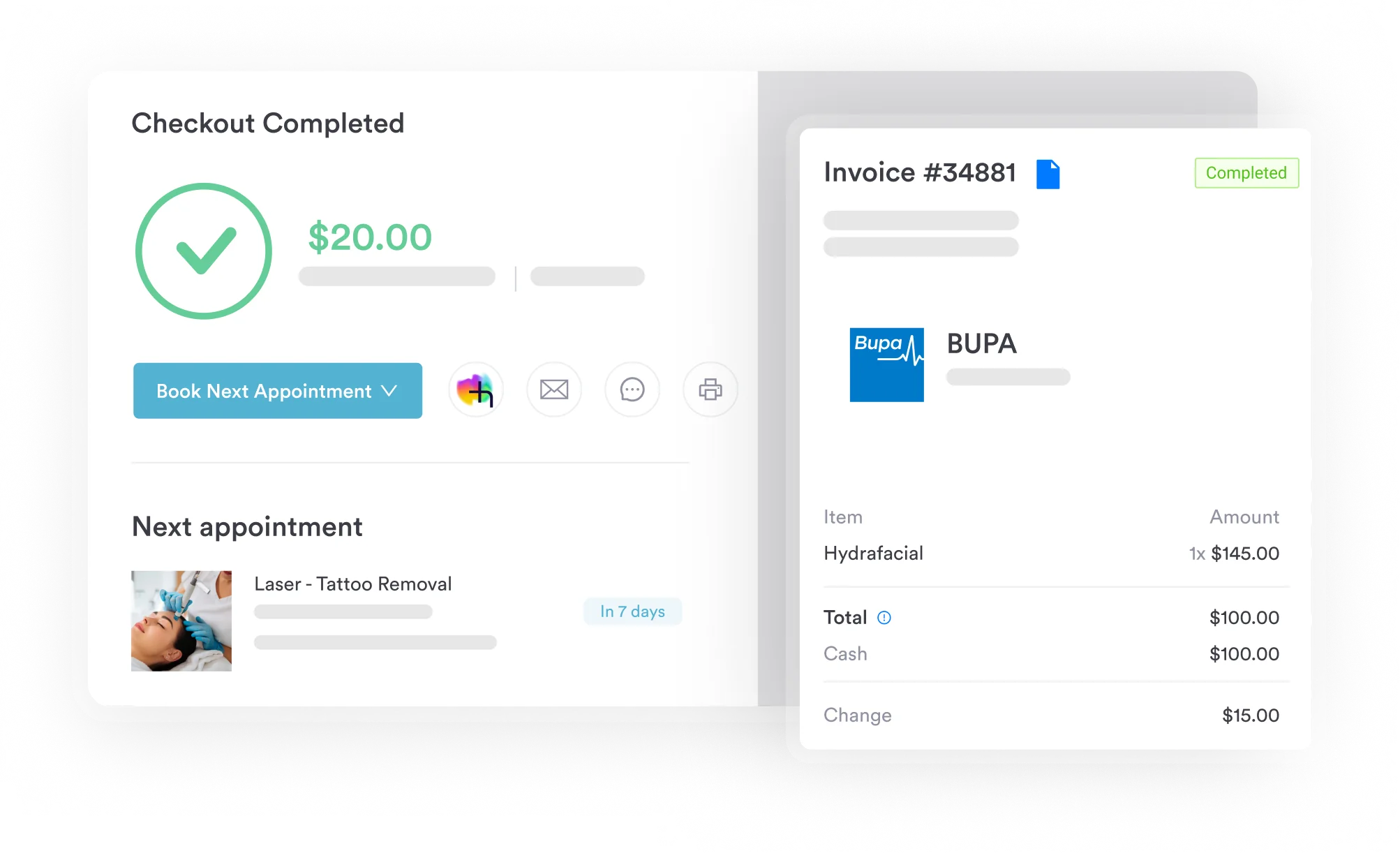
Automate claims through Healthcode

The audit trail built into Pabau’s client records captures the clinical notes, equipment details, and procedure date in one place. When an insurer requests supporting documentation for a 20240 claim, the practice can export the relevant record directly rather than reconstructing it from paper notes. For larger multi-clinician ENT practices, this is the difference between a 15-minute audit response and a two-hour administrative task.

Practices looking to reduce their overall private billing overhead can explore how practice management software handles the full billing cycle from appointment through to payment reconciliation. The same documentation standards that protect 20240 claims apply across the CCSD code set, so the investment in a structured system pays across all audiology billing, not just this one code. For practices focused on UK GDPR compliance in their clinical records, digital audit trails also satisfy the Information Commissioner’s Office requirements for clinical data retention.

Conclusion

CCSD Code 20240 is straightforward in principle: bill it whenever an impedance audiogram is performed as part of another procedure, always alongside the host code, never on its own. In practice, the errors cluster around three points: choosing 20230 instead of 20240, failing to pre-authorise the ancillary code, and producing clinical notes that do not document the specific components and results of the test. All three are preventable with a consistent workflow.

Pabau’s claims management and digital record tools help audiology and ENT practices build that workflow into their daily operations, reducing rejection rates and the administrative burden of re-submissions. To see how it fits your practice, explore the features that save private practices time or speak with the team.

Continue your research

Continue your research

Looking for a full Bupa CCSD code reference? Bupa CCSD codes guide covers the most commonly billed codes across all Bupa-recognised specialties with guidance on fee schedule navigation.

Need to understand Bupa’s procedure fee structure? Bupa procedure codes and fee schedule explains how fees are set, updated, and verified for UK private practice billing.

Want to see how Pabau handles private practice billing end to end? Private practice management walks through the workflow from appointment scheduling through invoice submission and payment.

Frequently Asked Questions

What is CCSD Code 20240 used for?

CCSD Code 20240 is the billing code for an impedance audiogram performed as part of another procedure in UK private healthcare. It covers tympanometry, acoustic reflex testing, and Eustachian tube function assessment when these tests are added to a broader ENT consultation or diagnostic hearing assessment, rather than conducted as a standalone appointment.

When is CCSD 20240 billed separately vs included in another procedure?

CCSD 20240 is always billed separately as its own invoice line alongside the host procedure code. The question is not whether to bill it separately from the host, but whether an insurer’s bundling policy will reimburse it separately. Some payers, particularly on certain Aviva member plans, bundle the impedance audiogram into the consultation fee. Check the member’s specific policy schedule before invoicing and include detailed procedure notes to challenge a bundling decision if necessary.

What is the difference between CCSD 20240 and CCSD 20230?

CCSD 20230 is the standalone impedance audiogram code, used when the impedance test is the only procedure billed for that session. CCSD 20240 is the ancillary version, used when the test is performed alongside a primary procedure such as a consultation or pure tone audiogram. Submitting 20230 when another procedure was also billed on the same date can lead to rejection, as can submitting 20240 without a host code.

Which insurance companies accept CCSD Code 20240 claims?

All major UK private medical insurers that use the CCSD schedule recognise Code 20240, including Bupa, AXA Health, Aviva, Vitality, WPA, Healix, Allianz Care, and Cigna. Recognition does not guarantee separate reimbursement: individual member policies and the insurer’s bundling rules determine whether the code is paid at its scheduled fee or absorbed into the consultation rate. Always verify against the current payer fee schedule and the member’s specific policy.

What documentation is required to support a CCSD 20240 claim?

The clinical record must include the date of service, the clinical indication for the impedance test, the make and model of the impedance audiometer with its calibration date, the tympanogram type for each ear, acoustic reflex thresholds or their absence, any Eustachian tube function findings, and the name of the clinician who performed the test. A bare note stating “impedance audiometry performed” is insufficient for Bupa or AXA Health audit purposes.

Can CCSD 20240 be billed alongside a consultation code?

Yes. A new or follow-up outpatient consultation code is one of the most common host procedures for CCSD 20240. The consultation code occupies the primary line and 20240 is added as the ancillary line on the same invoice for the same date of service. Pre-authorisation should be obtained for both codes at the time the episode is authorised, particularly for Bupa and AXA Health where retrospective addition of ancillary codes is a common rejection trigger.

Why would a CCSD 20240 claim be rejected by a private insurer?

The most common rejection causes are: no primary procedure code on the same date of service; the wrong code used (20230 submitted instead of 20240, or vice versa); missing pre-authorisation for the ancillary code; insufficient clinical documentation on audit; the insurer’s bundling policy absorbing the test into the consultation fee; or a date mismatch between the primary and ancillary code on the submission. Most rejections are preventable with a pre-submission invoice validation check.

×