Skin clinic software Australia: 6 best picks, AUD prices
Skin clinic software in Australia costs a two-practitioner practice between A$84...

Last Updated: Sep 22, 2026

Since 1 November 2025, MBS bulk billing incentives can be claimed for any Medicare-eligible patient you bulk bill.
The Bulk Billing Practice Incentive Program pays a quarterly 12.5% loading on MBS benefits, split evenly between the GP and the practice.
That loading is all-or-nothing, so privately billing one eligible service costs your practice the whole payment.
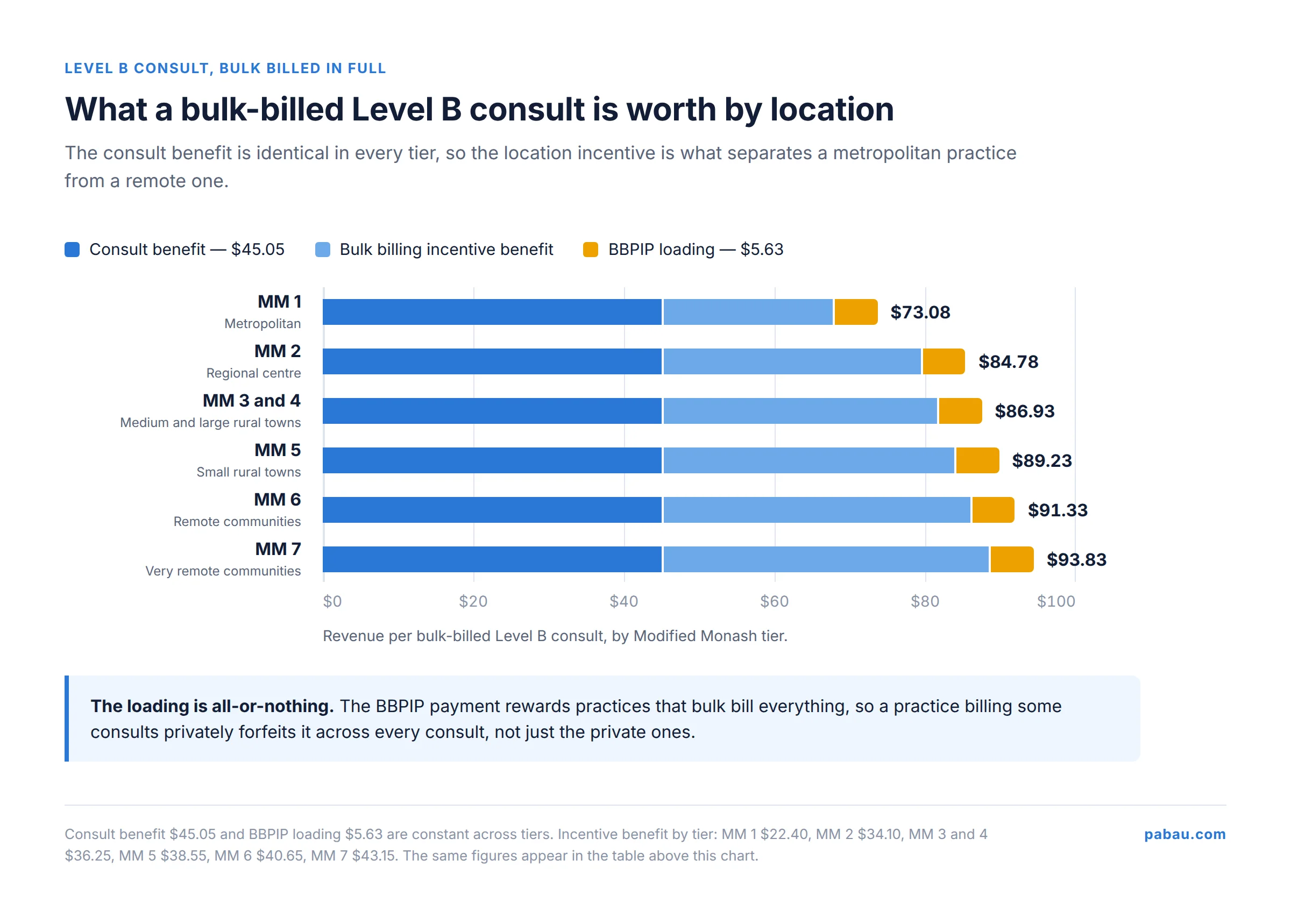
A bulk-billed Level B consult pays a metropolitan practice $73.08 as at July 2026, incentive and loading included.
New assignment of benefit rules began on 1 July 2026, and verbal agreement stays valid until 30 June 2027.
The bulk billing decision used to be settled on principle. Two changes moved it onto a spreadsheet. Since 1 November 2025, the MBS bulk billing incentives apply when you bulk bill any Medicare-eligible patient. Practices that bulk bill everything now collect a 12.5% loading on top of that. Our roundup of the best medical spa software compares platforms for cosmetic work, whose fees sit outside Medicare altogether.
The loading is where the arithmetic turns awkward. It is assessed at the practice level, and it is all-or-nothing. Privately bill one eligible service and the payment goes for the whole quarter. So the question is no longer whether to bulk bill a particular patient. It is whether your private fees earn more than the loading you give up to charge them.
Below are the verified incentive amounts by location tier, and the consent rules that changed on 1 July 2026. There is also a worked break-even calculation for your own consult mix. Every figure carries the date it was checked, because these numbers move.
When your practice bulk bills, it accepts the Medicare benefit as full payment for the service and claims that benefit directly from Services Australia. The patient assigns their right to the benefit to you, and pays nothing for the service.
Two consequences follow, and both shape the revenue side. You cannot charge the patient anything extra once a service is bulk billed. And the amount you receive is fixed by the schedule, not by you.
Bulk billing is one of three Medicare billing models. The other two, private billing and mixed billing, leave part of the fee with the patient to collect.
For GP non-referred attendances, the Medicare benefit is 100% of the schedule fee. A Level B consult in rooms is item 23, with a schedule fee of $45.05 and a benefit of $45.05, as at 1 July 2026. Bulk bill it and that full amount comes to the practice.
Private billing reverses the flow. You set the fee, the patient pays it, and the patient claims the benefit back from Medicare. The difference between your fee and the benefit is the patient’s out-of-pocket cost. Your medical billing software handles the invoice either way, but only one of these routes attracts an incentive.
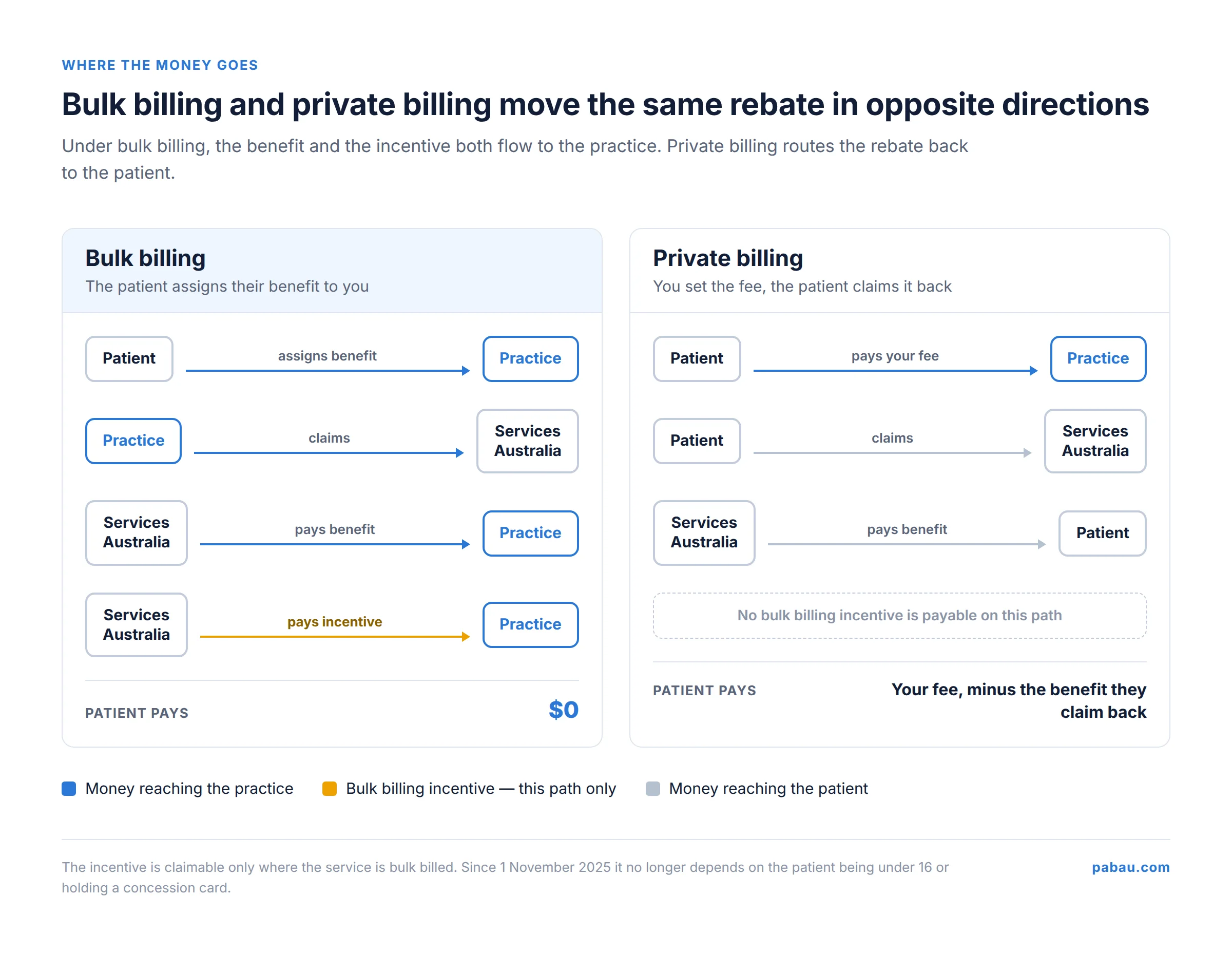
The eligibility test for MBS bulk billing incentives dropped its patient conditions. The requirement that the patient be under 16 years of age or hold a Commonwealth concession card was removed. Incentives can now be claimed whenever any Medicare-eligible patient is bulk billed.
That is the first of two components. The second is a practice-level payment, the Bulk Billing Practice Incentive Program, which rewards practices that bulk bill everything rather than rewarding individual services.
The history matters only as context. The government tripled the bulk billing incentive in November 2023, backed by a $3.5 billion investment. That change raised the amount. The November 2025 change widened who it covers.
| Element | Before 1 November 2025 | Now |
|---|---|---|
| Patients attracting an incentive | Under 16, or Commonwealth concession card holders | Any Medicare-eligible patient |
| Incentive amount | Tripled rates from November 2023 | Same structure, indexed each 1 July |
| Practice-level payment | None | 12.5% quarterly loading under BBPIP |
| Registration needed | None for incentives | MyMedicare plus BBPIP, for the loading |
Practices in BBPIP receive an additional quarterly payment of 12.5% on MBS benefits paid from eligible services. It is split evenly between the GP and the practice. It sits on top of Medicare benefits and the bulk billing incentives, rather than replacing either.
The condition is strict. A participating practice must bulk bill every eligible service for every Medicare-eligible patient. There is no partial version of this program.
Three registration conditions come with it.
Practices joining MyMedicare for the first time to take part are exempt from its accreditation requirements. Patients do not need to be registered in MyMedicare for the practice to participate.
Which incentive item you claim depends on two things: your practice’s Modified Monash location, and which consult item you billed. There is no single bulk billing incentive item, so the MBS item numbers your front desk uses every day decide which one applies.
Each Modified Monash tier has its own set of three. One covers the standard consultations, items 23, 36, 44 and 123. One covers Level A attendances and every other unreferred service. That includes chronic condition management items, health assessments, minor procedures, and the Better Access mental health items a mental health EMR would track. A third covers telehealth for MyMedicare-registered patients.
One detail is easy to get wrong, and it changes the math. The incentive items sit in Category 8 of the schedule, so Medicare pays a benefit of 85% of their schedule fee. The consult item pays 100%, the incentive pays 85%. The figures below show both, because the benefit is what reaches your bank account.
Schedule fees below were checked on MBS Online on 14 August 2026 and reflect the 1 July 2026 indexation. They change every 1 July.
| Modified Monash tier | Item | Schedule fee | Benefit paid (85%) |
|---|---|---|---|
| MM 1, metropolitan | 75870 | $26.35 | $22.40 |
| MM 2, regional centre | 75871 | $40.10 | $34.10 |
| MM 3 and 4, medium and large rural towns | 75873 | $42.60 | $36.25 |
| MM 5, small rural towns | 75874 | $45.30 | $38.55 |
| MM 6, remote communities | 75875 | $47.80 | $40.65 |
| MM 7, very remote communities | 75876 | $50.75 | $43.15 |
| Modified Monash tier | Item | Schedule fee | Benefit paid (85%) |
|---|---|---|---|
| MM 1, metropolitan | 10990 | $8.80 | $7.50 |
| MM 2, regional centre | 10991 | $13.35 | $11.35 |
| MM 3 and 4, medium and large rural towns | 75855 | $14.10 | $12.00 |
| MM 5, small rural towns | 75856 | $15.10 | $12.85 |
| MM 6, remote communities | 75857 | $15.85 | $13.50 |
| MM 7, very remote communities | 75858 | $16.95 | $14.45 |
Your tier is set by the location tied to the provider number used for the service, not by where the patient lives. Check it on the Health Workforce Locator before you configure anything.
Two items handle the crossover case. Some practitioners work in an MM 2 to 7 area while their practice sits in MM 1. Those services attract item 10992 or item 75872 instead. Both pay $40.10 for standard consultations and $13.35 for other services. Map this once and configure it, rather than deciding it per claim.
Full bulk billing pays a metropolitan practice $73.08 for a Level B consult. The question is whether your private fee beats that after you lose the practice loading. Here is how that figure is built.
| Component | Item | Amount |
|---|---|---|
| Medicare benefit for the consult | 23 | $45.05 |
| Bulk billing incentive, MM 1 | 75870 | $22.40 |
| BBPIP loading, 12.5% of the consult benefit | — | $5.63 |
| Total per bulk-billed Level B consult | $73.08 |
One assumption in that table is worth stating plainly. BBPIP pays 12.5% of MBS benefits from eligible services, and we have applied it to the consult benefit only. If the incentive benefit also counts toward the base, add $2.80 per consult. The department publishes the eligible services list, and it is worth checking against your own item mix.
Run the same build across the location tiers and the spread is wide. A very remote practice collects $20.75 more per Level B consult than a metropolitan one.
| Modified Monash tier | Incentive benefit | Total per bulk-billed Level B |
|---|---|---|
| MM 1, metropolitan | $22.40 | $73.08 |
| MM 2, regional centre | $34.10 | $84.78 |
| MM 3 and 4, medium and large rural towns | $36.25 | $86.93 |
| MM 5, small rural towns | $38.55 | $89.23 |
| MM 6, remote communities | $40.65 | $91.33 |
| MM 7, very remote communities | $43.15 | $93.83 |
The loading is forfeited across every consult, but a private fee is earned only on the consults you charge for. That asymmetry is the whole decision, and it runs against instinct.
Take a metropolitan practice doing 1,000 Level B consults a quarter. Privately bill 100 of them and you give up $5,630 of loading. Those 100 consults now have to carry the shortfall on their own. Each needs $56.30 more than the $67.45 a bulk-billed consult brings in, so the fee has to reach $123.75.
Privately bill more of them and the required fee falls, because the forfeited loading spreads over more paying patients. The table below shows where the line sits.
| Share of Level B consults billed privately | Private fee that matches full bulk billing |
|---|---|
| 10% | $123.75 |
| 20% | $95.60 |
| 30% | $86.22 |
| 50% | $78.71 |
| 100% | $73.08 |
A practice charging $95 and privately billing 30% of its Level B consults clears the bar. On 1,000 consults it takes $75,715 against $73,080 under full bulk billing. That is a margin of $2,635 a quarter, or roughly 3.6%, before a single bad debt or card fee.
The same practice charging $95 on only 20% of consults falls just short. The margins here are thin enough that the answer flips on a few dollars of fee or a few percent of mix.
A break-even figure is a starting point, not an answer. Several factors sit outside it and can be larger than the margin itself.
None of this points to one answer. A remote practice starts from $93.83 a consult and would need a high private fee to justify walking away from that. A metropolitan practice with an affluent list and a $130 fee is in a different position entirely. The framework is what transfers; the conclusion is yours to reach on your own mix.
Every bulk-billed service needs an assignment of benefit agreement carrying a set list of information. Your practice must keep it for at least two years. New requirements commenced on 1 July 2026, after a delay from the original date of 9 January 2026.
The old idea of a single approved form is gone. The rules now specify the information an agreement must contain, and leave the format to you. Paper and electronic both work.
An episodic agreement covers a described service and can be entered into before or after that service is rendered. There are two kinds, and the difference is more than timing.
A pre-agreement is entered before the service. It can cover more than one service to be rendered during the six months beginning on the day it is entered. A post-agreement is offered only after the service, and can cover several services already delivered.
Before either party offers entry, the patient must be given specified information in writing. For a general medical service that means your identifying details and the date of the service. Add the service category for a pre-agreement, or the item number for a post-agreement. Identifying details can be your name plus your practice address, or simply your provider number.
Verbal agreement remains valid for now, which is worth stating clearly because much of the guidance published earlier in 2026 says otherwise. The rules as they stood in July required a written agreement signed and dated by the patient.
That was amended. The Health Insurance Amendment (Assignment of Medicare Benefits) Regulations 2026 was made on 6 August 2026. Episodic agreements entered into between 1 July 2026 and 30 June 2027 need no signature. Verbal agreement from the patient is enough.
There is a condition attached. Where agreement is given verbally, the agreement itself must record that verbal agreement was provided, and the date it was provided. This is a 12-month transitional arrangement, so treat it as a window rather than a settled position.
Enduring agreements remove the per-service paperwork for some patients. They are available to patients registered with MyMedicare, residents of aged care homes, and patients of an ACCHO or AMS.
The mechanics carry duties your front desk needs to know. The patient must be at least 14 years old, or have a responsible person act for them. Agreements are per practitioner, so a patient can hold several at one practice.
Two deadlines apply to certain enduring agreements. You must notify the patient within 24 hours of making a claim. The notice names the practitioner, the patient, the date of service and the benefit claimed. Terminating an agreement needs at least two days’ written notice to the patient.
| Capture method | Valid when | What to retain |
|---|---|---|
| Written agreement, signed and dated by the patient | Always valid | The agreement, or a copy |
| Verbal agreement | Episodic agreements entered 1 July 2026 to 30 June 2027 | The agreement, recording that verbal agreement was given and the date |
| Enduring agreement | MyMedicare patients, aged care residents, ACCHO and AMS patients | The agreement, consent records, claim notifications and any termination notice |
The Health Insurance Act sets three obligations on these records, and one of them surprises practices still working on paper.
Records must be kept in electronic form, unless the Secretary has approved another form. Retention runs to the later of two dates. Two years after the agreement ceases to be in force, or two years after the record was created. Failing to keep, format or retain them is a civil penalty provision carrying five penalty units.
A paper form signed at reception therefore is not the end of the job. It has to be scanned and filed somewhere retrievable, which is easier if your EMR software already stores documents against the client record.
Registration is the step practices underestimate, because the loading only starts once the paperwork is in place. The sequence below runs through PRODA and HPOS.
One assumption sits under that list. Every practitioner on a site record must be able to bill Medicare in their own right. Registrars and newly registered practitioners often cannot yet, so confirm their billing privileges before their services count toward your bulk billing percentage.
Then keep it under review. HPOS offers two kinds of eligibility assessment. Forecast assessments run during the quarter, and final assessments determine payment at the end of it.
Run the forecast monthly. It shows bulk billing percentages for the practice and for each provider. A single privately billed service shows up while you can still investigate it. Finding that in a final assessment means the quarter is already lost.
Two habits round it out. Re-check every figure in this article each 1 July, when schedule fees index. And review your billing mix quarterly against your own numbers, which is where practice management reports earn their place.
The billing-mix decision is only as good as the numbers you feed it. Most practices cannot say what their consult mix looks like by item, by practitioner, by quarter, without someone spending an afternoon in a spreadsheet. Practice management software like Pabau holds the appointment book, the client records and the invoicing in one place. Those numbers then come out of the system you already run the day on. Once the code sits on the claim, the work shifts to submission, denials and appeals, which medical claims software covers.
Pabau lodges Medicare and DVA claims directly through its integrated Tyro Health connection — bulk bill claims settle in one to two business days, and assignment of benefit is captured digitally at claim time. Everything around the claim is handled in the same record: digital forms and consent capture sign and store documents against the client card, so the claim and the paperwork behind it live together.
Reporting is where the decision in this article gets made. Appointment volumes, revenue per practitioner and outstanding balances sit in one view. That lets you test a fee change against your own mix rather than a national average. If you go fully bulk billed, the same reports show whether the volume you gained covered the fee revenue you gave up.
Reminders and online booking sit alongside that, which matters more once every consult is bulk billed. At that point a no-show costs the benefit, the incentive and the loading on that slot. Cutting your patient no-show rate pays for itself.
Every Pabau subscription includes every feature, and structured onboarding means your team is not configuring it alone. Practices moving to a fully bulk billed model can see how it fits in a GP clinic software setup.

Pabau brings your appointments, client records, invoicing and reporting into one system. Test a bulk billing decision against your own consult mix and practitioner revenue.

The expansion did not make bulk billing the right answer. It made the answer calculable, and moved the decision from the individual patient to the whole practice.
What that means in practice is that mixed billing has become the option needing the strongest justification. A small private slice now has to carry a fee most practices would struggle to charge. Either commit to bulk billing everything and collect the loading, or price privately at a level that genuinely beats it. The middle ground is where the money quietly leaks.
Run the arithmetic on your own tier, consult mix and collection rate. Then diarise it for next 1 July, when the fees index again. Book a demo to see how Pabau reports the appointment volumes, practitioner revenue and outstanding balances that decision depends on.

Comparing systems for an Australian practice? Best medical billing software in Australia reviews the platforms practices shortlist, and what each one actually covers.
Billing an unspecified primary malignancy? Coding unspecified primary malignancies covers when this code applies and why guessing at it risks a payer audit.
Coding a hereditary bleeding disorder? Hemophilia B diagnosis code explains how factor IX deficiency is classified and documented for a claim.
Documenting an immunocompromised patient? Unspecified immunodeficiency coding guide covers when the unspecified code applies and where documentation commonly falls short.
The patient eligibility test was removed. MBS bulk billing incentives can now be claimed whenever any Medicare-eligible patient is bulk billed. Previously the patient had to be under 16 or hold a Commonwealth concession card. A separate practice-level payment, BBPIP, started alongside the change.
For a standard consultation it pays a benefit of $22.40 in a metropolitan practice, rising to $43.15 in very remote communities. Those are the 85% benefits on items 75870 to 75876, checked on MBS Online on 14 August 2026. Other unreferred services attract a lower base incentive.
No. Bulk billing is a decision your practice makes, and you set your own fees for services you do not bulk bill. The incentives and the 12.5% loading are payments for choosing to bulk bill, not obligations to do so.
Yes, and you still collect the per-service incentive on the ones you bulk bill. What you lose is BBPIP. That program requires bulk billing every eligible service for every Medicare-eligible patient, so a mixed model forfeits the 12.5% loading entirely.
Yes, until 30 June 2027. Regulations made on 6 August 2026 removed the signature requirement for episodic agreements entered between 1 July 2026 and 30 June 2027. The agreement must record that verbal agreement was provided and the date.
At least two years, and in electronic form unless the Secretary approves another format. The period runs until the later of two years after the agreement ceases to be in force and two years after the record was created. Failing to comply carries five penalty units.