Vasodilators medication list
A vasodilators medication list is a clinical reference that groups vasodilator d...

1
Last Updated: Oct 7, 2026
A nursing program recommendation letter is a formal endorsement of a nursing school applicant, written by a clinical supervisor, faculty member, or employer. It vouches for the applicant’s clinical skills, academic ability, and professional qualities, and most programs require it as part of the application.
Most nursing programs ask for two or three letters from different recommenders. Letters often carry the most weight in competitive graduate tracks. Those include Master of Science in Nursing (MSN), nurse practitioner (NP), and Doctor of Nursing Practice (DNP) programs. A strong letter gives the committee concrete examples of clinical performance, teamwork, and patient care that test scores and transcripts can’t show.
This guide covers who to ask, what each part of the letter should say, and how to request one. It also includes a free template and three worked samples.
A printable letter shell with fields for your organization, the date, the recipient, a reference number, and a subject line. Bracketed prompts mark the opening, middle, and closing paragraphs, followed by a signature block.
Download template
A nursing program recommendation letter is a supervisor’s, professor’s, or employer’s formal endorsement of an applicant’s clinical skills, academic record, and professional qualities.
Most nursing programs ask for two or three letters, and graduate programs often prefer recommenders with graduate degrees or clinical leadership experience.
Effective letters pair specific clinical examples and measurable achievements with qualities such as teamwork, communication, and critical thinking, then close with a clear endorsement.
Ask recommenders at least four to six weeks before the deadline, and give them your resume, the program details, and the strengths you want covered.
The downloadable template is a blank letter shell, so build the body from the structure and samples in this guide.
A nursing program recommendation letter transfers credibility from an established healthcare professional to an applicant they have observed firsthand. A generic reference letter vouches for character. A strong nursing recommendation ties observed clinical behavior to the competencies programs assess: patient safety judgment, communication under pressure, initiative, and resilience.
Admissions requirements, including recommenders, are set by each program, so check its application page.
Requirements vary by program, but most nursing schools set recommender qualifications so letters carry credibility. For undergraduate nursing programs, faculty advisors, clinical instructors, and nursing supervisors are standard.
For graduate nursing programs, the bar is higher. Recommenders should ideally hold a graduate degree. They should also have worked with the applicant clinically or professionally within a recent timeframe (often the past 2-5 years, depending on the program).
Avoid recommenders who have limited direct knowledge of the applicant, cannot speak to clinical or academic performance, or would submit a generic letter. A lukewarm letter can hurt more than no letter.
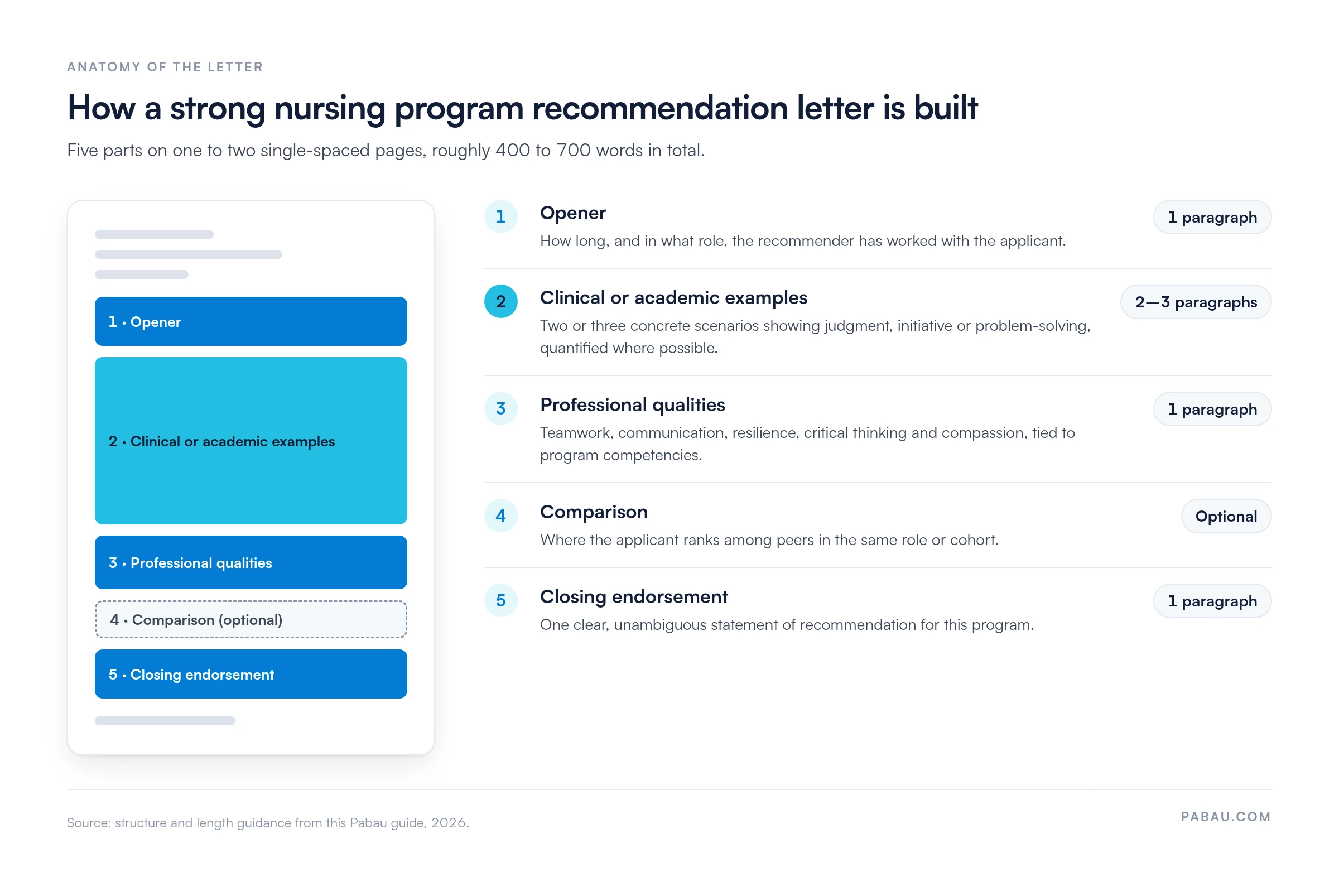
A well-structured letter follows a predictable arc. It establishes the recommender’s credibility and relationship to the applicant, anchors claims in specific examples, and closes with an unambiguous endorsement. Committees read many letters, so clarity and specificity are what make one memorable.
Aim for one to two single-spaced pages, roughly 400-700 words. Committees skim, so a concise letter built on evidence beats a rambling one. The diagram below shows how much of the page each part should take.
Below is a complete worked example from a clinical supervisor, such as a charge nurse or unit manager. Placeholders sit in [brackets] for easy customization. Swap the clinical examples for ones from the applicant’s own experience.
[Date]
Dear Graduate Nursing Program Admissions Committee,
I am writing in strong support of [Applicant Name]’s application to your Master of Science in Nursing program. I have had the privilege of supervising [him/her/them] as the Charge Nurse on the [Unit Name] at [Facility Name] for [X months/years]. During this time, I have observed [his/her/their] clinical excellence, leadership potential, and unwavering commitment to patient-centered care.
[Applicant Name] consistently demonstrates exceptional critical thinking and judgment. In one instance, [he/she/they] was assigned [X number] patients in [unit type]. [He/She/They] recognized subtle signs of deterioration in a post-operative patient and alerted the physician before the condition became critical.
[His/Her/Their] proactive approach and confidence in clinical assessment prevented a serious complication. [He/She/They] thinks through the reason behind each intervention before carrying it out.
Equally impressive is [his/her/their] ability to support colleagues under pressure. Newer nursing staff frequently seek [Applicant Name] out during difficult shifts, and [he/she/they] responds with patience and clear explanations.
[He/She/They] has volunteered to mentor [X] new graduate nurses and has contributed to our unit’s [quality improvement initiative, training program, or mentorship structure].
[Applicant Name] is also deeply committed to continued learning. [He/She/They] has completed [relevant certifications, additional training, or conference attendance], and routinely asks questions that connect evidence-based practice to bedside care. This intellectual curiosity, combined with [his/her/their] clinical competence, positions [him/her/them] well for the rigors of graduate nursing education.
I am confident that [Applicant Name] will bring the same excellence, curiosity, and leadership to your program. [He/She/They] has my enthusiastic recommendation for admission to your graduate nursing program.
Sincerely,
[Recommender Name]
[Title]
[Contact Information]
A faculty recommendation highlights academic rigor, engagement in coursework, and theoretical or research capability. This example suits applicants coming straight from a nursing program or with strong academic standing.
[Date]
To the Graduate Nursing Program Admissions Committee,
I am pleased to recommend [Applicant Name] for admission to your [Program Name]. [He/She/They] completed my [Course Name] course in [semester/year] and earned an [A/A-/B+]. That result reflects both strong foundational knowledge and the intellectual rigor required for graduate-level study.
Beyond grades, [Applicant Name] engaged deeply with complex concepts. During a class assignment on [specific topic], [he/she/they] combined current evidence with [his/her/their] clinical observations to argue for [specific position or approach]. [His/Her/Their] paper showed critical thinking and a willingness to challenge conventional wisdom. That mindset drives nursing research and evidence-based innovation.
[Applicant Name] is also collaborative and intellectually humble. [He/She/They] participated thoughtfully in discussions, respected alternative perspectives, and contributed to a positive learning environment for all students.
I strongly recommend [Applicant Name] for your graduate nursing program. [He/She/They] is well prepared for advanced study and has the potential to make meaningful contributions to nursing practice and research.
Sincerely,
[Professor Name]
[Title]
[Contact Information]
Some applicants ask a coworker, such as a peer nurse, colleague, or informal mentor, to write a letter. Programs prefer supervisor or faculty recommenders. A coworker letter still works if the writer holds a leadership role, like preceptor, or if clinical supervisors are out of reach. This sample emphasizes teamwork, reliability, and shared professional challenges.
[Date]
Dear Admissions Committee,
I am writing to recommend [Applicant Name] for your nursing program. I am [his/her/their] peer rather than supervisor. I have worked alongside [him/her/them] as a registered nurse on [Unit Name] for [X years]. In that time, I have seen [his/her/their] clinical integrity and dedication to patients firsthand.
[Applicant Name] is someone our unit turns to when patient care is most complex. [He/She/They] stays calm in high-stress situations and communicates clearly with both patients and team members.
When a patient became severely anxious during a procedure, [Applicant Name] explained what was happening and advocated for pain management. [He/She/They] stayed at the bedside until the patient felt safe, and brings the same compassion to every interaction.
Beyond clinical skills, [Applicant Name] is deeply reliable. [He/She/They] volunteers for difficult assignments, helps newer nurses troubleshoot problems, and actively participates in our unit’s safety huddles. These are the behaviors that build trust among nursing colleagues.
I am confident [Applicant Name] will bring the same integrity and commitment to your graduate nursing program. I enthusiastically recommend [him/her/them] for admission.
Sincerely,
[Recommender Name]
Registered Nurse
[Contact Information]
A vague or last-minute request often yields a generic letter. A thoughtful request gives recommenders the context they need to write a strong, specific one.
Many applicants also apply for clinical jobs while they wait on admissions decisions. If that’s you, the sample nursing assistant application letter shows how to present the same strengths to an employer.
If you are the one writing the letter, these practices separate standout letters from forgettable ones. Good examples often come from habits you’ve watched over months, such as how carefully the applicant handles nursing documentation.
Recommendation letters usually land on charge nurses and nurse managers. They are the same people buried in charting, scheduling, and chasing paperwork, so letters often get written late at night.
Pabau, our all-in-one practice management system, keeps staff schedules, treatment notes, and digital forms in one place. Its patient intake software sends forms before the visit, so completed answers are already in the patient record when the nurse walks in.
Clinical letters to patients and referrers are drafted straight from the record with Pabau’s letters and dictation software. Routine correspondence stops piling up at the end of a shift, and supervisors get back the time a specific, evidence-rich recommendation takes.

Pabau puts scheduling, treatment notes, and digital intake forms in one system, so the nurses who supervise your team spend less time on admin.

The letters that move admissions committees are specific. They name a situation, show what the applicant did, and explain why it predicts success in the program.
If you’re the applicant, pick recommenders who have watched you work, and give them the context to write well. If you’re the recommender, start from the template, follow the structure above, and say plainly that you recommend the candidate. A short, honest letter with two strong examples beats a long one full of praise.
Book a demo to see how Pabau cuts the admin load on the nurse leaders who supervise and recommend your team.

Applying for a clinical job too? Sample application letter for nursing assistant shows how to present clinical strengths to an employer.
Want examples a recommender can point to? Nursing documentation covers the charting principles and habits supervisors notice in strong nurses.
Building confidence at the bedside? Nurse charting cheat sheet gives note examples for writing clear, defensible charts.
Preparing for clinical rotations? Nursing assessments template walks through a structured head-to-toe assessment.
Leading handoffs on your unit? Nursing shift report template helps you hand over patients clearly at the end of a shift.
Most undergraduate and graduate nursing programs require two or three letters. Some programs accept one if the applicant has extenuating circumstances. Check each program’s specific requirements, as they vary.
Yes. Most programs include a waiver checkbox on the letter form. Signing the FERPA waiver tells the committee you have not influenced the letter, which can make it appear more credible. Many applicants choose to waive.
Yes. Graduate programs (MSN, NP, DNP) typically prefer recommenders with graduate degrees or advanced clinical experience. A faculty member from a previous nursing course is often ideal. Clinical supervisors with RN credentials are also appropriate.
One to two single-spaced pages, or roughly 400-700 words. Extra length doesn’t make a letter stronger, and concise, specific letters are often more effective.
Yes, but politely. Send one reminder email one to two weeks before the deadline. If the deadline passes and the letter is still missing, ask the admissions office whether they still accept late letters. Some programs will wait if they know a letter is in transit.