Blood type O food list
A blood type O food list sorts foods into what people with type O should eat, li...

1
Last Updated: Oct 6, 2026
A build muscle lose fat diet plan pairs a modest calorie deficit with high protein, so you lose fat while holding on to lean muscle. Resistance training does the other half of the work.
The numbers are simple enough to write on a sticky note. Eat 200-400 calories below maintenance. Take in 0.7-1g of protein per pound of bodyweight. Lift weights three to four days a week, and add about 150 minutes of moderate cardio. The template below turns those targets into seven days of meals.
A ready-to-use 7-day plan with daily calorie and protein targets, a macro split, and portion sizes for every meal and snack. Weekly progress checkpoints are built in.
Download template
Body recomposition is possible by eating 200-400 calories below maintenance while hitting 0.7-1g protein per pound of bodyweight.
Protein is set from bodyweight first, and the calories left over go to carbs at 30-40% and fat at 25-30%.
A 7-day meal prep cycle cuts the number of food decisions you make, which is what keeps the macros on target.
Practice management software like Pabau lets nutrition practitioners share meal plans, record adherence, and send automated check-in reminders.
Yes, and the effect has a name: Body recomposition. It works best for people new to resistance training, or coming back after a long break. Three inputs drive it:
Compare that with the two older approaches. A bulk adds muscle and fat together, while a cut strips fat and usually takes some muscle with it. Recomposition goes after both targets at once. Studies on high-protein dieting find that a deficit of 200-400 calories preserves muscle, because stored fat covers most of the shortfall.
Step 1: Work out your total daily energy expenditure, or TDEE. That is what your body burns at rest plus what your activity adds. Multiply your bodyweight in pounds by 14-16 if you are sedentary, 16-18 if lightly active, or 18-20 if very active.
Step 2: Subtract 200-400 calories from that number. A 300-calorie deficit suits most people. It is big enough to shift 0.5-1 lb of fat a week, and small enough to protect muscle and training performance.
Step 3: Track your weight and energy for two to three weeks. If energy crashes or your lifts stall, add 50-100 calories. If progress stops after four to six weeks, take 100 calories back off.
Protein, carbohydrates, and fat each do a different job while you are eating less. Here is the breakdown the template works from:
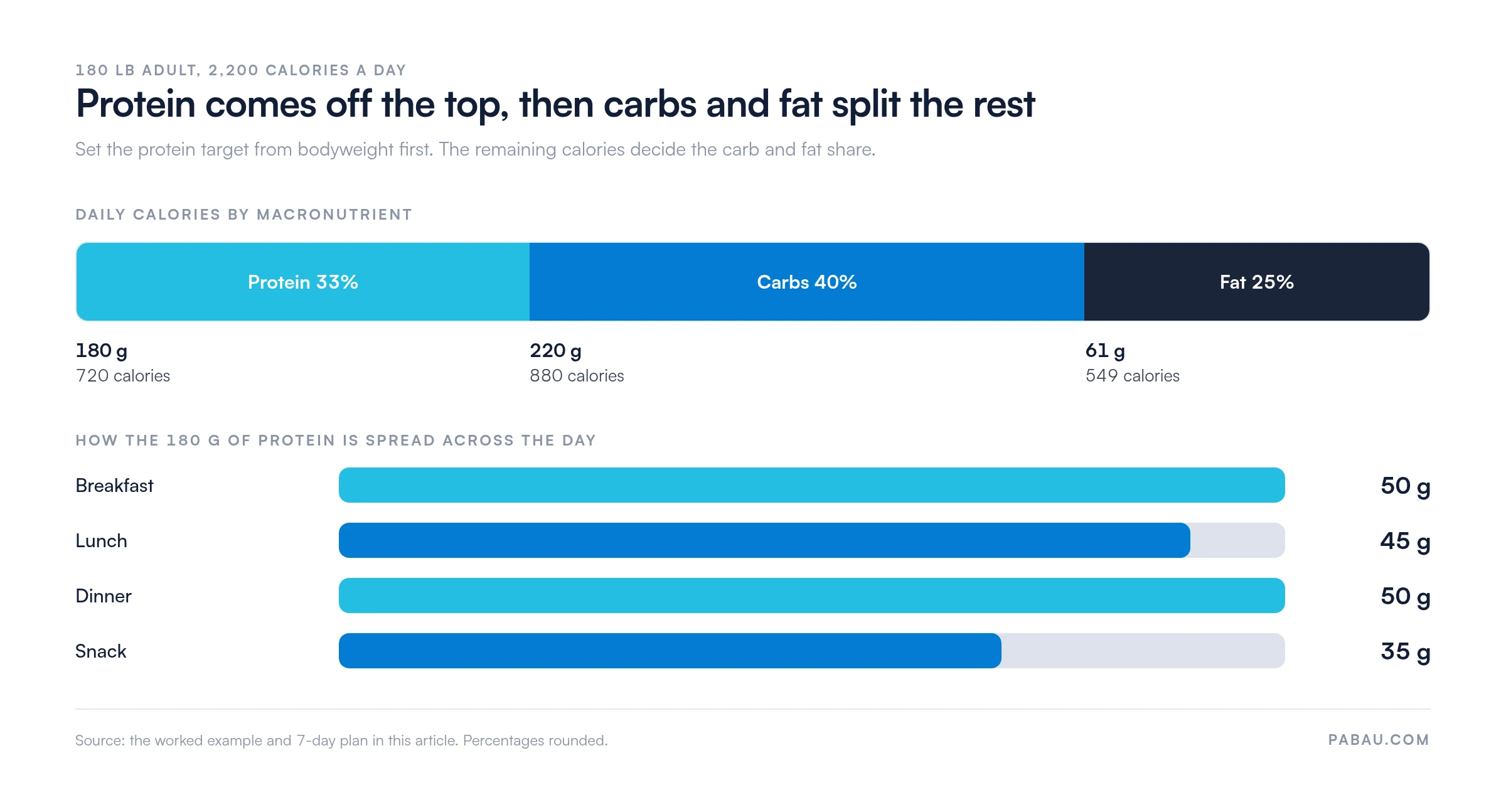
Example: A 180 lb person eating 2,200 calories, a 300-calorie deficit from a 2,500 TDEE, targets 180g protein, 220g carbs, and 61g fat. That works out at roughly 33% protein, 40% carbs, and 25% fat. Protein is fixed by bodyweight, so carbs and fat divide whatever calories are left.
That ordering is what makes the plan hold together, and it is easier to see than to describe. The chart shows where a 2,200-calorie day goes, and how the protein lands across four meals.
Some people find percentages easier to hold in their head than grams. If that sounds like you, the 30-30-40 diet plan template sets every macro as a share of your daily calories instead.
Hitting a daily protein target takes deliberate choices at every meal and snack. Build the week around these sources:
Pro tip: Spread protein evenly across the day, at roughly 40-50g per main meal. Muscle protein synthesis responds better to that pattern than to one large evening serving.
This sample week targets 2,200 calories and 180g of protein a day. Swap meals to suit your tastes, as long as the macros hold. Download the editable template above to set your own calorie and protein numbers.
Meal prep cuts the number of food decisions you make in a week, and fewer decisions is usually what keeps the macros on target. Practitioners coaching clients through it tend to hand over the plan through patient portal software, then read the check-ins from the same place.
Resistance training drives muscle growth, and cardio adds to the calorie burn. Recomposition needs both. The American College of Sports Medicine recommends three to four strength sessions a week. Build them on compound movements: Squats, deadlifts, bench presses, and rows. Add roughly 150 minutes of moderate cardio across the week, whether that is walking, cycling, or swimming.
Progressive overload is the signal your muscles respond to, so add weight, reps, or sets over time. Strength work also lifts your metabolic rate and protects muscle while you eat in a deficit. If you want the training side written out session by session, start with the weight loss workout plan template.
The core framework holds for everyone: A calorie deficit, high protein, and resistance training. Hormones and starting body composition justify a few small adjustments on top.
Women often do better with slightly more fat in the plan, which supports hormonal stability, and with a gentler deficit. Men usually tolerate a larger deficit without the same metabolic slowdown. High protein and progressive resistance training earn muscle for both.
Expect visible change in eight to 12 weeks. A larger shift, say 10 lb of fat lost alongside new muscle, takes four to six months of steady work. Beginners and returning lifters move fastest, thanks to newbie gains. Advanced lifters recomp more slowly.
Progress is not linear either. You might lose 5 lb and gain 3 lb of muscle in month one. Then the scale sits still for three weeks while your shape keeps changing. That is why measurement tracking tells you more than weight alone.
The scale alone will not show a recomposition. Watch for these non-scale victories instead:
Food does the heavy lifting here. A short list of supplements has evidence worth acting on:
Skip: Fat burners, proprietary blends, and metabolism boosters. The evidence behind them is thin, and the money goes further on groceries.
Most people drift between weeks four and six, either back into old habits or into a plateau. Keep a food log, take progress photos every four weeks, and change calories only once weight has held still for three weeks running. Then cut 100 calories, no more.
Coaches running this plan across a caseload have the same problem at a larger scale. Weight loss practice software keeps each client’s targets, check-ins, and photos on one record. A stalled month shows up while there is still time to fix it.
The usual setup is an emailed PDF and a string of text messages. The plan sits in one inbox, the weigh-ins in another, and the progress photos on somebody’s phone. By week six nobody can say what the client actually did.
Practice management software like Pabau keeps that history on the client record instead. You attach the diet plan to their file, and they read it in the client portal. Their weights and measurements save straight back to the same record. Progress photos sit alongside them, dated.
Automated reminders handle the check-in nudges, so you are not retyping the same message to a dozen clients every Monday. You get fewer missed check-ins, plus a progress history you can put in front of a client the week the scale refuses to move.

Practice management software like Pabau stores each client’s diet plan, measurements, and progress photos on one record. Automated reminders chase the check-ins, so your time goes into coaching rather than admin.

The arithmetic behind body recomposition is settled. Hold a deficit of 200-400 calories, eat 0.7-1g of protein per pound, and lift progressively heavier. What decides the result is whether you are still doing it in week 10.
So print the template, write your own numbers into it, and book a weekly check-in with yourself. Accept that the scale will lie to you for weeks at a time, and judge the plan on measurements and lifts instead.
If you coach clients through this, the same record-keeping decides your results too. Book a demo to see how Pabau keeps every client’s plan, measurements, and photos in one place.

List Item #1
List Item #2
Body recomposition works best for beginners and for people returning to training after a break. Anyone with 10 lb or more of body fat to lose is a good candidate. Advanced lifters who are already lean recomp slowly, and often do better on traditional bulk-and-cut cycles. Genetics, age, and hormones all move the pace.
Aim for 0.7-1g per pound of bodyweight a day. That intake preserves muscle during a calorie deficit and supports muscle protein synthesis around training. At 180 lb, that is 126-180g a day, spread across four or five meals.
It is possible if you eat mostly whole foods and pay attention to hunger cues. Tracking for the first two to four weeks is still worth it, because it shows you what your portions actually contain. After that you can ease off, with a check-in every few weeks to stay honest.
Plateaus are normal, and usually mean your body has adapted. After four to six weeks without progress, cut 100 calories, add one or two sets per session, or take a deload week at lighter weights. Rule out poor sleep and high stress before you touch anything else.
Use four signals together: weekly average scale weight, monthly measurements of waist, hips and chest, progress photos every four weeks, and your strength numbers. Read as a set, they show a recomposition the scale hides.
Total daily carbs matter far more than when you eat them. Putting carbs and protein within two to three hours either side of training does help energy and recovery. Beyond that, the daily split beats the clock.
Swap animal proteins for tofu, tempeh, lentils, chickpeas, beans, nuts, seeds, and plant-based protein powder. Plant foods carry more fiber and fill you up sooner, so you may need a slightly higher calorie intake to reach the same protein target. Variety is what gets you to 0.7-1g per pound.