Maja Popovska
Nutrition intake form
A nutrition intake form is a structured questionnaire that records a patientR...

3
Last Updated: Oct 22, 2026
Free PDF 3 pages, print-ready Clinician-reviewed
A lower carb meal plan is a structured dietary framework that limits carbohydrate intake to support weight management and blood sugar control. Most plans keep daily carbohydrates between 50g and 130g, adjusted for the patient’s goals and clinical picture.
For practitioners treating patients with obesity, type 2 diabetes, or metabolic syndrome, a ready-made template removes the design work. You hand over a structure rather than advice, and the next appointment has a document to review against.
The template covers a 7-day meal structure, approved and restricted foods, portion guidance, and macronutrient targets. This guide explains the carbohydrate thresholds behind it, how to walk a patient through it, and how to track adherence afterwards.
A structured planning template covering carbohydrate thresholds, approved and restricted foods, and a 7-day meal structure. It also carries portion guidance, macronutrient tracking, and prompts for the adherence barriers patients hit first.
Upload this PDF, or any form you already use, and Pabau's AI Form rebuilds it with tick boxes, text fields and a signature. Attach it to the treatment once, and every patient gets it on time.
AI Form rebuilds the consent, history and aftercare forms you already use. You review each one, then publish.
Patients complete forms on their phone before they arrive, so the front desk stops retyping paper.
Every signed form is versioned and attached to the treatment record, ready when you need it.
Set how long a consent stays valid. Returning patients skip forms they have already signed.
Supports HIPAA and GDPR compliance AES-256 encryption 4.8 on G2 4.7 on Capterra Trusted by 4,000+ practices worldwide

A lower carb meal plan keeps daily carbohydrates between 50g and 130g, which sits above both very low carb and ketogenic thresholds.
The template gives patients a 7-day structure with approved and restricted foods, so carbohydrate counts stop being guesswork.
Patients on insulin or sulfonylureas need prescriber review before cutting carbs, since those medications can cause hypoglycemia.
Practice management software like Pabau can send the template, log check-ins against the record, and automate follow-up reminders.
A lower carb meal plan is a dietary blueprint that reduces carbohydrate intake while keeping protein and healthy fats adequate. Practitioners use it to give patients structure around food choices, portion sizes, and meal timing. That structure removes the guesswork that derails most dietary changes.
Carbohydrate thresholds vary with the clinical approach and the individual patient. In common clinical use, low carb eating means roughly 50g to 130g a day. Very low carb approaches target under 50g, and ketogenic plans restrict further to 20g to 50g in order to trigger ketosis. NHS guidance sets no low carb threshold of its own, but its advice on starchy foods and carbohydrates is a useful reference for patients.
The three bands overlap at their edges, which is why patients mix them up. Seeing them on one scale usually settles the question faster than another explanation does.
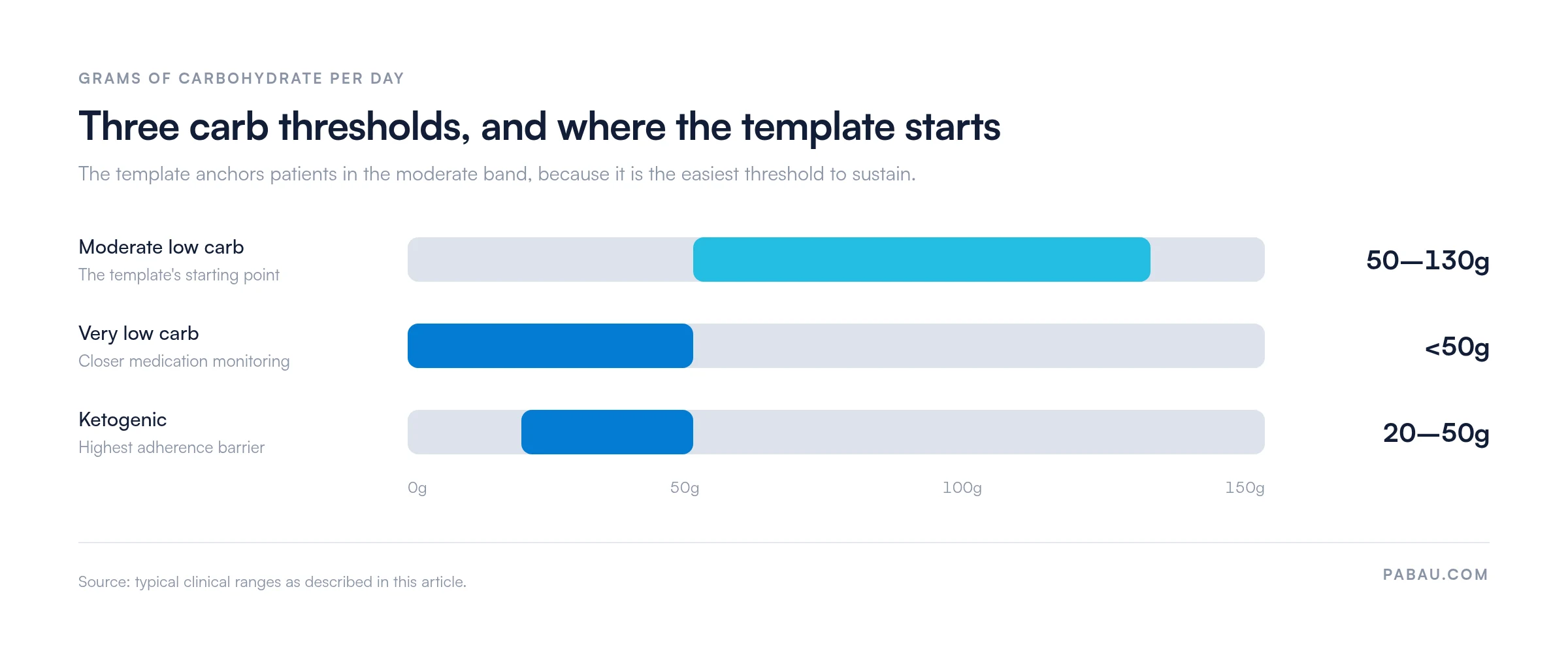
The template anchors patients in the moderate band as a starting point, because it balances ease of adherence against a meaningful metabolic shift. Adjust the threshold from there based on tolerance, health status, and measured outcomes.
The template lays out seven days a patient can follow immediately. Each day breaks into breakfast, lunch, dinner, and optional snacks, with approximate carbohydrate counts and a running daily total.
Several specialties use a structured low carb plan as a core patient education tool. Weight loss practices, metabolic health programs, diabetes services, and primary care all reach for one.
Structured meal planning improves compliance and clinical outcomes. A patient holding a printed or digital plan does not have to recall what you said. Nor do they have to interpret advice like “eat more vegetables and less bread.”
Carbohydrate quality matters as much as quantity. The Academy of Nutrition and Dietetics classifies carbohydrates as an essential nutrient and favors fiber-rich sources over refined ones. The template follows that line by leaving non-starchy vegetables unrestricted.
A well-formulated low carb plan still sets targets for protein and fat. Satiety and metabolic health depend on the balance across all three macronutrients, not on the carbohydrate number alone.
Protein targets: Aim for 25g to 35g per meal, or 0.8g to 1g per pound of goal body weight daily. Adequate protein preserves muscle during weight loss and steadies blood sugar. Sources include eggs, fatty fish such as salmon, poultry, beef, and Greek yogurt.
Fat sources: Emphasize monounsaturated fats such as olive oil, avocado, nuts, and seeds. Add omega-3 sources like fatty fish and flaxseed, and keep trans fats out. A meal of protein and fat with very few carbohydrates holds hunger off for four to five hours.
Non-starchy vegetables: The template prioritizes leafy greens, cruciferous vegetables, peppers, zucchini, and mushrooms. They are nutrient-dense and high in fiber, so they add bulk and satiety without moving the carbohydrate total much. Variety keeps micronutrient coverage broad.
Each day in the template already combines protein, fat, and non-starchy vegetables in proportions that support weight loss without the hunger that ends compliance.
A PDF sent as an email attachment lives outside the patient’s file. The copy they followed and the copy you hold can drift apart, so the next appointment opens with questions about which version they used.
Practice management software like Pabau keeps both copies as one. You send the template from the patient portal, and the record logs when it went out and when the patient opened it. Check-in forms come back into the same file, so adherence notes sit beside weight, HbA1c, and prescriptions.
Automated reminders handle the one to two week check-in without anyone rebooking it by hand. Pabau GO, our iOS app for practitioners, opens the same record between appointments, so a quick review does not need a desktop. Every subscription includes the full platform, so none of this sits behind a higher tier.

Pabau’s patient portal and digital forms deliver the template, collect check-in responses, and file both against the patient record. Follow-up reminders go out on schedule, so the next review is booked before the patient leaves.

A written plan changes what the follow-up appointment can do. Rather than asking a patient to recall a week of meals, you compare their log against a document you both hold. That comparison is what makes the next adjustment defensible.
The trade-off worth remembering is that a template is a starting position, not a prescription. Download it, use it with the next patient exploring carbohydrate reduction, and file it in their record. After two or three patients you will know which thresholds your population tolerates and which barriers surface first. Book a demo to see how Pabau distributes the template and keeps adherence notes in the patient file.

Working with a patient who also has type 2 diabetes? Low carb diabetic diet meal plan gives you a template built around glucose management and medication timing.
Need a plan with a higher protein emphasis? High protein low carb diet plan swaps in higher protein targets for patients focused on muscle retention during weight loss.
Looking for a longer-term meal structure? 30-day meal plan for weight loss extends the same template approach across a full month for patients who need more structure.
A lower carb meal plan generally keeps carbohydrates between 50g and 130g a day, depending on the patient’s goals. Very low carb approaches drop under 50g, and ketogenic plans restrict further to 20g to 50g. The template starts patients in the moderate range, since it is the easiest threshold to sustain long term.
It can be, but only with prescriber involvement. Insulin and sulfonylureas are the medications that can cause hypoglycemia when carbohydrate intake drops without a dose change. GLP-1 receptor agonists such as semaglutide and tirzepatide act glucose-dependently, so alone they carry low hypoglycemia risk. Review the plan with the prescriber before the patient starts, and document any dose changes.
A lower carb plan keeps carbohydrates between 50g and 130g a day and suits most patients long term. A ketogenic plan restricts carbohydrates to 20g to 50g to trigger ketosis, which is more restrictive and harder to sustain. The template uses the moderate range as its starting point, not keto.
Yes. The 7-day structure and the approved and restricted foods list are a starting framework, not a fixed prescription. Adjust carbohydrate thresholds, portion sizes, and food swaps based on each patient’s tolerance, medication, and measured outcomes.
Set a follow-up check-in at one to two weeks and have the patient log their actual meals against the plan. Distributing the template and collecting check-ins through a patient portal keeps that record in their file automatically. You are not chasing paper food diaries between visits.