GLP-1 usage by state: Who’s taking, searching and paying in 2026
GLP-1 usage by state peaks in West Virginia, America’s GLP-1 capital, with...

Last Updated: Oct 16, 2026

A diabetes management plan is one written document holding a patient’s glucose targets, medication instructions, lifestyle guidance, emergency steps, and review dates.
For most adults the fasting target is 80 to 130 mg/dL, and the plan records the reason behind any target set higher.
Eight checks make up the annual review, from HbA1c and retinal screening to weight, BMI, and a depression or anxiety screen.
Our four-page template gives each of those items its own field, so a completed plan needs no extra paperwork.
Practice management software like Pabau stores each plan in the patient record, so the whole team works from the current version.
Four pages of diabetes-specific fields, ready to print or complete on screen. It covers HbA1c and glucose targets, medication and insulin, and carbohydrate targets per meal. Activity goals, the hypoglycemia and hyperglycemia steps, and the eight-item annual review checklist follow.
Download templateA diabetes management plan is the one document that tells a patient what to do when the practice is closed. It sets the glucose targets, lists the medication, and prints the steps for a low reading at midnight. Get it right and care carries on between appointments.
Leave it half filled, though, and the next clinician inherits a plan describing a patient who has since changed. Most of the work is deciding what belongs in each field.
This guide walks through all six sections and names the reference figure to print beside each target.
A diabetes management plan is a written clinical document setting out how a practice will treat and monitor one patient’s diabetes.
The clinician and patient agree it together. It specifies blood glucose targets, medication regimens, lifestyle recommendations, emergency steps, and the follow-up schedule. From there it serves as both a clinical reference and a patient education tool.
The name changes with the setting. In schools, American Diabetes Association guidance calls it a Diabetes Medical Management Plan, or DMMP.
Australian Medicare contexts use Chronic Disease Management Plan, shortened to CDMP. Whatever it is called, the plan gets the whole team and the patient working to the same targets.
A complete plan covers six areas, and each one becomes a section of the form. All six need a specific instruction rather than a general one.
Blood glucose monitoring is where the plan starts. Set the targets against the patient’s age, diabetes type, comorbidities, and hypoglycemia risk, then write down what you chose.
These reference figures follow the ADA Standards of Care, and each one still needs individual adjustment. An older patient, or one with a history of severe hypoglycemia, is often safer at a higher target. Record that reason in the plan, because the next clinician cannot infer it.
Here is how that plays out. A 78-year-old with type 2 diabetes and two unexplained falls might get an HbA1c target of 8% rather than below 7%.
The form has a field for the number and a field for the reason, which might read “hypoglycemia risk, target relaxed”. An A1C goals by age chart is a useful sanity check before you loosen a target.
Targets only mean something when the patient records the readings. A printable blood glucose log gives them somewhere to do that, so a pattern is visible at the review.
This section fails in one predictable way. A drug lands on the list without its dose or its timing, which leaves a covering clinician guessing.
Write both, plus the route and any special instruction, for every medication on the list. A separate diabetes medication list helps when the regimen changes often.
For type 2 diabetes, treatment usually starts with metformin at 500 to 2,000 mg daily. Options added alongside it include SGLT-2 inhibitors such as empagliflozin, and GLP-1 receptor agonists such as semaglutide. Insulin comes in when those no longer reach the glycemic targets.
Type 1 diabetes runs the other way, with insulin as the foundation. Specify a basal-bolus regimen of multiple daily injections, or pump therapy with the carbohydrate-to-insulin ratio and the correction factor. Then note what the patient does about a missed or late dose.
Dietary guidance is the hardest part of the plan to individualize. Advice like “eat healthily” gives the patient nowhere to start. Record what they eat now, what gets in the way, and the one change they agreed to try.
A structured intake form does most of that work before the appointment starts, which leaves you editing a dietary history rather than building one.
The World Health Organization and the ADA both recommend 150 minutes a week of moderate aerobic activity, such as walking, cycling, or swimming.
Add resistance training two or three times a week. Write the agreed activity into the plan, with the glucose precautions that go with it.
Document any contraindication, such as advanced retinopathy limiting vigorous exercise. Note when to check glucose before, during, and after activity, and when to postpone a session altogether.
The plan has to work at 2 AM, when nobody is reading prose. Print the threshold, then print the steps directly underneath it. That way the patient and their household can act without calling first.
The two emergency thresholds sit at either end of those daily targets.
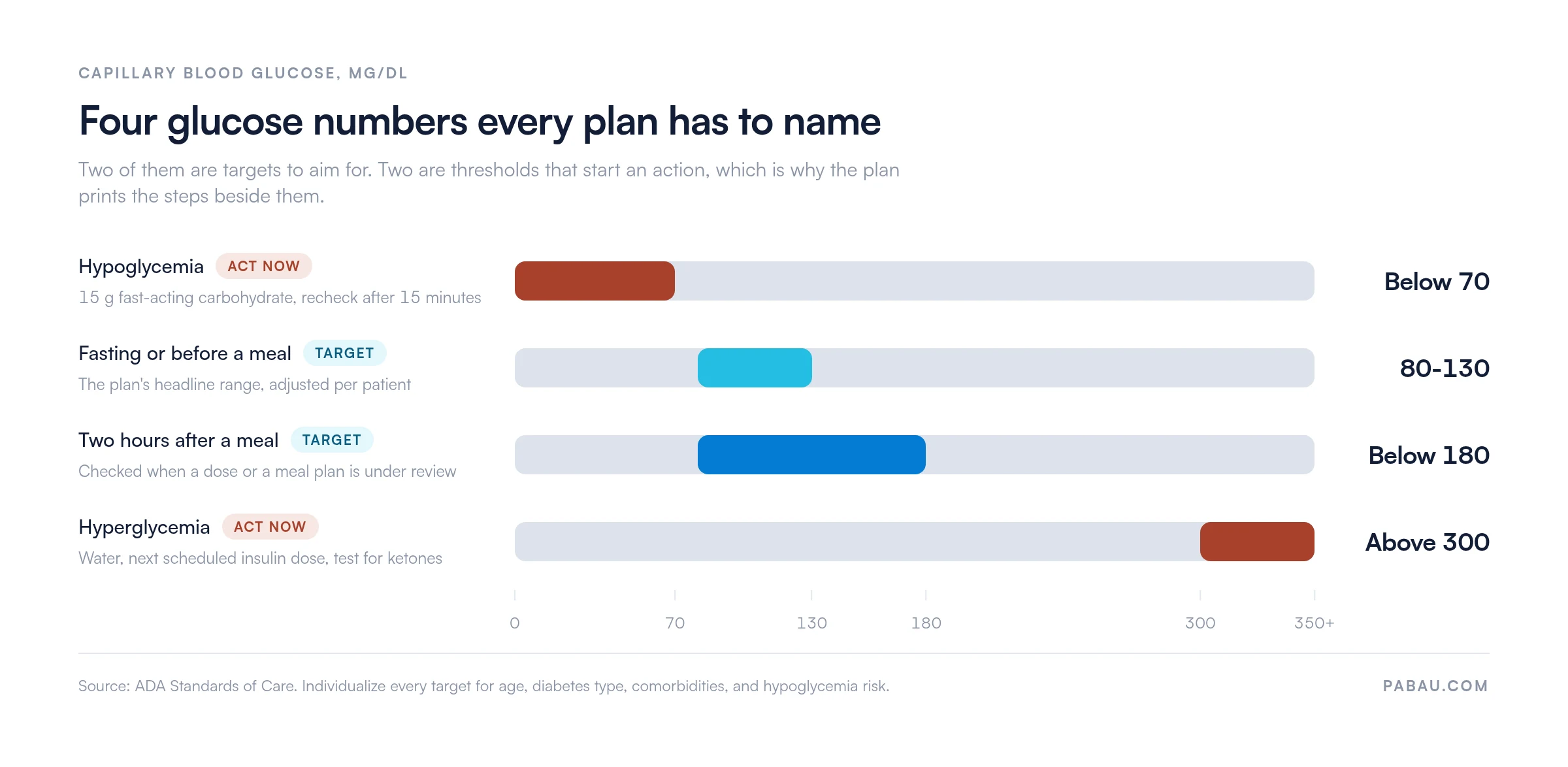
Hypoglycemia usually means blood glucose below 70 mg/dL (3.9 mmol/L). The 15-15 rule goes on the form, where the patient can find it under pressure.
Add glucagon instructions for severe hypoglycemia, meaning unconsciousness or seizure, and name each person trained to give it.
Hyperglycemia usually means blood glucose above 300 mg/dL (16.7 mmol/L). The patient drinks water, takes the next scheduled insulin dose if eligible, and tests for ketones in type 1 diabetes. Tell them to contact the practice if glucose stays high or ketones appear.
Out of hours, the person taking the call needs the action plan and the medication list side by side.
Name the structured self-management education program in the plan, and note what the patient still needs to learn. A plan that assumes knowledge the patient does not have will not survive the first sick day.
Education milestones slip quietly, because they fall between reviews with no one chasing them.
Effective education covers five areas at minimum:
Diabetes distress, meaning the frustration, guilt, or burnout of daily self-management, is common and easy to miss. Screen for depression and anxiety with validated tools such as the PHQ-9 and GAD-7, and name the referral route into mental health support.
Document any history of disordered eating or psychological comorbidity that affects adherence. A patient whose HbA1c climbs for no clinical reason is often struggling with the routine rather than the medicine.
A diabetes management plan needs reviewing at least once a year, and revising whenever it stops matching the patient. Eight checks make up that review.
Each result gets a date and a due date, so the next review starts from what is outstanding. A structured diabetic foot exam form is worth keeping beside the plan. That screening is the first thing to slip when a visit runs short.
Plans rarely fail because a section is missing. They fail on detail, and the same four problems come up again and again.
The form runs to four A4 pages and follows the six components above in the same order. Nine numbered sections make it up:
The form prints each reference target beside the field for what you agreed, so the guideline number and the patient’s number sit together.
The form adapts to your workflow rather than replacing it. Five steps get you from a blank page to a signed plan:
Before you hand the plan over, check four things:
The form suits endocrinologists, primary care physicians, diabetes educators, and practice nurses managing type 1, type 2, or gestational diabetes. It works the same in a solo practice, a multi-location group, or an integrated health system.
Practices running weight-management or metabolic programs alongside diabetes care get the most from it. Those teams benefit from software for metabolic clinics that keeps the diabetes plan and the weight program on one patient record.
Review the plan with the patient at every visit, not just once a year. Ask an open question, such as what got in the way of their goals this quarter. The answer usually explains a number you could not explain from the chart alone.
Most practices keep the plan in three places at once. The signed PDF sits in a folder, the medication changes live in the visit note, and the patient has an older printout at home. At the next review, someone has to work out which version is right.
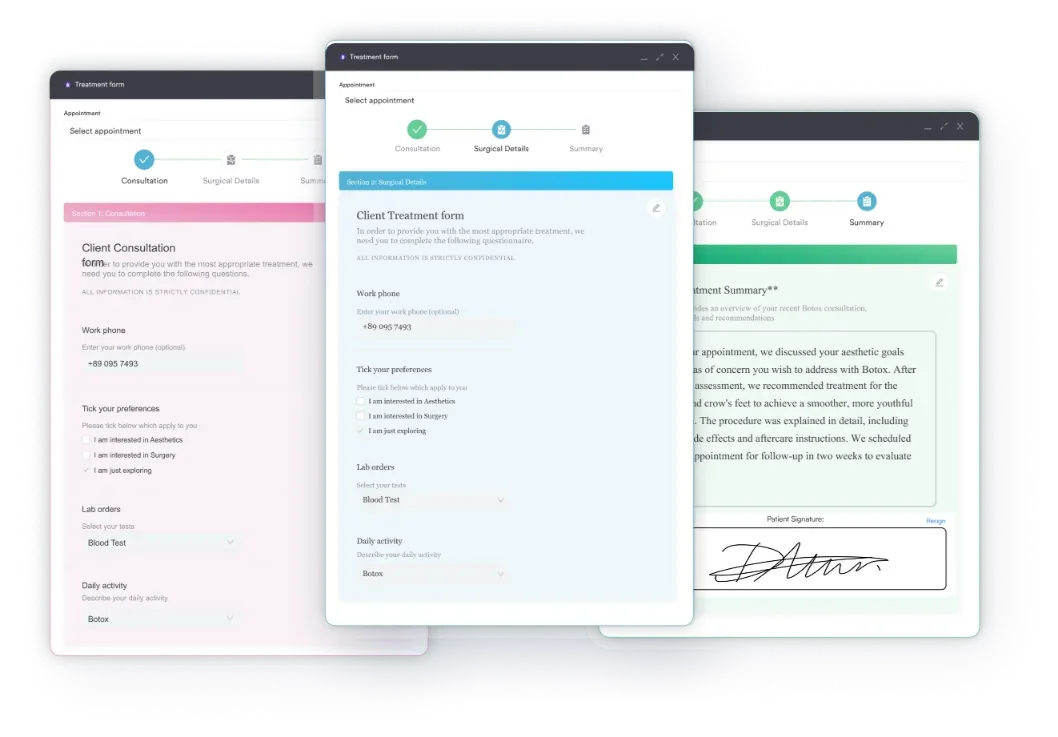
Pabau, our practice management software, holds the plan as a digital form on the patient record. Staff complete the glucose targets, medication list, and action steps in the form itself. The saved version becomes the one the whole team sees.
Automated workflows then schedule the annual review and send the patient their copy. You get one plan per patient, with a dated history of every change. That matters at an audit, and it matters more when a covering clinician needs the current insulin dose.

Pabau stores each diabetes management plan as a digital form on the patient record, then schedules the annual review for you. Your team always works from the current targets and medication list.

A diabetes management plan earns its keep between appointments. Its job is to tell the patient what to do when glucose runs low at midnight. It also tells the next clinician what was agreed, and why.
So write the targets down, write the reason behind each one, and set the review date before the patient leaves. That last step is what keeps the plan honest a year from now.
The cost is time, and that is usually where the paperwork loses. Book a demo to see how Pabau turns this form into a digital record your team updates in place.

Need the nursing view of the same patient? Diabetes nursing care plan maps the assessments, diagnoses, and interventions a nursing team documents alongside this plan.
Looking for the low-carb version of the nutrition section? Low-carb diabetic diet plan sets carbohydrate targets per meal in a form you can hand straight to the patient.
Want a dedicated protocol for severe lows? Hypoglycemia nursing care plan covers the assessment and monitoring steps that follow a treated episode.
Managing a patient at risk of DKA? Diabetic ketoacidosis nursing care plan takes over where the hyperglycemia action plan ends.
Need a reference chart for the patient’s own use? Fasting blood sugar levels chart gives them the ranges on a single page to keep at home.
Eight checks: HbA1c, a lipid panel, renal function, a foot exam, retinal screening, blood pressure, weight and BMI, and a depression or anxiety screen. Each one gets a target, a result, and a due date on the plan.
The targets shift from single readings to time in range. Aim for more than 70% of readings between 70 and 180 mg/dL. Keep time below 70 mg/dL under 4%, and time below 54 mg/dL under 1%. Record the monitoring method on the form, because a sensor review reads differently from a meter log.
The patient and the clinician both sign and date it. Give the patient a written copy at the visit. A family member, carer, or school nurse can hold one too, with the patient’s documented consent.
Sometimes. Medicare’s chronic care management codes need two or more chronic conditions and a comprehensive care plan. They also need at least 20 minutes of clinical staff time in the month. Diabetes on its own does not qualify, so check the enrollment rules first.
It is the Australian equivalent of this plan, used in primary care for chronic conditions including diabetes. Medicare rebates fund it through the chronic condition management items. It coordinates the GP with allied health, such as a dietitian or an exercise physiologist.