Grains food list: whole vs refined grains (free PDF)
A grains food list sorts grain foods into whole and refined groups, so patients ...

3
Last Updated: Oct 20, 2026

Body for Life is a 12-week program that pairs upper and lower body strength training with 20-minute HIIT cardio and six small daily meals.
The weekly schedule runs upper body on Monday, Wednesday and Friday, lower body on Tuesday and Saturday, and HIIT cardio on Thursday and Saturday.
One free day a week allows flexible eating, which keeps the plan sustainable for coaches managing client compliance.
Every strength session pairs heavy compound lifts at 8-9 intensity with isolation work at 12 reps and 7 intensity.
Practice management software like Pabau logs workouts, tracks measurements, and sends adherence reminders across the 12 weeks.
Inside you get the upper and lower body exercise lists with sets, reps and intensity targets, plus the seven-day schedule. It also carries the 20-minute HIIT protocol and printable sheets for logging every session.
Download templateThe Body for Life exercise plan is a 12-week body composition program built around six training days a week. Bill Phillips published it in 1999, and it still holds up as a framework a coach can hand a client on day one. Strength work runs on an upper and lower body split, and the cardio arrives in 20-minute HIIT blocks.
What this template adds is the coaching layer the program itself never documented. You get the baseline capture, the milestone reassessment points at weeks 4, 8 and 12, and a named intervention for the week-three adherence dip. Below you will find the full exercise lists, the weekly schedule, the HIIT protocol, and the nutrition structure.
The Body for Life exercise plan is a 12-week fitness challenge designed to change body composition through structured training and controlled nutrition. It pairs strength training with high-intensity interval training, or HIIT, across six training days a week. The framework runs on progressive intensity, close tracking, and one free day a week to protect adherence.
The clinical context matters for practitioners. Body for Life is an educational fitness framework, not medical advice. Screen clients for contraindications before you deliver the program, and document baseline fitness.
Make sure they understand the physical demands of 12 weeks of structured training. The template supplies the structure. Your scope of practice, your qualifications, and your client waivers supply the legal protection.
The template moves a client through five operational steps, each tied to a coaching touchpoint:
The framework serves several practitioner audiences, and each one uses it differently.
Teams in that third group usually keep the plan inside their weight loss clinic software. The training log then sits next to the weigh-ins and the diet notes.
A shared template gives a coaching team one progression to work from. The upper and lower split keeps frequency high without hammering one muscle group two days running. The 20-minute HIIT block delivers cardiovascular work inside a slot a busy client will keep.
Automated workflow reminders let a fitness team send the weekly check-in, the progress photo request, and the adherence nudge without anyone chasing by hand.
Documentation gets easier to defend too. A standard template shows a medical director or an auditor that every client followed the same protocol. The printable tracking sheets leave a record of sessions completed, intensities reached, and outcomes measured.
The free day helps as well, because a client who gets one planned break is less likely to quit.
Strength training splits across two session types. Upper body runs three times a week, and lower body runs twice. Each session opens with heavy compound work and closes with isolation movements.
Lower body days follow the same two-tier structure. Heavy compound lifts come first at 6-8 reps and 8-9 intensity. Isolation movements finish the session at 12 reps and 7 intensity, which fatigues the muscle without piling on load.
The cardio side of Body for Life runs on a 20-minute HIIT model. Steady-state cardio holds one effort level for the whole session. HIIT swings between maximal effort and recovery inside a short window, which builds conditioning while protecting the muscle the strength work is adding.
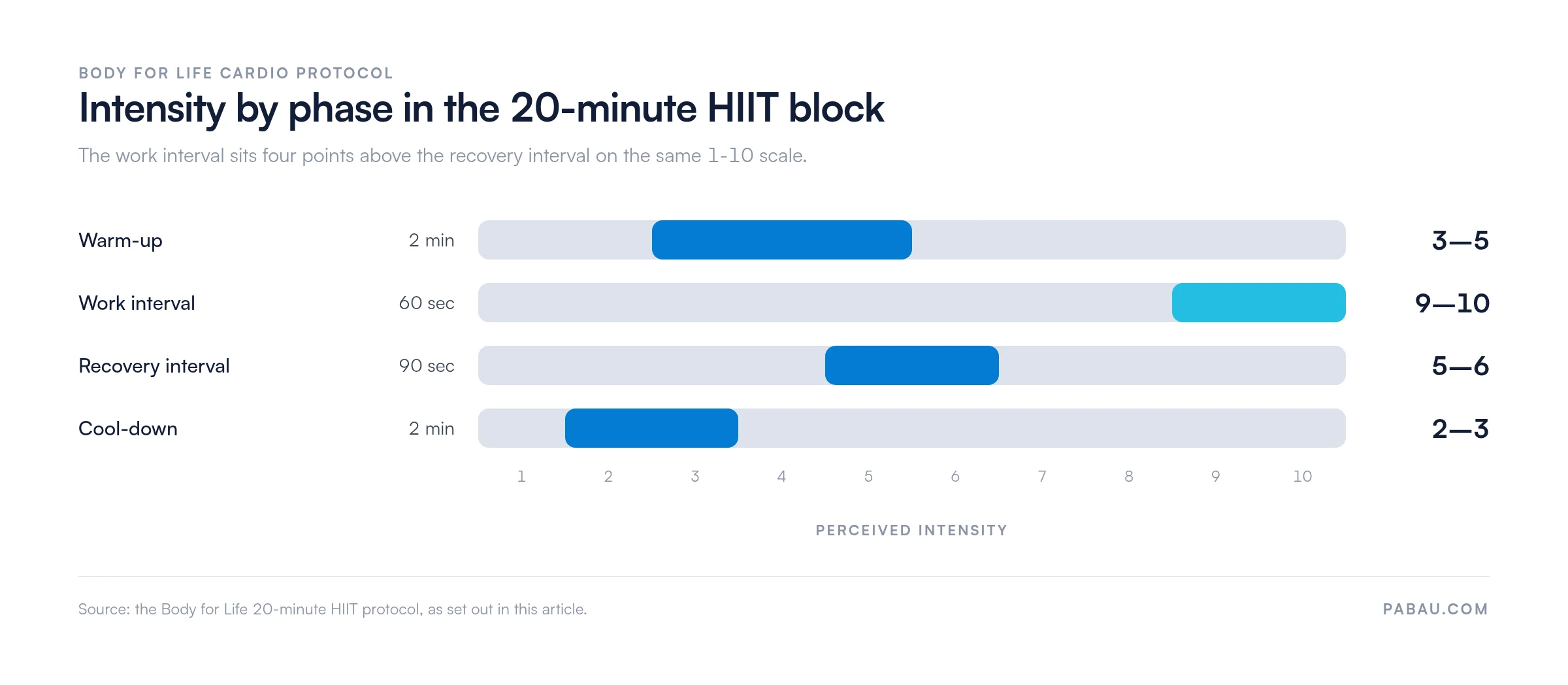
The protocol uses the same 1-10 intensity scale as the strength sessions. Minutes 0 to 2 are the warm-up, at intensity 3-5. The client then alternates 60 seconds of maximal effort at intensity 9-10 with 90 seconds of moderate recovery at 5-6.
That alternation fills the middle 16 minutes, and a 2-minute cool-down at intensity 2-3 closes the session. The appeal for a time-pressed client is the length. Twenty minutes on a treadmill, bike, elliptical or rower is a slot most people can find on a Thursday evening.
The intensity spread across those four phases is what makes the session work, and it is wider than the word cardio suggests.
Six training days sit inside a fixed weekly template, which makes cohort programs easy to coordinate. Most practices run Monday through Saturday and keep Sunday free. You can shift days around a client’s availability, as long as they never miss two in a row.
Progress tracking is not optional. Compliance climbs when a practitioner writes down the weights used, the reps hit, and the difficulty a client reported. Reassess body composition and take photos at weeks 4, 8 and 12.
Letting clients log their own sessions takes the typing off your team, and it gives them a reason to open the app between visits.
Training pairs with a fixed eating pattern of six small meals a day, spaced 2.5 to 3 hours apart. Each meal balances protein for recovery, complex carbohydrates for energy, and some healthy fat. The free day allows unrestricted eating, which matters more for adherence than for macros.
Clients almost always ask whether meal timing matters before a HIIT session. Sports nutrition research on nutrient timing supports eating one to two hours before training, though tolerance varies widely. Teach clients to read their own hunger cues rather than follow a fixed clock.
Three things decide whether a first cohort holds together. The first is a full fitness assessment. Record baseline strength, aerobic capacity where you can measure it, body composition, and movement quality.
Thin baseline data makes progress invisible to the client, and that is the fastest route to a dropout. The second is expectation setting. Adherence dips around weeks 3 and 4, once the novelty wears off, so line up your interventions before you need them.
Group check-ins, a progress photo reveal, and a small milestone reward all work. The third is delivery. Share the workout sheets, the nutrition guide, and the form videos somewhere a client can reach them on a phone.
That removes friction, and it tells the client the program was built rather than improvised. Clients who want a different entry point can start on the weight loss workout plan instead, then move onto this 12-week block.
Measurement is what keeps a client motivated. Full adherence over 12 weeks typically brings 2-5 kg (4-11 lb) of fat loss and 2-4 kg (4-9 lb) of lean muscle gain. Load on the main lifts usually climbs 20-30% over the same period.
Digital records make that evidence usable. Before and after photos stay secure, circumference changes line up month by month, and the testimonial writes itself.
Automated messages can carry the week 4, 8 and 12 congratulations, plus a re-engagement note at the usual dropout points. A referral prompt goes out once a client finishes.
Segment by baseline fitness once you have run a cohort or two. Beginners take lighter loads and longer rest. Experienced lifters cut rest or add drop sets. Progressive overload is the constant across all 12 weeks, whichever way you flex the rest.
Multi-location practices and franchises get the most out of a standard template. When every trainer works from the same structure, covering a shift or opening a second site needs no curriculum rebuild. It protects you on liability too, because an audit sees one protocol applied consistently.
Cohort-level reporting is where the operational payoff lands. You can see which clients hit which milestone, how each trainer’s adherence rates compare, and what the group’s average transformation looks like. Those numbers drive retention, and they give your marketing something specific to say.
Coaches who run these as group challenges often rotate formats between blocks. The 75 Hard challenge template works as the next cohort once a Body for Life group graduates. A 12-week kettlebell program fits that rotation, running the same length on four training days instead of six.
Most fitness teams run a program like this across three or four places at once. The workout sheets live in a spreadsheet and the photos sit in someone’s phone. The measurements go in a paper folder, and the check-in messages get typed by hand every Monday.
Pabau puts all four in the client record. Custom forms capture the baseline assessment and every session log, so week 12 sits next to week one without an export step. Measurements and before-and-after photos attach to the same record, which is where you go when a client asks what changed.
Automated workflows carry the rest. Set the week 4, 8 and 12 reassessment reminders once, and they go out for every cohort after that. Your team spends its Monday coaching instead of copying numbers between tabs.

Pabau logs workouts, measurements and progress photos in one client record, then sends the milestone reminders on its own. Your team coaches instead of chasing paperwork.

The Body for Life exercise plan earns its place because the structure is fixed and the intensity is measurable. A client always knows which session is next and how hard it should feel. That removes most of the decisions people use as an excuse to skip a day.
The trade-off is the admin. Six sessions a week over 12 weeks, times a cohort of clients, is a lot of logging. Run it on paper and the transformation still happens, but the evidence for it goes missing.
Download the template, run one cohort with it, and keep the tracking sheets. Book a demo to see how Pabau stores those 12 weeks of session logs, measurements and photos in one client record.

Need a simpler block to start a client on? Weight loss workout plan gives you a training template to hand over before a full 12-week challenge.
Running a group challenge next quarter? 75 Hard challenge template gives your cohort a different format once a Body for Life block finishes.
Clients asking how to split their macros? 30-30-40 diet plan sets out the protein, fat and carbohydrate balance behind the six-meal structure.
Need a screening reference for week one? Men’s BMI chart gives you a quick baseline reference at the first assessment.
Choosing software for a weight loss program? EMR for weight loss clinics walks through what to look for when records and measurements both matter.
Yes, when clients adhere. Research on HIIT and structured resistance training puts fat loss at 2-5 kg over 12 weeks. Lean muscle gain of 2-4 kg (4-9 lb) is realistic at reasonable adherence. Results still depend on baseline fitness, nutrition discipline, and recovery.
Yes. Beginners take lighter loads and longer rest, usually 90 seconds between sets instead of 60. The framework itself stays the same, and progression comes from load rather than structural changes. First-time lifters often see 15-25% strength gains in four weeks as they adapt neurally.
Yes. Women respond to periodized resistance training and HIIT the same way men do. The weekly structure, the intensity progression, and the nutrition principles all carry over. Some women start on lighter loads, which reflects individual starting strength rather than sex. Progressive overload is the variable that matters.
The free day allows flexible eating and no mandatory training. Practitioners read it differently. Some let clients eat freely, others keep mild portion control while allowing foods the plan otherwise restricts. The psychological permission matters more than the exact intake, because compliance over 12 weeks improves when a plan feels sustainable.
Strength days run 50 to 65 minutes, covering the warm-up, seven or eight exercises at three sets each, and the rest periods. HIIT sessions are a fixed 20 minutes. Saturday combines the lower body session with the 20-minute HIIT block, and the schedule lists it at 75 minutes.
Missing one day does not derail the block. Tell clients to pick up the next scheduled session rather than double up, because two hard sessions close together raises injury risk. More than two consecutive misses is an adherence problem, and it needs a conversation or a schedule change.