Waist-to-hip ratio chart: Risk bands for women & men (free PDF)
A waist-to-hip ratio chart sorts a patient’s waist-to-hip ratio (WHR) into...

3
Last Updated: Oct 14, 2026

The Mediterranean diet emphasizes plant-based whole foods, healthy fats such as olive oil, and fish. It is among the most studied patterns for heart and metabolic health.
A structured Mediterranean diet plan includes daily vegetables, legumes, and whole grains, fish twice weekly, and limited red meat.
The seven-day sample on this page helps patients picture realistic meal combinations and build confidence in the first week.
The downloadable template is a clinician-completed Mediterranean diet intake and plan form. You record goals, medical history, guidelines, meal planning notes, portion control, lifestyle factors, and progress.
Practice management software like Pabau lets you send the form digitally, store completed copies in the patient record, and track follow-up.
A two-page clinical form for documenting one patient’s Mediterranean diet plan. Fields cover goals, medical history, general guidelines, meal planning, portion control, lifestyle considerations, progress tracking, and notes. It is a blank documentation form that you complete with the patient, not a pre-filled meal schedule.
Download templateA Mediterranean diet plan turns broad nutritional advice into a documented, patient-specific record. The eating pattern comes from the traditional foods of countries bordering the Mediterranean Sea. The American Heart Association endorses it for cardiovascular benefit and long-term adherence.
The diet differs from restrictive plans by emphasizing abundance. Leafy greens, whole grains, legumes, nuts, and fish dominate daily intake. Olive oil replaces butter, and red meat appears only a few times a month. Framing the plan around what to eat more of, rather than what to cut, improves adherence.
This page does two jobs. The sections below give you the counseling content. The template above gives you the form you complete with the patient to record what you agreed.
The Mediterranean diet is an eating pattern based on the traditional diets of people living near the Mediterranean Sea. Greece, southern Italy, Spain, and North Africa are the main reference cuisines. Unlike fad diets, it prioritizes whole foods, plant-based meals, and healthy fats, which makes it a sustainable lifestyle approach rather than a temporary restriction.
Olive oil is the primary fat source. Fish and seafood are the main protein, eaten at least twice weekly. Plant foods form the foundation, including vegetables, fruits, whole grains, and legumes. Dairy stays moderate and comes mostly from cheese and yogurt, while red meat is minimal.
Shared, unhurried meals matter as much as the food itself. That makes the diet a lifestyle model rather than a calorie prescription, and it gives you more levers to pull during counseling.
The Mediterranean diet pyramid, introduced by Oldways Preservation Trust in 1993, shows how often to eat each food group.
This structure gives you a clear visual framework for explaining portion philosophy during a consultation. Sharing the pyramid removes ambiguity about frequency and reinforces that the plan is abundance-focused, not deprivation-based.
A seven-day sample removes daily decision fatigue for patients starting out. The week below is educational content on this page, not part of the downloadable form, so copy or adapt it for your own handouts.
This week shows how the framework translates into practical guidance. Patients can see that the pattern is not monotonous, and variety within the guidelines sustains adherence.
A Mediterranean diet plan works when patients understand both the abundance and the boundaries. The British Heart Foundation’s framework treats the limited foods as occasional indulgences rather than prohibitions.
Sorting food into four tiers moves the conversation away from restriction and toward abundance. Patient buy-in improves, and so does long-term adherence.
The Mediterranean diet has been studied extensively. Evidence links it with reduced cardiovascular disease risk, improved blood lipid profiles, and better weight management. The PREDIMED trial found lower rates of heart disease and stroke among people who followed it. Citing these findings anchors patient motivation during counseling.
Match the pattern to the target you are treating. Where blood pressure is the primary concern, the DASH diet plan is the closer fit, and the two patterns overlap enough to switch between them.
Time pressure is the most common barrier to Mediterranean diet adherence. Batch cooking removes most of that friction. Cover these tactics in the consultation, then record what the patient commits to under meal planning on the template.
Share these tactics when you hand over the completed plan. Practice management software like Pabau runs automated patient workflows in the background. Timed reminders go out by SMS or email on the days that matter, so the plan stays visible all week.

Work through the consultation in six steps, so the patient leaves with a first week already decided and written down. If you want a fuller dietary baseline first, capture it on a nutrition assessment form before you open the plan.
The template is a two-page clinical form you complete with the patient. It documents the plan the two of you agree on, so it does not arrive pre-filled with meals, food lists, or a shopping list. The split below shows what sits on this page and what the form asks you to fill in.
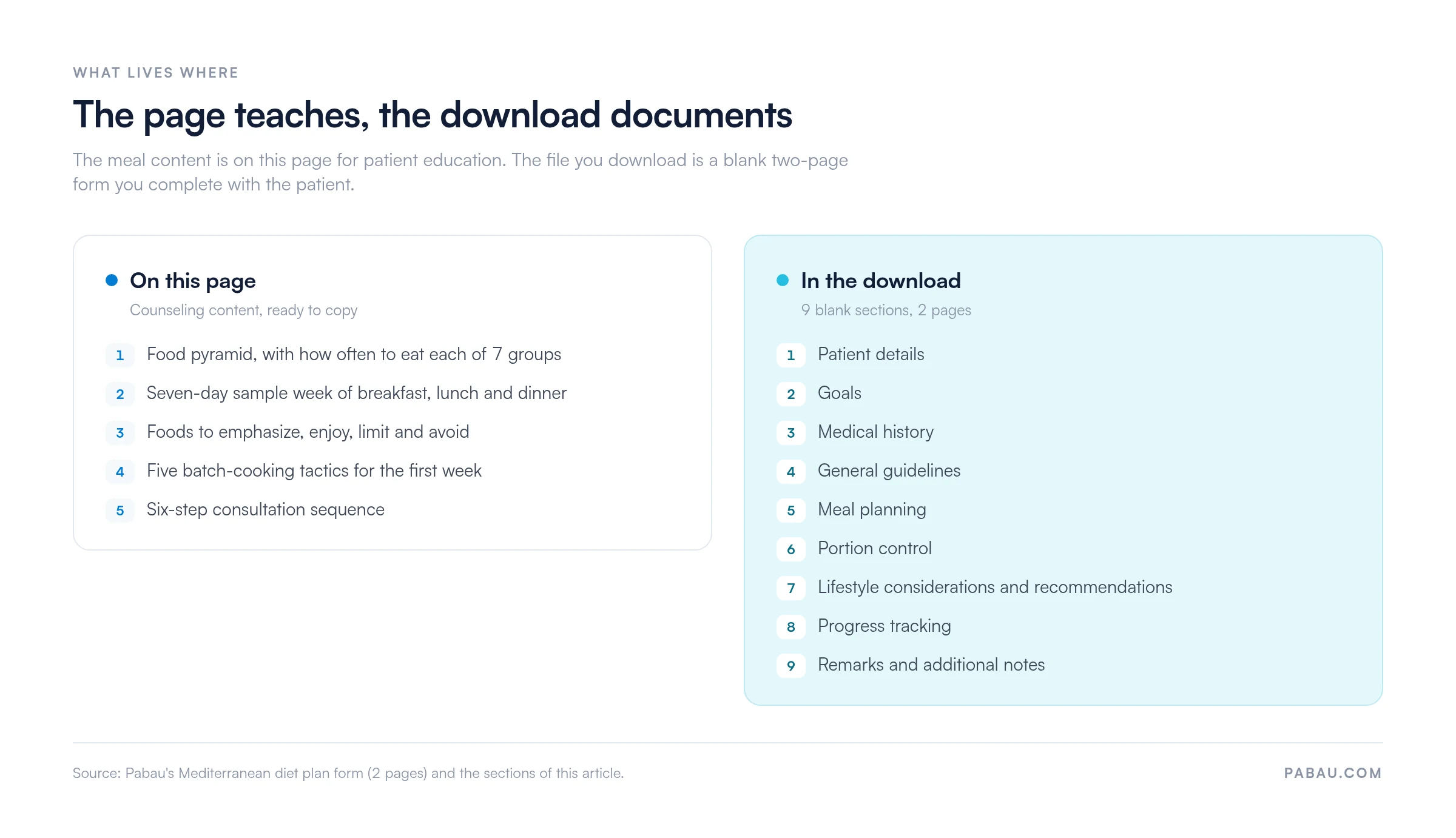
Because every field starts blank, the form suits any patient population you see. Pair it with the food pyramid and the sample week on this page when you need ready-made educational content to send home.
The Mediterranean diet is a standard recommendation across primary care, functional medicine, integrative medicine, and longevity practices. The evidence base is strong, the pattern accommodates diverse food preferences, and patients can sustain it. Documenting each patient’s version of it shows that your nutrition advice is specific rather than vague.
A completed plan form also gives the next clinician something to work from. It records what you advised, when you advised it, and what the patient agreed to try. Practices running structured nutrition programs usually keep those records inside weight loss clinic software.
Most practices print the form, complete it by hand, and file the paper copy. The patient leaves with the only version, and the next appointment starts without it. You reach the follow-up with no record of whether the plan was followed.
Pabau handles the same form digitally. Pabau digital forms let you send the Mediterranean diet plan before the consultation and complete it during the visit. The submitted form attaches to the patient record, so no one has to rekey it.
From there, the Pabau client portal gives the patient their own copy on demand. Automated workflows send the two-week and four-week check-ins on schedule. At the follow-up you open the previous form, read the progress tracking notes, and adjust the plan against what you recorded.

Pabau digital forms capture each patient’s Mediterranean diet plan and file it in their record. Automated follow-ups chase the check-ins, so you can see who stayed with the plan.

The Mediterranean diet earns its place in nutrition counseling because patients stay with it. Your job is to turn the pattern into a plan this patient can follow. Then write it down where you will both find it again.
Use the sections above as your counseling script and the template as your record. Book the review before the patient leaves, because a plan without a follow-up date is only a suggestion. Book a demo to see how Pabau sends, stores, and follows up on patient nutrition plans.

Treating hypertension alongside the diet? DASH diet plan gives you a sodium-focused seven-day template for patients whose blood pressure leads the plan.
Counseling on cardiac risk more broadly? Heart healthy diet plan covers both DASH and Mediterranean patterns with a tracking worksheet you can hand over.
Need a dietary baseline before you plan? Nutrition assessment form captures intake history, anthropometrics, and preferences in one pass at the first visit.
Documenting the follow-up visit? Nutrition SOAP note structures each review so adherence and measurements land in the chart the same way every time.
Weighing diet against medication? Lifestyle vs pharmacologic interventions sets out when dietary change alone is enough and when it needs pharmacologic support.
The Mediterranean diet plan is an eating pattern based on the traditional foods of Mediterranean Sea regions. It emphasizes vegetables, fruits, whole grains, legumes, and fish, with olive oil as the primary fat source. It prioritizes plant-based whole foods, healthy fats, and sustainable eating, with strong cardiovascular and metabolic benefits.
Begin by identifying two or three Mediterranean meals the patient already enjoys. Complete the downloadable plan form together during a nutrition consultation, recording goals, medical history, general guidelines, and meal planning notes. Then start with small swaps, such as olive oil instead of butter and fish twice weekly.
The Mediterranean diet can support modest, sustainable weight loss through its emphasis on whole foods, fiber, and satiety-promoting fats and proteins. It is not designed primarily as a weight loss diet. The goal is long-term health and disease prevention. Individual weight outcomes depend on overall calorie intake and physical activity. Consult your healthcare provider for personalized guidance.
The Mediterranean diet is flexible. If fish does not appeal, substitute poultry, legumes, or eggs for protein. For allergies, work with your healthcare provider or dietitian to identify safe substitutes within the Mediterranean framework. The core principle stays adaptable: abundant plants, healthy fats, whole grains, and moderate protein.