List of vitamins: All 13 with RDAs and deficiency signs
A list of vitamins names the 13 essential vitamins the body needs from food or s...

1
Last Updated: Oct 8, 2026
A Whole30 food list is the set of foods you can and cannot eat during the program’s 30-day elimination diet. Five groups come out for the full 30 days: grains, dairy, legumes, added sugar, and alcohol.
What stays in is broad. All vegetables, all meat and seafood, eggs, fruit, nuts, seeds, and natural fats are compliant, with no calorie counting and no portion limits.
The confusing part is the fine print. Potatoes, bananas, olives, and ghee all sound like they should be banned, and all four are allowed. This guide works through each category in turn, flags the items people get wrong, and hands you a grocery list sorted by store section.
A printable reference that sorts compliant foods by category and lists the prohibited items alongside the reason each one is out. It also carries a grocery list organized by store section, plus meal planning guidance for the 30 days.
Download template
Whole30 removes grains, dairy, legumes, added sugar, and alcohol for 30 days to surface food sensitivities and inflammation triggers.
All vegetables, quality proteins, fruit, nuts, seeds, and natural fats are compliant, with no portion limits on whole foods.
Potatoes, bananas, olives, pickles, and ghee are allowed, even though most people assume the program bans them.
The fine print also permits green beans, most peas, coconut aminos, certain vinegars, and fruit juice used as a sweetener.
Reintroduction runs one group at a time, with two or three days back on plan between each test.
Whole30 is an elimination diet run as a 30-day nutritional reset. Melissa Hartwig, now Melissa Urban, and Dallas Hartwig created it in 2009.
The program removes the food groups most often linked to inflammation, digestive trouble, low mood, and fatigue. You then use what you learn to build an eating pattern that suits you. The official can-I-have guide settles individual compliance questions.
All five groups come out at the same time, for the full 30 days. That gives your digestion and your inflammatory response a clean baseline to work from. Reintroduction is where the answers arrive.
You test one group on a single day, then go back on plan for two or three days and watch what happens. Worked through in that order, the whole reintroduction phase takes about ten days. Bloating, an energy crash, joint pain, brain fog, or a skin flare-up after a test day points to a sensitivity.
Five rules govern the elimination phase. Each one removes a whole food group, with no partial credit for a small amount on a special occasion.
Two further rules close the loopholes. The Pancake Rule bars baked goods made from compliant flours, so bread, tortillas, crackers, pizza crust, pancakes, waffles, and muffins are out. Almond flour and coconut oil are both compliant on their own. Baking Whole30 brownies with them recreates the food you are meant to be eliminating.
The second rule keeps you off the scale. Skip weighing and body measurements until day 31, so the 30 days stay about how you feel rather than what you weigh.
The approved list is built on whole ingredients that pick up no added sugar, grain, or dairy during processing. There are no calorie limits, no portion caps on most foods, and no macros to count.
All vegetables are compliant, starchy ones included. Non-starchy vegetables make up the bulk of most plates. Starchy vegetables supply the energy, and can take up a quarter to a third of the plate.
Choose proteins raised without added hormones or antibiotics where the budget allows. Fresh, frozen, and canned forms all count, provided no sugar, grain, or dairy went in during processing.
Fruit carries no portion limit, though whole fruit gives steadier blood sugar than juice. Nuts and seeds are compliant but calorie-dense, so many people portion them out deliberately. Natural animal fats and cooking oils are allowed.
Dried fruit is compliant, but the sugar in it is concentrated. Most people keep those portions small and lean on fresh fruit instead.
The prohibited list follows straight from the five rules. These are the products that catch people out, and the reason each one is off the table.
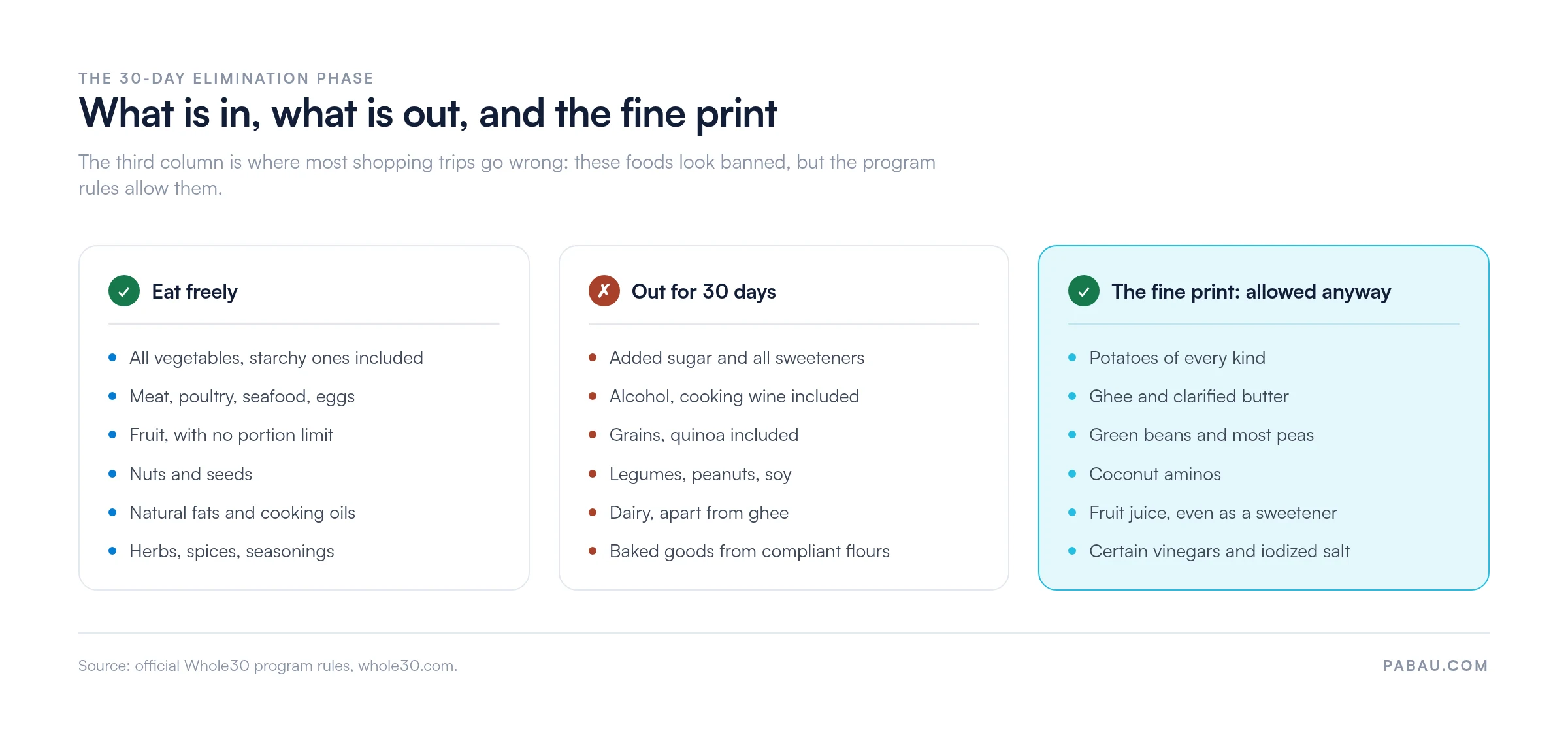
Several foods sit in a gray area where compliance depends on how they were made. The Whole30 can-I-have guide rules on each of them directly.
Read the three lists side by side and the pattern gets much easier to hold on to during a grocery run.
Work the list by store section and the weekly shop takes one lap instead of three. Print it, or keep it on your phone next to a broader healthy grocery list.
People managing IBS or small intestinal bacterial overgrowth often run Whole30 alongside a low FODMAP diet. That combination drops the high-FODMAP vegetables, including onions, garlic, asparagus, and broccoli. It also drops the high-FODMAP fruits, such as apples, pears, and stone fruits.
What is left is a narrower but workable core. It covers carrots, potatoes, green beans, leafy greens, bananas, blueberries, oranges, and proteins cooked with compliant fat and salt.
Every Whole30 meal follows the same build of protein, vegetable, and a natural fat. Three days is enough to see how that works in a kitchen.
There is no counting or macro tracking to do. For a longer rotation built the same way, a clean eating meal plan gives you a wider set of recipes to pull from.
People who finish Whole30 commonly report steadier energy, clearer skin, easier digestion, less joint pain, and a better mood. Most of that evidence is self-reported rather than drawn from large randomized trials.
The change with the clearest mechanism is dropping added sugar and processed food, which tends to steady blood sugar and cut the afternoon crash.
For a practitioner, the useful signal is adherence. Knowing which foods a client actually stuck to makes their reported improvements far easier to read during reintroduction.
Most of the difficulty in Whole30 is logistical rather than dietary. Four habits take care of the bulk of it.
An accountability partner or an online Whole30 group helps too. Both are good for settling gray-area questions quickly, and for getting through the middle week when the novelty has worn off.
Track your energy, digestion, mood, and symptoms every day of the 30. Those notes are what you compare against during reintroduction. Without a baseline, it is hard to say later whether the Day 12 brain fog came from food or from a short night’s sleep.
Practitioners who counsel clients on elimination diets usually hand over a printed plan and hope it survives the drive home. The paper copy gets lost, the client cannot remember which vinegars were allowed, and the next appointment opens with a recap instead of a result.
Pabau, a practice management software platform, keeps the plan attached to the client record instead. Our patient portal software holds the printable food list, so clients can open it before the appointment and again at home.
Pabau’s patient intake software collects dietary history and restrictions before the first visit, so the consultation starts with the facts already on file.
For practices where nutrition is the core service, weight loss clinic software ties the plan to appointments, reminders, and outcome notes in one system. Adherence data lands in the post-appointment note rather than in a separate spreadsheet.
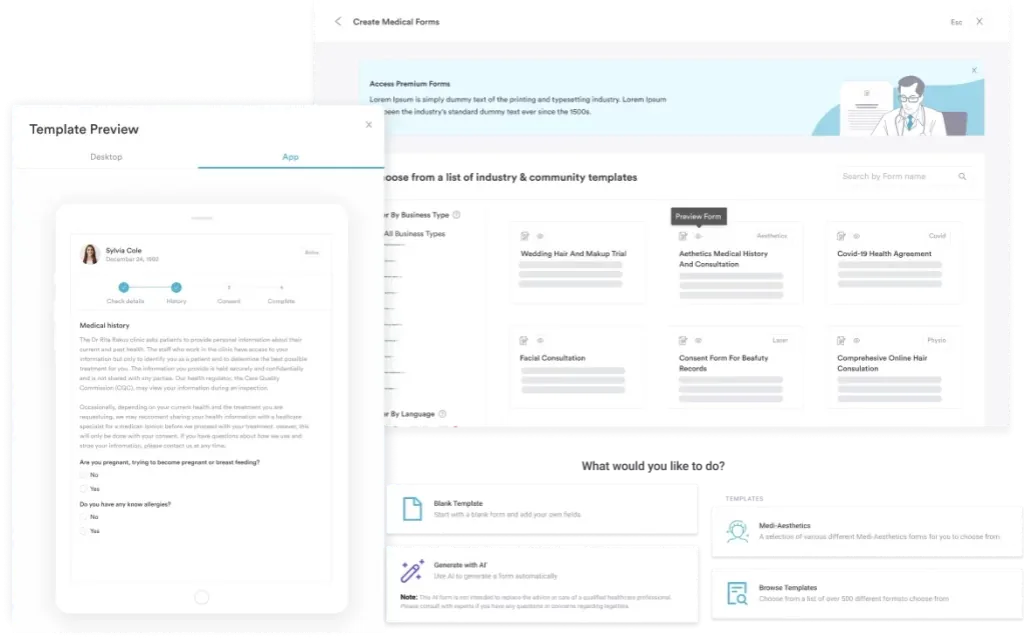

Pabau’s digital forms and client portal deliver the food list, collect daily symptom logs, and file both against the client record. Your team stops re-explaining the rules and starts reading the results.

The 30 days are simple to describe and hard to sustain. Preparation decides the outcome. That means a list you trust, a kitchen stocked from it, and a fallback for the evenings when cooking feels impossible.
Protect the reintroduction phase above all. Rushing the tests, or stacking two groups into one day, throws away the information the elimination phase just bought you.
For practitioners, the same logic applies to your records. Book a demo to see how Pabau keeps dietary plans, intake forms, and progress notes attached to the client they belong to.

Want to keep the whole-food habit after day 30? The whole food diet plan carries the same principles without the 30-day deadline.
Following the inflammation thread further? The anti-inflammatory meal plan builds meals around the foods most often linked to lower inflammation.
Is added sugar the group you suspect? The 2-week no sugar meal plan isolates that one group over a shorter run.
Comparing Whole30 with a lower-carb approach? The low carb food list sets out what changes when carbohydrate, rather than food group, is the limit.
You can eat all vegetables, including potatoes, plus quality proteins such as beef, chicken, fish, and eggs. Fresh fruit, nuts, seeds, and natural fats like olive oil and avocado are also compliant. Most whole foods carry no portion restriction.
Yes. Bananas are a compliant fruit, with no restriction on portion size or timing.
Yes. Potatoes are starchy vegetables rather than grains, so white, red, sweet, and fingerling varieties are all compliant. Baked, mashed, or cooked in a compliant oil all count.
Pickles are compliant when they are made without added sugar. Check the label carefully, because many jarred brands include sugar or corn syrup.
About ten days. You test one eliminated group on a single day, then return to the plan for two or three days before testing the next group.
Yes. Download the template at the top of this article for a printable reference organized by food category and by store section.
Whole30 is a strict 30-day elimination protocol with a structured reintroduction phase. Paleo is a long-term way of eating that also excludes grains, legumes, and dairy, but it has no formal reintroduction step.