Intake note template
An intake note is the clinical record a therapist or counselor writes at the sta...

2
Last Updated: Oct 22, 2026
A high-fiber diet meal plan is a structured eating plan that moves patients toward 25–38 grams of dietary fiber a day through whole foods. Done gradually, it supports bowel regularity, cholesterol control and weight management without the bloating that makes patients give up.
Most patients start well below that. The USDA Dietary Guidelines for Americans reports that Americans average only 15 grams a day. This free template gives you a one-page plan to agree fiber goals with each patient, assign actions and schedule reviews. The guide below supplies the ramp-up protocol, food choices and meal prep method you’ll fill it in with.
A printable plan for recording each patient’s background, up to five fiber goals with target dates, and the agreed actions with who owns each one. It also covers support in place, warning signs to watch for, and a dated review record with clinician sign-off.
Download template
A high-fiber diet meal plan moves adults toward 25–38g of fiber a day through whole foods, supporting bowel regularity, cholesterol control and fullness.
Soluble fiber from oats, legumes and apples lowers LDL cholesterol and steadies blood sugar, while insoluble fiber from vegetables, whole grains and nuts prevents constipation.
Raise fiber 3–5g at a time over four to six weeks, adding water at each step, to avoid the bloating that makes patients quit.
The downloadable plan records each patient’s goals, actions, support and review dates, so every fiber change is agreed and documented.
Practice management software like Pabau can collect intake answers before the visit and send meal prep reminders between check-ins.
A high-fiber diet meal plan sets a daily fiber target for a patient and maps out meals that reach it. Adults under 51 need about 25 grams (women) to 38 grams (men) a day, per the National Academies’ Dietary Reference Intakes. MedlinePlus, from the National Institutes of Health, puts the range for older children and adults at 21 to 38 grams.
Soluble fiber, found in oats, legumes and apples, dissolves in water and forms a gel that slows digestion. It lowers LDL cholesterol and stabilizes blood glucose. Insoluble fiber, found in vegetables, whole grains and nuts, adds bulk to stool and speeds transit, which keeps bowels regular.
A meal plan turns that advice into portions. Each meal is sized to hit a fiber number while staying nutritionally balanced, so patients can follow it without counting grams. Practices running weight loss or metabolic programs often keep it alongside progress notes in their weight loss clinic software.
High-fiber eating is a therapeutic recommendation for constipation, irritable bowel syndrome and type 2 diabetes. Record fiber counseling in the care plan and track adherence at each follow-up. The chart then shows why the advice was given and how the patient responded. A blood sugar log records the fasting and post-meal readings behind that response.
Use the template in five steps, from the intake appointment to the week-four review.
Run this way, each review has agreed milestones to check against, and the chart shows how the patient progressed.
Weight loss and metabolic health practices get the most use from it. High-fiber eating increases fullness and cuts calorie intake without eliminating a macronutrient, which makes it easier to sustain long term.
Functional and integrative medicine practitioners use high-fiber protocols for constipation, gut dysbiosis and chronic inflammation. They can adapt the plan to their own approach, for example by adding prebiotic foods or pairing it with supplement advice.
Primary care practices use it to reduce cardiovascular risk. The American Heart Association notes that dietary fiber can improve blood cholesterol and lower the risk of heart disease, stroke, obesity and type 2 diabetes. Patients whose main risk is hypertension need a blood pressure meal plan too, since fiber advice sets no sodium or potassium targets.
Gastroenterology, endocrinology and bariatric teams build the plan into wider nutrition care before and after surgery. Because it’s a PDF, you can add your logo, personalize targets to each patient’s tolerance and share it through a patient portal.
Clear documentation: Written goals, actions and review dates remove ambiguity. Patients know what to eat, and the chart shows what was recommended and why. That record matters for billing compliance and for HIPAA and payer/regulatory audits.
Workflow efficiency: Starting from a template means you don’t write each plan from scratch, which frees up consultation time for the patient. It also keeps advice consistent across the team, and support staff can handle distribution and follow-up reminders.
Digestive tolerance: Planning a gradual increase with a hydration target prevents the bloating, gas and discomfort that make patients abandon high-fiber eating. Without that plan, many patients feel worse in week one and decide the diet doesn’t suit them.
Measurable progress: Each review records bowel regularity, digestive symptoms and weight alongside fiber intake. Over time, you can see which foods and fiber sources worked best for each patient and refine future plans.
Professional credibility: A written plan built on USDA, NIH and AHA guidance shows evidence-based practice. It also gives you a clear record if a patient later questions the advice.
Send the plan straight after the first consultation, along with a short recorded walk-through of the transition steps. Patients start with fewer questions, and you keep a dated record that the guidance was sent.
Patients most often abandon high-fiber eating because of sudden bloating, gas and cramping. It happens when intake jumps from 12–15g to 35g overnight, and gut bacteria ferment the extra fiber faster than the gut can adjust.
A four-week graduated ramp avoids it, with water rising alongside fiber at every step.
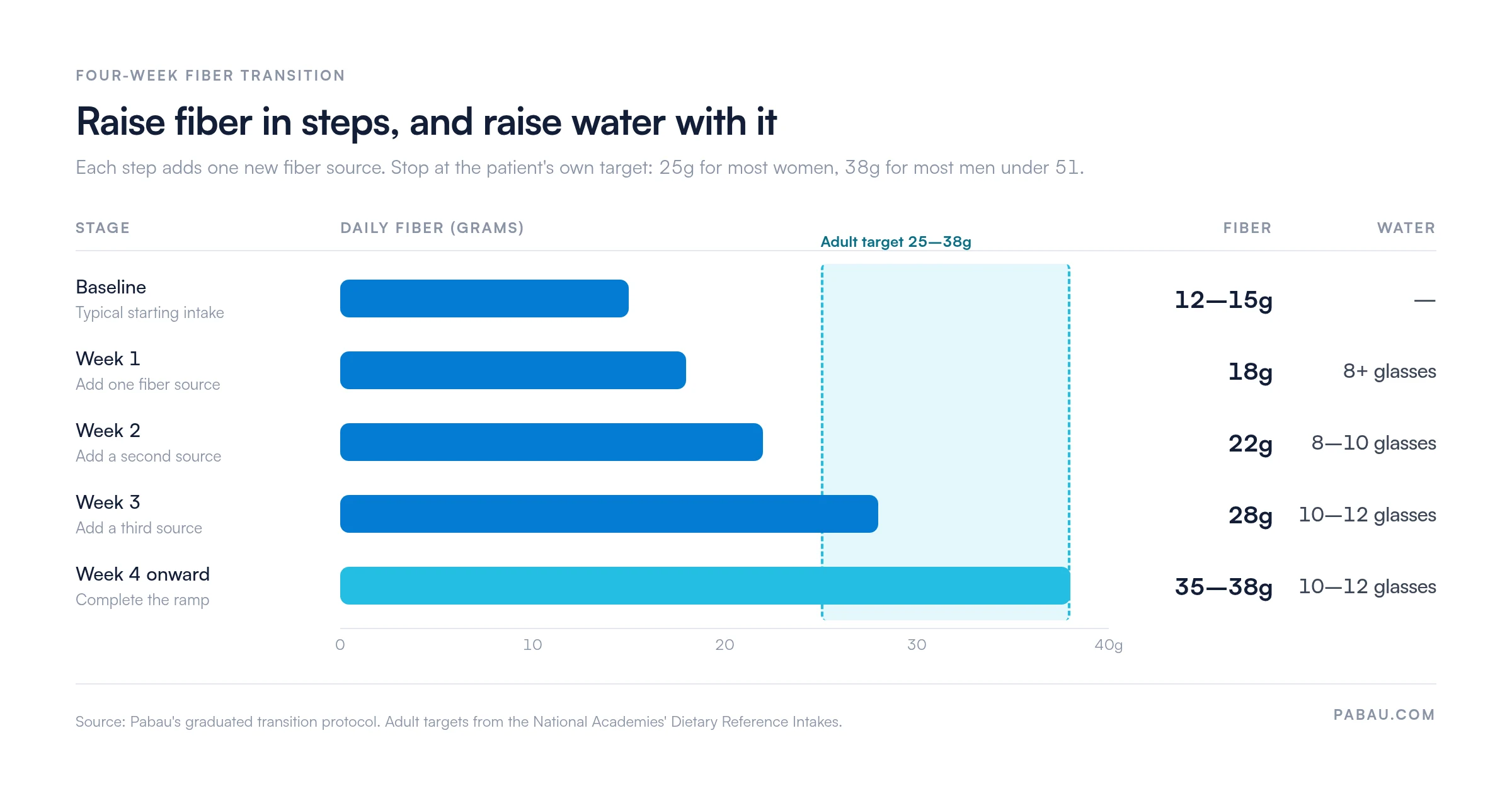
Stop the ramp once the patient reaches their own target. A woman under 51 with a 25g goal gets there during week three, so she holds that level instead of pushing on to 35g.
Tell patients that bloating is temporary and means their gut bacteria are adapting. Give them permission to slow down if symptoms intensify. There’s no penalty for taking six weeks instead of four, since sticking with it matters more than speed.
Hydration is non-negotiable, because fiber without enough water can make constipation worse. Add a simple rule to the patient handout: one extra glass of water for every 5g of added daily fiber.
Meal prep often decides whether patients stick with the plan. Batch-cooking grains, legumes and vegetables once a week takes away the daily decision that sends many patients back to processed food. Present weekly prep as a required step in the protocol.
Suggest a 90-minute weekend session to prepare the week’s staples:
During the week, patients build each meal from four parts. Start with ¾ cup of cooked grain and ½ cup of cooked legumes or other protein. Then add 1–2 cups of vegetables and 1 tbsp of nuts, seeds or oil. Each meal carries 8–12g of fiber and takes under five minutes to assemble.
In metabolic health practices, share this prep framework with the plan and revisit it at each follow-up. Patients who keep to the prep schedule have meals ready all week, so they face fewer daily decisions that can derail the plan.
A printed meal plan usually leaves with the patient and isn’t discussed again until the next appointment. By then, a patient who hit bloating in week one may already have quit.
With Pabau, intake answers land in the patient record before the first consultation, so you set goals from the patient’s own baseline. Pabau’s automated workflows then send a Sunday meal prep reminder by email and SMS. It links to the plan, a five-minute prep video and a shopping list. This removes friction and increases compliance through behavioral nudging.
Week-two and week-four reviews are booked and recorded in the same place. You can see at a glance who is keeping to the ramp and who needs a call.


Pabau sends intake forms, meal prep reminders and follow-up bookings on schedule, so patients get support between visits. Every review is stored in the patient record.

Fiber advice rarely sticks when it arrives as one target and a list of foods. It sticks when the patient has a written goal, a ramp slow enough to avoid bloating and a review date to aim for.
So start from the patient’s current intake instead of the final number. Raise it 3–5g at a time, tie water to every step and check in at weeks two and four. The trade-off is speed. A slower ramp takes a week or two longer, but patients are far more likely to stay with it.
Download the plan and fill it in with your next nutrition patient. Book a demo to see how Pabau’s patient education tools and automated reminders fit meal planning into your practice workflow.

Need a fuller baseline before you set fiber goals? Nutrition assessment form helps you record a patient’s starting point before you plan.
Treating raised LDL cholesterol? High cholesterol diet plan pairs with fiber advice for patients with cardiovascular risk.
Writing up nutrition follow-ups? Nutrition SOAP note structures the notes from each review visit.
Planning care beyond the diet itself? Nutrition care plan sets out goals and interventions across a patient’s wider nutrition care.
Supporting patients with type 2 diabetes? Diabetes management plan keeps blood sugar goals alongside dietary changes.
A high-fiber diet meal plan is a structured eating guide that helps you eat 25–38 grams of dietary fiber a day through whole plant foods. Adults under 51 should aim for about 25g (women) to 38g (men), per the National Academies’ Dietary Reference Intakes. Spread it across meals and snacks to keep blood sugar steady and support digestion.
Legumes are the richest source, with lentils at 8g and chickpeas at 7g per ½ cup cooked. Raspberries (8g per cup), pears (6g per medium fruit), oats (4g per cup cooked) and brown rice (3.5g per cup cooked) follow. Leafy greens add more, with spinach at 4.3g per 1 cup cooked. Start with foods you already enjoy and add new ones gradually.
Increase fiber gradually over four to six weeks, adding 3–5g at a time rather than all at once. Drink 8–12 glasses of water a day, because fiber without water can cause constipation. Bloating is temporary and eases as your gut bacteria adapt. If it’s severe, slow down to one addition per week.
Yes. Fiber adds bulk to meals, slows stomach emptying and increases fullness, so you feel satisfied on fewer calories. That makes gradual weight loss easier without strict calorie counting, especially when meals also include enough protein.
Soluble fiber (oats, legumes, apples, pears) dissolves in water, forms a gel and slows digestion. It lowers cholesterol and stabilizes blood sugar. Insoluble fiber (vegetables, whole grains, nuts, seeds) doesn’t dissolve and adds bulk to stool, which prevents constipation and speeds bowel transit. Eat a mix of both daily.
High-fiber eating is safe for most adults and children. People with Crohn’s disease, ulcerative colitis, diverticulitis or a bowel obstruction should check with their healthcare provider before increasing fiber significantly. Pregnant and breastfeeding women need slightly more fiber (28–29g a day) and should also increase gradually.