Grains food list: whole vs refined grains (free PDF)
A grains food list sorts grain foods into whole and refined groups, so patients ...

3
Last Updated: Oct 20, 2026
A weight loss plan for women over 40 combines a moderate calorie deficit with high-protein meals and strength training two to three times a week. Add 150 minutes of moderate cardio, 7–9 hours of sleep, and progress checks beyond the scale, and the plan holds up through perimenopause and beyond.
A large 2021 study in Science found that metabolic rate stays largely stable between ages 20 and 60. Midlife weight gain comes mostly from muscle loss, less daily movement, and poorer sleep. Falling estrogen also shifts fat toward the abdomen. This guide covers each factor, and the free template below turns them into goals you agree with your clinician.
A fill-in plan you complete with your clinician or dietitian and review together. It covers the background, up to five measurable goals with target dates, actions with owners, support in place, warning signs, and a dated review record.
Download template
Metabolic rate stays largely stable through midlife, so weight gain after 40 comes mostly from muscle loss, lower activity, and poorer sleep.
Strength training two to three times a week is the most effective way to preserve muscle and support sustainable weight loss.
Aim for 1.2–1.6 g of protein per kilogram of body weight daily, spread across three to four meals.
The Mediterranean and DASH diets are evidence-backed eating patterns that support weight loss and long-term heart health in midlife women.
See a registered dietitian or clinician when hormonal changes, medications, or conditions like thyroid disease complicate weight loss.
Three changes make weight loss after 40 harder than it was in your 20s or 30s. Women lose 3–8% of muscle mass per decade after age 30, and the loss speeds up after 40. Less muscle means fewer calories burned, both at rest and through the day.
Estrogen decline during perimenopause (typically ages 40–55) shifts fat storage toward the abdomen and can worsen insulin resistance. Chronic stress, disrupted sleep, and thyroid changes add to the challenge. A plan at this age has to put muscle preservation first and build habits you can keep for months.
Declining estrogen drives visceral fat, the metabolically active belly fat that surrounds the organs. It raises cardiovascular and metabolic disease risk. The shift isn’t inevitable, because strength training and adequate protein slow or reverse it. If you’re already in perimenopause, a menopause diet plan adds meal structure aimed at these changes.
A sustainable calorie deficit is 500–750 kcal a day below your maintenance level, which typically produces 0.5–1.5 lb of weight loss per week. The harder part after 40 is holding that deficit without losing muscle. That takes deliberate protein intake and balanced macronutrients.
If a faster pace tempts you, see what a two-week weight loss plan involves before you commit.
Aim for 1.2–1.6 g of protein per kilogram of body weight daily, which is higher than the standard recommendation. Spread it across three to four meals to optimize muscle protein synthesis. Women who prefer meat, fish, and eggs can build those meals around animal-based protein sources.
The Mediterranean diet and the DASH (Dietary Approaches to Stop Hypertension) diet consistently support weight loss and heart health in midlife women. Both emphasize whole foods, are sustainable long-term, and help with the insulin resistance common after 40.
A Mediterranean diet plan centers on olive oil, fish, legumes, vegetables, and whole grains. The PREDIMED trial showed it reduces cardiovascular risk. The DASH diet emphasizes vegetables, lean proteins, low-fat dairy, and whole grains while limiting sodium and added sugars.
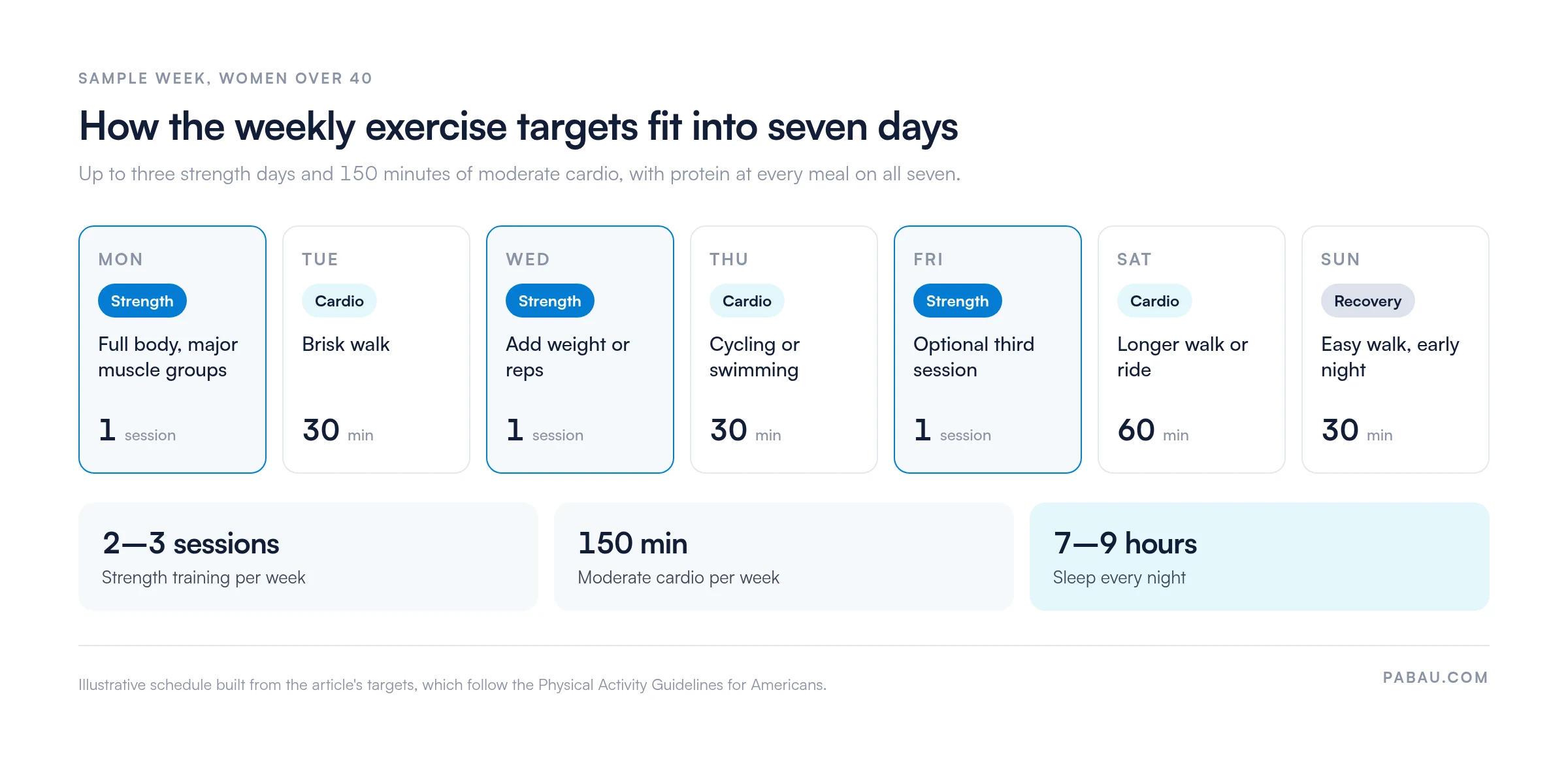
Strength training is the highest-leverage habit for women over 40. It preserves muscle, improves insulin sensitivity, and supports bone density, which matters more after menopause. Aim for two to three sessions a week targeting the major muscle groups, plus 150 minutes of moderate-intensity cardio. The sample week below shows one way to fit both around work.
If you’d rather follow a set routine, a weight loss workout plan lays out the sessions for you.
Sleep deprivation and chronic stress drive weight gain in women over 40. Both raise cortisol and ghrelin while lowering leptin, the satiety hormone. Aim for 7–9 hours of sleep a night. Manage stress with meditation, yoga, or coaching instead of relying on willpower alone.
A registered dietitian can personalize your plan around your calorie needs, activity level, and any medical conditions. See a clinician if you’re considering hormone therapy (HRT) or GLP-1 medications such as semaglutide or tirzepatide. These are prescription-only therapies that need clinical assessment and ongoing monitoring.
Why professional support matters: Women over 40 often have underlying insulin resistance, thyroid dysfunction, or medication interactions that a self-directed plan won’t catch. A dietitian or clinician can rule these out and build a plan around your health profile.
Scale weight alone is a poor measure after 40. As you build muscle and lose visceral fat, the scale may stall while your body composition improves. Track these instead:
The template above records your goals and review dates, and the sample week below gives you a starting point for meals. The Dietary Guidelines for Americans put maintenance at 1,800–2,200 kcal a day for women aged 41–50, depending on activity. Subtract about 500 kcal, then adjust portions to your activity level and hunger.
Daily framework: Breakfast (25–30 g protein), lunch (30–35 g), a snack (10–15 g), and dinner (30–35 g). That totals roughly 95–115 g of protein a day, or about 1.4–1.6 g/kg for a 70 kg (154 lb) woman. Add 2–3 cups of non-starchy vegetables to meals for extra fiber and fullness.
If you run a weight loss practice, this plan often lives on paper or as a PDF emailed to the patient. Goals, review dates, and waist measurements then end up split across the form, your notes, and the patient’s inbox.
Practice management software like Pabau keeps that work in one place. You can send the plan as a digital form before the consultation, so the patient fills in the background at home. The completed plan is stored against the patient record, next to treatment notes, before-and-after photos, and every review.
Online booking and automated reminders keep each review appointment on the calendar, which is how Pabau helps you streamline your weight loss practice. Patients stay on track between visits, and your team stops chasing paperwork.

Pabau sends weight loss plans as digital forms, stores them against the patient record, and books every review automatically. Patients stay on track, and your team spends less time on paperwork.

Weight loss after 40 rewards patience more than intensity. Protect your muscle with protein and strength training, and keep the calorie deficit moderate. Judge progress by your waist, strength, and energy as much as by the scale.
The trade-off is speed. Losing 0.5–1.5 lb a week feels slow, but it keeps the muscle that supports your metabolism for the decade ahead. Fill in the plan template with your clinician, so your goals and review dates are agreed and written down.
If you run a weight loss practice, book a demo to see how Pabau keeps each patient’s plan, reviews, and progress in one record.

Managing a thyroid condition too? The thyroid diet chart for weight loss suggests foods that suit a slower thyroid.
Want a longer runway? The 30-day meal plan for weight loss extends the sample week into a full month.
Need a simple weekly structure? The 7-day nutrition plan gives you a blank week to plan meals in.
Prefer a three-week program? The 21-day weight loss plan breaks a first push into three short phases.
Tracking BMI with your clinician? Body mass index assessment explains how BMI is measured and where it falls short.
Intermittent fasting may raise cortisol in some perimenopausal women and disrupt hormonal balance. The evidence is mixed. Some women do well on time-restricted eating, while others see sleep disruption or irregular cycles. Talk to a clinician before you start a fasting protocol.
A common starting point is your maintenance calories minus 500 kcal. The Dietary Guidelines for Americans put maintenance at 1,800–2,200 kcal for women aged 41–50, depending on activity. That puts many women at roughly 1,300–1,700 kcal a day. A registered dietitian can set your exact target from your body composition, activity level, and metabolic health. Never drop below 1,200 kcal without medical supervision.
HRT can improve body composition through estrogen’s metabolic effects, but it doesn’t directly cause weight loss. Research shows HRT may stabilize weight or modestly reduce visceral fat when combined with exercise and calorie control. Ask a clinician whether HRT is appropriate for you.
Energy, strength, and clothes fit often improve within 1–2 weeks, and scale changes usually show in 2–4 weeks. Sustainable weight loss is 0.5–1.5 lb per week. Faster loss often costs muscle, so a slower pace suits women over 40 better.
Whole foods should be the foundation. Magnesium or omega-3 supplements may help sleep quality and inflammation if you’re deficient, but no supplement replaces a sound diet and exercise plan. Discuss any supplement with a clinician to rule out medication interactions.