Intake note template
An intake note is the clinical record a therapist or counselor writes at the sta...

2
Last Updated: Oct 22, 2026
An animal based diet food list groups the foods approved within the animal-based framework into seven categories. Those are meat and poultry, organ meats, seafood, eggs and dairy, animal fats, bone broth, and fruit and honey.
The framework, made popular by Paul Saladino MD, differs from strict carnivore in one key respect. Specifically, seasonal fruit and raw honey are permitted alongside meat, organ meats, eggs, seafood, and full-fat dairy. It’s a popular eating framework rather than a clinical standard, and parts of it are contested. Overall, treat it as a patient choice.
For dietitians and wellness practitioners, a shared reference cuts the session time spent clarifying what’s in and what’s out. It also keeps documentation consistent across patient records. This guide also covers each category, a 7-day sample meal plan, foods to avoid, and a free downloadable PDF your practice can adapt.
A ready-to-use dietary planning template covering approved animal-based foods by category, a sample meal plan structure, adherence barriers, and practical substitutions. Designed for dietitians, nutritional therapists, and wellness practitioners.
Download template
An animal based diet food list includes ruminant meat, organ meats, eggs, seafood, raw dairy, animal fats, bone broth, select fruit, and raw honey.
Unlike strict carnivore, the animal-based framework permits seasonal fruit and raw honey.
Organ meats such as liver, heart, and kidney are the most nutrient-dense category, and the framework prioritizes them over muscle meat.
Foods to avoid include seed oils, grains, legumes, refined sugars, and ultra-processed products, which the framework excludes to cut antinutrients and inflammatory compounds.
Pabau, the practice management platform we build, lets dietitians collect and review adherence data in each patient’s record through digital intake forms.
The list sorts approved foods into seven categories, and each one has a distinct nutritional role. Organ meats come first for nutrient density, and ruminant meat forms the caloric backbone. Finally, fruit and honey sit at the permissive edge, which is exactly where strict carnivore draws its line.
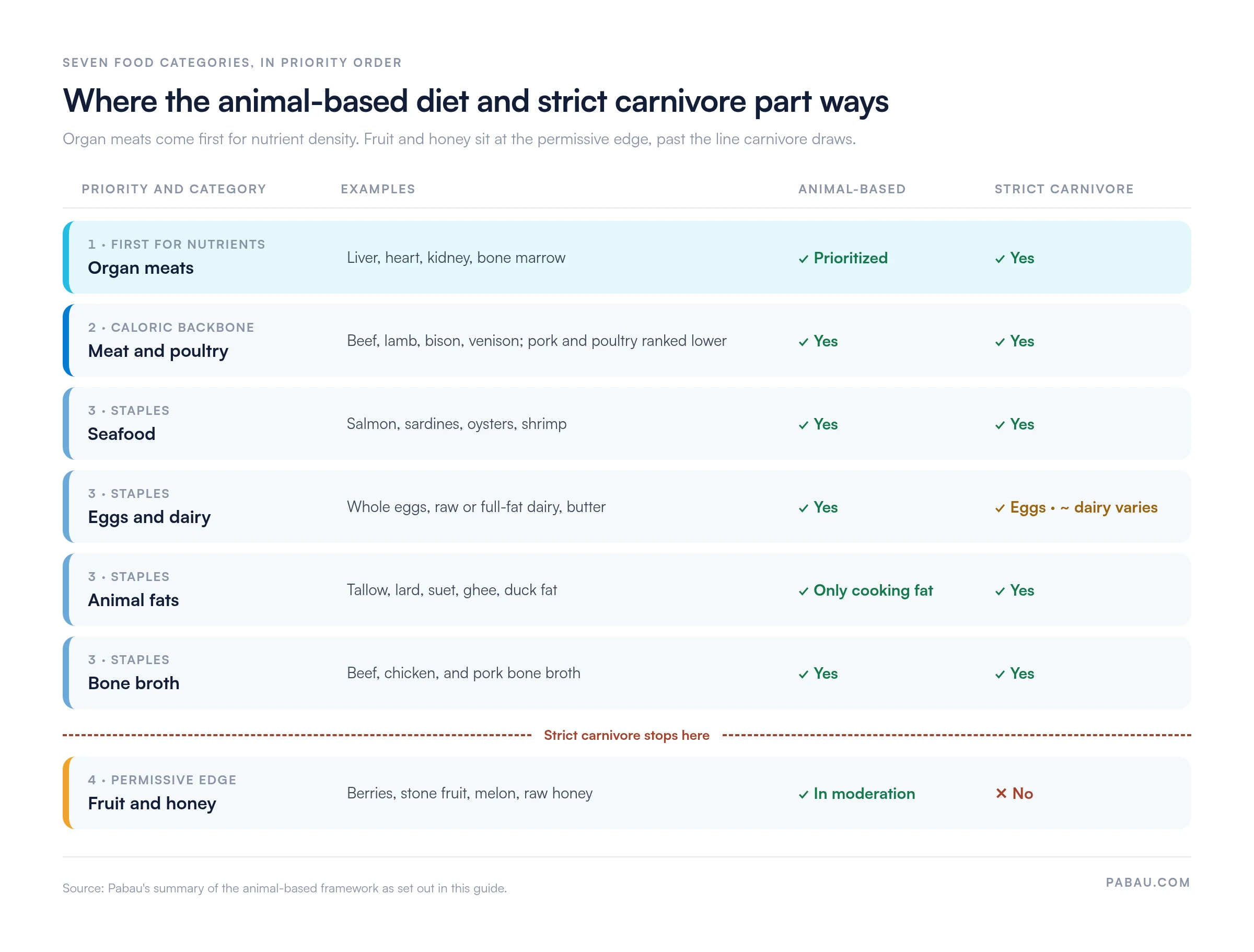
Ruminant meats are the foundation. In particular, beef, lamb, bison, and venison provide complete protein, saturated fat, and a broad micronutrient profile including zinc, iron, and B vitamins. Pork and poultry are included but ranked lower because their fatty acid profiles differ from ruminants. Game meats such as elk and wild boar are also approved.
Organ meats are the most nutrient-dense category in the framework. Beef liver is among the richest food sources of vitamin B12, folate, copper, and retinol, according to USDA FoodData Central nutrient data. For this reason, practitioners working with patients who have micronutrient deficiencies often focus on this category first.
Fatty fish and shellfish contribute omega-3 fatty acids, iodine, and selenium that are difficult to obtain from land animals alone. In particular, oysters are valued for their zinc content. Wild-caught sources are also preferred where available.
Whole eggs, especially pasture-raised, are a complete food in their own right. The yolk concentrates fat-soluble vitamins, choline, and cholesterol. Dairy in the animal-based framework favors raw or minimally processed, full-fat sources. However, raw dairy carries documented food-safety risks, and its legal availability varies by state and country. So flag both points when you advise patients.
All seed and vegetable oils are excluded. Instead, the framework uses rendered animal fats as the only approved cooking medium. Mainstream nutrition science contests this position, so present it to patients as a framework choice rather than settled evidence.
Bone broth is made by slow-simmering bones, connective tissue, and marrow in water. It also contains collagen, gelatin, glycine, and proline. Some studies suggest collagen supplementation may support joint and skin health, though the evidence quality is moderate. Overall, describe bone broth as a supportive food rather than a treatment.
This category distinguishes the animal-based framework from strict carnivore. Low-fructose fruit and raw honey are permitted, mostly when locally sourced and seasonal. However, high-fructose fruit is eaten in moderation rather than eliminated. By contrast, refined sugars and artificial sweeteners are excluded.
The animal-based diet permits foods that strict carnivore excludes. For this reason, that single distinction shapes how you counsel patients who come from a carnivore background. A ready-made carnivore diet plan helps when a patient decides to follow the stricter version instead.
The exclusion list matters as much as the food list for clinical documentation. Also, patients coming from an omnivore background usually need clarity on which everyday foods fall outside the framework.
This sample plan applies the food list to a practical weekly structure. Use it as a starting point in consultations, but adapt portion sizes and food choices to each patient’s goals and food access.
The core nutritional argument for the animal-based framework is bioavailability. Heme iron, found only in meat, poultry, and seafood, is better absorbed than the non-heme iron in plant foods, according to the Harvard T.H. Chan School of Public Health. As a result, the nutrient density argument matters for patients at risk of micronutrient deficiency.
For patients managing metabolic health, the high-protein, low-carbohydrate structure may support satiety and body composition. Harvard’s guidance on protein notes that healthy protein foods may help with weight control. However, its cohort data also link higher red and processed meat intake to more weight gain, so counsel each patient one by one.
Taurine is found mainly in animal foods such as meat, seafood, and dark poultry meat. Therefore, the list suits patients who previously followed plant-dominant diets, which supply little taurine.
The template fits any practice where dietary tracking and patient education are part of the standard workflow.
The template works across initial consultations, review sessions, and patient self-monitoring. Follow these five steps to build it into a nutrition practice workflow.
A structured food list template does more than save session time. It also sets a consistent record-keeping standard, which improves continuity between practitioners and supports audit-readiness in regulated nutrition settings.
When a patient struggles with organ meat aversion, start with beef heart rather than liver. Heart has a milder flavor and a texture closer to muscle meat, which makes it a practical bridge food. Soak the liver in milk or lemon juice for 30 minutes before cooking to soften its flavor.
Nutrition documentation carries the same obligations as other clinical records. Dietary plans, food lists, and patient-reported adherence data belong in the clinical record, under the same controls as consultation notes. Where a professional body requires it, a qualified clinician should review or sign off food lists and meal plans.
Many practices still keep the food list on paper or in a separate file, away from the medical record. As a result, fragmented records make it harder to see a patient’s full history. That matters most in practices that pair nutrition coaching with medical or aesthetic services, or lifestyle changes with medication for metabolic health.
In Pabau, the food list, intake forms, and consultation notes sit in the same patient record. Patients complete their forms before the session, so you start with their current intake already on screen. At each review, you then compare food lists side by side and adjust the plan without hunting through paper files. Metabolic health documentation then tracks adherence alongside clinical outcomes over time.

Pabau’s digital forms and patient records let dietitians and wellness practitioners collect intake data and track adherence over time. Consultation notes live in the same place.

The food list covers seven categories: meat and poultry, organ meats, seafood, eggs and dairy, animal fats, bone broth, and fruit and honey. Fruit and honey are what separate it from strict carnivore, so confirm which version each patient follows at the first session.
Present the list as a framework the patient has chosen, and flag its contested parts, such as raw dairy and the seed oil exclusion. Then record which categories each patient includes, which they avoid, and what gets in the way. Those notes give you a firm basis for reviewing progress and adjusting the plan.
Book a demo to see how Pabau keeps food lists, intake forms, and review notes together in one patient record.

Running a weight management practice? Weight loss clinic software covers how Pabau supports dietary tracking, patient records, and outcome reporting for weight management practices.
Is your patient going fully carnivore? Carnivore diet plan template gives you a ready-made plan for patients who drop fruit and honey altogether.
Working with an ancestral eating framework? Paleo diet plan offers a structured template for patients who want meat and vegetables without grains or legumes.
Need a lower-carb plan that keeps some plants? High-protein, low-carb diet plan helps you build meal plans for patients who want the protein focus without a strict animal-only list.
An animal based diet food list is a categorized reference of the foods approved within the animal-based dietary framework. It covers ruminant meat, organ meats, seafood, eggs, full-fat dairy, animal fats, bone broth, low-fructose fruit, and raw honey. It differs from a carnivore food list by permitting fruit and honey.
The animal-based diet permits seasonal fruit and raw honey, while strict carnivore does not. Both exclude grains, legumes, seed oils, and processed foods. The animal-based framework was popularized by Paul Saladino MD and emphasizes organ meats alongside fruit as ancestral foods.
Yes. Low-fructose, seasonal fruit such as berries, stone fruit, and melon is permitted on the animal-based diet. High-fructose fruit is eaten in moderation. This is one of the key distinctions from strict carnivore, which excludes all plant foods including fruit.
It may support weight loss for some people, thanks to its high protein content and the satiating effect of dietary fat, though results vary. Present weight loss as a possible benefit rather than a guaranteed result. Then monitor progress through regular dietary reviews and outcome tracking.
Excluded foods include all seed and vegetable oils, grains, legumes, refined sugars, artificial sweeteners, and ultra-processed foods. Most vegetables are also excluded, particularly high-oxalate and high-lectin varieties such as spinach, kale, and nightshades.