Grains food list: whole vs refined grains (free PDF)
A grains food list sorts grain foods into whole and refined groups, so patients ...

3
Last Updated: Oct 20, 2026

Falling estrogen drives the metabolic slowdown, the rise in cortisol, and the shift of fat toward the abdomen that most women notice in midlife.
Protein at 25 to 30 grams per meal, phytoestrogens, calcium with vitamin D, and fiber are the four nutrient pillars of the plan.
Each of the five days leads on a different nutrient, while calories and protein per meal stay constant across the whole cycle.
Running the cycle twice gives a 10-day block, which is long enough to measure weight, waist circumference, hot flashes, and sleep.
Practices can send the PDF through the patient portal, record baseline measures on day one, and review the same four measures at day 10.
The menopause diet 5-day plan to lose weight is a repeatable five-day meal structure built around the hormone changes behind midlife weight gain.
Every day sits at 1,500 to 1,800 calories, with 25 to 30 grams of protein per meal. Each day then leads on a different nutrient, moving from protein to phytoestrogens, omega-3s and fiber, magnesium, and finally vitamin D.
Run the cycle twice and you have a 10-day block, long enough to see movement in weight, waist measurement, and sleep quality. Below you’ll find why menopause changes the math, what to eat, and what to limit. The full day-by-day menu follows, plus a free PDF your practice can hand to patients.
A five-day meal plan with breakfast, lunch, dinner, and snack options for every day, plus portion sizes, shopping lists, and prep notes. Phytoestrogens, calcium, vitamin D, and magnesium are built into the menus for symptom support.
Download templateMenopause changes where the body stores fat, not only how much a woman eats. Estrogen production falls through perimenopause and menopause. That hormone helps regulate appetite, fat storage, and thermogenesis, the body’s own heat production. Four changes follow.
So a woman can eat the calories that suited her at 40 and still gain 10 to 15 pounds by 52. Age-agnostic diet advice fails for that reason. Her body has changed, and the nutrition plan has to change with it.
Four nutrient categories underpin menopause weight management and symptom relief. Targeting them deliberately is what separates this plan from general healthy-eating advice.
That framework is why the plan puts protein at every meal, works phytoestrogens into three of the five days, and pairs carbohydrates with fiber. Patients who want more variety at the same protein target can move on to a high-protein meal plan once the cycle is done.
This plan rebalances the plate rather than banning food groups. Most patients already recognize the shopping list.
Foods that spike blood sugar and cortisol speed up menopause belly fat. Cutting back on these four categories does most of the work.
None of these has to disappear permanently. Patients who want to keep the structure past the first 10 days can switch to a belly fat meal plan. It runs on the same principles.
The five days are built to be repeated. These five steps put the plan into a practice workflow instead of leaving it as a handout.
The template carries full meal specifications, shopping lists, and prep notes, so your team can adapt it to patient preferences and cultural dietary needs.
Below is a condensed version of the five days. Portion sizes, recipes, and prep notes sit in the downloadable PDF.
The days are not interchangeable. Each one leads on a different nutrient while the calorie and protein targets hold steady, which is what makes the cycle worth repeating.
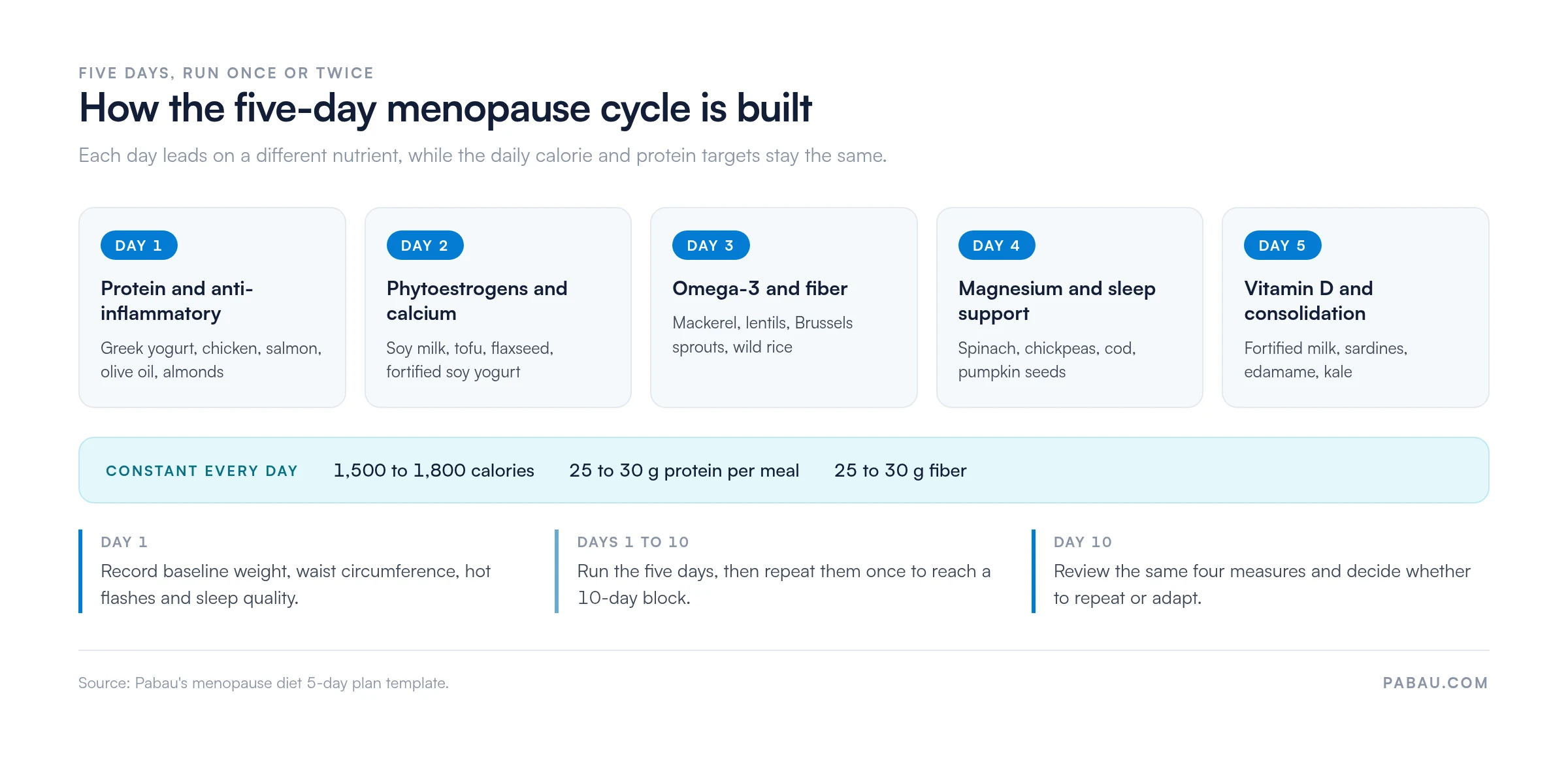
After day 5, restart the cycle or adapt the meals to patient preference. Consistency is what makes the difference, so aim for two consecutive cycles before judging the results. Patients who want a fixed two-week target instead can follow a short-term weight loss plan.
Most of what the plan needs comes from food. Three supplements have clinical evidence behind them in menopause weight management, and each is worth discussing with patients.
Tell patients to check with their primary care physician before starting a supplement, especially anyone on hormone therapy or blood thinners.
The five days are a jump-start, not a permanent protocol. Long-term results rest on three habits: steady eating patterns, strength training, and stress management. Regular check-ins keep patients accountable without overwhelming them.
Strength training targets visceral fat directly. Resistance work two or three times a week protects muscle mass and the metabolism that goes with it. Treat it as part of the plan rather than an optional extra.
Sleep and stress are the hormonal anchors. Short sleep raises cortisol and ghrelin, the hunger hormone, which undoes dietary progress. Aim for seven to nine hours. Then pick a stress outlet the patient will keep up, whether that is yoga, meditation, or a daily walk.
Most practices hand the plan over as a printout at the end of a consultation. The patient leaves with paper and the practice keeps no copy of what was given. By day 10 nobody knows whether any of it was followed.
Practice management software like Pabau closes that loop. Our weight loss clinic software sends the PDF to the patient portal as the appointment ends. The file is waiting before she gets home. Automated reminders on days 2, 5, and 10 prompt her to log how it is going.
Digital forms capture the baseline on day one: weight, waist circumference, hot flash frequency, and sleep quality. The same four fields come back at day 10. Both sets sit in the patient record instead of in someone’s memory.
The outcome is a menopause service you can price, repeat, and report on. Your team spends the follow-up appointment reading measurements rather than reconstructing what happened. You can also bundle the plan with a day 10 review as a paid package.

Pabau sends the template from the patient portal, captures baseline and day 10 measures on digital forms, and automates the follow-up reminders. Your team reviews numbers instead of chasing paper.

Five days will not reverse a hormonal shift. What they do is give a patient a structure specific enough to follow, and give you a measurable before-and-after to discuss at the next appointment.
One trade-off is worth naming up front. Early weight change is mostly water, so a patient expecting the scale to drop fast tends to quit around day 4. Tell her the first cycle is about the habit and the second is about the result.
Hand over the template, take the four baseline measures, and book the day 10 review before she leaves. Book a demo to see how Pabau sends the plan, chases the follow-up, and keeps every measurement in one patient record.

Need a handout for the inflammation side? The anti-inflammatory meal plan covers the same fats and vegetables in a format patients can follow for longer.
Looking for the exercise half? A weight loss workout plan gives patients the resistance training that protects muscle mass during menopause.
Need a baseline measure at day one? The women’s BMI chart gives your team a quick reference to record alongside waist circumference.
Comparing systems to run the service on? Our guide to an EMR for a weight loss clinic walks through what to look for before you commit.
Most women lose 2 to 5 pounds over the first five days, largely from water and lower carbohydrate intake. Steadier fat loss of 1 to 2 pounds a week appears after two or three cycles. Resistance training and consistent sleep are what get her there. Menopause weight loss runs slower than it does in younger women, so set expectations early.
The plan is whole-food based and mandates no supplements, so interactions are rare. Patients should still discuss any dietary or supplement change with their doctor or menopause specialist. That matters most for anyone on blood thinners, diabetes medication, or hormone therapy.
Yes, and it adapts easily. Swap animal proteins for tofu, tempeh, legumes, seitan, or plant-based protein powder. Keep the targets the same at 25 to 30 grams of protein per meal and 25 to 30 grams of fiber a day. The phytoestrogen sources are already plant-based.
Simplify the sourcing rather than the targets. Rotisserie chicken, canned beans, pre-cut vegetables, frozen fish, and Greek yogurt all count. Prep proteins and vegetables in bulk one day a week, then mix and match through the following days.
Book an appointment if weight gain exceeds 2 pounds a week while you are following the plan. Extreme fatigue, marked mood changes, or a history of disordered eating are also reasons to go. A doctor can check thyroid function and cortisol, screen for other causes, and discuss whether HRT is appropriate.
Diet and exercise slow menopause weight gain, but they do not reverse the metabolic decline behind it. The Menopause Society, renamed from the North American Menopause Society in 2023, treats nutrition and hormone therapy as complementary rather than competing. Where symptoms are severe or weight gain persists despite good adherence, HRT is worth raising with a prescriber.
Yes, indefinitely. After two cycles most women find it easier to adapt the structure to their own tastes than to follow the exact menus. The nutrient framework of protein, phytoestrogens, calcium, and fiber is the part to keep. The specific foods can change.