Despina Petrushevska

OT SOAP note sample: Free template and worked examples
Download your free OT SOAP note sample A four-page form with an identifying head...

1
Last Updated: Nov 5, 2026
Free PDF 2 pages, print-ready Clinician-reviewed
A tier medication list is a drug list that sorts medications into cost-sharing levels, from low-cost generics to high-cost specialty drugs. Patients and clinicians use it to see which drugs cost least and which carry higher out-of-pocket costs. Insurers and Medicare Part D plans build these lists into their formularies. Each plan decides how many tiers it uses and which drugs sit in each one. This guide explains what each tier usually means, how restrictions such as prior authorization apply on top, and where to find a plan's own list. It also includes a free printable checklist your practice can adapt.
A two-page tick-box checklist with fields for the patient's name, date of birth, record number and who prepared it. It adds blank sections for essentials, documents and optional items, eight item rows with quantity and confirmation boxes, and a notes page.
Start from scratch, or upload this PDF or any form you already use, and Pabau's AI Form rebuilds it with tick boxes, text fields and a signature. Attach it to the treatment once, and every patient gets it on time.
AI Form rebuilds the consent, history and aftercare forms you already use. You review each one, then publish.
Patients complete forms on their phone before they arrive, so the front desk stops retyping paper.
Every signed form is versioned and attached to the treatment record, ready when you need it.
Set how long a consent stays valid. Returning patients skip forms they have already signed.
Supports HIPAA and GDPR compliance AES-256 encryption 4.8 on G2 4.7 on Capterra Trusted by 4,000+ practices worldwide

A tier medication list groups drugs into cost levels set by each plan’s formulary.
Tier 1 generics usually carry the lowest copays, while specialty tiers carry the highest cost-sharing.
Prior authorization and step therapy can restrict drugs regardless of their tier.
In Pabau, the practice management platform we build, each patient’s medication details and review notes sit in one record.
A tier medication list is the tiered section of a formulary that assigns each covered drug to a cost level. Plans use tiers to signal how expensive a drug is for the insurer and how much the patient pays at the pharmacy.
In clinical settings, the same list shows prescribers and practice teams which medications a patient can likely get without extra steps. In addition, it flags the drugs that will need a conversation about cost or alternatives.
Each plan builds its own formulary and decides how to divide its tiers. For example, Medicare.gov notes that each plan can divide its tiers in different ways, so the same drug can sit in different tiers across two plans.
However, tier placement varies by plan, so always check the plan’s own list before you advise a patient on cost.
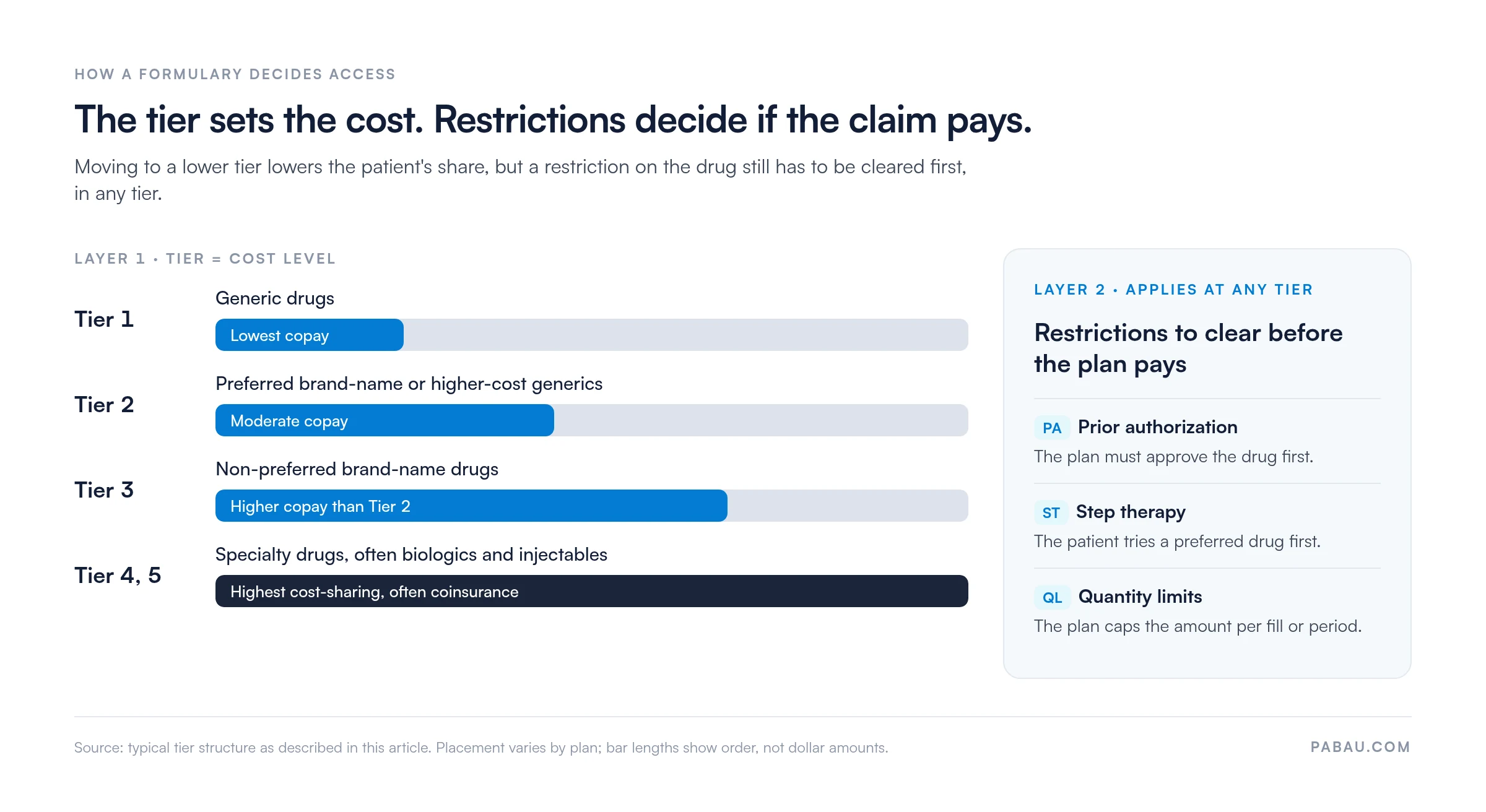
Tier 1 holds the lowest-cost generic drugs. As a result, patients usually pay the smallest copay here, which makes it the first place to look when cost is a barrier.
Tier 2 usually holds preferred brand-name drugs or higher-cost generics. Specifically, cost-sharing here is moderate, and the plan has chosen these options as preferred alternatives.
Tier 3 holds non-preferred brand-name drugs, which generally cost the patient more than Tier 2. Therefore, clinicians often check for a preferred alternative in Tier 1 or Tier 2 before the patient leaves the appointment.
Specialty tiers hold high-cost biologics, injectables and infusion drugs. In fact, these drugs often need special handling or administration, which is why they tend to carry the highest cost-sharing.
Medicare Part D plans use tiered formularies, and CMS sets the rules that plans follow. Overall, many plans use five tiers, though the number and make-up of tiers can differ from plan to plan.
Because cost-sharing rules and tier placement change from year to year, check the current Medicare drug plan finder before quoting any figure to a patient. Indeed, Medicare.gov is the authoritative source for plan-specific details.
Start by finding the drug name on the list, then read across to its tier and any restrictions beside it. First, a drug’s tier tells you the cost level, while its restrictions tell you what has to happen before a claim is paid.
Tier placement is only one layer of access. Prior authorization, step therapy and quantity limits can apply to a drug in any tier, as the diagram below shows.
Generic drugs usually sit in Tier 1, and brand-name drugs usually sit in higher tiers. Indeed, FDA bioequivalence standards support generic substitution, but clinical judgement still applies to each patient.
Tier placement drives the cost gap between the two, so compare the patient’s copay for each option before deciding on a switch. For instance, extended-release versions often appear as separate entries, and a medication suffix list helps staff match the exact product to the plan entry.
Specifically, pharmacists, nurses, prescribers and practice managers use this kind of list to keep medication records consistent. Overall, primary care, internal medicine and specialist practices all handle tiered drug questions at the point of prescribing.
The check goes faster when patients bring a current medication list to the appointment.
A standard checklist makes medication records comparable across patients and staff. Its header ties each list to one patient by name, date of birth and record number. In addition, the prepared-by and date fields show who compiled it and when.
The form has no dedicated tier or review-date columns. Instead, write the plan name, each tier and the next review date into an item row or onto the notes page yourself.
Record the plan name and plan year next to every tier entry. Tier placement changes between years and between plans, so an undated tier note becomes unreliable within months.
Build your list from the medications your practice prescribes most often. Pull each tier from the plans your patients use, then review the list on a fixed schedule. Run it alongside your medication reconciliation form so the list matches the drugs each patient currently takes.
A printed tier list in a binder, or a spreadsheet on a shared drive, drifts out of date fast. As a result, nobody can tell which copy the prescriber checked at the last visit.
Pabau, the practice management platform we build, stores medication details in each patient’s medical records. Notes, forms and appointments sit in the same file, so the tier note never lives on a loose sheet.
You can also rebuild this checklist as a digital form. The forms behind Pabau’s intake software for practices can capture the tier, plan year and next review date on screen. As a result, at the next appointment, the prescriber sees the last recorded tier and the date it was checked.

Pabau stores medication details, forms and review notes in one patient record. Prescribers see the latest tier note before they write a prescription.

A tier medication list is only as useful as the date on it. Plans move drugs between tiers from year to year, so check any undated list against the plan’s current formulary before you quote a cost.
Start with the drugs your practice prescribes most, and record each tier and restriction next to the plan year. The trade-off is upkeep. Otherwise, a list nobody reviews will mislead a patient about cost, so give it an owner and a review date.
Book a demo to see how Pabau keeps medication notes and review dates inside each patient record.

Writing the prescription next? Prescription pad template gives you a printable pad with the fields a prescription needs.
Tracking drugs bought without a prescription? OTC medication list records the over-the-counter products a patient takes alongside prescribed drugs.
Flagging drugs that need extra checks? High-alert medication list lists the medications where an error carries the most risk.
Logging doses over time? Medication log tracks each dose given, with dates and times.
Keeping a pharmacy-side record? Pharmacy record documents dispensing details for each patient.
A tier medication list is the tiered section of a drug formulary that assigns each covered medication to a cost level. Lower tiers usually cost patients less.
Find the drug, note its tier, then check for restrictions such as prior authorization or step therapy. The tier shows the cost level. The restrictions show what else must happen before the drug is covered.
Tier 1 holds the lowest-cost generics, Tier 2 holds preferred brand-name drugs or higher-cost generics, and Tier 3 holds non-preferred brand-name drugs. Exact cost-sharing depends on the plan.
Specialty drugs are usually in the highest tiers, but placement depends on the plan. Some plans use Tier 4 for specialty drugs and Tier 5 for the most expensive ones.
Check the plan’s formulary or drug list on the insurer’s website, or use the plan finder on Medicare.gov for Medicare plans. Confirm the plan year before you advise a patient.