OSHA respirator medical evaluation questionnaire
The OSHA respirator medical evaluation questionnaire is the mandatory health for...

1
Last Updated: Oct 15, 2026

The suffix of a generic drug name encodes its pharmacological class and its mechanism of action.
The highest-value endings are -olol for beta-blockers, -pril for ACE inhibitors, -statin for statins, -cycline for tetracyclines, and -pam or -lam for benzodiazepines.
Suffix recognition speeds up medication reconciliation and flags contraindications by drug family rather than by individual drug.
The endings are governed by the WHO International Nonproprietary Names Programme, so they carry the same meaning in every INN country.
Pabau’s prescription management holds a full medication history on the patient record, so drug class checks happen in the chart.
A medication suffix list is a reference that decodes the ending of a generic drug name to reveal its pharmacological class.
Read -pril and you are looking at an ACE inhibitor. Read -olol and it is a beta-blocker, -statin a statin, -cycline a tetracycline antibiotic.
That ending is the most useful part of the name. It is assigned under the WHO International Nonproprietary Names Programme, so it carries the same meaning in every country that uses INN naming. The prefix and the stem identify the individual drug. The suffix identifies the family it belongs to.
So instead of memorizing thousands of generic names one at a time, you learn about a dozen endings. This guide lists them by drug class and maps each one to its mechanism. It also shows where the pattern pays off during medication reconciliation, dispensing checks, and exam prep.
Every suffix in this guide on one printable sheet, grouped by drug class. It covers the three parts of a generic name, the mechanism behind each ending, and example drugs for each class.
Download templateA drug suffix is the ending of a generic name, and it names the drug’s pharmacological class. Most endings follow patterns set by the WHO International Nonproprietary Names Programme, which makes the naming predictable rather than arbitrary.
Every generic name is built the same way.
Example. Lisinopril splits into “lisino-” and “-pril”. A clinician reads the ending and registers an ACE inhibitor. That brings a predictable set of checks with it, including dry cough, hypotension, and potassium monitoring. The same read works on enalapril, ramipril, and captopril.
That decode looks the same whichever class you start from.
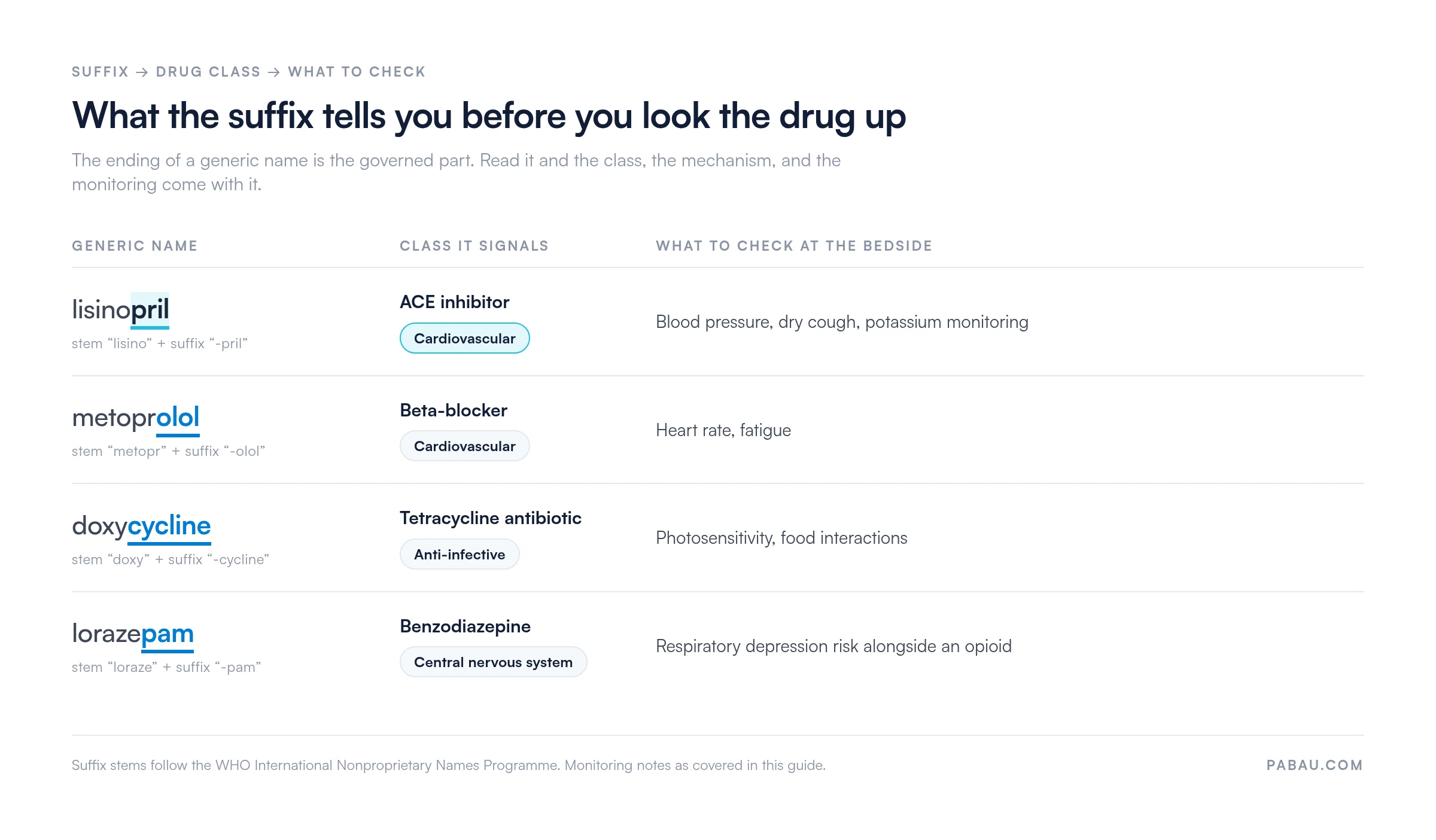
The table below groups the most common drug suffixes by pharmacological category. It is the core reference used in clinical practice, NCLEX preparation, and pharmacy technician study.
These 10 endings cover the drug classes you meet most often on a medication list. Learn them first, then add the narrower ones as they come up in your setting.
For the drugs you handle every shift, a drug card template is the natural companion. It gives one drug a full page for dose, route, and monitoring. This list gives you the class at a glance.
Pattern recognition earns its keep at five points in the day.
The pattern only works against a written record. A medication log gives you one row per drug, with the dose and the date. That layout is what makes a suffix scan quick at the bedside.
The template supports three groups in particular.
Faster verification. Reading -pril or -olol off a list is quicker than looking each drug up. Across dozens of medication checks a day, that time adds up.
Safer contraindication screening. Class knowledge lets you predict side effects and interactions without a lookup for every drug. A patient on diazepam plus an opioid needs respiratory monitoring, and the -pam ending flags it.
Consistent counseling. Every -pril carries dry cough risk and needs potassium monitoring. Every -statin carries muscle symptom risk. Patients then hear the same warning from whoever sees them.
Less to memorize before an exam. Patterns are lighter to carry than thousands of individual names. For NCLEX and PTCB candidates, that shifts the work from recall to recognition.
The suffix system is governed by the WHO International Nonproprietary Names (INN) Programme, established in 1950. INN assigns one generic name per substance, independent of brand names. So lisinopril reads as an ACE inhibitor whether it is sold as Zestril (AstraZeneca) or Prinivil (Merck). The FDA and the United States Adopted Names (USAN) Council align with INN when new generic names are approved for the US market.
That governance is why the pattern holds. The ending comes from a nomenclature rule written for clinician safety and cross-border consistency, not from a marketing department.
In a lot of practices the medication list lives in two places at once. Part of it sits on the intake questionnaire the patient filled in. The rest sits in a note from the last visit. Reading a patient’s drug classes off that takes longer than it should.
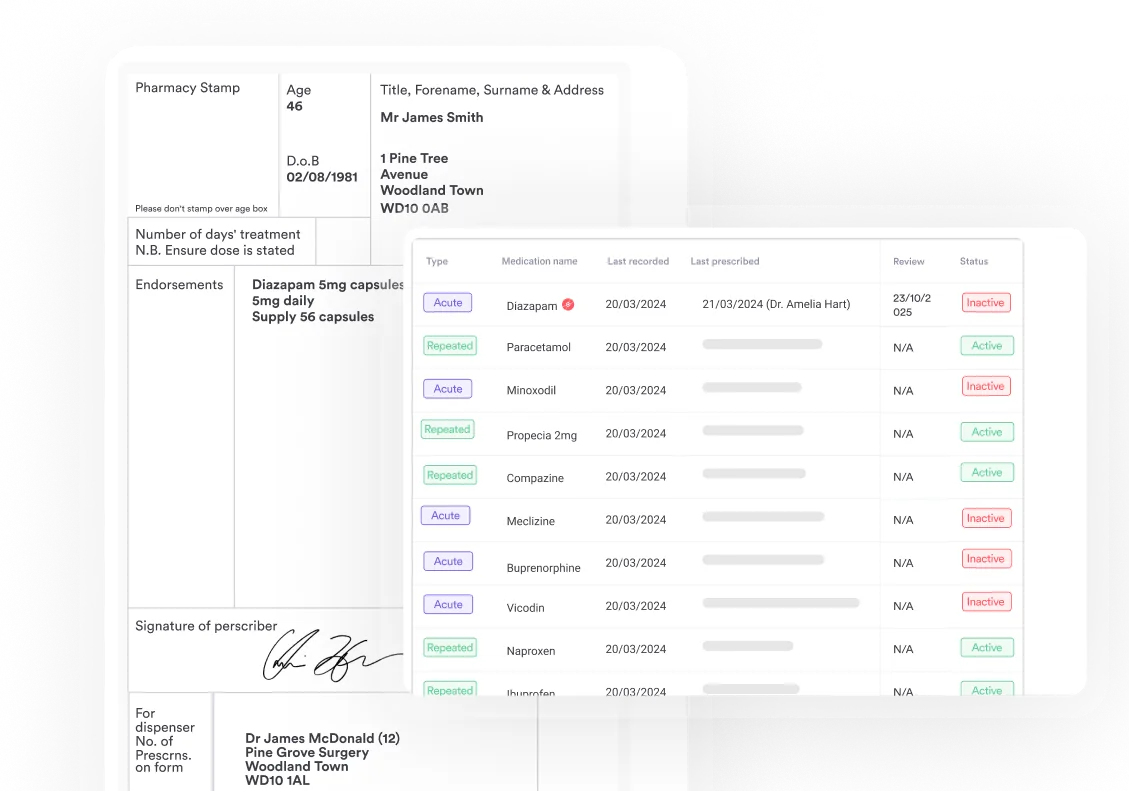
Practice management software like Pabau keeps that list in one place. Pabau’s prescription management software holds the full medication history on the patient record. So the list you scan for -pril and -olol endings is the list the prescriber works from. New prescriptions are written from inside the record, and Pabau checks each one against the patient’s existing medications and allergies before you finalize it.
Repeat prescriptions renew on a trigger rather than on someone’s memory. Every prescription keeps an audit trail with the drug, the dose, and the status. So when a nurse spots two interacting classes on a list, the record already shows who prescribed what and when.

Pabau’s prescription management holds the full medication history on the patient record. New prescriptions are checked against existing medications and allergies before you finalize them.

Learn the endings once and this stops being a list to memorize. It becomes a reflex you apply to any medication list you are handed.
Start with the 10 in the table above. Print the sheet, keep it where the medication checks happen, and use it during reconciliation rather than after it. The narrower endings can wait until your setting throws one at you.
The pattern only helps if the list it reads is current and in one place. Collecting medications up front with patient intake software keeps that list accurate before the patient arrives. Book a demo to see how Pabau stores medication histories on the patient record, so drug class checks happen in the chart.

Need to track what a patient takes and when? Medication schedule template lays out doses by time of day, so no dose gets given twice.
Building a reference for the drugs you give most? Drug card template gives one drug a full page for dose, route, and monitoring.
Want the medication list to hold up under review? Nursing documentation covers what to record, when to record it, and what auditors look for.
Writing the care plan that goes with the medication? List of nursing interventions gives you the wording for each intervention type.
A medication suffix list is a reference that decodes the endings of generic drug names to reveal their pharmacological class. Each ending, such as -pril, -statin or -cycline, signals a predictable set of side effects, contraindications and clinical uses. That lets you identify related medications at a glance.
Suffix recognition speeds up medication verification and reduces errors during dispensing and administration. It also supports rapid contraindication screening. For NCLEX and PTCB candidates, learning the patterns replaces the work of memorizing thousands of individual drug names.
The suffix -pril indicates an ACE inhibitor, short for angiotensin-converting enzyme inhibitor. Examples include lisinopril, enalapril, ramipril and captopril. Every -pril drug lowers blood pressure, carries a dry cough risk and needs potassium monitoring.
During medication reconciliation, scan the patient’s list for suffix patterns. A -pril is an ACE inhibitor, so check blood pressure and monitor potassium. An -olol is a beta-blocker, so check heart rate and watch for fatigue. A -cycline is a tetracycline antibiotic, so note photosensitivity and food interactions.
Start with the 10 in the table above. Beta-blockers end in -olol, ACE inhibitors in -pril and statins in -statin. Antibiotics split three ways, with -cillin for penicillins, -cycline for tetracyclines and -oxacin for fluoroquinolones. Benzodiazepines end in -pam or -lam. The rest are -gliptin for DPP-4 inhibitors, -nib for tyrosine kinase inhibitors and -mab for monoclonal antibodies.
Yes. The WHO International Nonproprietary Names Programme standardizes generic drug nomenclature globally. A -pril ACE inhibitor is recognized as an ACE inhibitor in the US, the UK, Canada, Australia and every other country that uses INN-compliant naming.