Getting along with siblings worksheet
A getting along with siblings worksheet is a printable that helps children and t...

2
Last Updated: Oct 23, 2026

The free template on this page is a blank goal-drafting worksheet for math, English, and science, not a library of pre-written goals.
Each subject block prompts you for the numbers that make a goal measurable, such as accuracy percentage, grade level, and term counts.
IDEA requires measurable annual goals, so every statement needs a named skill, a criterion drawn from baseline data, and a review date.
Practice management software like Pabau stores finished goals as digital forms, so progress data and parent updates sit with the student record.
A blank three-page worksheet for drafting measurable IEP goals in math, English, and science. Each subject block prompts you for the accuracy percentages, grade levels, and term counts that make a goal measurable. Your team writes the goals; the form structures and documents them.
Download templateSpecial education teachers, speech-language pathologists (SLPs), school psychologists, and IEP teams spend hours drafting measurable goals for Individualized Education Programs. The template on this page will not hand you finished goals. It gives you a blank three-page worksheet for math, English, and science, with a prompt for every number a measurable goal needs. This guide pairs that worksheet with example goals across reading, math, science, behavior, autism, and speech-language. It also covers the SMART rules that keep each goal audit-ready.
An IEP goal bank is a collection of measurable goal statements organized by skill area, disability category, and grade level. Teams pull an entry, adapt the wording, and place it in the student’s IEP instead of drafting from a blank page. Banks typically span academic domains, functional skills, and therapeutic areas such as speech-language or occupational therapy.
A bank saves drafting time, but it cannot choose the criterion for a specific student. That number comes from evaluation and baseline data, which is what the worksheet below asks you to record.
Under the Individuals with Disabilities Education Act (IDEA), every IEP must contain measurable annual goals, whatever source the wording comes from. The statutory basis is IDEA 2004 (20 U.S.C. § 1414(d)), which requires that goals be measurable, standards-aligned, and reviewed at least once a year. Most states add that each goal must address a need identified in the student’s evaluation.
The download is a blank clinical form rather than a goal bank. It runs three pages, one subject block each, and every line is a field you complete for the student in front of you. The form’s own instruction is to assess the student’s strengths, select the relevant subjects, then set measurable criteria with the team.
| Subject block | Fields the form asks you to set |
|---|---|
| Math IEP goals | Addition and subtraction range, accuracy level, multiplication and division range, accuracy percentage, problem-solving accuracy percentage, level of complexity, number of math terms |
| English IEP goals | Grade level, reading accuracy, reading material grade level, paragraph length, number of new words, listening passage length, listening accuracy, presentation length |
| Science IEP goals | Number of science terms, scientific object, number of concepts, number of components |
Behavior, autism, speech-language, and executive functioning goals are not on the form. Draft those in your IEP system, using the examples further down this page as a starting point. For the speech-language domain, our speech therapy goal bank collects measurable statements by skill area.
A compliant IEP goal has to be measurable, and three questions decide whether it is. Which skill will the student show, how will the team score it, and by when? The SMART framework keeps all three answers inside one statement.
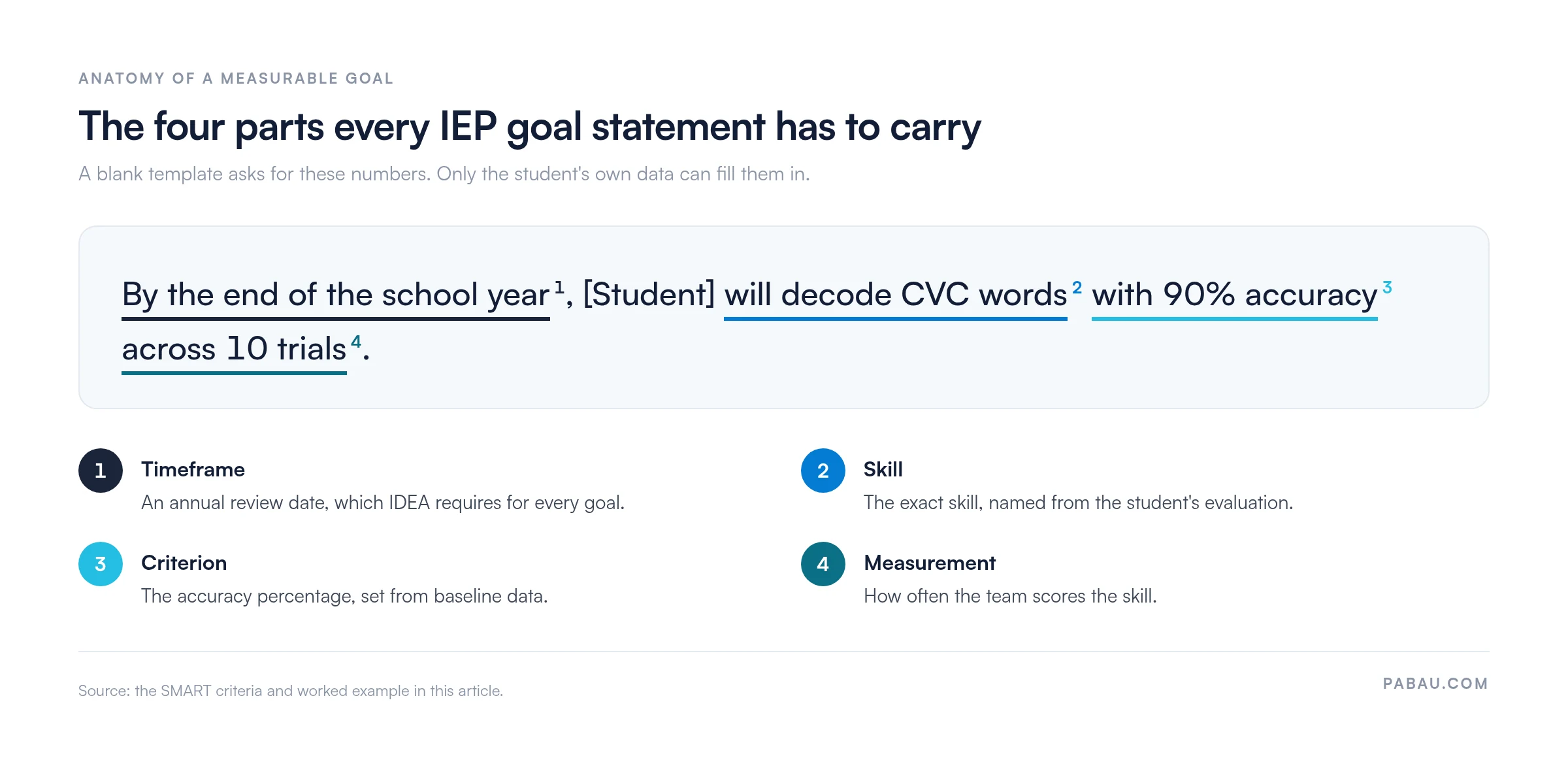
“By the end of the school year, [Student] will decode CVC words with 90% accuracy across 10 trials” is SMART. “Improve phonics skills” is not measurable, and it risks a finding during a state or federal audit. The breakdown below shows which part of that statement carries each requirement.
The worksheet turns a vague need into a set of numbers you can defend, one subject at a time. Work through it with the team before the meeting, not during it. For a student with ADHD, the criteria often need a support condition, such as a timer or a visual checklist.
Reading is the most common IEP goal domain, and it maps onto the English block of the worksheet. Students with decoding or comprehension difficulties usually need a criterion set below their grade placement. The examples below cover foundational skills, fluency, and comprehension.
The math and science blocks ask for computation ranges, accuracy percentages, and term counts. Each example below fills those fields in, so you can see what a completed line looks like as a finished statement.
Behavior and social-emotional goals support students with emotional or behavioral disabilities, autism, or trauma histories. These goals target self-regulation, peer interaction, classroom participation, and emotional expression. Progress here depends on home follow-through, so engaging families in therapy keeps school and home scoring the same behavior.
Autism-specific goals address communication, social reciprocity, sensory regulation, and adaptive behavior. Where a student has both autism and speech delay, one statement often has to carry communication and social flexibility together.
Speech-language pathologists write goals for articulation, language development, fluency, and voice. Recording each session in speech therapy software rather than on paper makes reporting faster and goal adjustments more frequent. Common SLP examples include the following.
Executive functioning goals target organization, planning, task initiation, and working memory. Occupational therapists and special educators often share these goals, which prepare students for employment or adult living. Life skills goals cover self-care, community participation, and safety awareness.
A completed worksheet still lives on paper. Most teams then retype each goal into another system, or file the sheet and lose the baseline numbers that justified the criteria. When the annual review arrives, someone rebuilds the picture from memory and a folder of session notes.
Therapy practice management software like Pabau removes that retyping. Digital forms hold the same fields the worksheet asks for, so accuracy percentages, computation ranges, and term counts stay attached to the student record. Progress notes, session data, and uploaded documents sit in one timeline.
Parents can follow progress through our online booking and client portal instead of waiting for the annual meeting. Related service providers see the same goal set, so a speech therapist and a classroom teacher score the same criterion the same way.
The outcome is a goal set you can report on at any point in the year, rather than a document your team rebuilds each spring.

Pabau holds your drafted goals as digital forms attached to the student record. Progress notes, session data, and parent updates sit in one timeline, so you can report on a goal at any point in the year.

Goal banks speed up drafting, but the goal that survives an audit is the one whose criterion came from the student’s own data. The template on this page is built for that step. It prompts you for every number a measurable math, English, or science goal needs. The examples above show what each finished statement looks like. Download it, draft with your team, then store the finished goals somewhere they can be scored. Book a demo to see how Pabau turns goal documentation into progress data you can track all year.

Need goals for the speech-language domain? Speech therapy goal bank covers articulation, language, fluency, and AAC targets.
Need baseline data before you set a criterion? Articulation test walks through the assessment that produces those numbers.
Working on decoding and literacy targets? Dyslexia worksheet gives you practice material to pair with a reading goal.
Documenting progress after each session? SOAP notes for speech therapy structures the notes that show a goal is being met.
An IEP goal bank is a collection of measurable goal statements organized by skill area, disability category, and grade level. Teams find a statement that matches the student’s need, then adjust the wording and the performance criteria. The finished goal goes into the Individualized Education Program with a progress-monitoring plan. A bank speeds up drafting, but it cannot pick the criterion for a specific student. That number has to come from evaluation and baseline data.
The template is a blank three-page form covering math, English, and science. Each subject block lists the criteria your team sets. Those include accuracy percentages, computation ranges, and reading material grade level. Paragraph length, passage length, and the number of new math or science terms are fields too. It holds no pre-written goal statements, and it does not cover behavior, autism, speech-language, or executive functioning. Use it to structure and document the goals your team writes.
Measurable IEP goals follow the SMART framework. Specific means naming the exact skill. Measurable means quantifying success with a percentage, frequency, or rubric. Achievable keeps the target within reach for the student and the timeframe. Relevant ties the goal to a need identified in evaluation. Time-bound sets an annual review date with periodic progress checks. For example, “By June 30, [Student] will decode CVC words with 90% accuracy across 10 trials” is measurable. “Improve reading skills” is not, because no one can score it.
Yes, IDEA 2004 (20 U.S.C. § 1414(d)) legally requires that every IEP include measurable annual goals aligned with grade-level standards and addressing each student’s disability-related needs. IEP goals must be reviewed at least annually, and progress must be monitored and reported to parents regularly.
Yes. A bank entry becomes individualized once you set the performance criteria, measurement method, and timeframe from that student’s own data. Take a generic line about decoding words at X% accuracy. Setting X to 80% for a student reading below grade level makes it that student’s goal. Recording those criteria is exactly what the blank template on this page is for.
A broad IEP goal bank spans academic domains such as reading, math, writing, and science. It also covers functional and adaptive skills, including self-care, social interaction, and life skills. Therapeutic areas such as speech-language, occupational therapy, and physical therapy usually get their own sections. Behavior, emotional regulation, and disability-specific areas such as autism or ADHD complete the set. Many banks also sort goals by grade level to keep them developmentally appropriate.
IDEA requires that IEP goals be formally reviewed at least annually. Many districts monitor progress quarterly or more often, especially for students making slow progress. If a student masters a goal, the team can revise it before the annual review. The same applies when the data shows a goal is out of reach.