Anja Dodevska

Social skills worksheet for autism
What is a social skills worksheet for autism? A social skills worksheet for auti...

1
Last Updated: Nov 18, 2026
Free PDF 1 page, print-ready Clinician-reviewed
A worry time worksheet is a CBT tool that helps patients set aside one fixed daily period for worrying. Anxious thoughts are written down and postponed instead of running all day. Worry postponement is a practical technique for generalized anxiety disorder (GAD), and the worksheet gives patient and clinician a shared record to review.
The free one-page version has name, date and time fields and one open box. There, the patient lists each worry, the reason for it and a possible solution. This guide explains how the technique works, how to introduce it in session, and how to adapt it for children and autistic adults.
A one-page worksheet with name, date and time fields and one open box. Patients list each worry, the reason it worries them and a possible solution.
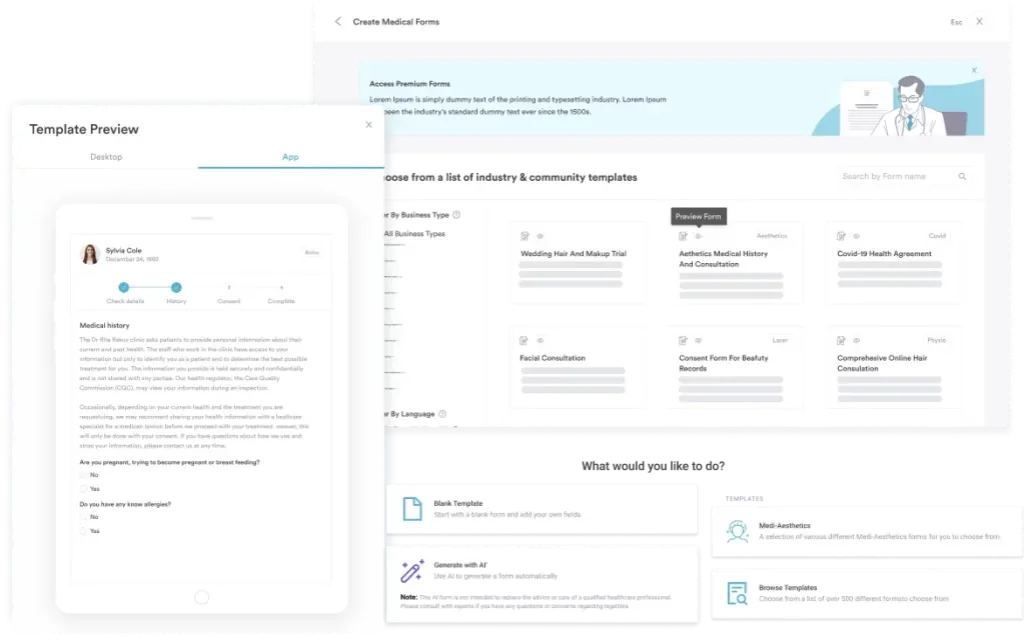
Start from scratch, or upload this PDF or any form you already use, and Pabau's AI Form rebuilds it with tick boxes, text fields and a signature. Attach it to the treatment once, and every patient gets it on time.
AI Form rebuilds the consent, history and aftercare forms you already use. You review each one, then publish.
Patients complete forms on their phone before they arrive, so the front desk stops retyping paper.
Every signed form is versioned and attached to the treatment record, ready when you need it.
Set how long a consent stays valid. Returning patients skip forms they have already signed.
Supports HIPAA and GDPR compliance AES-256 encryption 4.8 on G2 4.7 on Capterra Trusted by 4,000+ practices worldwide

A worry time worksheet sets one fixed daily window for worry, so anxious thoughts are written down and postponed instead of running all day.
Worry postponement is a CBT technique for generalized anxiety disorder (GAD), and a 2024 randomized trial found it reduced worry in people with GAD.
The free worksheet has one open box where the patient lists each worry, the reason for it and a possible solution.
Adapt the language, length and visuals for children, young people and autistic patients, with a parent or guardian involved where appropriate.
Pabau, the practice management platform we build, keeps completed worksheets on the patient record so you can review them across sessions.
A worry time worksheet is a CBT resource that asks the patient to set aside a fixed daily period for worrying. Worries that come up in between wait until then. A 2024 randomized waitlist-controlled trial found worry postponement significantly lowered worry in people with generalized anxiety disorder (GAD). The effect held at a four-week follow-up.
The completed sheet gives you a written record of what the patient worries about, how often, and what they think could help. It is most often used for GAD, where persistent, diffuse worry is the dominant symptom.
The technique works by moving worry into a scheduled slot. Patients learn that worries can wait, which eases the sense of constant threat across the rest of the day.
The technique goes back to a 1983 stimulus control study by Borkovec and colleagues. Self-labeled worriers who held worry to a set time and place reported significantly less daily worry than untreated controls.
The flow below follows one worry from the moment it appears to the session where you review it.
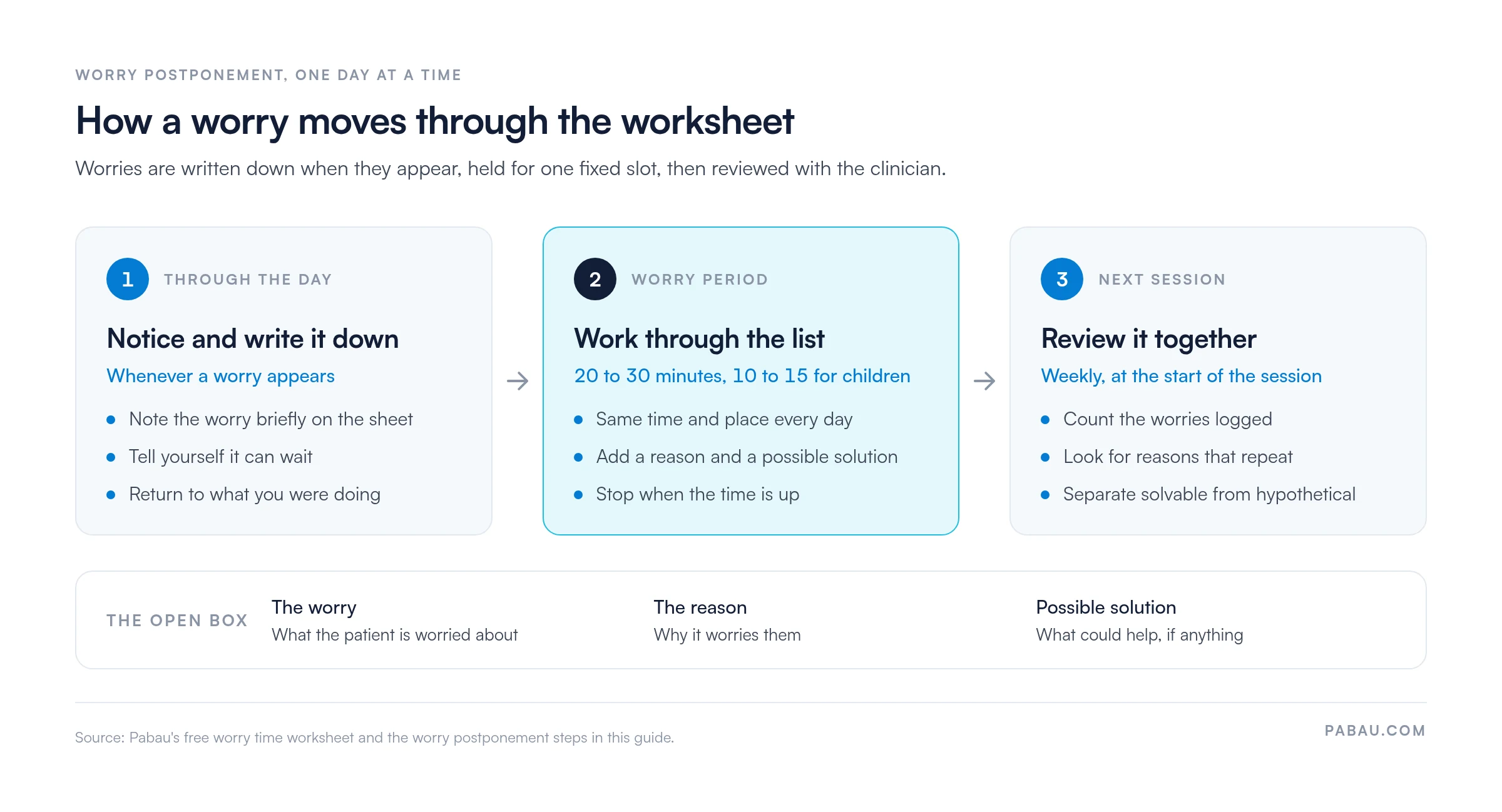
The free worksheet keeps the task small, so a patient can fill it in within a few minutes. It is a single page with three parts.
The sheet has no rating scales or body-sensation prompts. If you want distress scores, ask the patient to write a 0 to 10 rating beside each worry.
The open box holds most of the clinical information. When you review it with the patient, look at three things.
Worries with no possible solution are usually hypothetical. They suit thought challenging, or the worry tree, better than more problem-solving.
Introduce the technique as a way to make worry more manageable. Explain the rationale in plain language before the patient takes the worksheet home.
Ask the patient to rate each worry for likelihood and distress before the worry period starts. Comparing those ratings with what then happens is often the most useful part of the next session.
Adults with generalized anxiety disorder are the patients most often given worry time worksheets. Keep the scheduled period realistic for work and family commitments. Agree a clear rule for worries that arise outside the window.
Some autistic adults find a structured, predictable worry period helpful. Check that the worksheet’s language and layout suit the individual, and adjust the level of detail as needed.
Worry time can be adapted for children and young people, but they need simpler language, a shorter worry period and visual cues. Clinical judgment about age and developmental stage applies throughout.
A worry time worksheet is one of several CBT anxiety worksheets. Each targets a different part of the anxiety cycle, so the choice depends on what the patient needs to work on. A thought record worksheet suits one distressing belief. A progressive muscle relaxation script helps when tension builds during worry.
Consistency matters more than perfect execution. Most of the value comes from the patient repeating the routine daily and reviewing it with you. One shared worksheet across the practice also keeps documentation consistent between clinicians.
Many therapy practices still hand out worksheets on paper or by email. Completed sheets come back late or not at all, and they rarely reach the patient’s file.
Pabau, the therapy practice management software we build, sends the worksheet as a digital form before the session. Its patient intake software stores each response against the patient, so nobody has to scan or retype it.
With medical records management, notes, worksheets and reviews sit in one auditable record. You can open last week’s worry list at the start of the session and compare it with this week’s.

Book a demo to see how therapy teams send, store and review CBT worksheets inside the patient record.

Worry time only works when the routine holds, so the first job is a slot the patient can keep every day. Give it at least a week of entries before you judge whether it fits.
Your review starts in the open box. Count the worries, look for reasons that repeat, and separate the ones with a possible solution from the ones without. That split tells you whether to move on to problem-solving or to thought challenging.
Keeping each completed sheet on the patient record makes those patterns visible across weeks. Book a demo to see how Pabau sends, stores and tracks CBT worksheets for therapy practices.

Want a baseline before you start worry time? GAD-7 anxiety assessment template gives a seven-item score you can repeat as treatment goes on.
Is the worry tied to one upcoming event? Anticipatory anxiety worksheet helps patients work through fear about a specific future situation.
Reviewing outcomes across a caseload? Mental health EMR covers how therapy teams organize notes and records.
A worry time worksheet is a CBT tool that schedules a fixed daily window for worry. Patients log worries as they arise and review them during that window.
Worry time is a CBT technique used for generalized anxiety disorder (GAD). NICE guideline CG113 recommends CBT for GAD but does not name worry time itself. A 2024 randomized trial found worry postponement reduced worry in people with GAD.
It is a single page with name, date and time fields and a short note on why a set worry time helps. One open box asks the patient to list each worry, the reason for it and possible solutions.
Yes, with adaptation. Use simpler language, shorter worry periods and visual cues, and involve a parent or guardian in the routine.
Most patients fill it in daily during the scheduled worry period and review it weekly with their clinician.