Running readiness scale
The running readiness scale (RRS) is a five-task movement test that shows whethe...

2
Last Updated: Oct 21, 2026
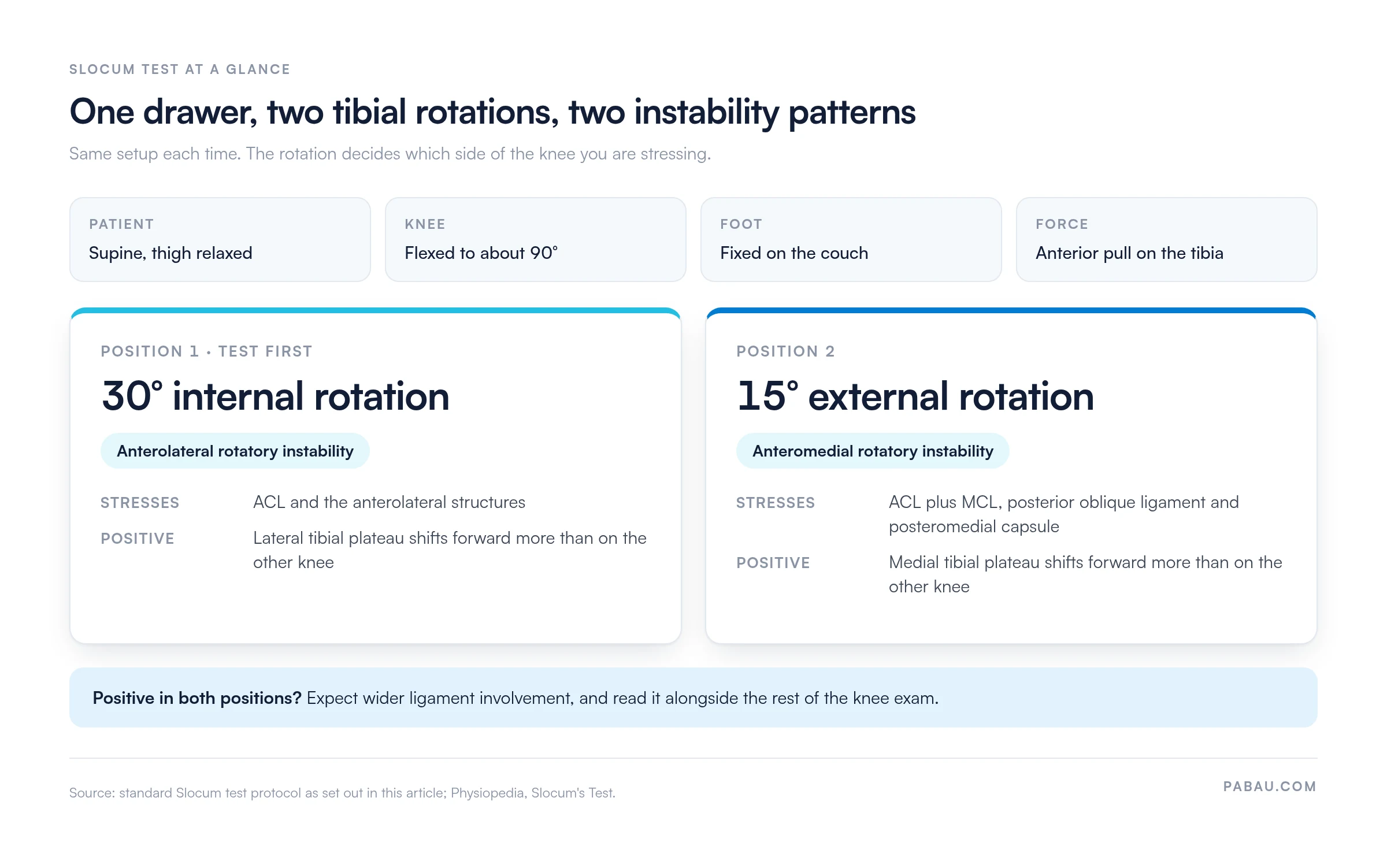
The Slocum test is a knee drawer test performed with the tibia rotated. It checks for rotatory instability, most often after an ACL injury. Slocum and colleagues described it in the 1970s, and it uses two positions. With the knee flexed to about 90 degrees, you pull the tibia forward in 30° internal rotation, then in 15° external rotation.
More forward shift than on the other knee points to anterolateral or anteromedial rotatory instability. That tells you which structures beyond the ACL may be damaged, so it shapes referral and rehab plans. Below, we walk through the setup, how to read each position, the mistakes that skew results and how to write it up.
A one-page form with patient name and date fields, step-by-step test instructions and examiner reminders. It ends with an open notes section for recording your findings on each knee.
Download template
The Slocum test is an anterior drawer performed with the tibia rotated, used to check rotatory knee instability.
Test at 30° internal rotation for anterolateral instability and 15° external rotation for anteromedial instability, with the knee flexed to about 90 degrees.
Hamstring guarding, a sliding foot and over-rotation are common reasons for a false negative.
A positive result supports a diagnosis but does not replace imaging or clinical judgment.
Record the version used, both rotation positions and the side-to-side comparison so results stay comparable over time.
The Slocum test shows whether the knee is unstable in rotation, not only in a straight line. It targets anterolateral rotatory instability (ALRI), where the lateral tibial plateau subluxes forward as the tibia rotates. The external rotation position adds a check for anteromedial rotatory instability (AMRI).
You’d reach for it when an ACL injury is suspected. Once the ACL is compromised, the capsule and collateral structures become key secondary restraints. Rotation shows you which of them are still holding. The test works best as one part of a full knee examination, alongside history, palpation and other ligament tests.
The patient lies supine with the knee flexed to about 90 degrees and the foot fixed on the couch. Many examiners sit lightly on the forefoot to hold it in place. Your hands wrap around the upper tibia, with your thumbs on the joint line.
Keep the force gentle and controlled. Stop if the patient reports sharp pain or marked apprehension, because either can change the result and may call for imaging.
A positive Slocum test means more forward shift than on the uninjured side in that rotation. Clinicians usually grade it by how much extra translation they feel and whether the endpoint is firm or soft.
The table below sets out what each position stresses.
A finding at 30° internal rotation alone points to anterolateral laxity. A finding at 15° external rotation alone points to anteromedial laxity, which involves the medial structures as well as the ACL. Positive results in both positions suggest wider involvement.
The diagram below puts the setup and both positions side by side.
The modified Slocum test is a side-lying, gravity-assisted version of the lateral pivot shift. Despite the name, it is not a side-lying drawer. The patient lies on the unaffected side with the pelvis rotated about 30° backward. The affected knee starts at about 10° of flexion.
You then apply a valgus force while flexing the knee. In a positive test, the subluxed tibia reduces at about 40° of flexion. Gravity does some of the work, which can help with a larger patient. Its diagnostic value is unproven, though, so note which version you used in the record.
False negatives often come from technique as much as from the knee itself. These are the errors worth checking for:
The lateral pivot shift test is a related rotatory test that is widely used to confirm ALRI. It is routinely done with the patient awake. Even so, guarding often limits the awake pivot shift, especially soon after injury. The modified Slocum is itself a pivot shift variant.
The anterior drawer test uses the same 90° knee position with the tibia in neutral. It measures straight anterior translation, while the Slocum test adds rotation. Run them together and you see both the size and the direction of the laxity.
Reliable sensitivity and specificity figures for the Slocum test are hard to find. It has rarely been included in diagnostic accuracy studies, so its clinical value is still debated. Treat it as one test in a battery, and check primary research before quoting any figure.
The Physiopedia entry on Slocum’s test summarizes the procedure and the structures each position stresses.
Patient cooperation, guarding, pain and examiner experience all affect the result. A negative test does not rule out a ligament injury. Equally, a positive test does not confirm a rupture.
If you’re running a broader screen, an orthopedic examination template keeps the Slocum result next to your other findings.
Record the test in the objective section. State the version, the knee tested, both rotation positions and the side-to-side comparison. Then link the finding to your assessment and plan, so the next clinician can follow your reasoning.
Example objective entry: Slocum test, supine, right knee. At 30° internal rotation, increased anterior translation compared with the left, soft endpoint, no pain. At 15° external rotation, symmetrical with the left, firm endpoint. Mild hamstring guarding settled with cueing.
If your team works from shared physical therapy SOAP notes, use the same fields every visit. That makes changes in laxity easy to track across sessions.
In many practices, special test results end up on paper forms or in free-text notes. Each clinician writes them a little differently, so comparing visits means reading between the lines.
Pabau, the practice management platform we build, lets you turn this checklist into a structured clinical note. Pabau Scribe, our AI scribe, is built into the platform and drafts the note from your consultation. Patients can also complete digital forms before the visit, so their injury history is ready when they arrive.
Each result then sits in one patient record, next to appointments and earlier notes. That’s the job of good physical therapy EMR software, so you can see at a glance whether rotatory laxity is improving.

Pabau’s clinical notes, Pabau Scribe and digital forms keep Slocum test findings structured and comparable across visits. Every result lands in one patient record, ready for the next clinician.

The Slocum test earns its place when you run it the same way every time. Get the rotations right, 30° internal and then 15° external, and keep the foot fixed. Always compare against the other knee.
A clear positive tells you which side of the knee needs a closer look, and when to refer. A negative result in a guarded patient deserves a retest, not reassurance. Book a demo to see how Pabau keeps your knee exam findings structured and easy to compare.

Seeing laxity in the opposite direction? Reverse pivot shift test explains the technique, interpretation and accuracy.
Suspect the posterolateral corner? Posterolateral drawer test covers technique, grading and pitfalls.
Worried about the meniscus too? Thessaly test shows how to perform it and avoid false positives.
Tracking function after a knee injury? Knee outcome survey gives you a scored patient-reported measure.
Deciding whether to X-ray? Ottawa knee rules sets out the five criteria and how to apply them.
It is a modification of it. The anterior drawer pulls the tibia forward in neutral rotation. The Slocum test repeats the pull at 30° internal and 15° external rotation to show rotatory instability.
The Lachman test is done at about 20 to 30 degrees of knee flexion. It is widely regarded as the most sensitive clinical test for an ACL tear. The Slocum test adds information about rotation, so many clinicians use both.
A firm endpoint suggests the restraining ligaments are intact or only partly torn. A soft or absent endpoint with extra translation raises suspicion of a complete tear. Confirm it with imaging.
You can, but the result is less reliable. Pain, swelling and guarding often mask laxity in the first days after injury. Many clinicians note the limitation and retest once the swelling settles.