GLP-1 diet plan
A GLP-1 diet plan is a structured eating framework for patients taking semagluti...

2
Last Updated: Oct 13, 2026

A SOAP note records one physical therapy visit in four parts: subjective, objective, assessment, and plan.
The Objective section carries the most weight in a review, because a payer can re-measure what you wrote.
The Assessment section is where you justify skilled therapy, so a thin one invites a denial.
Write the note during the visit or right after it, while the measurements are still in front of you.
Practice management software like Pabau builds the four sections into the client record, so each visit is documented the same way.
A four-part note form with prompts for every section, from pain rating and functional limits through range of motion and muscle grades. It also covers progress toward goals, visit frequency, and home exercise instructions.
Download templateSOAP notes for physical therapy do one job above all others. They show that what happened in the treatment room was skilled care. The format splits a visit into four parts, and each one answers a different question a payer will ask later.
Most claims turn on the Objective section, because measurements are the only part a reviewer can check against your next note. Get that section specific and the rest of the note falls into line.
Below you will find the four sections explained, two filled-in examples, the checks to run before you finalize, and a template to download.
A SOAP note is a structured record of one visit, split into subjective, objective, assessment, and plan. The four letters give every therapist on the team the same order to work in. That consistency is what makes a chart readable months later, and defensible if a payer asks for it.
Dr. Lawrence Weed introduced the format in the 1960s as part of the problem-oriented medical record. It spread from medicine into physical therapy, occupational therapy, and speech-language pathology, and it stayed.
The American Physical Therapy Association points therapists to the format in its defensible documentation guidance. CMS and commercial payers expect the same structure when they request records.
Each letter has its own job. Subjective is what the patient tells you, and Objective is what you measure. Assessment is your reading of those two together. Plan sets out what happens next, and when therapy should end.
Every section answers a different question, and mixing them up is the quickest way to weaken a claim. The table sorts what belongs where, and the walkthrough below adds the detail.
Start with the patient’s own words. Ask what brought them in, where it hurts, what makes it worse, and how it changes their day. Quote them where the wording matters, because “I can’t get up the stairs at work” is more useful than “reports pain with stairs”.
Much of this arrives before the visit if you collect it in advance. A completed physical therapy intake form gives you the history, medications, and pain detail so the session starts with questions rather than paperwork.
Record what you measured, observed, and tested, with numbers attached.
This is the most defensible part of the note, because a reviewer can hold it against your next entry. “Good strength” proves nothing. “Hip abductors 4/5 bilaterally” proves you tested.
Goniometry and manual muscle testing supply the two numbers most notes lean on. Grade consistently, record the side, and use the same position each time so the readings stay comparable.
Say what the findings mean and how the patient is tracking against their goals.
This is the section that justifies skilled therapy, so name the reason the patient cannot progress alone. Link the impairment to the task it blocks, not just to the joint.
Set the frequency, the interventions, and the home program, then say what discharge looks like.
Vague plans are the ones payers question. Write “bridges 3×15 daily” rather than “home exercises”, and put a number on the discharge criteria.
The home program deserves the same specificity as the work you do in the treatment room. A written home exercise program with sets, reps, and frequency also gives you something concrete to review at the next visit.
A payer does not read your note the way a colleague does. A reviewer works through it hunting for four answers, one per section, and the note either supplies them or it does not. Knowing which question belongs to which section changes what you write.
The chart below pairs each question with its section, alongside how long that part usually runs. Objective is the heaviest for a reason. It is the only section a reviewer can verify by comparing two dates.
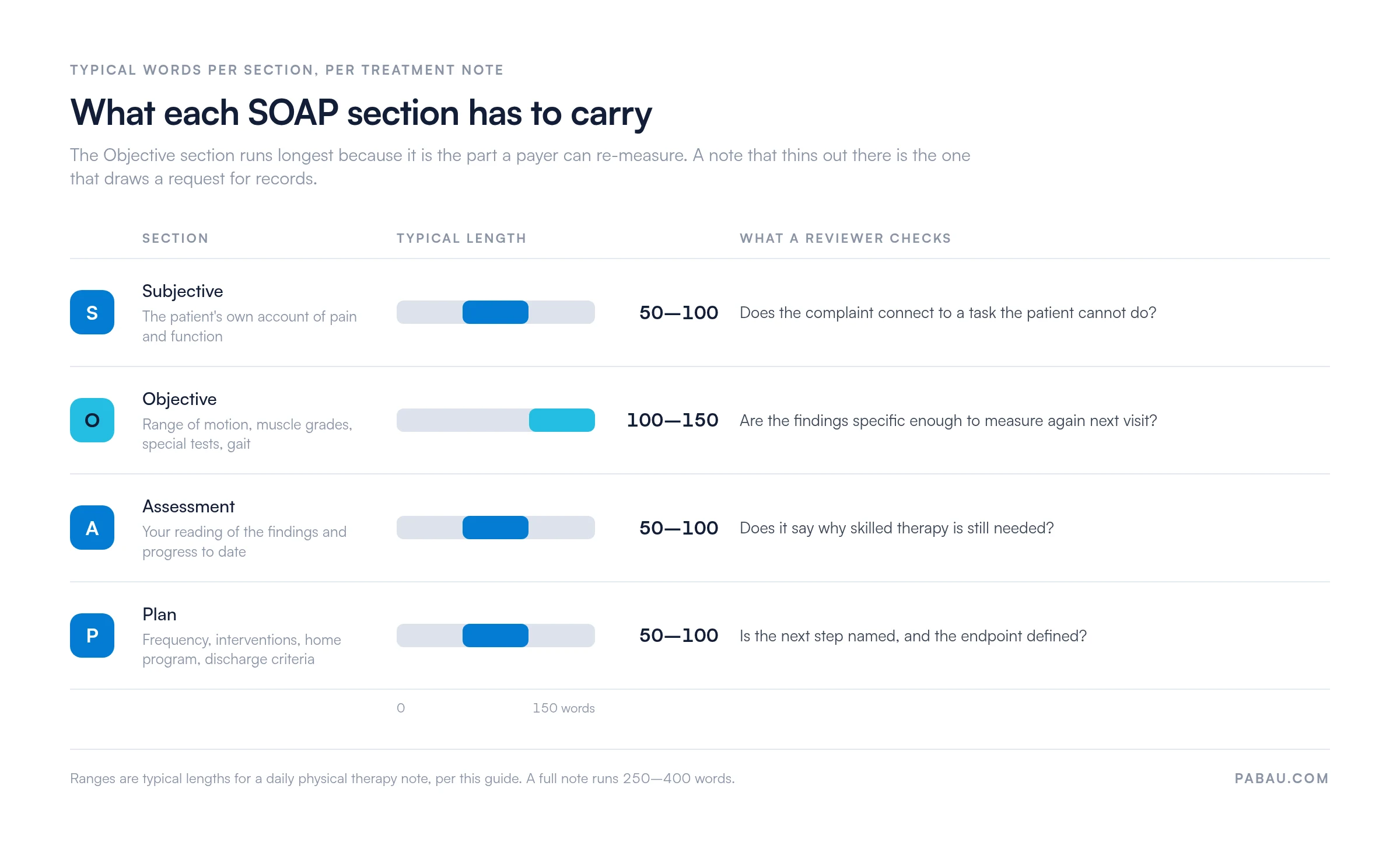
Treat those word counts as guidance rather than a target. A short Objective section on a straightforward follow-up is fine, so long as the numbers in it can be measured again next week.
Reading a filled-in note is faster than reading a rule. Here are two, one acute and one post-surgical, written the way they would appear in a chart.
Notice what the Assessment does in both notes. It never repeats the measurements above it. It says what they mean, and why the patient still needs a therapist rather than a printed handout.
Good documentation is a set of habits rather than a talent. These are the ones that pay off across a full caseload.
Denials rarely come from poor therapy. They come from notes that cannot prove good therapy happened. These are the patterns reviewers pull out most often.
Six questions, worth running before you sign. They catch most of what a reviewer would otherwise catch for you.
The claim rests on the note. Coding, charge capture, and any later appeal all trace back to the wording in the chart. A thin entry costs money weeks after the visit.
That delay is why documentation can feel disconnected from revenue, even though the two move together.
Medicare looks for four elements in the record:
Reviewers then read for internal consistency. Do the Objective findings support the diagnosis? Does the Assessment follow from the data? Does the Plan track progress rather than repeat last week’s? Notes that look identical across sessions get flagged first.
Coding follows the note, so the two are worth reviewing together rather than separately. Our guide to physical therapy billing covers how codes and units line up with what you documented in the chart.
Not only physical therapists. The same four-part structure travels across most of allied health, which is why a therapist moving between settings rarely has to relearn it.
A blank box invites variation, and variation is what audits find. A template holds the order and the prompts steady, whoever is typing.
Write the note during the visit, or immediately after it, rather than hours or days later. Memory fades, and notes reconstructed at the end of the day lack specificity. Reviewers pay particular attention to entries written long after the date of service, because the delay raises questions about accuracy.
In a lot of practices the note lives wherever there is space. That means a paper form, a Word template on a shared drive, or a free-text box that never prompts for a measurement. The format then drifts therapist by therapist, and nobody notices until a payer requests records.
Practice management software like Pabau handles it differently. Clinical note templates hold the four SOAP sections inside the client record, with the fields your practice decides on. The therapist completes them at the point of care, on the same screen as the appointment and the treatment history.
Because the note sits in the record, last visit’s measurements are one scroll away, so comparing progress does not mean hunting through a folder. Pabau Scribe, our AI scribe, can draft the note from the session, leaving you to review and correct rather than type from scratch.
The result is a chart that reads the same whoever wrote it, and one less evening spent catching up. Our software for physical therapists is built around that record, so documentation, scheduling, and billing all read from the same file.

Pabau’s clinical note templates hold the four SOAP sections inside the client record. Your team documents the same way on every visit, and spends less time catching up after hours.

Someone else reads your note on a different day, usually with a claim attached. That is the standard worth writing to. If a stranger can follow your reasoning and measure your findings again, the note has done its job.
Start with the template above, and with one habit. Write the note before you leave the room, while the numbers are fresh and the reasoning is still in your head.
Book a demo to see how Pabau keeps SOAP notes structured, searchable, and ready when a payer asks.

Want your measurements to hold up on review? Range of motion assessment covers how to take and record goniometry readings a reviewer can repeat.
Need a standardized score for the Objective section? The QuickDASH outcome measure gives you an upper-limb score you can track visit to visit.
Documenting under a different scope? Our chiropractic SOAP note template adapts the same four sections for spinal assessment and adjustment records.
Comparing systems to write notes in? Our round-up of physical therapy EMR software weighs the options on documentation, scheduling, and billing.
Less time than writing it later. A note written at the point of care takes a few minutes, because the measurements are still in front of you. Reconstructing one at 7PM takes longer and reads thinner.
Yes. PTAs document the treatment sessions they deliver. The supervising PT still owns the evaluation, the plan of care, and any change to it. Co-signature rules vary by state, so check your practice act.
Use past tense for what happened in the session, and present tense for current status. Write that the patient ambulated 150 feet, and that range of motion remains limited. Pick one convention for the whole team.
Only the ones on your practice’s approved list. ROM, MMT, and HEP are widely understood. Invented shorthand slows down the next therapist, and gives a reviewer a reason to question what you meant.
Write it as a late entry and date it honestly. Never backdate. Record the date of service and the date you wrote it, then stick to what you can still verify from the session.