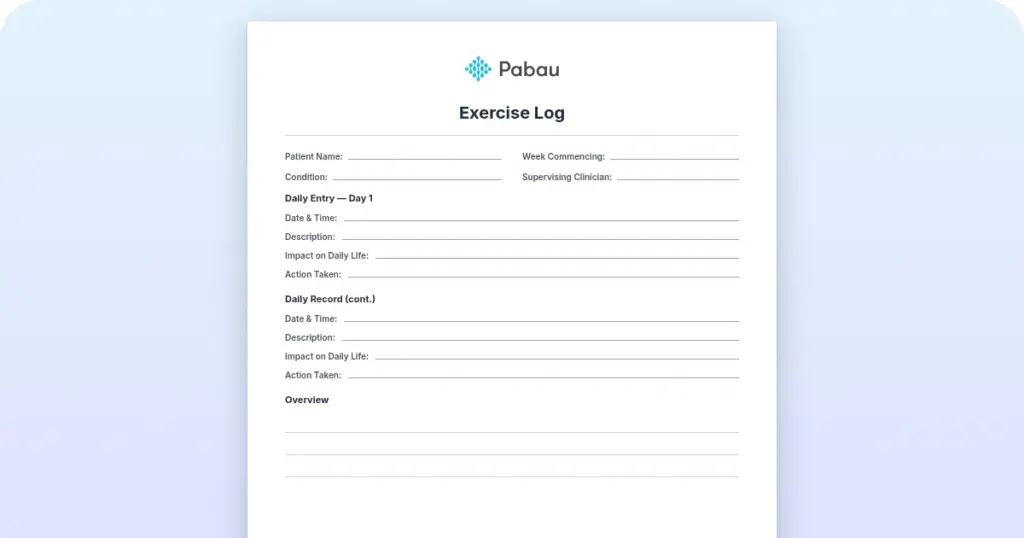
Exercise worksheet to download: What it is and what to record on the worksheet
An exercise worksheet is a structured document that records a patient’s ex...

1
Last Updated: Oct 27, 2026

The lateral pivot shift test detects ACL deficiency by reproducing the subluxation and spontaneous reduction of the lateral tibial plateau.
Awake sensitivity is low at 24 to 48%, but specificity is 97 to 98%, so a positive result carries substantial diagnostic weight.
Grading runs from Grade 0 (no shift) to Grade 3 (gross impaction), and Grade 2 or above often changes the operation.
Lachman’s test screens for ACL injury at around 85% sensitivity, and the pivot shift then confirms how much rotational instability is present.
Practice management software like Pabau records the pivot shift grade, side, and examination context as fixed fields in one auditable note.
Most ACL clinical tests tell you whether the ligament is torn. They do not tell you how much rotational instability came with the tear. That is what makes the lateral pivot shift test irreplaceable.
Introduced by MacIntosh and Galway in 1972, it remains the only widely used clinical test that reproduces what patients describe from the field. The knee gives way under load during cutting or pivoting, and this test recreates that event on the examination table.
Two numbers decide how you use the result. A positive shift is 97 to 98% specific for ACL deficiency, so it rarely misleads you. Awake sensitivity sits at 24 to 48%, so a Grade 0 in clinic proves nothing.
This guide covers the anatomy behind the test, the step-by-step technique, and the grading scale. It then works through the published accuracy figures and how the pivot shift sits alongside the Lachman and anterior drawer tests.
The lateral pivot shift test is a dynamic knee examination that detects anterior cruciate ligament (ACL) deficiency and anterolateral rotatory instability. It works by recreating the event ACL-deficient patients feel when they cut or pivot.
The lateral tibial plateau subluxes anteriorly on the lateral femoral condyle, then spontaneously reduces as the knee flexes. Clinicians usually shorten the name to the pivot shift test. The pivot shift test for ACL injury covers the rotational half of the knee examination, which the Lachman test cannot reach.
That subluxation-and-reduction cycle is what clinicians feel as the characteristic clunk. MacIntosh first described it in 1972, after noticing that patients consistently reported a giving-way sensation during sport. Grading its severity now guides decisions about graft selection and anterolateral ligament (ALL) reconstruction.
The American Academy of Orthopaedic Surgeons (AAOS) treats the pivot shift phenomenon as central to functional ACL instability assessment.
A pivot shift injury is rarely one structure failing on its own. The test loads several at once, and knowing which ones contribute explains why muscle guarding, secondary restraint integrity, and anesthesia change the result.
The clinical implication is straightforward. A Grade 3 shift usually means the ACL and its secondary restraints are both injured. An isolated ACL tear typically produces Grade 1 or Grade 2.
A pivot shift knee examination needs no equipment beyond the examiner’s hands. What it does need is a patient who can stay relaxed. Even mild quadriceps guarding hides a positive finding in an awake patient.
The maneuver combines valgus stress with internal tibial rotation while the knee flexes from full extension through roughly 40 degrees. The Physiotutors clinical reference sets out the pivot shift test knee and hip positions used below, and it stresses complete relaxation in supine.
Place the patient supine on the examination table with the leg fully relaxed. Stand on the side of the knee being tested.
Physiotutors describes the starting position as about 30 degrees of hip flexion with 30 degrees of hip abduction. Add slight internal rotation at the hip, and keep the knee close to full extension.
Wrap the distal hand around the lateral aspect of the proximal tibia, with the heel of the hand just below the fibular head. The proximal hand supports the thigh just above the knee. The distal hand delivers both the valgus force and the internal rotation moment.
Some clinicians instead grasp the calcaneus and rotate the whole leg internally, then apply valgus from behind the fibula. Either grip works, provided the two loads stay on throughout the movement.
Technique consistency matters more here than in most knee assessments. Examiner experience independently predicts sensitivity, and junior clinicians miss Grade 1 findings often. Practicing on cooperative patients with MRI-confirmed ACL tears is the fastest way to build the feel.
A positive pivot shift test means the ACL is deficient and the knee has anterolateral rotatory instability. The clunk or glide during flexion confirms that the lateral tibial plateau subluxed anteriorly, then reduced when the IT band engaged.
A negative result does not rule out ACL injury, especially in an awake, guarding patient. False negatives are far more common than false positives in clinic.
False positives do happen. Posterior horn medial meniscus tears, generalized ligamentous laxity, and unusual lateral compartment anatomy can all produce a shift. Read the result alongside the Lachman test, imaging, and the patient’s history.
The standard pivot shift grading scale runs from Grade 0 to Grade 3. A consistent clinical measurements tracking system lets practitioners benchmark instability over time and compare pre- and post-reconstruction findings. The table below sets out each grade, how it feels, and what it means.
Grade 2 and Grade 3 findings carry higher re-injury rates after isolated ACL reconstruction. Several orthopedic centers now use the grade to decide whether an anterolateral tenodesis or ALL reconstruction should accompany the ACL repair. The scale used here matches the classification in the peer-reviewed pivot shift methodology literature.
Awake, the lateral pivot shift test is 24 to 48% sensitive and 97 to 98% specific for ACL deficiency. That makes it one of the most specific clinical tests available, and one of the least sensitive.
The variable that moves sensitivity most is whether the patient is awake or under general anesthesia. The table below shows how far that single factor shifts the numbers.
These figures appear across several systematic reviews. The most cited is the Benjaminse et al. meta-analysis from 2006, published in the Journal of Orthopaedic & Sports Physical Therapy (JOSPT). It pooled a sensitivity of 24% and a specificity of 98%.
In practice, a positive finding in an awake, cooperative patient is strong evidence of ACL deficiency. A negative one needs care, particularly in acute presentations where hemarthrosis and guarding push reliability down further.
Reverse pivot shift test sensitivity and specificity follow the same shape for the opposite injury pattern. Rubinstein and colleagues reported 26% sensitivity and 95% specificity, so a positive finding again counts for far more than a negative one.
Muscle guarding is the single biggest reason a torn ACL still produces a Grade 0 in clinic. Several other variables push the result in both directions, and sports medicine and musculoskeletal physical therapy clinicians should work through them systematically.
If a patient is too apprehensive to relax during clinic examination, document the attempt and the guarding grade. Arrange examination under anesthesia at the time of arthroscopy. Never report a Grade 0 as a definitive negative if guarding was present throughout.
No single ACL test performs well on every diagnostic dimension. Running the pivot shift alongside the Lachman and anterior drawer tests gives a fuller picture of anterior translation and rotational instability. A physical therapy EMR that records each test result separately keeps that whole pattern visible later.
The anterior drawer test, historically prominent, adds the least in acute presentations. It now mainly cross-checks chronic laxity at 90 degrees of flexion.
Lachman’s test is the better screen, and the pivot shift is the better confirmation. Lachman’s test detects anterior tibial translation at 20 to 30 degrees of flexion with roughly 85% sensitivity, so it catches most ACL tears.
The pivot shift adds the one thing Lachman cannot measure. It shows how much rotational instability the tear left behind.
Run the two in sequence for the highest combined diagnostic confidence. Use Lachman first to decide whether the ACL is torn. Then use the pivot shift to grade what that tear means for surgical planning.
The reverse pivot shift test looks for posterolateral rotatory instability rather than ACL deficiency. It runs the mechanism in the opposite direction. The lateral tibial plateau sits posteriorly subluxed in flexion and reduces as the knee extends toward 20 to 30 degrees.
Order it alongside the lateral pivot shift test when the history points to a hyperextension or dashboard mechanism. Biomechanical work is clear on what a positive result implies. Cutting the PCL alone, or the posterolateral corner alone, does not change the reverse pivot shift.
Only combined injury increases its magnitude. So a positive reverse pivot shift should push you to look for a combined PCL and posterolateral corner injury. Our guide to the reverse pivot shift test covers the technique and accuracy figures in detail.
The lateral pivot shift test earns its place at four separate points in the episode of care, not only at diagnosis. Physical therapists and sports medicine clinicians managing long rehabilitation timelines use it repeatedly. During later rehab stages, the lateral step down test adds a functional read on knee control that complements the pivot shift’s ligamentous findings.
The limitations belong in the clinical note too. The test is not a standalone ACL diagnostic, and it is unreliable in acute presentations with hemarthrosis. A sweep test grades the effusion, so the note shows why a negative shift was read with caution.
It also needs cooperation that pediatric patients and those in severe pain often cannot give. Inter-examiner reliability holds up among experienced clinicians, then falls considerably with less experienced examiners.
The pivot shift says nothing about the meniscus, so add McMurray’s test when a meniscal tear is on the list. The lateral pivot shift test measures ligamentous and rotational instability only.
That distinction matters because the two injuries travel together. Ramp lesions of the medial meniscus posterior horn commonly accompany ACL tears. A posterior horn tear can also produce a false positive shift on its own.
McMurray’s test pools at roughly 61 to 70% sensitivity and 71 to 79% specificity across meta-analyses, so pair it with joint line palpation. Record both results separately, because a knee can be rotationally unstable and mechanically blocked at the same time.
A pivot shift entry that reads positive and nothing else is unusable three months later. Incomplete recording is a medicolegal exposure, and it makes serial comparison impossible.
Referral letters, insurance correspondence, and return-to-sport sign-off all depend on what you wrote at the first visit. A complete entry records five things.
A SOAP note structure puts the pivot shift result in the objective section and the interpretation in the assessment section. Safer clinical note-writing principles for musculoskeletal assessment cut the ambiguity that makes downstream care harder.
Practices running higher volumes of orthopedic assessments get more from digital assessment forms with standardized fields for each special test. Grading dropdowns and side selectors remove the free-text variability that makes audit and outcome tracking painful.
Pabau’s structured client record captures pivot shift grade, laterality, and examination context in consistent, searchable fields. Post-reconstruction comparisons and return-to-sport sign-offs then rest on recorded data rather than memory.
Practices with rotating clinicians, common in sports medicine settings, gain the most from that standardization.

Building one standard orthopedic assessment template pays off fast. Include the pivot shift, Lachman, and anterior drawer tests alongside your functional measures, so nothing is missed at first presentation or at follow-up.
For anyone opening a physical therapy practice, that template is worth writing before the first patient arrives. Physical therapy practice management software holds it and the audit trail in one place.
Most regulators require contemporaneous, legible, and complete records of assessment findings, special tests included. Timestamped digital entries meet that standard more reliably than handwriting, and they still make sense to an auditor years later.

Pabau captures pivot shift grade, side, and examination context as structured fields in the client record. Serial comparisons and return-to-sport sign-offs then stay grounded in recorded data.

The lateral pivot shift test is worth trusting when it is positive and worth discounting when it is negative. Its specificity is near-unmatched, its awake sensitivity is poor, and both facts should shape how you write the result down.
The grade is where the clinical value sits. No other clinical test gives you that. It can change the operation from a standard reconstruction to a reconstruction plus anterolateral stabilization.
One thing is worth remembering. A Grade 0 recorded in clinic on a guarding patient proves nothing, so write down the guarding as well as the grade.
Pair the pivot shift with Lachman’s test and a careful history, and you have the most complete ACL assessment available without imaging. Capturing that data consistently is the harder half of the job. Book a demo to see how Pabau supports sports medicine and physical therapy practices.

Need standardized orthopedic intake documentation? Chiropractic intake form template provides a structured starting point for musculoskeletal assessment documentation that adapts to sports medicine workflows.
Need a template to score it? Anterior drawer test template walks through grading tibial displacement 0-3+ and includes a free template for recording your findings.
Want to strengthen your physical therapy compliance records? Physical therapy clinic requirements outlines the documentation and operational standards physical therapy practices need to meet.
Looking for software built for multi-clinician musculoskeletal practices? Chiropractic software from Pabau covers appointment management, clinical notes, and outcome tracking for hands-on practice disciplines.
The lateral pivot shift test detects ACL deficiency and anterolateral rotatory instability. It reproduces the subluxation and reduction of the lateral tibial plateau on the lateral femoral condyle. That confirms the giving-way sensation ACL-deficient patients describe during sport. Clinicians also use it to grade rotational instability and to assess post-reconstruction outcomes.
A positive pivot shift test, meaning a palpable clunk or glide during knee flexion, indicates ACL deficiency with anterolateral rotatory instability. The finding is highly specific at 97 to 98%. A positive result in an awake, cooperative patient is therefore strong evidence of ACL injury. A negative result does not rule out a tear, particularly when the patient is guarding.
The Lachman test measures anterior tibial translation at 20 to 30 degrees of flexion, with roughly 85% sensitivity. That makes it the better screen. The pivot shift measures rotational instability by reproducing the subluxation-and-reduction event, with far higher specificity (97-98%) and lower awake sensitivity (24-48%). The two are complementary. Screen with the Lachman first, then use the pivot shift to characterize how much rotational instability is present.
General anesthesia eliminates muscle guarding completely. In an awake patient, quadriceps co-contraction stabilizes the tibia and prevents the subluxation event even when the ACL is torn. Under anesthesia, sensitivity rises substantially while specificity stays around 98%. That makes examination under anesthesia (EUA) before arthroscopy the most accurate setting for grading.
The pivot shift test was first described by David MacIntosh and Robert Galway in 1972. MacIntosh noticed that patients with ACL tears reported a giving-way sensation during athletic activity. He developed the test to reproduce that subluxation-reduction event clinically. The test is sometimes called the MacIntosh test in recognition of its origin.
Grade 2 (clunk) and Grade 3 (gross or impaction) findings generally prompt a surgical discussion, particularly in active patients. Grade 2 results frequently guide the decision to augment ACL reconstruction with anterolateral tenodesis or ALL reconstruction. Grade 3 suggests combined ligament injury requiring comprehensive planning. Grade 1 findings in lower-demand patients may be managed conservatively with physical therapy, depending on functional status and patient goals.