Monika Lazarevska

Modified Rankin Scale
What is the modified Rankin Scale used for? Clinicians use the modified Rankin S...

3
Last Updated: Nov 3, 2026
Free PDF 2 pages, print-ready Clinician-reviewed
A 4 day exercise plan spreads training across four sessions a week and leaves three days for recovery. Most plans use an upper/lower, push/pull/legs/upper or full-body split. That rhythm suits rehab patients and general fitness goals alike, because each muscle group gets worked with rest in between. The CDC recommends muscle-strengthening activities on at least two days a week, so four sessions clears that bar with room to progress.
This free template records the agreed goals, the actions and who owns them, the support in place, warning signs and each review. The split options in this guide are a reference for filling it in.
A two-page plan with patient details, up to five goals with measures and target dates, and seven actions with an owner and review date. It closes with a support checklist, warning signs and contacts, a five-row review record and signature lines.
Start from scratch, or upload this PDF or any form you already use, and Pabau's AI Form rebuilds it with tick boxes, text fields and a signature. Attach it to the treatment once, and every patient gets it on time.
AI Form rebuilds the consent, history and aftercare forms you already use. You review each one, then publish.
Patients complete forms on their phone before they arrive, so the front desk stops retyping paper.
Every signed form is versioned and attached to the treatment record, ready when you need it.
Set how long a consent stays valid. Returning patients skip forms they have already signed.
Supports HIPAA and GDPR compliance AES-256 encryption 4.8 on G2 4.7 on Capterra Trusted by 4,000+ practices worldwide

A 4 day exercise plan spreads training across four weekly sessions with three recovery days, which suits both rehab and general fitness goals.
The three common splits are upper/lower twice, push/pull/legs/upper, and full body four times, and the goal decides which one fits.
Progression works best in a fixed order: add reps first, then load in small steps, and change exercises only after six to eight weeks.
The template records goals, actions and owners, support, warning signs and reviews, while the split options in this guide serve as reference.
Record the reason for every load change in the review record, so the next practitioner can see why the plan moved on.
A 4 day exercise plan is a weekly training program built around four sessions, each aimed at set muscle groups or movement patterns. The other three days are for recovery, placed between or after sessions so tissue has time to repair.
For a physical therapist, it’s a way to move a patient from early rehab toward full activity in planned steps. For a personal trainer working on referral, it’s a shared record of what was agreed, what got done and what changes next.
Four days comfortably exceeds the CDC’s minimum of two strength days a week. It also leaves room to rest each muscle group before you train it again. The template doesn’t prescribe exercises, though, so start with what goes in each part of it.
The PDF is a two-page goals-and-actions plan, not a session-by-session training log. You write the split and starting loads into its goal and action fields, then track how it’s going in the review record.
Here’s how each part works in practice.
Any practice that prescribes exercise and needs to show what was agreed will get use out of it. These are the settings where it earns its place fastest.
A verbal plan is gone by the time the patient reaches the parking lot. A written one keeps paying off at every review.
Record the reason for each change in the review record, not only the new load. ‘Squat raised from 30 kg to 32.5 kg after 3 x 12 with good form in sessions 3 and 4’ is a defensible note. ‘Increased load’ is not.
With the paperwork settled, the next decision is how to divide the four training days.
The split is the biggest design choice in a four-day week. Upper/lower suits most beginners and strength goals, push/pull/legs/upper suits muscle growth, and full body suits early rehab.
Push / Pull / Legs / Upper
Day structure
Chest/shoulders/triceps, back/biceps, lower body, upper body repeat
Best for
Muscle growth, intermediate lifters
Weekly sessions per muscle group
1-2x depending on grouping
Upper / Lower x2
Day structure
Upper body, lower body, upper body, lower body
Best for
Strength gains, beginners to intermediate
Weekly sessions per muscle group
2x for all major groups
Full body x4
Day structure
Whole-body compound movements each session
Best for
Rehabilitation, beginners, general fitness
Weekly sessions per muscle group
4x at lower volume per session
In early rehab, full body x4 is often the best fit because it trains movement patterns that mirror daily activity. As capacity improves, a switch to upper/lower or push/pull/legs/upper adds specificity and load.
Beginners do best on the upper/lower split, with two or three working sets per exercise instead of four. The aim in the first weeks is control of each movement, not volume.
For a first load, the ACSM position stand suggests roughly 60-70% of one-rep max for 8-12 reps in novices. Rehab patients start lighter, at a weight they can move with control and without a symptom flare.
Here’s what a sensible first week looks like on that split.
3 x 10-12sets x reps
3 x 10-12sets x reps
3 x 10-12sets x reps
3 x 10-12sets x reps
Wednesday, Saturday and Sunday are rest or active recovery days. Resist adding sessions in weeks two and three, because finishing all four planned sessions matters more early on. For patients who want to train five days, our five-day beginner plan lays out that week.
Progressive overload is what keeps the plan working past the first few weeks. Without it, four sessions a week maintain fitness rather than build it.
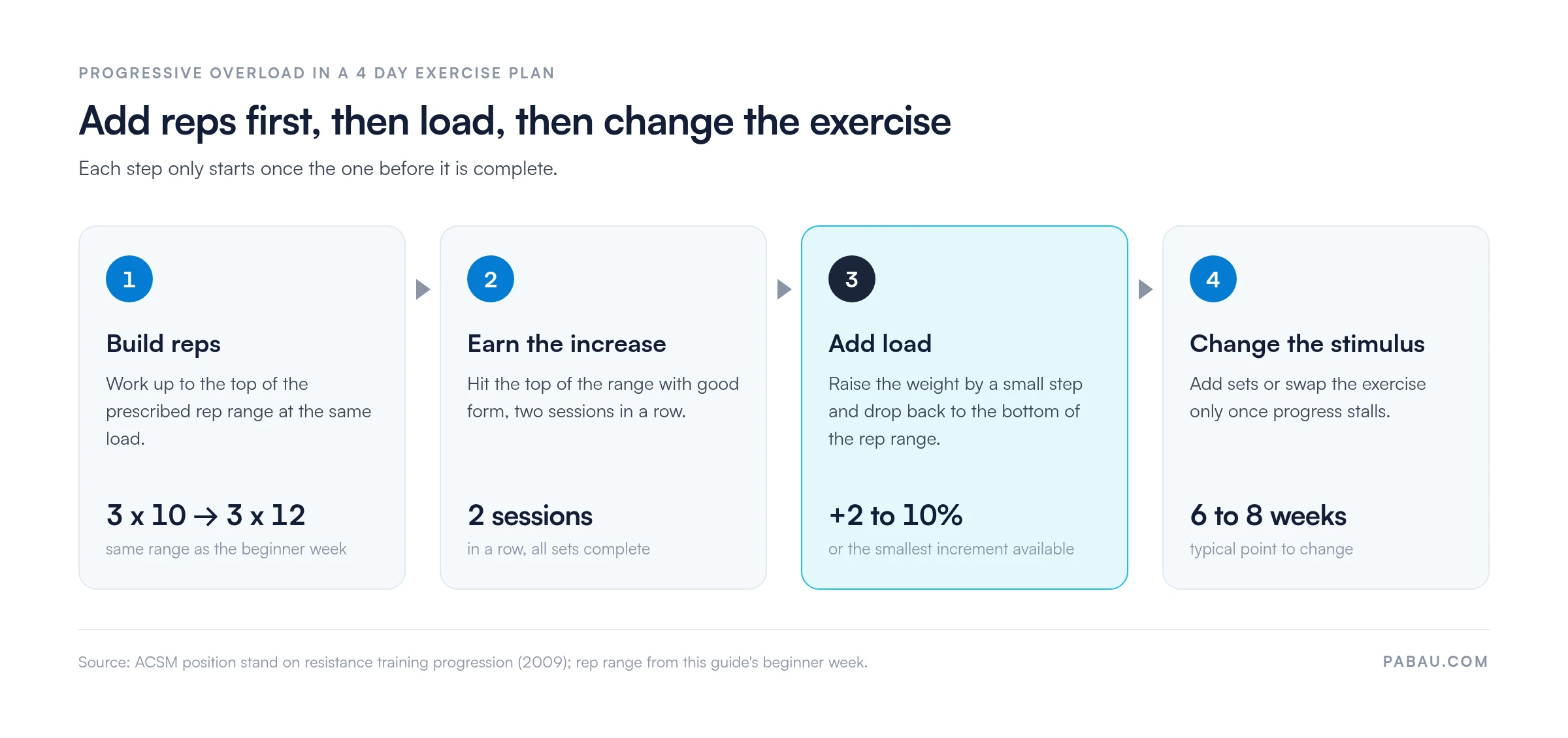
Apply it in a fixed order. Add reps first, so the beginner week’s 3 x 10-12 reaches 3 x 12 before the weight changes. Once the top of the range holds for two sessions in a row, it’s time to add weight. Then drop back to the bottom of the rep range.
Raise the load by the smallest increment available, or roughly 2-10%, the range the ACSM position stand suggests. On a 30 kg squat, a 2.5 kg step is about 8%. A fixed 5 kg jump is too big for light lifts, since it adds about 40% to a 12 kg goblet squat.
Change sets or exercises only when progress stalls, typically after six to eight weeks. The four steps run in this sequence.
Pabau’s measurements tracking software lets you log the figures at each visit and see the trend across the program. For rehab patients, that trend supports a discharge decision or a handover to community fitness.
Rest days are when training turns into progress. Muscle protein synthesis stays elevated for roughly 24-48 hours after a resistance session, so too little recovery between sessions limits results.
What a good rest day looks like depends on the training phase.
Patients who also follow a home exercise program can use rest days for its lighter drills.
Pabau’s pre and post-care software can send rest-day guidance as scheduled messages. Patients get the reminder, and your team skips the follow-up call.
Stalled plans usually trace back to a handful of habits, and each one is easy to spot at a review.
Training the same muscles on back-to-back days. The second session starts tired.
Alternate upper and lower days.
Adding load before the reps are there. Form slips first, and rehab patients often feel it as a flare-up.
Hold the load until the top of the rep range holds for two sessions in a row.
Writing vague goals. “Feel stronger” can’t be reviewed.
Give each goal a number and a date.
Skipping reviews. A plan nobody reviews drifts away from the patient’s progress, and the review record stays empty.
Fill in the review record at every check-in.
Doubling up after a missed session. Two sessions get crammed into one.
Push the week back a day instead.
In many practices, the exercise plan lives on paper or in a PDF sent by email. By the next review it’s in a drawer, and the notes about what changed sit somewhere else.
Pabau’s digital forms let you turn a plan like this into a form that’s assigned at the visit and saved to the patient record. Anyone who opens the record sees the current goals, the actions and the review history.
Pabau Scribe, our AI medical scribe, drafts the note from your review conversation, so there’s less typing between sessions. That counts most for busy practices running a physical therapy EMR, where documentation piles up fast.

Pabau stores exercise plans, review notes and measurements on the patient record, so every practitioner works from the same version between sessions.

A 4 day exercise plan rarely fails on exercise choice. It fails when nobody writes down the goal, the load or the reason it changed, so the next review starts from memory.
So pick the split that fits the goal, start lighter than you think, and progress in order. Then use the template to agree goals, owners and warning signs, and book the first review before the patient leaves.
The cost is a few minutes of paperwork per review. In return, you get a plan any colleague can pick up and defend. Book a demo to see how Pabau keeps exercise plans and reviews on one patient record.

Need a simpler log for each session? Exercise worksheet explains what to record for each exercise a patient completes.
Planning a longer training block? 6 week exercise plan lays out a program across a six-week cycle.
Want sessions built around the big lifts? Compound exercise workout plan covers how compound movements build strength and muscle.
Working with runners? Strength training plan for runners is a free template for adding strength work around running.
Choosing software for your therapy team? Physiotherapy practice management software compares the leading tools for therapy practices.
Yes. Dumbbells, a bench and resistance bands cover most of an upper/lower split. Swap machine moves for free-weight versions, such as goblet squats for the leg press and band pulldowns for the lat pulldown.
It helps, because strength training protects muscle while you eat in a calorie deficit. Pair it with aerobic activity, since the CDC recommends 150 minutes of moderate activity a week alongside two strength days.
Many can, once they’ve built a base. CDC guidance for adults 65 and older adds balance work to the same two-day strength minimum. Start with lower-volume full-body sessions and review progress before adding days.
Most sessions run 45-60 minutes, including a 5-10 minute warm-up. Weekly volume matters more than session length, so a focused 45 minutes is enough for most beginners.
Yes, as long as the two days work different muscles. Upper then lower works well back to back. Avoid two lower-body days in a row, because the second one starts on tired legs.