GLP-1 diet plan
A GLP-1 diet plan is a structured eating framework for patients taking semagluti...

2
Last Updated: Oct 13, 2026

The Ottawa knee rules are five criteria that decide whether an acute knee injury needs an x-ray, and any single positive criterion means imaging.
Sensitivity approaches 100% for clinically significant fractures, while specificity sits near 49%, because the rule is built to miss no fracture.
The rule was derived in adults and later validated in children, and it is most reliable above age 5.
A negative result does not exclude ligament, meniscal or other soft tissue injury, so the examination continues either way.
Recording which criterion was tested, not just the outcome, is what makes a negative result defensible if the patient re-presents.
The Ottawa knee rules are a validated clinical decision tool that determines which patients with acute knee injuries need an x-ray to exclude a fracture.
Stiell et al. first published them in 1995 at the Ottawa Civic and General Hospitals in Canada.
According to the Royal Australian College of General Practitioners, the rules have a sensitivity approaching 100% for clinically significant fractures. A negative result can therefore spare the patient an unnecessary x-ray. This guide covers the five criteria, step-by-step application, accuracy data, a comparison with the Pittsburgh knee rules, and the rule’s limitations.
The Ottawa knee rules state that a knee x-ray series is required when a patient presents with any one of five criteria following acute injury. Each criterion is binary, so it is either present or absent. A single positive finding is enough to indicate imaging.
Two criteria need a note on clinical precision. Isolated patella tenderness requires that no bony tenderness exists elsewhere. If tenderness is diffuse across the joint, this criterion does not apply in isolation.
Weight-bearing ability is assessed at two moments. Check it immediately after the injury, from the history, and again when the patient arrives at the practice. A patient who limps through four steps still meets the weight-bearing threshold. One who cannot complete four steps at either point does not.
Applying the Ottawa knee rules takes roughly two minutes when the assessment sequence is clear. NICE Clinical Knowledge Summaries carry a dedicated page on the Ottawa knee rule. It covers patients over 2 years old who present with acute knee pain, swelling, or tenderness after trauma.
A negative result does not rule out all pathology. Soft tissue injuries, ligament damage, and meniscal tears sit outside the scope of the rule. Clinical judgment remains essential when the examination suggests significant joint injury despite a negative assessment.
Where imaging is deferred but the knee stays symptomatic, rehabilitation planning takes over from triage. A graded return-to-running protocol gives the patient a structured route back to activity without guesswork about load.
Physical therapy teams should document each step of the assessment, including the weight-bearing result, the flexion range, and the palpation findings. Purpose-built physical therapy EMR software holds those fields in one structured note instead of scattering them through free text.
That record is auditable, and it supports both clinical continuity and medico-legal defensibility. Structured documentation also shows when a clinician applied the rule but overrode a negative result on judgment. Free-text notes rarely preserve that detail.
Document the assessment outcome AND the specific criterion tested. A note reading ‘Ottawa knee rules applied, negative’ gives no information if the patient re-presents. Record whether weight-bearing was tested at both time points, the degree of flexion achieved, and which anatomical points were palpated.
The Ottawa knee rules were designed as a high-sensitivity rule. The priority is missing no fracture, even at the cost of some unnecessary imaging. The headline figures, drawn from multiple validation studies, reflect that design intention.
Low specificity is the price of that safety margin. A decision rule built to clear patients without imaging only works if it misses essentially no fracture. Roughly half of the patients with a positive result will therefore have a normal x-ray, and the rule’s derivation accepts that openly.
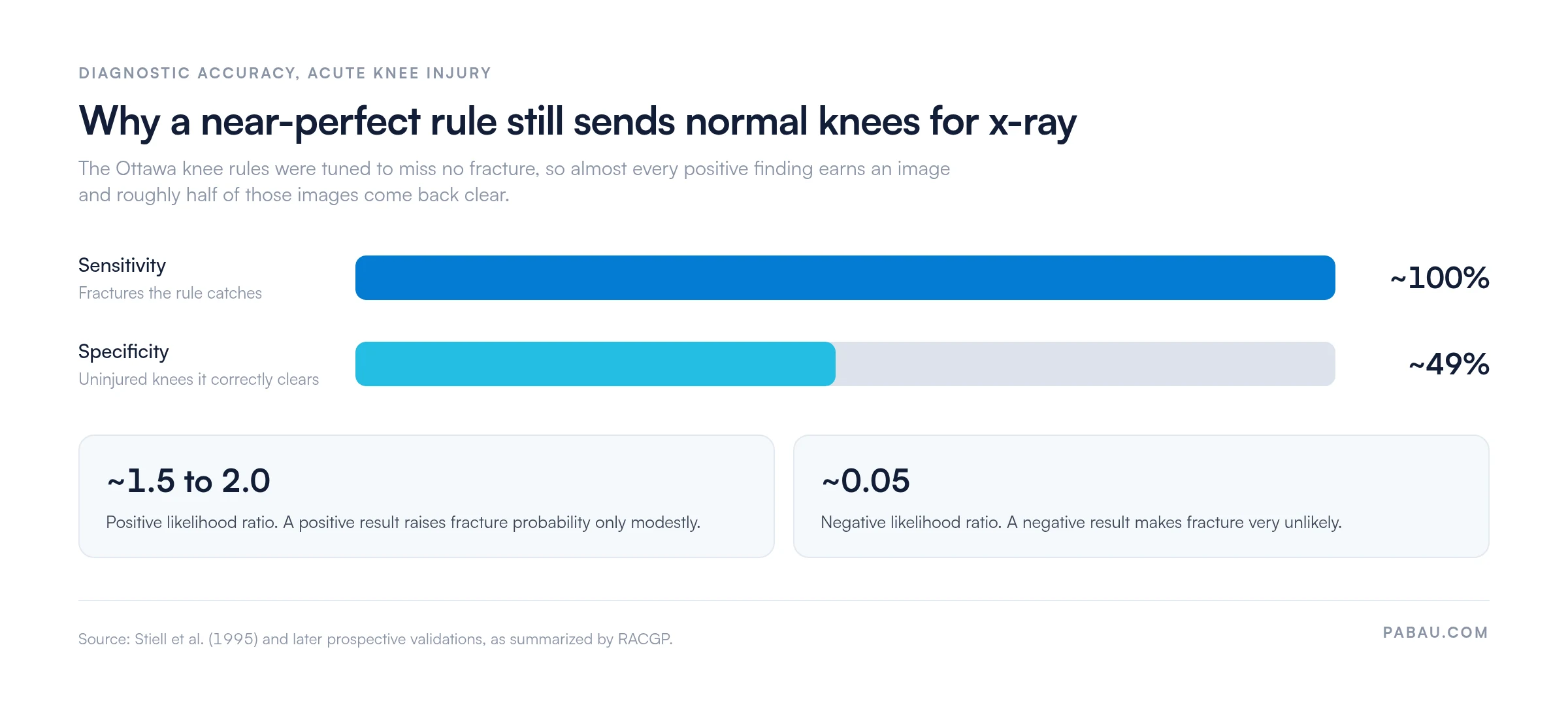
Multiple prospective validation studies, including those referenced by RACGP Australian Family Physician, have confirmed sensitivity approaching 100% across different settings and populations. The rule holds up in both emergency department and primary care contexts.
That breadth supports its use wherever physical therapists and GPs see acute knee injuries. Practices running sports medicine software can apply the same validated threshold whether the setting is secondary or primary care.
The Pittsburgh knee rules are the main clinical alternative to the Ottawa knee rules for triaging acute knee injuries toward imaging. The two tools share the same goal, but they use different criteria and produce different sensitivity-specificity trade-offs.
The Ottawa rules are more widely adopted in primary care and physical therapy triage because they need no information about the mechanism of injury. That history is not always reliable in the acute setting. The Pittsburgh rules offer higher specificity, which cuts unnecessary imaging in emergency departments where mechanism data is more consistently available.
Neither rule is definitively superior. The choice depends on the clinical context and the protocols the setting already follows. Our Pittsburgh knee rules template sets out those two criteria in a form you can file with the consultation note.
The Ottawa knee rules are reliable in the populations they were derived from, but several clinical scenarios fall outside those boundaries. Applying the rule without accounting for these limits risks both false reassurance and inappropriate imaging deferral.
A complete Ottawa knee rule record also notes whether the patient could cooperate with weight-bearing and flexion testing. Without that line, a negative finding is hard to defend if a fracture turns up later.
Clinical decision rules only reduce clinical and medico-legal risk when the application is documented as rigorously as the decision itself. A practitioner who correctly applies the Ottawa knee rules but records only “no x-ray required” has left the reasoning invisible.
Practice management software like Pabau captures structured assessment data at the point of consultation, decision-rule criteria included. Each criterion is recorded as a discrete field rather than buried in narrative text, so the finding stays searchable and auditable. The patient record then holds a timestamped, practitioner-attributed log of every assessment.

Build an Ottawa knee rule template directly in Pabau’s digital forms. Add five checkboxes, one per criterion, plus a weight-bearing notes field, a flexion measurement field, and a clinical outcome dropdown. Every practitioner in the team then follows the same documented process, and the completed form attaches automatically to the patient record.
For practices working through physical therapy compliance requirements, structured documentation of clinical decision tools is part of routine governance. When referral thresholds, protocols, and assessment findings are captured consistently across a team, audit preparation takes hours rather than days.

Pabau gives physical therapy and sports medicine practices structured digital forms and patient records. Assessments like the Ottawa knee rules are captured consistently, and they stay searchable and audit-ready.

Take one habit into your next acute knee assessment. Running the five criteria is quick. Recording which ones you tested, and what each one showed, is what protects the decision months later when the patient re-presents.
The trade-off worth remembering is the one the rule was built around. Roughly half the patients you send for imaging will come back with a normal film, and that is the intended cost of missing no fracture. Deferring an x-ray on a negative result is defensible only when the assessment behind it is on the record.
Standardizing that record across every practitioner is more a software problem than a clinical one. Book a demo to see how Pabau turns a decision rule into a structured, searchable part of the patient note.

Need the ankle equivalent of this rule? Ottawa ankle rules calculator walks through the ankle criteria and how they differ from the knee rule.
Want the two-criterion alternative on file? Pittsburgh knee rules template gives you the Pittsburgh criteria in a form you can attach to the consultation note.
Tracking knee function after the imaging decision? Knee outcome survey scores symptoms and daily function, so you can show change across a course of treatment.
Cleared the fracture but suspect a meniscal tear? Meniscus rehab exercises handout gives the patient a staged home program to take away.
The Ottawa knee rules are a set of five validated clinical criteria for acute knee injury. They determine whether a patient requires x-ray imaging to exclude a fracture. Stiell et al. developed them in 1995. They are widely used in emergency medicine, primary care, and physical therapy because a negative result reliably rules out clinically significant fractures. Sensitivity approaches 100%.
Apply the Ottawa knee rules to patients over 2 years old with acute knee pain, swelling, or tenderness after trauma. The injury should be within the past seven days. Do not apply the rule to patients who are intoxicated, have altered consciousness, or have a distracting injury elsewhere. In children under 5, use it with caution alongside independent clinical assessment.
The Ottawa knee rules use five criteria and require no knowledge of injury mechanism. The Pittsburgh knee rules use two criteria and require blunt trauma or a fall as the mechanism. Ottawa rules have higher sensitivity (approaching 100%); Pittsburgh rules have higher specificity (around 60%), meaning fewer unnecessary x-rays in settings where mechanism data is reliable.
Yes, with an age caveat. Bulloch et al. (2003) prospectively validated the rule in 750 children aged 2 to 16 and reported 100% sensitivity. The authors concluded it is reliably valid in children older than 5, because the 2-to-5 subgroup was small and less consistently assessed. Below age 5, use the rule alongside independent clinical assessment rather than as the sole decision tool, and stay alert to physeal injuries.
Key limitations include reduced certainty in children under 5 and unreliable results in intoxicated or unconscious patients. It also does not apply when a distracting injury prevents reliable assessment, or to subacute and chronic presentations. The rule also does not exclude soft tissue injuries such as ligament tears or meniscal damage.
Weight-bearing is assessed by asking the patient to take four steps on the injured limb. Limping is permitted. The criterion is met only when the patient cannot complete four steps at all. This assessment is done at both the time of injury (from history) and at the point of clinical assessment. A patient who completes four steps even with difficulty does not meet this criterion.
The Ottawa ankle and knee rules share the same decision-rule framework but use different anatomical criteria. The ankle rules assess tenderness over the medial and lateral malleolus and the base of the fifth metatarsal, plus weight-bearing ability. The knee rules assess age, patella tenderness, fibula head tenderness, flexion ability, and weight-bearing. The two rule sets are applied independently to their respective anatomical regions following acute trauma.