PCS pain catastrophizing scale: Scoring, cutoffs, and free template
The PCS pain catastrophizing scale is a 13-item self-report questionnaire that m...

3
Last Updated: Oct 15, 2026
An orthopedic examination is a structured physical assessment of the bones, joints, muscles, ligaments, and tendons that finds the source of pain or lost movement. It runs in six stages: history, observation and gait, range of motion, neurological and vascular checks, special tests, and a diagnosis with a plan.
This free template gives each stage its own section, so every clinician records findings in the same place. Use it on paper, or as the blueprint for a digital form in your practice.
A six-section form that follows the examination from history and chief complaint through to diagnosis and follow-up. It has fields for gait, active and passive range of motion, neurological and vascular checks, and special tests by region.
Download template
An orthopedic examination assesses bones, joints, muscles, ligaments, and tendons in a fixed sequence of six stages.
Record history, observation, range of motion, neurological checks, and special tests in separate fields.
Special tests support a diagnosis but do not establish one on their own.
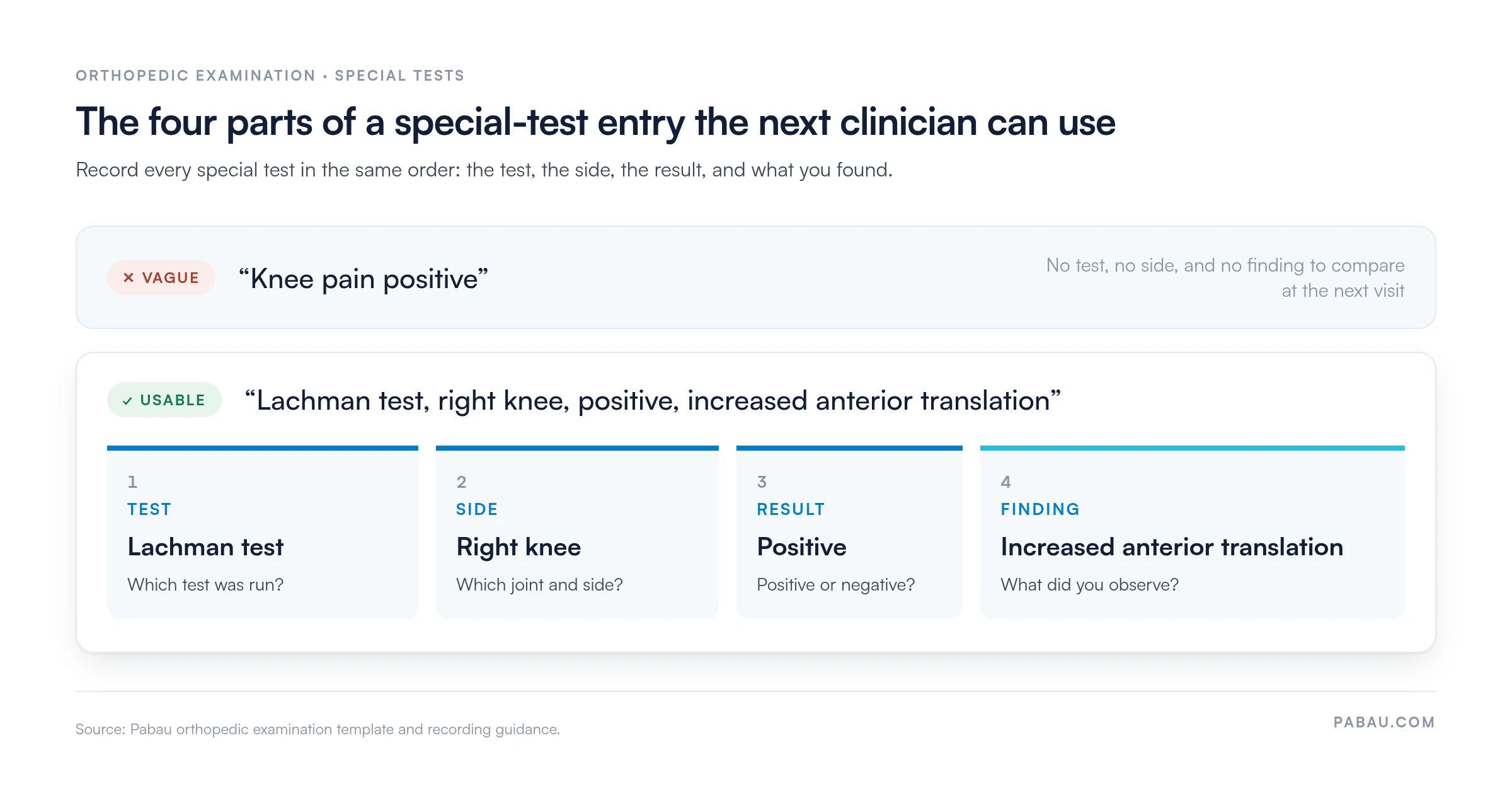
A usable special-test entry names the test, the side, the result, and the finding.
Practice software such as Pabau can turn the template into a digital form, so every clinician fills in the same fields.
An orthopedic examination is a systematic physical assessment of the musculoskeletal system. It establishes whether a patient’s pain, swelling, or movement loss comes from a joint, muscle, ligament, tendon, or nerve.
Orthopedic surgeons, physical therapists, chiropractors, and osteopaths all use this structure, though the depth varies by setting. A surgical referral typically needs a fuller examination than a routine physical therapy review.
The template follows the order most clinicians already work in. Each section maps to one stage of the examination, so you can complete the form during the appointment or straight after it.
Print it if your practice still works on paper. If you’re moving to digital records, use it as the checklist for building your own form.
The form records what you find. Interpreting those findings stays with the examining clinician.
Keeping the same order at every visit makes findings easier to compare over time. When each section has a fixed place, an empty field stands out before the patient leaves.
Two stages often need more room than a single line allows. A postural assessment template records front, side, and back views. Our guide to range of motion assessment explains how to measure and record each joint’s movement.
Special tests help narrow the differential diagnosis, but they are not conclusive alone. Positive findings should always be interpreted alongside history, observation, and imaging where indicated.
The Lachman test is widely used when an anterior cruciate ligament (ACL) injury is suspected. Our knee examination guide sets out the four stages of a knee assessment and which tests to trust.
Shoulder and hip complaints follow the same pattern. The shoulder exam guide covers technique and special tests step by step, and the hip examination guide does the same for the hip.
Good documentation separates what the patient reports from what the clinician observes. It also links the working diagnosis to the findings that support it.
Special tests are where vague notes cause the most trouble at the next visit, as the breakdown below shows.
Record the test name, the side examined, and the result in the same format every time. Vague entries like ‘knee pain positive’ are hard to use later. A line such as ‘Lachman test, right knee, positive, increased anterior translation’ gives the next clinician something to act on.
If you record a diagnosis code, check it against the current ICD-10-CM code set before you submit the claim. Notes kept in a structured system are easier to search and to audit.
Sports medicine, physical therapy, chiropractic, and osteopathic practices all use structured examination records, as do orthopedic surgery teams. Each setting keeps the same core fields but adjusts how many special tests it records.
In a physical therapy setting, the examination is usually the first of many visits. Physical therapy practice software keeps the form, the progress notes, and the treatment plan in one patient record.
A fixed template reduces the chance that a clinician skips a region or a test. Consistent records also make handovers smoother when a patient moves between practitioners.
Structured fields make the record easier to audit. When each finding is tied to a named test and result, a reviewer can follow the reasoning behind the treatment plan.
On paper, the examination form lives in a folder and the history questionnaire arrives on a clipboard in the waiting room. Comparing this visit with the last one means finding both sheets.
Pabau, the practice management platform we build, sends digital forms before the appointment, so the clinician starts with the patient’s own account. The answers flow into Pabau’s medical records, where examination notes sit with the rest of the patient’s history.
You can set up a note template that mirrors the six sections of this form, so every clinician records findings in the same fields. Pabau doesn’t interpret findings or make diagnoses, and clinical judgment stays with the practitioner.

See how structured clinical forms and notes keep examination findings consistent across your team.

An orthopedic examination is only as useful as the record it leaves behind. Pick one template, keep the same section order at every visit, and write each special test as test, side, result, and finding.
The payoff comes at the follow-up and the handover, when a colleague can compare findings without calling you. The cost is a few extra seconds per test, which is far less than repeating an examination.
Book a demo to see how Pabau turns this form into a digital template your whole team fills in the same way.

Recording reflexes in the neurological stage? Deep tendon reflex exam gives you a template for grading and documenting each reflex.
Need a fuller neurological screen? Cranial nerve examination checklist walks through the cranial nerves in a set order.
Measuring hip movement? Hip range of motion test sets out normal values alongside a free recording template.
Charting shoulder mobility? Shoulder range of motion chart template records each shoulder movement on one chart.
Testing ligament stability? Anterior drawer test covers the steps, grading, and a free template.
An orthopedic examination is a structured physical assessment of bones, joints, muscles, ligaments, and tendons. It helps clinicians identify the cause of pain, swelling, or reduced movement.
The clinician takes a history, observes posture and gait, tests range of motion, checks neurological function, and runs region-specific special tests. Findings are recorded and a plan is agreed.
Bring any imaging, a list of current medications, and a clear note of when symptoms started. Wear clothing that allows the affected area to be seen and moved.