Journal prompts for mental health
Journal prompts for mental health are guided questions that help people process ...

2
Last Updated: Oct 13, 2026

A psychosocial assessment is a structured evaluation of a client’s psychological functioning, social environment, and presenting concerns.
Eight core domains belong in every assessment: presenting problem, psychiatric history, social history, family history, substance use, mental status, social support, and trauma history.
Send intake forms before the first session, interview across each domain, then write the findings as one narrative that feeds the treatment plan.
Practice management software like Pabau sends customizable intake forms before the session and keeps the finished assessment in one HIPAA-compliant client record.
A ready-to-use form covering the presenting problem, psychiatric and social history, family background, substance use, and mental status examination. It also prompts for social support, cultural context, and client strengths.
Download templateA psychosocial assessment records why a client is seeking help, what their history holds, and how they are functioning right now. It is the document that a diagnosis, a treatment plan, and any later audit all lean on.
Without a set structure, the same clinician documents the same intake differently from one month to the next. Domains get skipped, client quotes get paraphrased, and the record thins out. A standard form fixes the order of the questions and the shape of the write-up, so the assessment reads the same whoever completed it.
A psychosocial assessment is a structured evaluation of a client’s psychological functioning, social environment, and presenting concerns. Therapists, social workers, counselors, nurses, and psychiatrists all use one at intake.
A brief intake form collects contact details, insurance, and a reason for referral. The assessment goes further, and records:
The assessment is the foundation of clinical work. It informs diagnosis under the DSM-5-TR, structures the treatment plan, documents informed consent, and shows the clinician’s due diligence. The National Association of Social Workers (NASW) treats a complete assessment as the standard of care. That holds in outpatient therapy, inpatient units, community mental health centers, and private practice alike.
Every assessment should include the eight domains below. Use the list as your checklist when you write one, or when you review someone else’s:
Those eight domains group into four layers, and the grouping is what makes the interview flow rather than jump around.
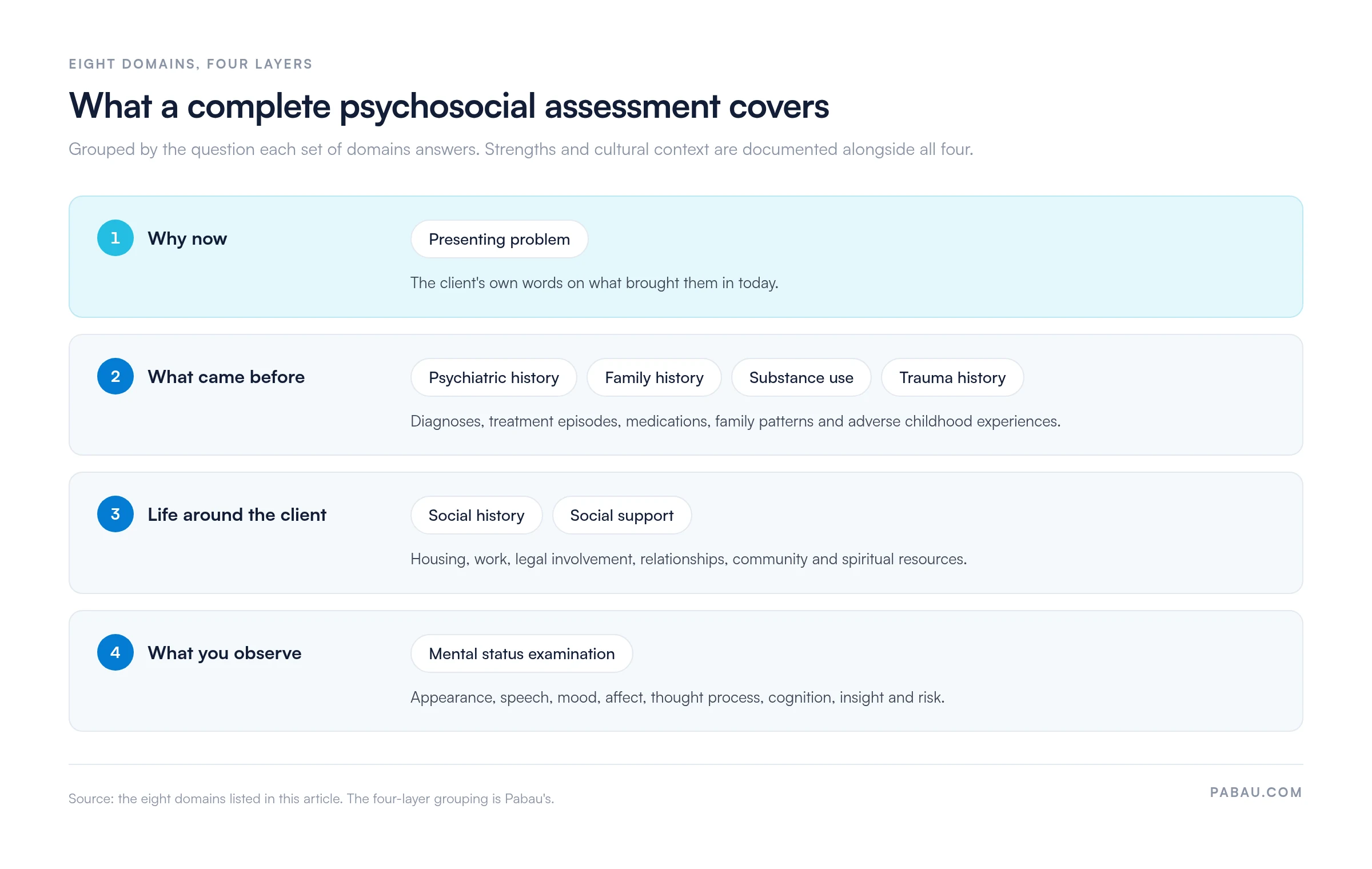
Strengths-based factors belong in the record too. Note resilience, coping skills, cultural identity, hobbies, and accomplishments, plus any cultural considerations that shape treatment. Then adapt the sections to your setting, since an outpatient therapy assessment differs from an inpatient hospital one.
Writing a thorough assessment follows a predictable workflow. These five steps keep the domains covered and the documentation defensible:
Store the finished assessment in a secure client record that meets HIPAA requirements in the US, or GDPR in the UK and EU. Never email or text an assessment unencrypted.
Below is a de-identified, completed assessment showing how the sections read together. The example is based on a typical adult mental health intake:
Client name: [Anonymized] | Age: 34 | Date of assessment: [Date]
Presenting problem: Client reports increased anxiety and panic attacks over the past three months, triggered by an upcoming marriage and work stress. States, “I feel like I’m going to have a heart attack every time I think about the wedding. I can’t sleep.” Denies suicidal ideation, but expresses hopelessness about managing the anxiety.
Psychiatric history: One prior episode of depression in college at age 20, treated with therapy, no hospitalization. No prior psychotropic medications. No prior self-harm.
Social history: College-educated, employed full-time in finance. Lives with fiancé in an apartment. Good work performance, no job loss. Socially active with four or five close friends. Exercises three times a week. No legal history.
Family history: Mother has generalized anxiety disorder, managed with medication. Father has no known mental health history. One sibling with no psychiatric history. Reports a tense relationship with mother and a close relationship with father.
Substance use: Alcohol one to two drinks per week, denies problematic use. Denies tobacco, cannabis, and other drugs.
Mental status: Alert, oriented to person, place, time, and situation. Appearance neat and appropriate for weather. Speech clear, rate normal. Mood anxious, affect congruent. Thought process logical, no flight of ideas. Denies hallucinations or delusions. Insight good, judgment intact. Denies suicidal or homicidal ideation.
Social support: Fiancé supportive, close family relationships, active friend group. Attends church weekly for spiritual support. No isolation concerns.
Trauma history: Denies childhood trauma, abuse, or neglect. One car accident at age 16 with no injury, and no PTSD symptoms since.
Strengths: Strong work ethic, stable relationships, good insight, active coping through exercise, spiritual grounding, and a prior successful course of therapy.
Clinical impression and diagnosis: A 34-year-old with no prior anxiety disorder presents with three months of panic attacks and generalized anxiety. Both track to major life transitions. Family history of anxiety is present. Symptoms are consistent with generalized anxiety disorder (F41.1, DSM-5-TR). Rule out adjustment disorder given the recent stressors. Prognosis is good given the strengths and motivation on record.
Treatment plan: Begin cognitive-behavioral therapy focused on anxiety management, thought records, and exposure to avoided situations. Add psychoeducation that normalizes premarital stress. Evaluate the need for a psychiatry referral if symptoms escalate or persist beyond six sessions. Follow up in one week.
Read the example as one clinical story rather than 11 boxes. The impression only holds because the earlier sections earned it, and the treatment plan only holds because the impression named a target.
Experienced clinicians slip into documentation habits that weaken the record’s clinical and legal value. Watch for these six:
A structured approach to documentation heads off most of these. Our guide to social work SOAP notes applies the same discipline to the session notes that follow intake.
Any licensed mental health professional can conduct the assessment, at intake or shortly after. That includes therapists, social workers, counselors, psychiatrists, and nurses in inpatient or hospital settings.
In most practices the primary clinician runs the interview and writes it up. Larger organizations sometimes hand the first interview to a case manager or intake coordinator, who passes the findings to the treating clinician. That handoff only works if both people read the same document, so store the assessment in a shared client record rather than a personal folder. Therapy practice management software does that by default.
Most clinicians complete the assessment at the first appointment, or across the first two when time is short. It then becomes a reference point for the rest of the care. A new trauma disclosure, a hospitalization, or a major life event is reason to update or supplement it.
In a hospital or inpatient mental health setting, nursing staff often conduct or contribute to the assessment. Their emphasis falls on activities of daily living, medication compliance, safety risk, and social determinants of health such as housing, food security, and insurance.
A psychiatric evaluation template used in a nursing context gives more room to physiological factors and medication history than an outpatient therapy form does. The domains stay the same. The clinical focus shifts toward acute stabilization and discharge planning alongside diagnosis.
In most practices the assessment lives outside the client record. The clinician works from a document on a shared drive and types the narrative up after hours. It then gets filed somewhere separate from the notes that follow it.
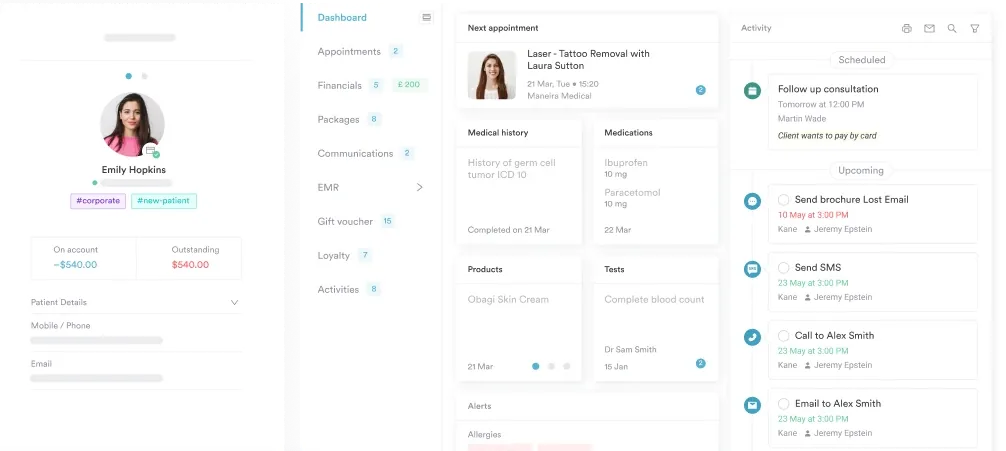
Pabau sends customizable intake forms to the client before the first appointment, with your own assessment domains built in. The responses land straight in the client record. The interview then starts from what the client has already told you, rather than from a blank page.
During or after the session, you dictate your findings and Pabau Scribe, our AI scribe, drafts the narrative for review and signature. The finished assessment stays encrypted, HIPAA-compliant, and readable by the rest of the treatment team from any device. That means less time typing and more time listening.
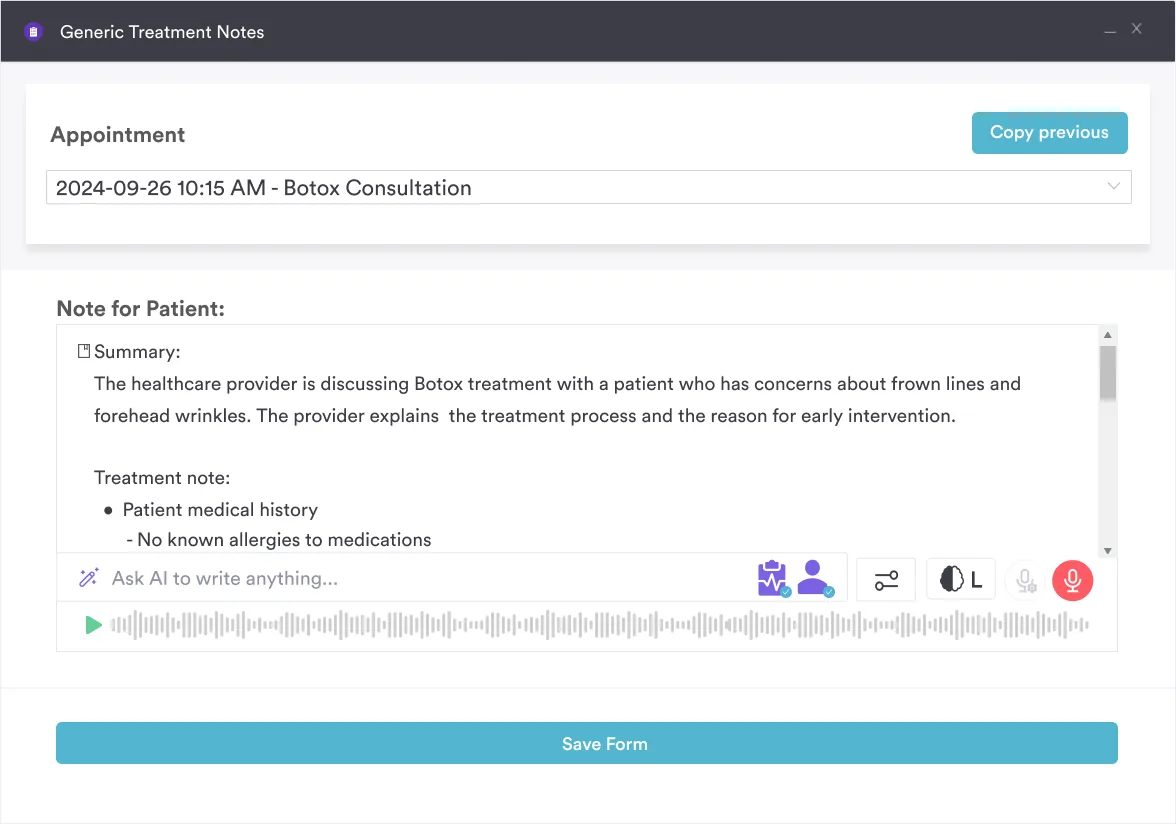

Streamline intake, template management, and clinical notes so your team spends less time on paperwork and more time on patient care.

The assessment you write at intake sets the ceiling on the care that follows. A thin one leaves the next clinician guessing, and it leaves you defending a record that never showed your reasoning.
The trade-off worth remembering is time. A full assessment costs 60 to 90 minutes of interview plus roughly half an hour of writing, and a template does not remove that. What it removes is the variation, the skipped domain, and the second appointment spent asking what you forgot the first time.
Download the form above and run it through your next three intakes. Book a demo to see how Pabau sends the assessment questions out before the session and keeps the finished write-up in the client record.

Need to add the biological picture to your assessment? Biopsychosocial assessment covers how medical history, medication, and physical health sit alongside the psychosocial domains.
Want a shorter form for first contact? Mental health intake gathers demographics, history, and presenting concerns before the assessment interview begins.
Working with adults in an integrated setting? Adult biopsychosocial intake adds medical and medication sections to the standard intake structure.
A psychosocial assessment focuses on the client’s psychological functioning, social environment, and history. A biopsychosocial assessment adds a biological dimension. That covers medical history, medications, genetic predisposition, neurological factors, and the effect of physical health on mental health. Integrated healthcare settings often prefer the biopsychosocial framework because it accounts for both.
A thorough in-person intake appointment typically takes 60 to 90 minutes. If the client completes a structured intake form beforehand, the appointment can focus on clarification and deeper exploration. Documentation afterward adds 20 to 30 minutes, depending on complexity and whether you use AI-assisted documentation.
Yes. Psychiatric nurses, medical-surgical nurses in mental health units, and community health nurses all conduct psychosocial assessments as part of standard care. The framework is the same, though the emphasis shifts by setting. Inpatient work focuses on acute safety, outpatient on diagnosis and coping, and community health on social determinants.
Yes, in most regulated settings. State licensing boards, accreditation bodies such as The Joint Commission, and insurers all require a documented assessment. It has to be on file before intake or within a few sessions of it. A complete assessment is also the standard of care under NASW and APA guidelines.
A complete assessment covers the presenting problem, psychiatric history, social history, family history, and substance use. It also records the mental status examination, social support, trauma history, cultural factors, and client strengths. It closes with a clinical impression linked to a DSM-5-TR diagnosis and an initial treatment plan.
The intake assessment is the clinical entry point. It establishes the client’s baseline, identifies risk, documents informed consent, and gives every later session a reference to work from. It also informs triage, shows whether the client suits your setting, and guides how you allocate clinician time.